[youtube]https://youtu.be/N39mnu1Pkgw[/youtube]
(La Trobe University, 2010)
Earlier this term, while working as a teacher-librarian, a social studies teacher shared with me an assignment where students were studying a variety of protests across the world. I pulled together vetted resources from news websites, databases, encyclopedias, video and podcast sources to support this assignment. A few days later, I was asked to gather a research hub of material to support a science class. In both cases this was for junior classes and designed to guide students in the right direction for gathering resources for their research projects.
 My research gathering for these assignments fell at the same time I was working on the LIBE 477 blog looking for key words for our first assignment. I kept circling back to the broad term of digital literacy. As I collected material, I wondered if students were developing the skills they need to be able to pull resources together if asked? Would they struggle to locate material? Would they select credible resources? Often as TLs, we pull books, bookmark indexed topics and guide students through their research queries and this is a part of the job I love. This supports students and classroom teachers by condensing research time and supports subjects with assignments at hand. I still wonder, however, if our LLC program could do more to support students with the discovery process of acquiring resources when faced with a research query. Are they developing the necessary digital literacy skills?
I mulled these questions over earlier in the term after reading Will Richardson’s book Why School, specifically the chapter, “Our kids are illiterate”. After some feedback working with teachers, it was clear to me that students would benefit in developing digital literacy skills. Learning how to navigate topics and knowing where to find material that would best support their research challenges a number of our students. It felt like a great opportunity to frame developing this skill within our library learning commons program for my vision of the future assignment.
Our LLC does an orientation with grade 8 students in September. This is an introduction and exploration of the space, resources and services. For my vision of the future assignment, I plan to create a mid-year booster to the orientation. This booster will be a unit designed around developing digital literacy skills which will focus on the strands:
-
-
-
- Create
- Understand
- Use
- Access
(Media Smarts, n.d.)
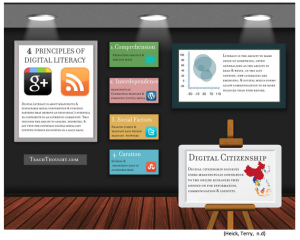
My unit will explore elements of digital citizenship where using technology safely and responsibly will be promoted. I will delve into how to find digital resources using our databases, encyclopedias and Focused Education digital bundle. The unit will explore: where to start, using keyword searches and how to narrow which resource is best? I will also explore how to identify “fake news”, teach students CRAAP detection and how to evaluate a website. I plan to develop a toolbox for students to learn from. This toolbox will include interactive lessons that we can pull from and include video demonstration clips through Screencastify.
As I am developing this project, I am developing it to be thematically connected by the topic of digital literacy, but my lessons are standalone per topic. This will enable short mini lessons or longer library block flexibility. I am cognizant that developing this toolbox does not necessarily mean it will get used in its entirety. It will however, give me options to share, with subject teachers, ideas for boosting digital literary skills that works best for their subject areas.
Digital Literacy “is the awareness, attitude and ability of individuals to appropriately use digital tools and facilities to identify, access, manage, integrate, evaluate, analyse and synthesize digital resources, construct new knowledge, create media expressions, and communicate with others, in the context of specific life situations, in order to enable constructive social action; and to reflect upon this process” (Martin, A., 2005, p. 135).
Works Cited:
eCampus News. (2019). “College Educated Adults Get an F in Digital Literacy”. [Image]. Retrieved 20 March 2021 from: https://www.ecampusnews.com/2019/07/02/college-educated-adults-get-an-f-in-digital-literacy/
Heick, Terry. (n.d.). Teachthought: 4 Principles of Digital Literacy. [image]. Retrieved 20 March 2021 from: https://www.teachthought.com/literacy/4-principals-of-digital-literacy/
La Trobe University. (2010). Why Can’t I Just Google? Retrieved on 20 March 2021 from: https://www.youtube.com/watch?v=N39mnu1Pkgw.
Martin, A. (2005). “DigEuLit – A European Framework for Digital Literacy: A Progress Report.” Journal of E-Literacy. Vol 2.
Media Smarts. (n.d). Digital Literacy Fundamentals. Retrieved 18 March 2021 from: https://mediasmarts.ca/digital-media-literacy/general-information/digital-media-literacy-fundamentals/digital-literacy-fundamentals
Richardson, W. (2012). Why School?: How Education Must Change When Learning and Information Are Everywhere. TED Conferences. Kindle Edition.