02/23/20

2020: The Role of the Teacher-Librarian

Managing and Evaluating Reference Services

“In today’s rapidly changing society, students must have the opportunity to develop the ability to retrieve, assess, and apply information. As we equip students with these skills, we will help ensure that learning does not end with the completion of formal education, but continues throughout life.”  (Information Literacy Committee & Davies, n.d)
The theme of managing and evaluating reference services explored topics: reference interviews, managing a reference collection and evaluating reference services. Within these areas, however, the theme explored the over-arching question – what is the role of the teacher-librarian?  Our class discussions focused on defining the role in 2020 and how the role of the teacher-librarian has evolved.

I have always rationalized the most essential role for the teacher-librarian is to develop, build and maintain a collection for the school community.  This is a multi-step process that involves collaboration, fostering relationships with staff and students as well as being knowledgeable with curricular needs.  A teacher-librarian needs to have an understanding of course topics, upcoming projects and students’ reading preferences.  Riedling says that “one of the primary functions of a school librarian is to assist students in the use of the library and its collection.”  In order to ascertain what a student wants, a teacher-librarian must conduct a reference interview. (Riedling, 2019, pg. 89)
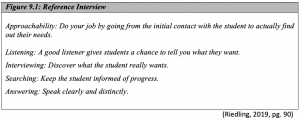
 

Riedling further explains the reference interview in detail from exploring approachability and question types to creating a quiet, comfortable setting. Riedling’s discussion with the reference interview centrally focuses on the student/teacher-librarian reference interview and lacks highlighting the inclusion of the classroom teacher to the process, thereby minimizes the importance of cooperative planning.  (Mueller, Lesson 5) Integrating cooperative planning within the role of the teacher librarian is a key component to supporting reference skills though Cooperative Program Planning and Teaching.

Russell’s article, “Teachers and Librarians: Collaborative Relationships” defines collaboration as being “based on shared goals, a shared vision, and a climate of trust and respect (Muronago & Harada, 1999). Each partner fulfills a carefully defined role; comprehensive planning is required; leadership, resources, risk, and control are shared; and the working relationship extends over a relatively long period of time.” (Russell, 2000) Shared collaboration between teachers and teacher-librarians is pivotal to running a successful learning commons.

The Learning Commons 

Many of the discussions in this theme have centered on evaluating – what is the role of the teacher librarian? The answers that rise often relate to approachability, flexibility, and collaborators. School libraries have been changing over the past decade and libraries go beyond being places that exclusively house resources.  On my school’s library homepage, our philosophy is shared with the community and states: “our library is a learning commons where physical and virtual spaces overlap and students and staff work independently and collaboratively.” (“Welcome to the Home Page of Rockridge Library Learning Commons”, n.d.)  The below video from Richmond School District, elaborates on the evolution of the library to learning commons.  The learning commons philosophy contributes to shaping the role of the teacher-librarian, most notably in how it relates to cooperative planning.

(Richmond SD38, 2019)


Cooperative Planning:

At my school the library team aims to engage in cooperative planning with teachers from the start of the year.  This begins with quick refreshers on databases and new material in staff meetings and email blasts.  We encourage classes/teacher collaboration and invite teachers to discuss upcoming topics they plan to explore, and we talk about ways we can help support information skills.  We also find hosting early in the year a staff gathering with hot chocolate and treats as well as a display of pre-selected fiction and teacher resources brings the community together.
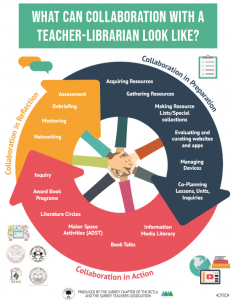
Another way to jostle collaboration has been to maintain records from past years.  What did Science 11 work on last November or what topics did English 12 begin in January? One example of this in my current teacher-librarian assignment, we anticipate months in advance that Social Studies 10 is going to be studying The October Crisis and FLQ in the spring, as they have done so in the past. Before Christmas, we checked in with all of the Socials 10 teachers as well as Learning Support to see if our current collection meets the needs of our students and anticipated research assignments.  It was reconfirmed, after our initial assessment, that our resources were academically advanced and would not meet the needs for all learner profiles.  We began researching for easier reading texts and ended up allocating a healthy chunk of the budget to developing this section in the library, knowing that all learner profiles would benefit from the additions. For a teacher-librarian to develop and build a successful collection, fostering relationships to ascertain community needs is essential.  The best way to determine those needs are through cooperative planning and reference interviews.  Essentially through cooperative planning with subject experts, teacher-librarians can efficiently conduct reference interviews with students, by being prepared with reference material selections and provide instruction on information skills. (Mueller, lesson 5)

(“Collaboration“, n.d.)

How Cooperative Planning Connects to Evaluation of References?

“Teacher-librarians work collaboratively with other teachers and school administrators to develop information literate students. Teachers and teacher-librarians work together to develop an instructional program that ensures that information literacy outcomes are integrated into student learning experiences in a developmental and sequential manner. These experiences allow students to learn and practice the necessary information skills across the curriculum. Teacher-librarians develop school information literacy plans that pinpoint the levels at which specific skills will be introduced and identify subject areas where they are most appropriately incorporated” (Asselin, 2003, pg. 57)

In the example mentioned earlier with Socials Studies 10 topics of the October Crisis and FLQ, an evaluation of references was undertaken and prompted by:

  1. Self-evaluation
      • Did our references adequately support students/teachers on this topic last year? How can it be improved?
  2. “A statistical evaluation of the use of reference materials (circulation, reference interviews, student use etc.);” (Mueller, Lesson 7)
      • Much of the reference materials are not permitted to be signed out, however, we are now maintaining scans on Destiny when these are accessed in reference interviews, so that the evaluation of circulation can be measured.  In the topic of FLQ and October Crisis, no reference texts appeared to be used.
  3. “An evaluation of the “satisfaction” levels of students and teachers using the reference collection;” (Mueller, Lesson 7)
      • We engaged in discussions with classroom teachers to understand research goals and to discuss reference material selections we currently have.  What might improve?  This collaborative approach helped us understand areas to focus on improving within the collection.

It is not practical to do the above for every reference source or even topic, however, in this case, it felt like the best approach.  Mueller discusses evaluating reference services more broadly-beyond a singular reference text or topic within reference, but rather to look at the collection holistically. Some other considerations for evaluating reference services would be:

    • Comparisons to accepted “Standards” outlining best practice, for example Achieving Information Literacy: Standards for School Library Programs in Canada.
    • An evaluation of the teacher-librarian’s role as the person delivering the reference services
    • Peer (teacher-librarian to teacher-librarian) evaluation;
    • Administrative evaluation of our library program in general; (Mueller, Lesson 7)

Further, when evaluating reference services, and “deciding where and how learning resources should be organized, located, and stored, those involved in these decisions must ensure that the resources are easily accessible by staff and students. The format, cost, and number of learning resources, as well as the personnel and facilities available, will be factors in these decisions.” (Evaluating, Selecting and Managing Learning Resources: A Guide, 2002, page 87)  The guide further explores how the organization of support should be divided into three areas: intellectual access, physical access and digital access.  Riedling touches on this briefly and reinforces the need for a planned, organized, weeded and accurate arrangement of a reference collection.  She acknowledges, “at the elementary level, reference instruction continues to use print sources because of the difficulty young children experience in navigating the Internet.  However, the use of print resources decreases as the level of education increases because older students can make effective use of the sophisticated search interfaces and the wide variety of reference resources available online.”  (Riedling,2019, pg. 26)

Final Thoughts:

Maintaining a reference collection that meets the needs of the school community is one of the largest responsibilities for teacher-librarians.  It goes beyond curating a collection and requires continual cooperative planning/collaboration with teachers, understanding the school community and curricular needs, frequent evaluation of reference services, budget maintenance and record keeping.  Record keeping should include past library lessons, research requests and statistic information about the circulation of the collection as well as database use.  Teacher-librarian roles evolve and adapt much like our spaces have and the flexibility to move and grow keeps the job exciting.

“Collection Development is a process of systematically building library collections to serve, study, teach, research and meet other needs of students and teachers.” (Riedling, 2019, pg.15)

References:

Asselin, M., Branch, J., & Odberg, D. (Eds.). (2003). Achieving information literacy: Standards for school library programs in Canada. Retrieved from http://accessola2.com/SLIC-Site/slic/ail110217.pdf

Canadian School Libraries (CSL) [Image]. (2018) “Leading Learning:  Standards of Practice for School Library Learning Commons in Canada.” Retrieved from:  http://llsop.canadianschoollibraries.ca

Collaboration. (n.d.). Retrieved February 23, 2020, from
https://www.surreyschools.ca/llc/instructionalpractice/collaboration/Pages/
default.aspx

Evaluating, selecting, and managing learning resources: A guide. (2002). Victoria, B.C.: British Columbia Ministry of Education.

Information Literacy Committee, & Davies, J. (n.d.). Resource-Based Learning. What is it? Retrieved February 20, 2020, from Information Literacy & Learning website: http://www.edu.pe.ca/BIL/bil.asp?ch1.s2.gdtx

Mueller, Aaron. (2020) Lesson 5: The Reference Interview: Cooperative Program Planning and Teaching for Personalized Inquiry.

Mueller, Aaron. (2020) Lesson 7: Evaluating Reference Services.

Richmond SD38 (Producer). (2019). The Evolution of the Library [Video file]. Retrieved from https://youtu.be/5sadWGKFs4k

Riedling, A. M., & Houston, C. (2019). Reference skills for the school librarian: Tools and tips (4th ed.). Santa Barbara, CA: Libraries Unlimited, an imprint of ABC CLIO.

Russell, S. (2000). Teachers and Librarians: Collaborative Relationships. Eric Digests, (ED444605). Retrieved from ERIC database.

​Welcome to the Home Page of Rockridge Library Learning Commons. (n.d.). Retrieved February 20, 2020, from http://www.sd45slc.ca/about-rockridge-library.html
02/9/20

Evaluation of Reference Sources: Geography Encyclopedias

Introduction:

Our secondary school was initially designed as middle school but changed shortly after opening to a grade 8-12 secondary school with a current enrollment of approximately 900 students.  The learning commons has evolved over the years to include a partitioned classroom, makerspace, Lego wall and computer terminals in addition to the various workspaces which include traditional table arrangements, beanbags and cushioned armchairs.  This has all been designed to maximize a constrained space for both functional usability and aesthetics.  Our reference section of texts represents a small section within the space.  Noticeably, many of the encyclopedia, science, history and geography volumes are 15+ years old, with newer sources gradually being added.  The online references are supported through our district ERAC Bundle, with additional subscriptions provided through the school’s learning commons.  For this assignment, there were many subject specific encyclopedia volumes to focus on, but the area that I feel needs the most weeding and updating falls within the 910 Dewey area of the reference section – The Encyclopedia of World Geography, 2nd Edition.

Part 1 – Evaluative Review and Rubric of a resource

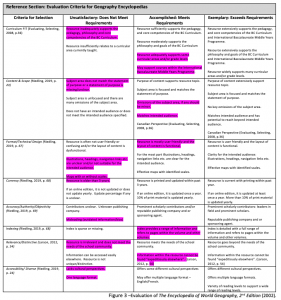
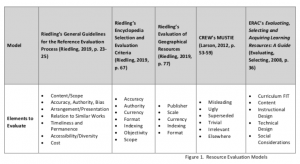
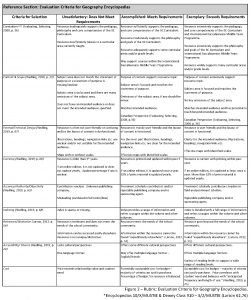
Riedling states that “encyclopedias remain essential reference sources for any student at the beginning of the information inquiry process.” (Riedling, 2019, p. 66).   She further explores the conundrum faced by librarians that has them weighing cost with currency.  With respect to geographical texts, as “human society has become more global than ever before; therefore, recent geographical resources are a necessity.” (Riedling, 2019, p. 75) Currency is essential for geographical texts to hold accuracy and relevance.  In developing a framework for my rubric to evaluate an encyclopedia with a geography subject, I compared models explored by Riedling in Reference Skills for the School Librarian, CREW: A Weeding Manual for Modern Libraries, and ERAC’s Evaluating, Selecting and Acquiring Learning Resources: A Guide. Riedling’s criteria for evaluating a reference with respect to the general guidelines becomes more streamlined with the types of resources evaluated. The criteria within the evaluation structure, however, is largely tailored to the acquisition of resources.  When constructing an evaluative rubric, one that fits both weeding and acquisition needs to be designed. Therefore, the inclusion of criterion from CREW’s MUSTIE evaluation for weeding is integral to my designed rubric.  ERAC’s evaluation guides also inspired my designed rubric, due to the curricular focus components.

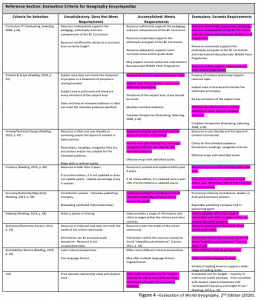
The Rubric

Reference Source Evaluation

The Encyclopedia of World Geography, 2nd Edition

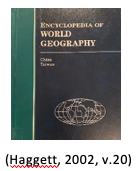
The next step of the reference evaluation is determining whether The Encyclopedia of World Geography, 2nd Edition meets criteria that justifies weeding and selecting a replacement. The Encyclopedia is a 24-volume set, published in 2002 by Marshall Cavendish.  Using the rubric from Figure 2, the resource was evaluated, with the omission of cost as inapplicable, and it was ascertained The Encyclopedia of World Geography, 2nd Edition is an unsatisfactory reference resource.


The Encyclopedia of World Geography, 2nd Edition against the rubric

When selecting The Encyclopedia of World Geography, 2nd Edition, it was not unexpected that it would successfully meet the criteria for a ‘weedable’ reference text.   When considering curriculum FIT, the number of courses using the text and whether the new curriculum was adequately supported by the content was the first evaluation undertaken.  The representation of the Canadian arctic and dated terminology of “Native Indians” (Haggett, 2002, Vol 3, p. 394), is not in keeping with curriculum overview of Aboriginal Perspectives and Knowledge, which states:

“British Columbia has long had the goal of improving school success for all Aboriginal students. Achieving this goal will require that the voice of Aboriginal people be heard in all aspects of the education system; the presence of Aboriginal languages, cultures, and histories be increased in provincial curricula; and leadership and informed practice be provided.” (“Curriculum Overview”, n.d.)

The dated representation of indigenous peoples in the text is harmful to the First Peoples Principles of Learning. After exploring more volumes, it was clear to see that the fundamental reason this encyclopedia set needs to be weeded is because it is outdated and, in some sections, misinforms.  Volume 15 explores the Middle East with very dated perspectives on Syria before the civil war and before ISIS.  Equally this is similar with Volume 21 about South East Asia and its description of the conflicts in Burma with Aung San Suu Kyi’s recent release from house arrest and her restrictions on political freedom. (Haggett, 2002, vol 21, p. 2892)

Part 2 – Find, select, and evaluate a potential resource replacement:

Once weeding was decided, the next question soon became – will this text be replaced by another encyclopedia text volume?  Online encyclopedia? Or a combination?  I reached out to our vendors and evaluated 3 different potential replacements:

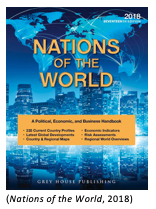
  • Nations of the World, 2018;

      • One Volume that explores 235 Nations in limited detail.
        • Sample pages on Australia demonstrate general economy and political background, but it doesn’t delve into the territories, and it only briefly mentions indigenous peoples, glossing over land claim and social issues. Limited perspective in sample. (Nations of the World, 2018, p. 103-117)
      • Briefly touches on current political and economic events
      • Online access – Non IP Authenticated, enabling remote login access
      • One language
      • Quote: $240.00 CAD (quote provided by representative at Salem Press)
      • Evaluation Result: Ruled out – Content/Scope is lacking for this to be a replacement resource.
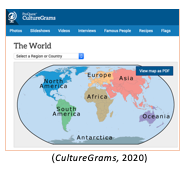
  • CultureGrams (CultureGrams Data, n.d., p. 1) 

      • Online access only. Offsite login access ability
      • English only, but reads aloud content for accessibility (“Antarctica”, 2020)
      • Provides: “local perspectives on more than 200 countries, detailing daily life and culture, including history, customs, and lifestyles. From Afghanistan to Zimbabwe, each concise, reliable, and up-to-date report is written and reviewed by local experts, providing users with unique, intimate cultural details from a real insider’s perspective.” (CultureGrams Data, n.d., p. 1)
      • Quote: $977.53 USD/12 months (quote provided by ProQuest and based on 900 students)
      • Evaluation: Ruled out – after evaluating the online trial, the content and scope was appropriate, but the cost justification was off balance. A yearly expenditure of this size would not proportionately reflect student needs.
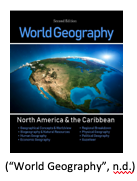
  • World Geography, Second Edition, 2020;

      • 6 volume set explores:
        • Geographical Concepts and Worldview
        • Human Geography, including Political Geography
        • Regional Breakdown
        • Physical Geography
        • Economic Geography
        • Biogeography and Natural Resources
        • Gazetteer
      • Per vendor, some language toggle ability
      • Free online access – non-IP authenticated. Login access offsite.
      • Quote: $793.33 CAD (Quote provided by representative at Salem Press)
      • Evaluation Result per the rubric below: Good option to serve as replacement; however, an online trial is not available until September 2020 and before a purchase, this would need further evaluation.

World Geography, Second Edition, 2020 against the rubric

Concluding Remarks:

The resource that supports my school’s need isn’t necessarily the best resource evaluated. When considering replacing a multi-volume set from the reference section, the most ideal replacement is a text/online combo.  Many of the coursework assignments that the learning commons supports require students to access books and online resources.  In every source I evaluated, the Canadian perspective was lacking, but within topic of World Geography, most of the material is published in the US.  This impacts Canadian perspective, but potentially also the accessibility for multi-language use, particularly in French.  Another mitigating factor is cost.  A one-time expenditure versus yearly one heavily weighs in the ruling out of a resource like Culture Grams.  Having said this, were this to be a part of our district’s ERAC bundle, then the emphasis of having an onsite book would be weighed less in my evaluation.  Cost is a key driver in the evaluation process.

World Geography, 2nd Edition offers better support of the new curriculum with its currency. The outdated ‘facts’ and archaic terminology justifies the weeding of The Encyclopedia of World Geography, 2nd Edition.  Because of the newly updated content World Geography, 2nd Edition, however, senior level courses such as Comparative Cultures 12 and Physical Geography 12 will have more opportunities for students to connect with the text and online material.  The updated content explores through country specific presentation perspectives of past and present cultures, which is a key curricular competency for Comparative Cultures 12. (“Comparative Cultures”, n.d.) Additionally, the text’s topical coverage of regional breakdown, physical geography, biogeography and natural resources support the assessment of how human and environmental factors and events influence each other, a key curricular competency for Physical Geography 12 (“Physical Geography”, n.d).

The format and indexing of World Geography, 2nd Edition is comparable to The Encyclopedia of World Geography, 2nd Edition, except for content amounts.  The Encyclopedia is 25 volumes versus 6 and includes one exclusive index textbook.  There is a reduction in the amount of content/detail, but the value of currency outweighs in this instance.  The final evaluation, which I was unfortunately unable to undertake will be to request the online access component in September, when it is available.  This will enable a more comprehensive assessment of user friendliness and the format/technical design.  Overall, World Geography 2nd Edition, received a positive evaluation due to cost, currency, format variety and curriculum FIT.

Works Cited:

“Antarctica” (2020). CultureGrams Online Edition. ProQuest. Retrieved from http://online.culturegrams.com/famouspeople/country.php?contid=13&cid=236&wmn=Antarctica&type=World

Comparative Cultures 12. (n.d.). Retrieved February 4, 2020, from BC’s New Curriculum website: https://curriculum.gov.bc.ca/curriculum/social-studies/12/comparative-cultures

CultureGrams Data Sheet [Pamphlet]. (n.d.). ProQuest.

Curriculum Overview. (n.d.). Retrieved February 3, 2020, from BC’s New Curriculum website: https://curriculum.gov.bc.ca/curriculum/overview

Evaluating, Selecting and Acquiring Learning Resources: A Guide [Guide]. (2008). Retrieved from https://bcerac.ca/wp-content/uploads/2018/09/ERAC_WB.pdf

Haggett, P. (2002). Encyclopedia of world geography (2nd ed.). New York, NY/USA: Marshall Cavendish.

Larson, J. (2012). CREW: A Weeding Manual for Modern Libraries [Manual]. Retrieved from https://www.tsl.texas.gov/sites/default/files/public/tslac/ld/ld/pubs/crew/crewmethod12.pdf

Nations of the World. (2018). Retrieved from https://greyhouse.com/Media/GreyHousePublishing/samples/nations_pgs.pdf

Physical Geography 12. (n.d.). Retrieved February 4, 2020, from BC’s New Curriculum website: https://curriculum.gov.bc.ca/curriculum/social-studies/12/physical-geography

Proquest Libguides CultureGrams. (2019) Retrieved February 8, 2020 from http://proquest.libguides.com/culturegrams

Riedling, A. M., & Houston, C. (2019). Reference skills for the school librarian: Tools and tips (4th ed.). Santa Barbara, CA: Libraries Unlimited.

World Geography. (n.d.). Retrieved February 4, 2020, from Salem Press website: https://www.salempress.com/book/world-geography

02/2/20

Supporting Information Literacy Goals Through Reference Services


“The purpose of reference services is to align information to flow efficiently from reference sources to those who need it.” (Riedling 5)


(Gitomer, Crouse, & Allen, 2017).


The responsibility of ensuring information efficiently flows from reference sources to students, teachers and parents has resonated the most with me through the exploration of the foundation of the reference services theme.  It is one of the key aspects of being a new teacher-librarian that I enjoy: being a part of the reference process and connecting students with information to support their inquiry. It is also one of the more intimidating elements of the job. I recall not long ago when supporting a new teacher with a research assignment looking at the reference section in the library and beyond in mild panic.

The assignment specified that students were to cite both print and online sources – primary and secondary.  No problem. Right? I eagerly undertook the research assignment and began to gather resources when I soon realize that not only has this topic not been explored recently in our learning commons, I essentially have 3 print reference texts and 8 books in the main catalogue.  Of these texts some were a stretch as to whether they would be ‘good’.  This led me to begin sourcing texts from other secondary schools in the district and I was fortunately able to bring the selection up to 45 texts, but my print references remained at 3.  I was confident students would have options and be able to fulfill the criteria for the assignment, but where they ‘good’?


(“Search vs Research,” 2016)

I find myself frequently asking during the query process – is the source I am connecting a student to the best for their question? Is it current enough? Is it the best medium – would a book be better than a database?  Is the content accessible for this student’s reading level? As I learn our collection more, explore our online digital resources and connect with our teachers on coursework objectives, my confidence in this area builds.  This course has, however, encouraged me to reflect on research models and how to meaningfully take students from search to research with their inquiry.

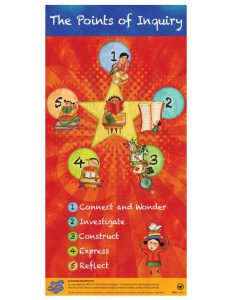
When learning about the various research models, I found the steps of connect and wonder, investigate, construct, express and reflect that form the BCTLA’s Points of Inquiry research model shape many of the research assignments that I have observed or created myself (the latter albeit inadvertently).  This is likely due to the naturally intuitive shape of the POI research model coupled with a subconscious effect of absorbing the teaching techniques of other teacher-librarians I’ve worked with. (The Points of Inquiry, 2011)

As I discover more about the research process, I find myself mentally categorizing the research models.  Kuhlthau is more emotionally cognizant of student emotion/behaviour, whereas Stripling and Pitt’s model has more analysis and evaluation emphasis.  I like that Kuhlthau’s guided inquiry process emphasizes students’ emotional responses to the research process as they are guided through uncertainty, optimism, frustration, confusion, relief and then ideally confidence.  Stripling and Pitt’s on the other hand feels very similar to Points of Inquiry, however, with the inclusion of REACTS taxonomy and the additional inquiry and evaluative steps, Stripling and Pitt’s research model feels more advanced and perhaps better suited for higher grade levels.

When comparing models and looking at the intrinsic similarities, it’s clear they all share a similar framework, but the emphasis and scope within a research step is the key difference between models.  I am now in a position where I can ask – which model suits the project/class best.

Credibility of source?

I was surprised that one area that lacked mention in many of the research models was the need to evaluate the credibility of a source.  In the age of “Fake News”, source credibility is a key component for inclusion in every research task that I’ve done in the library thus far. While students sit on the more current side of the digital divide, the continued support in teaching digital literacy feels relevant to most research assignments. For most students, source credibility means an evaluation that explores: who is the author; is the website reputable; is there bias?
(“Wooden dice,” n.d.)

What is a ‘good’ reference resource?

I am learning the necessity to continually evaluate the collection – does this source meet the “good” standard as a reference resource? Knowing that it isn’t always practical to weed as often as Asselin’s, Achieving Information Literacy recommends, it doesn’t mean that the exploration for better reference sources never stops – though it is hard not to feel discouraged knowing that the collection funding is grossly under standards and the viability of the next great find is unlikely to align fiscally.  A ‘good’ reference resource must meet the following criteria:

  • Does the scope “reflect the purpose of the source and its intended audience?” (Riedling 22)
  • Is it accurate, hold authority and is there a bias?
  • What is the arrangement and presentation of the resource? Will its sequence be familiar to our patrons?  Does it provide clarity or intuitiveness?
  • What is the relationship to similar works? Will the resource add to the collection, or will it simply overlap?
  • Is it current?  Will it have longevity?
  • Is it accessible/diverse? Does it provide “inclusive information from different cultural perspectives?” (Riedling 23)
  • How much will it cost? Is it justifiable to meet the above needs of students?

In exploring the foundation of reference services, I have been challenged to reflect on my role as a teacher-librarian and more specifically as it relates to the reference process. It is clear that in order to build a successful, supportive and efficiently used learning commons, the information literacy goals must be supported by an active search for resources and reference services on a consistent basis.

“For school librarians reference services are more than just information skills or activities; these services represent significant and meaningful engagement in a profoundly human activity, ministering to one of the most basic needs of humans—the desire to gain knowledge.” (Riedling 3)


Works Cited:

Asselin, Marlene., Branch, J., & Oberg, D., (Eds). (2003). Achieving information literacy: Standards for school library programs in Canada. Ottawa. Retrieved from http://accessola2.com/SLIC-Site/slic/ail110217.pdf

BCTLA Info Lit Task Force. (2011). The Points of Inquiry: A Framework for Information Literacy and the 21st century Learner. [Poster] British Columbia Teacher-Librarians Association. Retrieved from https://bctla.ca/wp-content/uploads/2018/02/the-points-of-inquiry.pdf.

Gitomer, D., Crouse, K., & Allen, J. (2017, November 9). Studying the Use of Research Evidence: Methods and Measures in a Complex Field [Photograph]. Retrieved from http://wtgrantfoundation.org/studying-use-research-evidence-methods-measures-complex-field

Riedling, A. M., & Houston, C. (2019). Reference skills for the school librarian: Tools and tips (4th ed.). Santa Barbara, CA: Libraries Unlimited.

Search vs Research [Video file]. (2016). Retrieved from https://library.mcmaster.ca/research/how-library-stuff-works

Wooden dice form the word fact or fake – 3D Ilustration [Photograph]. (n.d.). Retrieved from https://www.shutterstock.com/image-illustration/wooden-dice-form-words-fact-fake-1428426371 Royalty-free stock illustration ID: 1428426371