
Categories
Uncategorized

Zambi

Zambi the Baby Elephant

So a few months ago I discovered this plush Hasbro elephant named “Zambi”. I almost used the video “See what inspired project Zambi”  on the the site for my blog post… but couldn’t detach myself from it enough emotionally to be coherent about it (Click Zambi to follow a link to the page). The drawings on the ears were created by kids at a school in Zambia where I volunteered  for six months. Fifty percent of the money from the sales of this elephant will go charities chosen by Hasbro, HIV/AIDS orphans being one  group to benefit. I’d love to have any thoughts you’d like to share about this … just because I’m curious (though I know everyone is likely studying). I can’t figure out how to feel about it… it really upset me, but nobody else i’ve shown it to seems to have had the same response…

The message to the parents is interesting:

http://www.hasbro.com/en_CA/discover/The-Story-of-Project-Zambi.cfm

I can see that there are benefits. Importantly, the toy raises awareness of HIV/AIDS in a young privileged demographic, namely North American childern. There is a “focus on making a difference” and an entire page for parents about how Project Zambi can teach children about empathy, caring and the global community. In technocentric self-indulgent culture, getting children to start caring about others is important. Gettign a gift that also “does something for others,” might begin sending the message that “other people are important.”

However, I know the kids in the video…. and the way they are shown is never the way I would chose to depict them. Through my lens, the video and side shots really make them look like victims, which is rather contrary to my experience. I’m hesitant to give a description, at risk of generalizing or speaking for them, but many of the kids I met in Zambia  were as happy and energetic as any children in Canada. Those who’s parents had died of HIV/AIDS were some of the strongest, smartest and most compassionate at the school,  often looking after brothers and sisters. Also, while they do talk about interdependence (right at the bottom of the parent page), for me, the overwhelming message feels like “We (the lucky ones) should help them (the unlucky ones)”
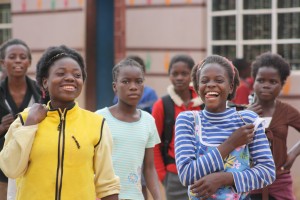
Grade 5 Girls

The above picture is more the image I have of the kids at the school, but feel free to critique this as well… I am certain to have my own biases and welcome your extrapolations on any and all of the above… Thanks! All the best with studying!

Categories
Uncategorized

Awaiting Tomorrow -HIV/AIDS in the Congo

YouTube Preview Image

There are volumes of voices speaking out for HIV/AIDS “victims.” Nelson Mandela, Bono, Stephen Lewis, Stephanie Nolan, Starbucks and even George W. Bush have contributed their words to the chorus. However, the voices of impoverished, HIV+ Africans appear to join the discourse only on rare occasions, and often this happens when others speak on their behalf. In this way, it seems that these voices fit into the category of sub-altern: marginalized and un-heard.

In addition, with regard to HIV/AIDS, numbers are often allowed to take the place of voices from the less privileged global majority.  It sometimes seems as if we are meant to gain an understanding of another person’s lived experience through the study of overwhelming statistics. This is an impossible expectation. For example, hearing that twenty-two million people in Sub-Saharan Africa live with HIV doesn’t translate into an appreciation of what it is like to live with HIV. With numbers as large as twenty-two million, individuality of those included in the statistic can get lost in calculation.

Jean-Jacques is one person within that statistic. A 25 year old father of two, he lives in the Eastern Democratic Republic of the Congo. He has had AIDS (symptomatic expressions of the HIV virus) for a year. He is dizzy, vomits, and is very thin. Jean-Jaqcues explains that life-extending medication is very costly and because people living with HIV/AIDS get little support from the government he, and others with AIDS will die (I think this is what he means by the phrase “We are late”). Jean-Jacques says that he would gladly be an advocate for HIV/AIDS treatment, if he were to receive it. He then calls on those who “think of the people of the Congo” and on the government to do something about the crisis. He seems frustrated by the apathy of the Congolese government. He says that people have tried to draw the Minister of Health’s attention to the crisis, but that they have received no response. Having watched Rape of a Nation (See below) where I learned about the election of Congo’s  current totalitarian government, I found Jean-Jaques description of the ambivalent health minister both intriguing and depressing. Jean-Jaques embodies the effect of living with a government that disregards the welfare of its people.

Jean-Jacques expresses a painful tension in this video. He would like to be able to work with his community to combat HIV/AIDS. He says that if treatment helped him to live he could be a spokesperson for medications. Historically, AIDS has been a stigmatized disease, and in this light, Jean-Jacques willingness to share his story is rather remarkable. He seems to be passionate about the issue, dedicated to an idea of action and courageous enough to share his story. However, in the end, Jean-Jacques is caught in a familiar colonial power differential “We call on the donors…they help us and we’ll be saved.” Jean-Jaques is pushed into the position of a victim. While he has a fervent drive to create positive change for himself and for his community, he’s held back illness, poverty and an uncaring government. It is difficult to know which of his problems have been exacerbated by development agendas.

There are certainly things about this video that are problematic. Jean-Jacques has been allowed a chance to share his story and he is speaking for himself, but he is giving a western style interview and it has been translated into English. In being offered an opportunity to meet privileged audiences “in the centre” (in their homes, on their computer screens, in a translated language) nuances and ideas may have been lost. In addition, it is unlikely that Jean-Jaques would have been responsible for filming or editing the video. The clips chosen for inclusion were likely selected by another person.  The individual who edited the video has chosen (consciously or unconsciously) images that reinforce their own ideas, biases and agendas to the video. Jean-Jacques may be speaking, but it seems as if his voice is coming to us through multiple filters. He has been given space to speak in this video, but tragically, for the most part, it is only to ask the privileged “donors” for help.

Spam prevention powered by Akismet