Categories
Do the right thing Multicultural life New Media Musings Whirling Dervish

Quick Tokyo Spin

commuters.jpg

The past weekend I took a brief trip to Tokyo, and it’s such an enormous, chaotic, mad elephant compared to our slow and peaceful existence in the Hokkaido mountainside. Oh yes, I was glad to come back to fresh air and quiet, but I really love Tokyo, too, for its vibrant energy and for its most excellent people watching opportunities. It appears as if some people in Tokyo have thrown off all their fashion inhibitions, and it’s great to see the results, like men in glittery ballroom gowns and horn-rimmed glasses and teenage girls in French Maid costumes with green knee socks and yellow platform sneakers.

I attended a very hilarious and moving documentary, “Recolonize Cologne,” by Sun-ju Choi, a Korean ex-pat director in Germany, about Germany’s colonial history in Africa and about the mistreatment of immigrants from Cameroon. It was part of the Refugee Film Festival, held at the Swedish, Italian, and French Embassies.

One of my favorite parts in the film was where she cleverly used Lego characters to re-enact the invasion and deceitful tactics of the German companies/government in Cameroon – adding irony and wit to what was a horrible and inhumane campaign. She managed, with a low budget, to capture the innate idiocy of claiming superiority over others.

I also loved her idea to have the main narrative involving an impromptu public performance of a Cameroonian German, who was carried through the Cologne streets in a makeshift throne, shouldered by stereotypical, blonde-haired Germans, acting as a reincarnated Cameroonian king. The King then staked claim to a small part of the public square, with those velvet ropes seen in movie theaters, and named it the Nation of the Multitudes. He then passed out his nation’s universal passports to the bemused and puzzled crowd, declaring them free to travel, work, and live wherever they wished in the world.

Along with the passports, his ‘servants’ passed out hot potatoes wrapped in tinfoil to the onlookers as well because, his ‘page’ announced simply, “we know Germans like potatoes.”

I just looked for an English link on the film, but only found one in German, but I did discover a multilingual site working on the behalf of migrants and refugees in Europe here.

Categories
Multicultural life

Sports Day

soloelf.jpg

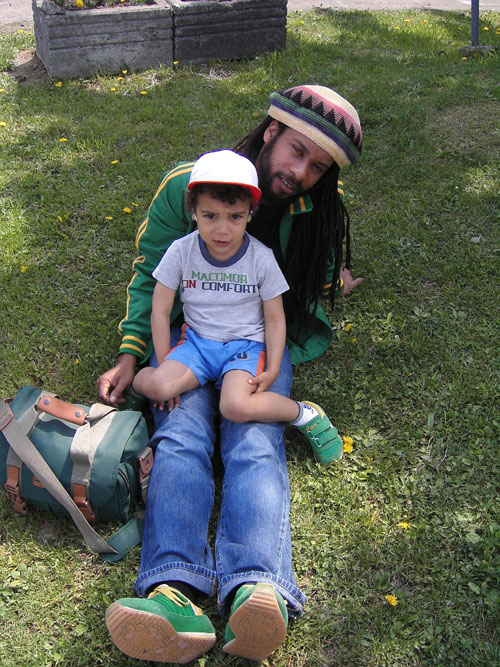
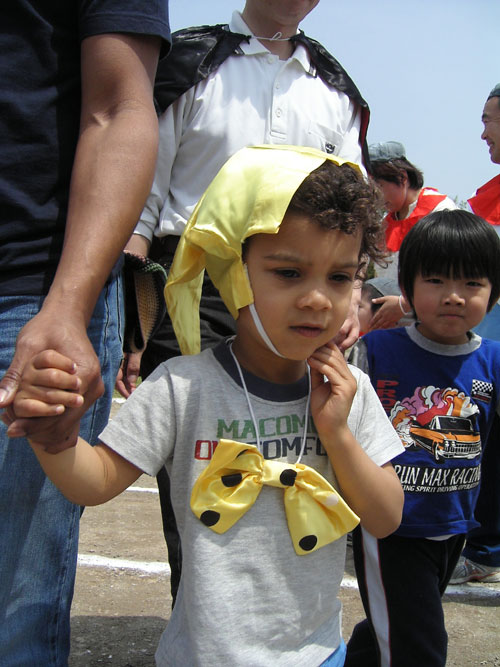
An inescapable event for anyone attending schools in Japan, the annual Sports Day, which was held this Sunday. Here my son shows off an example of the sports day fashions. I, of course, got an extra added gift of sunburn.

All in all, it was a surreal, and completely humorous event.

Sorry I couldn’t film the big dance number where all the parents and kids wore gold streamers on their wrists and we frantically flailed our arms and legs about in circle formation to a song that had a curious word-addition to the chorus: “Hallelujah.” I’m not sure what the rest of the song was about at all. Either way, it was serious blackmail material…best kept undocumented.

Categories
Multicultural life Oops

Three elves

elves.jpg

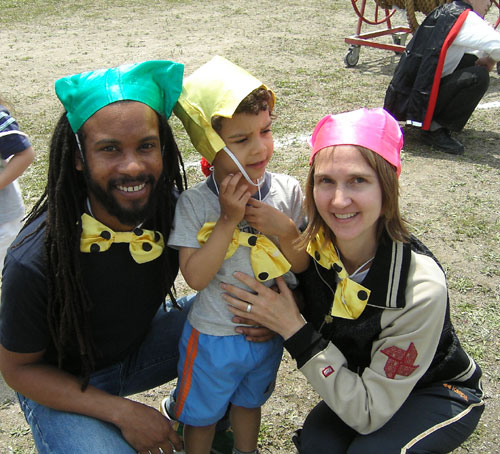
How did we end up in these elf outfits exactly? Well, the race entailed putting on costumes stuffed in a colorcoded bag and then we had to run about 50 meters to unstack some plastic cones and then race back to tag the next group of lucky nursery school parents/child. I think my husband is the best elf of us three.

Categories
Multicultural life Respite

Chilling

dntsportsday.jpg

A and T chilling during the long-winded sports day opening ceremony.

Categories
Ainu rights Multicultural life

Attending the Chi-nomi-Shiri-Kamuy-nomi festival

arashiyama.jpg

Last week Arashiyama was the setting for the Chi-nomi-Shiri-Kamuy-nomi, an Ainu ceremony of prayer to the gods and blessing of prayer sticks. The ceremony was led by the local Chikabumi Ainu.

Categories
Ainu rights Multicultural life

Food for the gods

godsfood.jpg

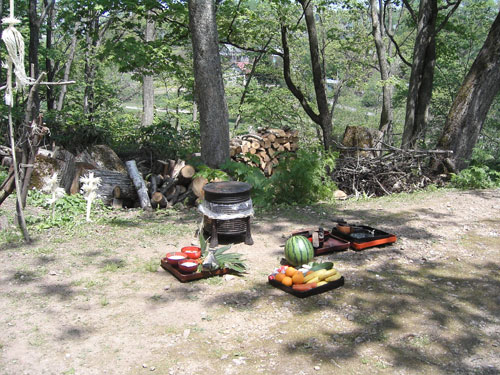
Here are the foods prepared for the gods.

Categories
Multicultural life

Fusa-san and the ladies

fusasancrew.jpg

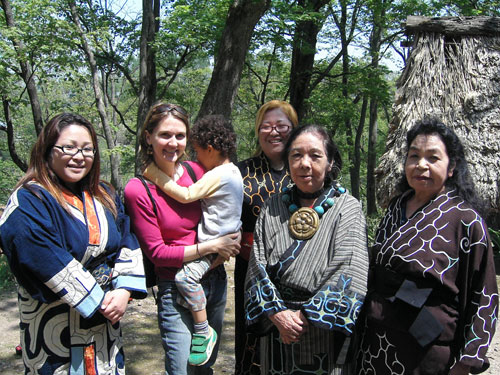
Here I am with my son and the inimitable Fusa-san and some of the ladies.

Categories
Ainu rights Multicultural life

Inaw Blessings

blessingpryr.jpg

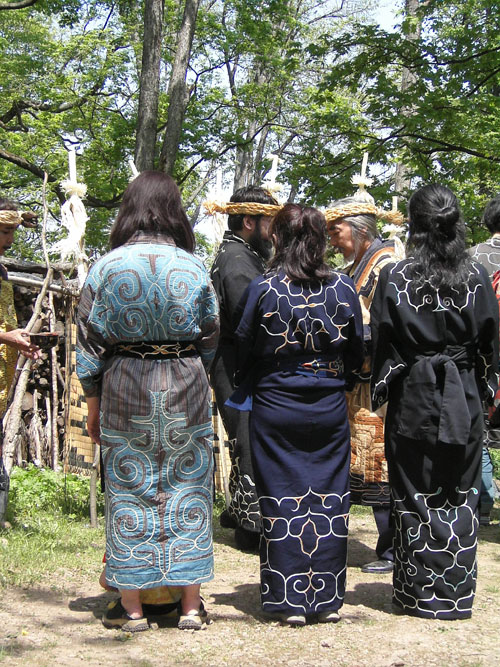
Here Ota-sensei (L) blesses the new prayer sticks with Kawamura Kenichi (R), the leader of the Chikabumi. The sticks are called Inaw. The inaw are carved into birds who will then fly the prayers to the chosen gods (lIwasaki-Goodman & Nomoto, 1999, p. 223, in Ainu: Spirit of a Northern People, Dubrueil & Fitzhugh, eds.).

Categories
Ainu rights Multicultural life

Opening Prayers

opengpryr.jpg

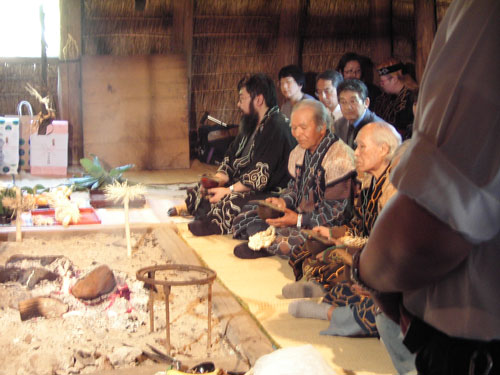
Here are the opening prayers conducted inside the chise. The male elders and other respected male leaders said prayers, while the leader’s wife poured the sake. I didn’t see the entire ceremony because my son decided to shout his own prayers out loud and so I thought it best he do that outside.

Categories
Ainu rights Multicultural life

Chise

chise.jpg

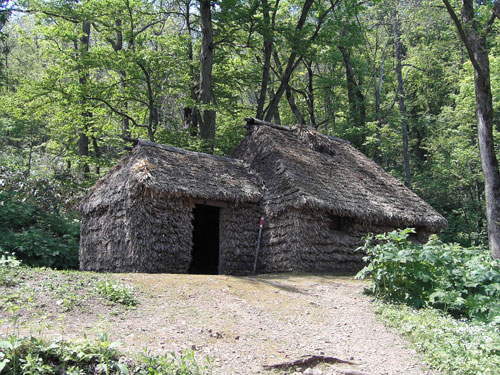
Here is a picture of the smaller chise (traditional Ainu house) on the grounds of the park at Arashiyama (Storm mountain).

Categories
Multicultural life

Shade dwellers

shadelovers.jpg

The shaded awnings of the chise is where some people, including my son, elected to stand during the outside portion of the Chi-nomi-Shiri-Kamuy-nomi Ainu prayer festival held May 27.

Categories
Do the right thing Multicultural life New Media Musings Reading Minds

Exploring new ways of seeing

cups_libraryexhibit.jpg
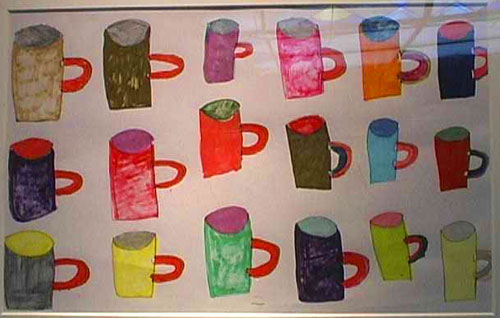
anonymous artist – Outsider art exhibit at local library

I haven’t had the chance to get to this place lately. Been traveling about and reading books on the treatment of the peasant class during the pre-modern and modern era of Japan. Once again, I am opening my eyes wider to what is in the hidden history of Japan and starting to recognize important interconnections with the history of the Ainu here in Hokkaido and to the poor all over Japan and, ultimately, the world.

It seems to me quite obvious that the controlling power base tries to define as many differentiating (and often arbitrary) characteristics of others to weigh in as losers against their own perceived supremacy of group characteristics in order to justify the continued unequal and inhumane treatment of those ‘undesirables.’

The undesirables are meant to stay undesirable, in other words. Thus, the under-class has a role, it seems in part, to keep the elites feeling superior and justifiably self-righteous.

I have always found social history much more fascinating than the standard fare drilled in young minds. The book I mentioned I am in the process of reading above is Peasants, Rebels, Women, and Outcastes by Mikiso Hane. He argues that the road to modernization for the majority of Japanese was slow, and wretched, filled with disease, starvation and discrimination. I recommend it, but of course it won’t be a cheerful read! More like a bucket of ice water thrown on a sleeping bear.

I also met a woman scholar yesterday who trained at SIT in Brattleboro, VT, and is now an intercultural trainer. She built a website recently to open the dialogue up within Japan on multicultural issues. It’s entirely in Japanese but here it is! I was thrilled to see this sort of positive action being taken within Japan.

Categories
Ainu rights Multicultural life Reading Minds

Race, Resistance and the Ainu of Japan: A Great Book

This is the first book-length work in English I’ve found to comprehensively explain Wajin-Ainu power relations: Siddle, Richard. (1996). Race, Resistance, and the Ainu of Japan. London: Routledge.

And what a book! It details the complexities and contradictory historical records about the Wajin conquest of Hokkaido and the impact on the Ainu, who are Hokkaido’s (or Ainu Mosir’s) Indigenous people.

I am enjoying learning about this history because it is so important for me as a member of Japanese society to know this, especially since I hope to have my students (future public school teachers) learn these truths, too. Right now there are only 2 sentences about the Ainu in the just-released 2006 mandatory history textbooks of compulsory education (Thanks to Kitty Dubreuil for showing me that!). One of those sentences is in a footnote. This is deplorable, but not surprising, given the myth of hegemony the government steadfastly defends to this day.

Many parallels between the Wajin’s systematic and socially constructed marginalization of the Ainu and the colonial systems marginalizing other Indigenous peoples in the world can be found.
For example, when Wajin first entered Ainu Mosir, they were mostly men who were very poor and often exiled convicts. Ainu women were often raped after their men were sent to work as forced labor (at gunpoint) for the fish fertilizer work camps very far from their homes. The children of these violent encounters were considered Ainu and were brought up by their mothers alone.

Stories like these fill me with anger, but more than that, fill me with the determination to make sure my students know this sad history and not cloak Hokkaido history as a ‘pioneer’ history of brave men entering ‘no man’s land.’ The Ainu were here and are still here, and the silence needs to be broken via inclusive history education in the schools. I can’t understand how the Japanese government can get away with such silences and lies. I guess all power systems pick and choose a history suitable to maintaining their privileged status, just look how the current US president stubbornly sits on his throne of thorny lies.

I recommend this book to all folks interested in Japan. Siddle has done a good job at revealing the dirty little (and big) secrets of the Wajin power games.

Categories
Ainu rights Multicultural life Reading Minds

Multi-ethnic Japan

I am finishing up a book by John Lie (2001), called “Multi-ethnic Japan.” I plan on using much of its argument to teach Identity and Culture here at Hokkaido U of Education. Fascinating stuff, and I learned much about the hybrid character of Japanese culture, or rather it opened my eyes to what is already all around me!

His main argument is this: Just as the US power base and government “created” and propagated the idea of a unified “white race,” which effectively pulled into one group diverse ethnicities such as Italian, Irish, Russian, and Jewish peoples, further erasing the many ethnic identities inside each of those groups, etc.), and just as the French government tried to sell the idea of a unified Francophone nation in its education system, so, too, have the Japanese government and intellectuals attempted to erase the heterogeneous ethnic makeup of Japan, teaching Japan to the masses via education and media as “One nation, one race, one language.” And they have done a very thorough job. I haven’t met many folks who don’t think of Japan as a singular, special, and unified people.

What surprised me most is the fact that this idealized idea of Japan as a homogenous people really didn’t solidify until post WWII, and mostly in the mid-1960’s. Of course, western Japanologists helped support this lie, too.

I had been taught this myth before I came to Japan and had believed it during my first years in Japan, even though I knew firsthand of the presence of Okinawan, Ainu, Burakumin, Korean, Chinese, Filipino, Brazilian, Iranian, Peruvian, African, Russian, Indian, Bangladeshi and Canadian, US, Australian and numerous European peoples, etc. living in Japan. Basically, all nations’ peoples are represented here, although this author argues they are primarily concentrated in the larger cities.

But even in our small city in northern Hokkaido, we have Filipino, Australian, German, Russian, Swedish, Iranian, Indian, Ainu, US, Taiwanese, Chinese, Korean, and Canadian peoples, and an array of multiethnic peoples, so I am not sure of this emphasis on ethnic richness as being only in the larger cities. Rather, I think it more that, just as most Wajin Japanese live in large cities, so do the ethnicities. For some reason, I blindly ignored these facts of diversity and saw Japan as a remarkably singular nation, culturally and racially. I think I felt the older groups (the Ainu, the Okinawan, the Korean and the Chinese people had more or less disappeared into the Japanese cultural soup, and were, by and large, Japanese. And then, the rest of the ‘newer’ immigrants were here temporarily, soon to return to their homelands (and that included me)).

It wasn’t until I started reading maybe ten years ago about the inane and problematic concept of ‘race’ that I began to question deeply my own country’s racialized language, and then, later, to turn a clearer lens to my view of Japan. As you know, race is not a scientific categorization of peoples: it is based primarily on assumptions made by physical characteristics and cultural behavior, the former argument is nebulous and contradictory as a designator (for example, dark or pale gradations of skin can occur in many peoples as can curly or straight hair, and why aren’t types of toenails included?;-)), and the reason people developed different ‘looks’ had to do with the geographical fact that, way back then, people didn’t travel or intermarry often (and they still don’t, really!) and the latter argument depends on one’s upbringing and society. Scientists have proven, via genetic testing, that we humans are the same: there isn’t enough deviation in anyone’s DNA to qualify one group of people as another ‘race.’ We easily say that a sparrow and an eagle are both birds, but we can’t say the same of different human beings! Maybe not the best analogy, since those two birds likely have significant DNA differences, and we humans simply don’t!….Yet the sad ability of societies to persist in classifying humans into different races continues ad nauseum, and even I find myself falling into the trap at times…hard not to, with all the indoctrination going on.

Anyway, that was a little rant, back to the point. Next time you hear someone talk of Japan as an Island nation that was closed off for 300 years, hence forming a special unified peoples, remember this: Many nations are ‘island nations’ and historically-speaking, being an island nation actually aided the intermixing of cultures (this is how the Wajin got to Japan in the first place! This is how they adopted Chinese philosophies, religions and a writing system, Korean pottery, and Portuguese bread!). Also, the Tokugawa Shogunate did not close off outsiders for 300 years; they only centralized the control of the ports. Trade with and travel to foreign nations continued throughout that time, and many ideas and goods continued to be brought in under Tokugawa rule. These are the two most prevalent arguments I hear by Japanese (and others) to argue the uniqueness (and often superiority) over other cultures, but these arguments cannot hold true.

Furthermore, from the Meiji (1868) era on up until the end of WWII, the successive Japanese governments aggressively sought empire expansion and attempted to force assimilation of the so-called conquered peoples of the Ainu Mosir, Ryuku kingdom (Okinawa), Taiwan, Manchuria, Korea, the Philippines, etc. by outlawing their customs, languages and teaching Japanese in the Japan-run schools. They even tried to control their diet and way of dress. Thus, during this long imperialist and expansionist stage (inspired by the western nations, by the way), many ethnicities were encouraged to become ‘Japanese’, were designated legal Japanese citizens (though prejudice and discrimination were the norm, of course) and inter-marriages were encouraged. From this alone, we can see that Japan is and never was a ‘pure’ blood nation, no more than the Britain is or was.

This is a very important book for me because it validates the multi-ethnic character of Japan and opens the possibilities for more acceptance and knowledge about other ethnicities. I could go on and on, but, just read the book, okay? Now the difficult task for me: how do I teach this without students feeling attacked– from seeing it as a troublesome, uncomfortable, identity-breaking truth? I hope to teach it so that they see the truth as a saving grace, as a reason for celebration, culminating in a richer national identity. Wish me luck.
Categories
Multicultural life New Media Musings

Iceland as the only nation-state

From class forum:

Thanks, Paula, for that illuminating entry from Wikipedia:
just goes to show how clumsy these terms can be when only
one nation-state, Iceland, can be said to exist.

Perhaps Wikipedia needs an edit because Japan is NOT
one homogenous nation that the world and Japan sell it as:
always have been ethnic minorities, but usually
ignored by media and gov’t. and world.

I’ll try to edit that wiki in August when life stops going
at ‘terminal velocity’ (Virilo, M&P 179), sigh.

Now to toot my horn (beep-beep, ) if you want to read
about this homogenous myth in the light of the Ainu
(indigenous people to Japan)see a paper I wrote last term.

Link here

When you combine an easier to define term
(state: an attempt at static bureaucratic organization)
with a tenuous concept (‘nation’: a group who upholds a
belief in a constructed (false?) shared culture/history),
few spots in reality can be called nation-states.
Always a myth?

Iceland, appears to have a pretty homogenous nation, but
also has a growing presence of foreign immigrants and the
problems/joys that entails.

Though I don’t entirely trust data of the US State Dept.
(since it never examines its own dirty laundry), their
site
gives more detail on the plight of the non-Icelandic
in Iceland.

Categories
Multicultural life Whirling Dervish

Driving for light conversation

Yesterday evening my family and I drove out, creeping our way instinctively through a blizzard, to the neighboring village of Higashikawa. We had been invited by a local NPO worker who said the townspeople wanted to speak with foreigners for advice about setting up a concierge system for incoming foriegn tourists who wished to hike Asahidake of the Daisetsu mountains.

Yet, not surprisingly (after ten years in this country I should have known better), after we arrived we were spaced out evenly (a man from Korea was also present), so we were about three to four Japanese people per adult foreigner.

I was asked how long I had been in Japan, in Asahikawa, what I did for a living, how old my son was, why he had a Japanese name, what my husband did, where I learned to speak Japanese, and whether I cooked Japanese food or not, etc.

In other words, the event turned into a “talk with the foreigner” event and in an hour and a half no one asked me any questions about what would be helpful for foreign tourists who wished to visit the National Park (and later my husband confirmed that no such questions were asked of him either).

Only Kazu, the organizer for the event, made one comment, in Japanese, somewhat related to the unmentioned concierge planning. He said that when foreign tourists came to the mountain in tour groups all went smoothly because the Japanese agent handled everything and made sure the visitors followed the rules. But when people from foreign countries visited independently problems occurred. He said that they couldn’t read the rules since they were written in Japanese, and thus, they broke many rules. I wanted to state the obvious, that the rules should be posted in other languages, but I held my tongue.

When we begged leave, my husband had a puzzled look on his face and I was reminded of why I normally declined such formal social invitations.

The only person who seemed to have a blast was our son, who had the rare chance to eat three taboo chocolate chip cookies, and he celebrated the windfall by circling the sedated adults who sat around the table as if he were an insane hornet.

On the way home, driving slowly on invisible roads covered with snow and with visiblilty limited to ten yards, I went to the verge of apologizing for dragging my husband and son out of our warm house, into a snowstorm, for light conversation with total strangers. Instead, I said that we could chalk it up as a cultural learning experience.

My husband said, “And we met some nice people.” “People we will probably never see again,” I added. And so, we chuckled about the evening, thinking that maybe they had met with us to warn us indirectly to follow the rules if we ever stepped foot on the mountain. Very happy to be heading toward home, I silently wondered if our hosts had felt the scheduled meeting a success?

Categories
Multicultural life Whirling Dervish

Grammar and spiced pistachios

I just spent a steady hour with a red pen (I don’t usually use a red pen, but I felt a bit peevish) dancing, sliding and hopping through two English Literature students’ graduate theses on Midsummer Night’s Dream and something by D.H. Lawrence I have never read.

The smell of coffee grounds scooped into an unused filter lured me forward to the last pages and it held its lovely scent in front of my nostrils as a reward. Now I have the cup brewed and a snowstorm outside the window to lull me back into blissful solitude.

As it is an official work holiday, I would have had rather been at home, but it is my job to help these students and I can’t refuse to help them…I haven’t the heart to be so cold (or is it bold?). Now that I am here, however, I can feel at peace.

The two informed me that a drone of fourth-year students would be flying to visit me in January as the deadline approaches…something I am not too excited about, but I am also well aware how few college students are good at doing their work ahead of schedule: procrastinators reign supreme.

Yesterday:

My son and I visited a woman and her two children whom we met at the shopping mall. They are from Tehran. She is lonely and cold in this city; her husband is an artist and instructor for Tokai University, so she spends her days with her one year old while her husband and older daughter, age 9, are away at school. She misses her parents and her very big house and her maid and the inexpensive fruits and vegetables of Iran. She will return home in February with her children for a 2-3 month visit.

She had her veil off at home and she had a thick shock of lovely brown hair, something one would never imagine being tucked underneath her calico blue and white cotton head-scarf. Her daughters are bright red cheeks and smiles. We ate pistachios that had been soaked in some sort of reddish sticky spice and my son chewed like a beaver through the skin of an apple, creating a superficial spiral design with his front teeth. Luckily I had brought them four new apples (an apple in Japan is over a dollar each!), so I could feel less guilty over his baby beaver antics.

Well, I had hoped to use these “days off” to write and read, but I have yet to act on the first of these goals….am I the same as those students who put writing off until it’s too late? I hope not! Here I sign off to dip my toes into imagination lake.

Spam prevention powered by Akismet