Categories
Ordinary Miracles Poems & art Reading Minds Uncategorized

Reading Robert Bly

KICX2501

I came across T-chan, age 7, reading Robert Bly’s book, Morning Poems. He read silently, his mouth shaping out the words. It’s the first time I ever noticed him reading one of my books.

It makes me wonder what else he has been reading when I wasn’t around. I am so proud of him.

A line from the poem “For Ruth” that he was reading:

‘And I’ve learned from you this new way of letting a poem be.’

Categories
Do the right thing Multicultural life New Media Musings Reading Minds

Exploring new ways of seeing

cups_libraryexhibit.jpg
anonymous artist – Outsider art exhibit at local library

I haven’t had the chance to get to this place lately. Been traveling about and reading books on the treatment of the peasant class during the pre-modern and modern era of Japan. Once again, I am opening my eyes wider to what is in the hidden history of Japan and starting to recognize important interconnections with the history of the Ainu here in Hokkaido and to the poor all over Japan and, ultimately, the world.

It seems to me quite obvious that the controlling power base tries to define as many differentiating (and often arbitrary) characteristics of others to weigh in as losers against their own perceived supremacy of group characteristics in order to justify the continued unequal and inhumane treatment of those ‘undesirables.’

The undesirables are meant to stay undesirable, in other words. Thus, the under-class has a role, it seems in part, to keep the elites feeling superior and justifiably self-righteous.

I have always found social history much more fascinating than the standard fare drilled in young minds. The book I mentioned I am in the process of reading above is Peasants, Rebels, Women, and Outcastes by Mikiso Hane. He argues that the road to modernization for the majority of Japanese was slow, and wretched, filled with disease, starvation and discrimination. I recommend it, but of course it won’t be a cheerful read! More like a bucket of ice water thrown on a sleeping bear.

I also met a woman scholar yesterday who trained at SIT in Brattleboro, VT, and is now an intercultural trainer. She built a website recently to open the dialogue up within Japan on multicultural issues. It’s entirely in Japanese but here it is! I was thrilled to see this sort of positive action being taken within Japan.

Categories
Ainu rights Multicultural life Reading Minds

Race, Resistance and the Ainu of Japan: A Great Book

This is the first book-length work in English I’ve found to comprehensively explain Wajin-Ainu power relations: Siddle, Richard. (1996). Race, Resistance, and the Ainu of Japan. London: Routledge.

And what a book! It details the complexities and contradictory historical records about the Wajin conquest of Hokkaido and the impact on the Ainu, who are Hokkaido’s (or Ainu Mosir’s) Indigenous people.

I am enjoying learning about this history because it is so important for me as a member of Japanese society to know this, especially since I hope to have my students (future public school teachers) learn these truths, too. Right now there are only 2 sentences about the Ainu in the just-released 2006 mandatory history textbooks of compulsory education (Thanks to Kitty Dubreuil for showing me that!). One of those sentences is in a footnote. This is deplorable, but not surprising, given the myth of hegemony the government steadfastly defends to this day.

Many parallels between the Wajin’s systematic and socially constructed marginalization of the Ainu and the colonial systems marginalizing other Indigenous peoples in the world can be found.
For example, when Wajin first entered Ainu Mosir, they were mostly men who were very poor and often exiled convicts. Ainu women were often raped after their men were sent to work as forced labor (at gunpoint) for the fish fertilizer work camps very far from their homes. The children of these violent encounters were considered Ainu and were brought up by their mothers alone.

Stories like these fill me with anger, but more than that, fill me with the determination to make sure my students know this sad history and not cloak Hokkaido history as a ‘pioneer’ history of brave men entering ‘no man’s land.’ The Ainu were here and are still here, and the silence needs to be broken via inclusive history education in the schools. I can’t understand how the Japanese government can get away with such silences and lies. I guess all power systems pick and choose a history suitable to maintaining their privileged status, just look how the current US president stubbornly sits on his throne of thorny lies.

I recommend this book to all folks interested in Japan. Siddle has done a good job at revealing the dirty little (and big) secrets of the Wajin power games.

Categories
Do the right thing Poems & art Reading Minds

Hot Spring Mine and Salgado

SulfurHotSpringMine.jpg

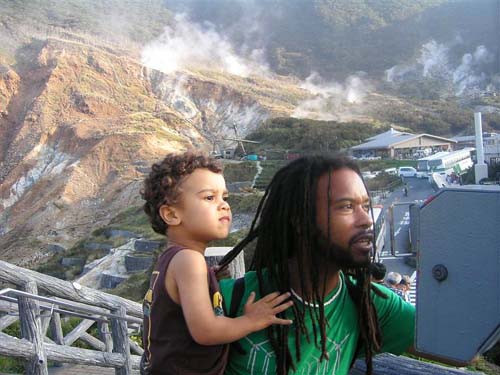
For the first time in late September I saw a place where hot spring waters are harvested for the many hotels dotting the Mt. Fuji landscape. The scene looked like my Catholic childhood imagination of Hell: yellowy scarred stains next to smoldering thick pools of spoiled oatmeal, yellowish-white fumes twisting and groaning like ghosts, the entire mountain side was shaved and carved into a wasteland, and finally, the omnipresent sulfurous smell lingered on our skin and hair until we bathed at night. The smell was similar to Fourth of July gunpowder smokebombs..or of the smell of paper mills in the northernmost Minnesota town where I was born. If you mix in the busloads of tourists devouring black-shelled eggs, you’ll get the gist of this Hell.

Yet, despite the ugliness and desolation, sigh, I admit I love this shot of husband and son looking at Mt.Fuji, while the sulfurous smoke rises in the backdrop.

Yet, it can’t compare to the powerful work of my favorite contemporary photographer, Sebastiao Salgado. For example, his book WORKERS blew me away…though I actually had the chance to see these photos first at an exhibit in Meguro at the Tokyo Museum of Photography maybe 8 years back? He does a lot of work for the UN and has donated his photos to make posters for UNICEF, at CHANGING THE WORLD WITH CHILDREN Campaign, in support of the world’s children.

He wrote, “I hope that the person who visits my exhibitions, and the person who comes out, are not quite the same,” says Mr. Salgado. “I believe that the average person can help a lot, not by giving material goods but by participating, by being part of the discussion, by being truly concerned about what is going on in the world.”

An awakening happened inside me from viewing his work, and I believe it would happen to any warm-blooded human who enters the eyes of the people he photographs. I can never forget the phtoographs of the gold miners in Brazil. All that desolate misery and physical pain for someone else to pocket the profits and then another to wear a gold chain around his/her privileged neck! Makes you think about the insanity of this world.

But his photographs are not meant to fill you with despair, but to fill you instead with anger and courage to demand for the dignity of all people.

He also wrote, “More than ever, I feel that the human race is one. There are differences of colour, language, culture and opportunities, but people’s feelings and reactions are alike.”

Check out his NY Times online exhibit of the Landless workers movement in Brazil (which he actively supports), called TERRA.

We can find a way, people, to get things right, can’t we? On a good day, I hold hands out for hope to settle like a green dragonfly.

Categories
Ainu rights Multicultural life Reading Minds

Multi-ethnic Japan

I am finishing up a book by John Lie (2001), called “Multi-ethnic Japan.” I plan on using much of its argument to teach Identity and Culture here at Hokkaido U of Education. Fascinating stuff, and I learned much about the hybrid character of Japanese culture, or rather it opened my eyes to what is already all around me!

His main argument is this: Just as the US power base and government “created” and propagated the idea of a unified “white race,” which effectively pulled into one group diverse ethnicities such as Italian, Irish, Russian, and Jewish peoples, further erasing the many ethnic identities inside each of those groups, etc.), and just as the French government tried to sell the idea of a unified Francophone nation in its education system, so, too, have the Japanese government and intellectuals attempted to erase the heterogeneous ethnic makeup of Japan, teaching Japan to the masses via education and media as “One nation, one race, one language.” And they have done a very thorough job. I haven’t met many folks who don’t think of Japan as a singular, special, and unified people.

What surprised me most is the fact that this idealized idea of Japan as a homogenous people really didn’t solidify until post WWII, and mostly in the mid-1960’s. Of course, western Japanologists helped support this lie, too.

I had been taught this myth before I came to Japan and had believed it during my first years in Japan, even though I knew firsthand of the presence of Okinawan, Ainu, Burakumin, Korean, Chinese, Filipino, Brazilian, Iranian, Peruvian, African, Russian, Indian, Bangladeshi and Canadian, US, Australian and numerous European peoples, etc. living in Japan. Basically, all nations’ peoples are represented here, although this author argues they are primarily concentrated in the larger cities.

But even in our small city in northern Hokkaido, we have Filipino, Australian, German, Russian, Swedish, Iranian, Indian, Ainu, US, Taiwanese, Chinese, Korean, and Canadian peoples, and an array of multiethnic peoples, so I am not sure of this emphasis on ethnic richness as being only in the larger cities. Rather, I think it more that, just as most Wajin Japanese live in large cities, so do the ethnicities. For some reason, I blindly ignored these facts of diversity and saw Japan as a remarkably singular nation, culturally and racially. I think I felt the older groups (the Ainu, the Okinawan, the Korean and the Chinese people had more or less disappeared into the Japanese cultural soup, and were, by and large, Japanese. And then, the rest of the ‘newer’ immigrants were here temporarily, soon to return to their homelands (and that included me)).

It wasn’t until I started reading maybe ten years ago about the inane and problematic concept of ‘race’ that I began to question deeply my own country’s racialized language, and then, later, to turn a clearer lens to my view of Japan. As you know, race is not a scientific categorization of peoples: it is based primarily on assumptions made by physical characteristics and cultural behavior, the former argument is nebulous and contradictory as a designator (for example, dark or pale gradations of skin can occur in many peoples as can curly or straight hair, and why aren’t types of toenails included?;-)), and the reason people developed different ‘looks’ had to do with the geographical fact that, way back then, people didn’t travel or intermarry often (and they still don’t, really!) and the latter argument depends on one’s upbringing and society. Scientists have proven, via genetic testing, that we humans are the same: there isn’t enough deviation in anyone’s DNA to qualify one group of people as another ‘race.’ We easily say that a sparrow and an eagle are both birds, but we can’t say the same of different human beings! Maybe not the best analogy, since those two birds likely have significant DNA differences, and we humans simply don’t!….Yet the sad ability of societies to persist in classifying humans into different races continues ad nauseum, and even I find myself falling into the trap at times…hard not to, with all the indoctrination going on.

Anyway, that was a little rant, back to the point. Next time you hear someone talk of Japan as an Island nation that was closed off for 300 years, hence forming a special unified peoples, remember this: Many nations are ‘island nations’ and historically-speaking, being an island nation actually aided the intermixing of cultures (this is how the Wajin got to Japan in the first place! This is how they adopted Chinese philosophies, religions and a writing system, Korean pottery, and Portuguese bread!). Also, the Tokugawa Shogunate did not close off outsiders for 300 years; they only centralized the control of the ports. Trade with and travel to foreign nations continued throughout that time, and many ideas and goods continued to be brought in under Tokugawa rule. These are the two most prevalent arguments I hear by Japanese (and others) to argue the uniqueness (and often superiority) over other cultures, but these arguments cannot hold true.

Furthermore, from the Meiji (1868) era on up until the end of WWII, the successive Japanese governments aggressively sought empire expansion and attempted to force assimilation of the so-called conquered peoples of the Ainu Mosir, Ryuku kingdom (Okinawa), Taiwan, Manchuria, Korea, the Philippines, etc. by outlawing their customs, languages and teaching Japanese in the Japan-run schools. They even tried to control their diet and way of dress. Thus, during this long imperialist and expansionist stage (inspired by the western nations, by the way), many ethnicities were encouraged to become ‘Japanese’, were designated legal Japanese citizens (though prejudice and discrimination were the norm, of course) and inter-marriages were encouraged. From this alone, we can see that Japan is and never was a ‘pure’ blood nation, no more than the Britain is or was.

This is a very important book for me because it validates the multi-ethnic character of Japan and opens the possibilities for more acceptance and knowledge about other ethnicities. I could go on and on, but, just read the book, okay? Now the difficult task for me: how do I teach this without students feeling attacked– from seeing it as a troublesome, uncomfortable, identity-breaking truth? I hope to teach it so that they see the truth as a saving grace, as a reason for celebration, culminating in a richer national identity. Wish me luck.


Categories
New Media Musings Reading Minds Space is the Place

What the BLEEP do we know?

I finally had the chance to sit down and watch a film I had read about in my New Media class discussions.: What the BLEEP do we know?, which is a sort of self-help film but also a film about quantum physics, too, and I liked it, and this is not without a critical eye, but because it talks about tough things: like victimization, the cycle of negativity, and how we could be following the path inward toward knowing who we are as humans. Such things not normally talked about in mainstream media or societies these days. Of course, the film simplifies it (108 minutes cannot explain a human life at all), but at least it draws us to question how we accept our lives as ‘fate’ and asks us to become more active in our designing.

It wasn’t a film anyone entrenched firmly in any one organized religion would like because it questions the static and rule-based limitations these religions use. It puts responsibility and action and agency square back into human hands, and says we design our lives in concert with the larger interconnectedness of the universe; that is, we are creative actors.

I was most interested in how the human cells have receptors for chemicals produced in the hypothalamus, and as the cell divides it produces more receptors for those commonly used chemicals associated with our emotions (love, empathy, sexual desire, anger, self-pity, despair, or whatever) and less receptors capable of taking in nutrients, minerals and proteins needed for our health. Thus, if we continuously feel negative, our physical cells will create more receptors to meet that demand of a need for negativity–thus we fulfill our sad design/destruction. I would like to start using this idea to lessen those negative ideas, and my occasional feelings of road rage (this is obviously not a needed emotion, so why do I have it?).

Anyway, I recommend it to anyone who wants to touch on what quantum physics is about and to perhaps see how a new type of living could result from such ideas: here’s the link

Categories
New Media Musings Reading Minds

Agamben’s ideas, pt.1

I spent some time today reading some works by Giorgio Agamben, a contemporary philosopher. He talks about finding the Entivicklungsfahigkeit in a work as his vocation as a scholar. This, he explains, is a term coined by Feurerbach that means the philosophical element in any work is an element that allows the capability of it to be further developed. It is, again in his idea, the unsaid, the undeveloped, or the potential for further thought–which Coleridge called the ‘ignorance’ of the creator/author left to be discovered by the audience.

I also learned a bit more about Foucault’s concept of the panopticon, which becomes his archetype or paradigm, for institutions of power, such as prisons and mental institutions, or as Agamben later argues, for concentration and refugee camps and ‘terrorist’ detention centers.

A panopticon, according to its originator, an Irishman by the name of Jeremy Bentham, it meant a design for an inspection house that would have one central figure watching and controlling the captured ‘inmates’ (1791), but Foucault saw this proposed building as the paradigm for the system of power that, once in place, operates as the control center of the power force and its individual players merely act out the designated (and defined) roles of warden and inmate. Thus, any singular historical phenomenon or object or person might be a paradigm (or example or symbol) for the larger world, and in this instance the panopticon is the model for a mechanism of power or for ‘panoptism.’

More later, but he also talks about the refugee as being the central figure (again, a paradigm) for the postmodern world. Interesting stuff (to me…), as in some ways, I fit his definition of a refugee, at least in the sense that I am someone who often chooses and prefers to be outside of the nation-state.

Categories
New Media Musings Reading Minds

The Hybrid Self

This week we read about cyborg theory, a recent view that life as we thought we knew it (as the individual animal/human as a separate cohesive entity) is a myth and that all life forms are really collectives: we are each composed of many living organisms (cells, bacteria, amoebas, etc.), chemicals, electricity, and now technologies and their effects (Murphie & Potts, 129). This seems reasonable to me in the sense that we are actually a combination of all sorts of living matter, each unique somewhat in our DNA code patterning, but the theory fails to explain consciousness and free will to me (to them these are probably chemical concoctions or nonexistent?): cyber theorists see all life as an event not an entity…

Cyborg theorists then push this idea beyond the individual, and see the entire world as collective information being processed: living organisms that network and communicate and self-generate. They include machines and the technologies used by the living into the realm of the network (as part of life). To them, we have reached at state where machines/technologies are imbedded inside us and we inside them. In sum, they seem to see all of us as mere interconnected cyborgs (are we then one big planetary, galactic organism?), and they argue we cannot survive anymore without our machine technologies. I think this view of the human as a mere information being processed as limited and too dependent on the limiting computer metaphor to to explain a much more complex world.

Well, I guess I tend to take a broader picture also of what they see as technologies. A sharp rock, a spark to start a fire inside a cold cave are technologies and, yes, I think humans need such things to survive, but I also know that the vast majority of people on this planet live quite well without the so-called ‘high’ technologies. I think people enmeshed in the cyberworld always forget that important point. The cyberworld is really a tiny space inhabited by a few privileged(?) folks, and the investigation of DNA is in its infancy and has yet to provide us any real answers about what life is…and I fear with Bill Joy (M&P, 140-141) that researchers might be acting with too much confidence & without any foresight or ethical concerns about the consequences of their bumblings in the dark.

Thus, they, as in those very few who are obsessed with the latest technologies, are maybe in some ways part-machine, because of their constant interaction with them, and those of us mildly involved in using latest technologies might be convinced we are now interconnected with the machines, but probably about 80% of the world population is not so involved in a world of machines or technologies beyond the hoe and bicycle. I guess you could argue that they are impacted by those technologies and those who use them….mostly in adverse ways, too, unfortunately.

Yes, we are all interconnected, but nature, animal/human life, and the machines are not so evenly held in importance for the majority of humans. The patterns in nature are not so well understood, but computers are (at least by their makers). I think the imbalance between humans and the natural world has caused the increasing dependence on technologies to try to correct or control the imbalance we manufactured in the first place. Machines are our band-aids, but they are no match for Nature’s need to find balance. Humans will not outwit nature, I believe, because they haven’t the foresight and they can’t control their greed.

But has it reached a point where some of us need the computer and it needs us for survival? Certainly one hooked up to a lung machine needs it to survive, but is that the quality of survival we wish for ourselves? Is such technology really wonderful if that person can’t stand up and climb a mountain? I guess it is for that person to decide ultimately. Is being plugged into a computer 24-7 a worthwhile existence? For those who are, perhaps it is valuable (addictive), but isn’t it more of a virtual existence?

Does the difference between life and virtual life really matter? We could argue that reality is not real anymore: perhaps the world has turned into Baudrillard’s Simulacra (the world bears no relation to reality whatsoever, merely a sign for another sign)? With all the mediaspeak and sound bites, are we truly sure what is going on? If virtual reality is all that remains, then those of us who have ‘become one’ with such technologies will need to find an alternative to physical bodies because our bodies will wither away (or float-bloat) away. Computers are fun, fascinating, and challenging, but a lot simpler than the ecosystem of a forest. Cyborg theory falls short of theories based on bio-diversity, it sees life as interconnected information processes, but it doesn’t acknowledge the damage humans and their technlogies have had on the natural environment. We need to admit that humans are the major actors creating the many natural imbalances occurring.

In sum, reading about cyborg theory helps me re-think, re-evaluate how I live my life…to tell the truth…thinking about all of this made me choose the bicycle over the car this morning. I, for one, prefer to have my physical self united with my mind, even if that means embracing my fragile mortality! 🙂

Murphie, A. & Potts, J. (2003). Culture and Technology. NY: Palgrave Macmillan.

Categories
New Media Musings Reading Minds

Why r cyborg theories useful?

This cyborg theorizing appeared when we reach for ways to make
our machines/technologies more like us: we begin to
investigate what a human being is, and discover that DNA
sequencing and electrical synapse (information looping)
are the Human machines we will need to understand to
replicate or mirror life. This then brings us to
question what thought is, and whether is merely
limited to the biological region of the brain. Cyborg
theorists such as Hayles and Clark (M&P, Ch. 5) see mind
as not trapped but as an energy that can leave its
physical locus for our loci and loop anywhere there is
information to be had, really.

In response, I think these theories gained importance
when they moved beyond mere physical (6 Million Dollar
man/Terminator) conceptions of cyborgs, and into the
idea of machine and mind as intertwined collective
minds; something I hadn’t really considered before. Much
food thought to munch on.

Categories
New Media Musings Reading Minds

Revolution will not be propagandized

I agree that there are complex intricacies of power and
how those who are oppressed become numb (or accepting)
of what is happening to them, to see it as ‘normal’ and
to even self-regulate and peer-regulate continued
oppression.

Too often, these days, I think I blame the ‘rich
powerful white guys,’ but I think Foucault’s ideas you
mentioned (via Gerrie, 2003) of focusing on the very
power structures themselves, we can better recognize the
roles all of us play in oppressive structures: I would
rather think, like Foucault, that those at every level
of society are complicit in the inequalities and everyone
can gain awareness, and with effort, directed action..

His ideas seem related to the educator Paulo Freire’s in
that when fighting one’s oppressor, one cannot do so
healthily or entirely until one becomes aware of the
role one’s self plays in the power game
(“Conscientization”).

Also, he makes the apt observation that many so-called
“revolutions of the people” end up behaving exactly like
their oppressors, with the same propaganda tactics used
to influence the masses, resulting in intolerance for
protest and the fattened cats on the top.

You comment peaks my curiosity about how some workers in
these corporate factories must be fighting/resisting the
systems.

Freire, P. (1970). Pedagogy of the oppressed. NY: Herder
and Herder.

More on Friere

Last thought:…the revolution may not be televised, but will it be digitalized?

Categories
Beginning Spiral New Media Musings Reading Minds

Brain rain or theoretical trampoline

In my current class, Cultural and New Media Studies, we have begun to explore the theoretical frameworks people tend to use when they discuss the relationships or the collision-intertwining of humans and technologies. It is all quite overwhelming and academic and so, from my class notes, and my own interpretations, I wanted to sound out what the various schools of thought are:

The technological-determinists tend to see the technology itself as controlling the masses and determining how we behave, and the masses are without any means to stop this control and shaping of our society.

The cultural materialists tend to see the technological impact as intertwined with political, social and (namely) economic contexts, and they also tend to see humans as possible active agents of how the technologies may be used.

The essentialists believe there is a logical, rational, systematic explanation for how humans behave and how machines behave. If it can’t be explained scientifically yet, it simply means we haven’t developed the science, but that problem can be solved eventually, via progress.

The techno-utopians believe technology is the new promise for solutions to modern day ills. The technologizing of education, health, media and more is seen as beneficial and freeing to humans; although the emphasis tends to focus on the economic benefits for those involved in the technology industries.

The critical theorists saw the long-held notion of scientific rationalism as a means to control, manipulate and distract the masses from any political consciousness. This school of thought developed in a resistance to the rise of fascism. They felt the organization of labor and technologies were dehumanizing and opposed to self-actualization. They believed humans had the power to (re) shape their systems.

The constructivists ask that we examine who has the power of the technologies, what is their aim, and who tries to control whom. They also seek to expose and dismantle the fabricated nature of power structures. I think these people might also called radical humanists, seeking to actively overthrow power structures that create oppression.

Post-colonialists are those involved in expressing resistant ideologies to the dominant (colonial) power(s) ideologies. This counter-thought can be a focus on those marginalized globally or locally by many factors: ethnicity, class, gender, sexual orientation, “race,” education and status.

Post-modernists see all studies as limited by context and locality, no center or universals can exist. I like to think of this as the ‘chaos’ theory of humanity. They attempt to explore a multitude (a cacophony) of perspectives and voices without hierarchy, but still rejecting the dominant western bias of one set ‘tradition’ or set of ideals as representative for all.

Contextualists do not see the political, social, economic factors as separable from technological factors: all is interdependent. Thus, technologies create contexts and contexts create technologies.

Interactionists, similar to contextualists, concentrate on how technologies form and change according to their constant intertwining with the other factors.

Finally, the most recent theories, such as hybridity and cyborg studies, erase the traditional delineation of social, political, economic and technological factors as well as dismiss notions of ethnicities, genders, alive and dead, completely. These theorists feel humans have become machines and machines have become human. Human-machine relations are neither harmonious nor antagonistic, rather the boundaries are so blurred and constantly repositioning, that the two cannot be distinguished from the other.

Well, those were ideas from my notes and often taken directly from my teachers Stephen Petrina and Francis Feng.

I conclude that each theory has its focus and emphasis, and most of us think with an amalgamation of theories (without much consciousness). I just hope to recognize the theories elements in what I read, knowing each one has its weaknesses and motives.

If you read this entire blog, you must enjoy the theorectical trampoline! Jump! Jump!

Spam prevention powered by Akismet