Categories
Comm 464

The Age of Influence

Why only focus on conveying a message through your own social media profiles when you could be leveraging the social influence of your fans and followers to significantly amplify the effect?

It is now obvious that brand evangelists have enormous power to affect and potentially boost sales, however, the trouble is in determining who these key “influentials” are in the first place.
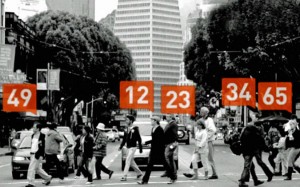
This is exactly the need that is being met in the online marketing realm through the use of social analytics such as Klout, a measure (between 1-100) of social influence based on a person, group or brand’s activity and audience on social networks. This tool has been hugely popular since it was launched in 2008, but is now being challenged by several startups such as Tellagence and Little bird who are differentiating their services by finding influencers in narrower categories and uncovering people who may have low Klout scores but whose social activity could actually lead to effects on sales.

By processing over 12 billion data points per day, these new influence models claim to be more accurate, thus making them increasingly appealing to marketers. Yet, if the goal really is to impact the bottom line then we need to be more strategic about how we’re currently using social media as a tool to achieve real results. These results may not materialize overnight, however, by staying on top of analytics tools such as these, we are not only saving time, but investing smarter to target those who really matter.


Reference: Finding Social Media’s Most Influencial Influencers
Categories
Comm 464

1 Like for a $50 Million Jackpot

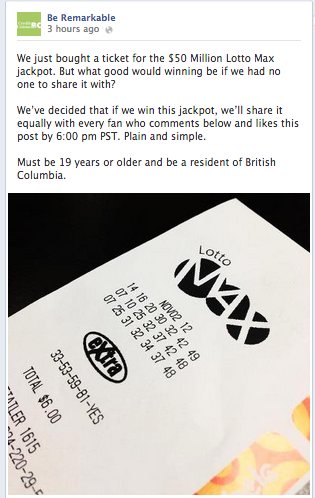
When it comes to incentives, nothing beats winning a $50,000,000 Lotto Max jackpot. When I stumbled across this particular post from Be Remarkable on my Facebook newsfeed I was struck with how simple, yet genius the idea was.  Within seconds of seeing my friend had liked the post, I followed suit and made a comment in the hopes of sharing in the prize.

The concept was simple: purchase a lottery ticket and if it happened to be the winning ticket the money would be shared with fans who engaged with the photo. But most importantly, the call to action was strong and beyond easy for users: just like and comment on the photo and you could share in part of the $50 million jackpot.

Sounds simple, but the results were pretty remarkable. Within a matter of three hours they had well over 6,000 likes, close to 4,000 comments and over 250 shares. Not only is that alone impressive, but what strikes me as the most strategic part of the campaign is how many people it has the potential to reach. I had never heard of Be Remarkable (a community for BC Credit Unions) before an old friend happened to like it and it appeared on my news feed, which I’m sure was the case among many diverse networks of people all across British Columbia and beyond.

It just go to show that overcoming the barrier to engagement on social media really comes down to appealing to consumers’ most basic desires. Generic calls to action may generate responses from a select few active “Creators”, however, in order to foster engagement within the broader community of social media “Spectators”, a good tactic is to ensure posts are simple, but with a clear incentive.

Although I never ended up getting a share in the jackpot, I can’t argue the fact that this was hugely beneficial for BC Credit Unions in terms of awareness and social media buzz. However, if the true aim of social media is to generate genuine engagement and develop meaningful relationships with their community of users, then this just seems like a cheap bribe.


Categories
Comm 464

We are ok. #Sandy

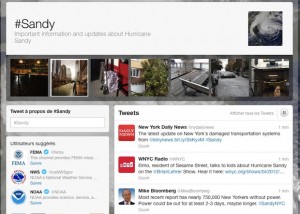
When it comes to crises online, usually brands want to avoid them at all costs; however, in the case of Hurricane Sandy, this was and still continues to be one major crisis where the power of social media needed to be harnessed to broadcast rather than downplay the situation.

Once power was lost in millions of homes on the east coast, there was little hope of staying updated through the traditional means of TV and radio, it was therefore up to social media to act as the connector and provider of reliable information. And boy was it put to the test.

On October 30th alone, #Sandy had more than 4 million mentions with an estimated reach of more than 3 billion Twitter followers. “Hurricane Sandy” was also the top phrase on Facebook in the USA with the top 3 phrases including “we are ok”, “power: lost power, have power, no power”, and “damage.” Instagram also played a huge role in creating a live visual documentary of events with the photo-sharing site racking up over 10 pictures per second with the hashtag ‘Sandy.’

While unfortunately there were quite a few jokes and rumors flying around on Facebook and in the twittersphere, what stood out the most was the true power and ability that these platforms have to connect people especially in times of need. Each site served a unique purpose, with twitter accurately providing real-time updates, Facebook connecting loved ones, and Instagram sharing the reality through touching visuals with the rest of the world. Each came to the rescue in their own way and continue to contribute to fighting and braving out this horrific natural disaster.

However, is it only in times of grave need that connection and the spread of a message can happen at such a large scale? Clearly the potential is and has always been there, this was just somewhat of a wake-up call to either learn how to swim in this social space or get lost in the deep end.


References: Facebook, twitter abuzz with hurricane chatter

Facebook Becomes Nation’s Hurricane Bulletin Board: “We Are Ok” is #1 Shared Term This Morning

Social media follows Hurricane Sandy’s destructive path

Categories
Comm 464

A look into the future of social media

Never be afraid to put aside a good thing to achieve a great thing.”

After attending a presentation this past week by Alfredo Tan (Direct of Marketing Solutions at Facebook Canada), I left with my mind spinning with ideas, inspiration and a better understanding of the evolution of how we as humans connect online. It was absolutely fascinating to hear directly from an insider from the company at the forefront of digital innovation, and after a couple of days trying to digest it all here are my top 3 takeaways:

1.    Put people at the center

We are now in an era of online authenticity where people are open enough to create genuine identities online. It is these people who are the driving force of what we as marketers do online and therefore they should be at the heart of all of our decisions. Facebook fans are the most valuable customers and the power they now have to influence their friends is astounding.

2.    Tell a story

The web is built around people, and there is nothing that engages people more than compelling stories. This has always been the case in human interaction, and is no different online. Social media platforms simply provide the opportunities for brands to thrive, then it is up to marketers to communicate their stories effectively to captivate their audience.

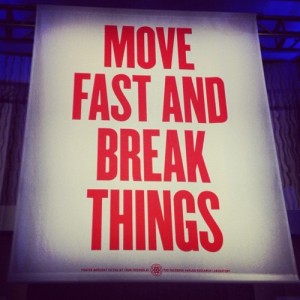
3.    Move fast and break things

In the world of technology, staying one step ahead of the game is not enough. Facebook has certainly figured out how to be a leader in innovation and one of the key reasons is because of their ability to move quickly and learn quickly. To quote Zuckerberg himself, “if you never break anything, you’re probably not moving fast enough.”

There is so much potential in the digital space, if only we have the courage to put aside a good thing and take the leap of faith to achieve a truly great thing.

Categories
Comm 464

Red Bull Gives You Wings – Literally.

“Red Bull gives wings to people who want to be mentally and physically active and have a zest for life.”

To say that Felix Baumgartner is an extreme athlete that has a “zest for life” is an understatement. This 43-year-old Austrian skydiving expert recently broke three world records, becoming the first person to break the speed of sound barrier in a freefall. More than 8 million people watched his livestream on YouTube and the jump was shown by more than 40 TV stations and 130 digital outlets, making it not only a huge success for Felix but more importantly for the company that was able to push the limits of traditional marketing: Red Bull.

While Red Bull is already known for sponsoring extreme athletes and events, the exposure and hype built up about the Red Bull Stratos was unprecedented. Not only was the online community going crazy over it (I mean come on, half of the worldwide trending topics on Twitter were related to it), but as a future marketer I was too.

216,000 likes, 10,000 comments, and 29,000 shares all within 40 minutes, well that is pretty darn impressive. But in my opinion, what is more impressive is how incredibly strategic this was for Red Bull as a brand. This stunt was not only completely authentic to their brand personality, but was also a literal manifestation of their brand message “Red Bull gives you wings”, not to mention was a testament to their creativity and ability to push boundaries.

In a world with so much advertising clutter (especially online), this was certainly a lesson to be learned on how to stand out and create extraordinary buzz. All it really takes is an engaging story and the courage to take a risk and to take a stand for what your company believes in. If you’re still not sold, well just take a look at this and be prepared to be blown away.

YouTube Preview Image

Reference: Red Bull Stratos May Change Future of Marketing,    Big Risk, Big Reward: Felix Baumgartner and Red Bull Deserve All The Marketing Buzz They Get

Categories
Comm 464

Pinterest’s New Rival

After just discovering The Fancy this morning I feel both shocked, delighted, and annoyed. Shocked that I have been missing out on what seems to be the future of online shopping, delighted that a site so perfectly thought out and designed now exists, and annoyed that this may just be my new favorite addiction (adios Pinterest).

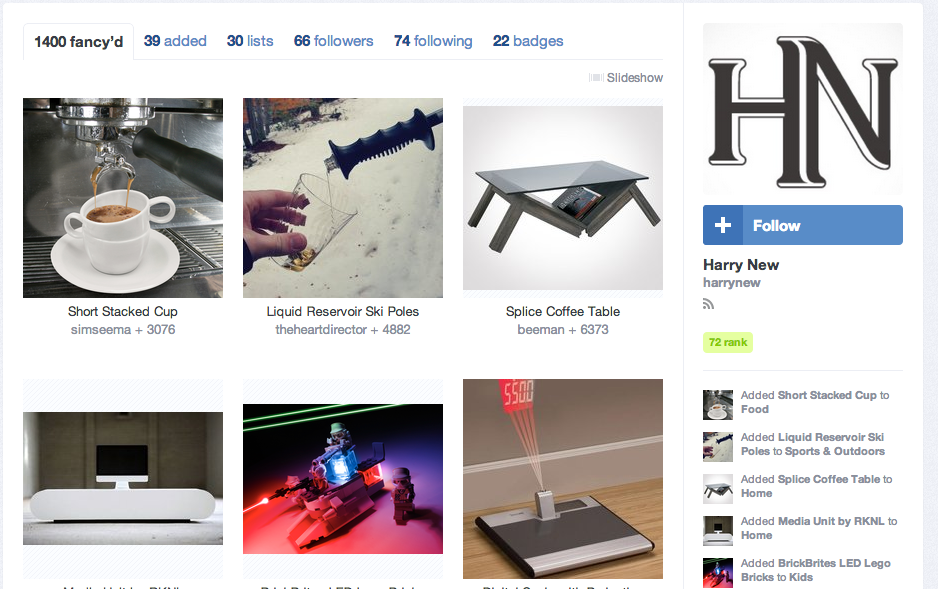
So what is this new site that has me so worked up? The Fancy is a platform very similar to Pinterest but with the unique feature that allows users to “fancy” items that they wish to buy and then directly purchase them. This site can be described as part wish list, part online magazine, part e-store and complete visual indulgence.

From a business and brand perspective, this click-to-purchase business model seems genius. Not only can users save the items they fancy to their catalogue and follow friends (similar to Pinterest) but they can also then purchase those unique items in a matter of minutes. Other unique features include a referral program that gives users credit when friends sign-up and make purchases, subscription boxes that for $30 send users $60 worth of products found on The Fancy site, and a partnership with American Express that gives users statement credits for purchases using their card followed by a tweet using the #AmexTheFancyOffer hashtag.

While The Fancy’s 2 million users mainly consist of younger women (between 18-24), I see huge growth potential both through adoption by other demographics and for brands who see this model as much more attractive in terms of direct ROI than platforms such as Pinterest and Tumblr.

Watch out Pinterest you may just have a new rival.


Reference: Viral Blog – The Fancy: The Future of Social Media?

Categories
Comm 464

Clicks Don’t Matter

Are click-through-rates really a thing of the past? Just try convincing marketers of that.


Facebook’s new undertaking to convince marketers that click-through rates don’t matter is, in my opinion, quite bold. To most marketers CTR is presumably a standard measure of an online ad’s performance, or has been to date. However, with new research from Nielson showing only a 0.07% correlation between high click-through rates and actual sales I could just be convinced.

It’s hard not to be skeptical of this messaging, since Facebook’s display ads typically get fewer click-throughs, but it does certainly make sense to look beyond the click. According to a study from Datalogix, 99% of sales generated from online branding ad campaigns came from consumers viewing the ads, not necessarily interacting with them. Which if true, does seem to make the point that we should be looking at performance not solely in terms of click-through rates.

Facebook is now recommending marketers look at creating value through impressions, maximizing reach, and figuring out the right ad frequency, all of which supposedly create a “clear roadmap to success for digital marketers” according to Facebook’s head of measurement and insights, Brad Smallwood.

I would argue that when it comes to social media there is no such thing as a clear roadmap to success. I do think while click-through rates have their advantages in terms of measuring direct response to ads, it is important to look critically at advertising objectives to figure out if perhaps metrics should be looking at targeting upper funnel measures such as awareness and familiarity with the brand.


References: Facebook to Marketers: Clicks Don’t Matter, But Reach and Frequency Do, Facebook Says It’s Looking Beyond Click Throughs

Categories
Comm 464

Putting Pinterest into Perspective

“Pinterest: where women go to plan imaginary weddings, dress children that don’t exist, and decorate homes they can’t afford.”

Ironically enough, this quote was found from a pin on a board titled “Define Pinterest – ADDICTED”. It made me laugh and at the same time caused me to reflect a little deeper on the underlying reasons people are so addicted to Pinterest and how brands can effectively capitalize on that.

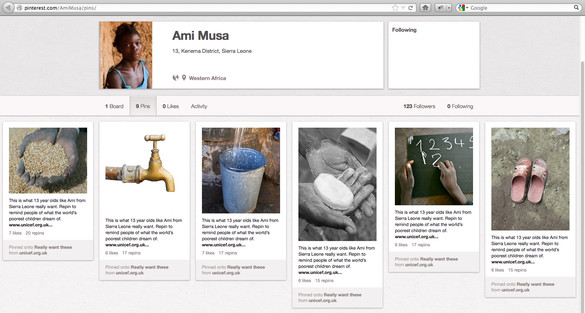
While many large companies such as Whole Foods, Sephora, and Honda and have found creative ways to capitalize on its addictive qualities and garner a following on Pinterest, one campaign in particular caught me by surprise. UNICEF, well-known as the leading charitable organization for children, recently created a Pinterest board that puts our first world materialistic desires to shame.

The page highlights a young 13-year old girl from Sierra Leone named Ami and only has one board “Really want these”. The only six pins on her board include fresh water, soap, and rice – certainly a stark contrast to the lavish outfits, recipes, and wedding rings most commonly drooled over by young women in North America. Users can repin her posts to spread awareness and can also donate by clicking on any one of them.

Not only does this put our wants and needs into perspective but shows that there are certainly interesting new ways for untraditional companies, in this case NGOs, to leverage the wide user base of Pinterest addicts and create strong word-of-mouth.


Reference: The (Intentionally) Saddest Pinterest Page in the World

Categories
Comm 464

Could Facebook Change The Way We Search?

As members of Gen Y, it is fair to say most of us have been conditioned to head straight to Google when we’re looking for specific information. But what if the next evolution of the search engine actually provided direct answers to our questions rather than just spitting out results?

That is exactly what Facebook’s Mark Zuckerberg has in mind and something which could eventually pose a significant threat to Google. Lucky for Facebook, Google has failed to create it’s own successful social network, leaving Facebook with the huge advantage of vast amounts of personal data (check-ins, photos, biographical data, stories published to friends, etc.) that could serve as the perfect means to answer specific questions rather than solely providing facts and links.

So what would this look like? While it seems doubtful that a separate Facebook search site will be launched anytime soon, it is certainly possible that Facebook’s current search bar could be improved to be able to include this added functionality. I mean how incredibly cool would it be if Facebook could provide answers to questions like, “What are the best restaurants my friend’s have visited in the past month?” or, “Which of my friends, or friends of friends knows that contact I met at an event last night?”

These are exactly the types of socially related searches that could be extremely relevant to people and something that Google is certainly missing at the moment. Investors and businesses are also particularly intrigued by the potential for increased ability for paid ads both in the search typeahead, as well as next to or above search results. And in my opinion, after quite the controversial IPO, this could be Facebook’s much needed solution to generate a totally new stream of revenues and help increase their stock price.

So what does this mean for marketers? This could be the perfect way to further tap into Facebook’s 845 million active user base by positioning ads at exactly the right time and place when people are hungry for answers and most likely to be influenced.

Reference:  http://techcrunch.com/2012/09/16/faceboogle/

Categories
Comm 464

Tattoo thinking

Everyday we are faced with hundreds of decisions. Some of them we make subconsciously, while others we contemplate for days. I bet you’ve rarely woken up one day and spontaneously decided to get a tattoo. This is obviously due to its irreversible nature, but when it comes to other not-so-permanent decisions why are we so hesitant to be bold and take risks?

I must admit I was quite refreshed after reading marketing guru Seth Godin’s blog “Tattoo Thinking” that proposed a new lens with which to view decision making from both a personal and corporate perspective. Although a tattoo is forever, most marketing decisions aren’t and the rewards can often be much more promising. The question he then begs is with higher benefits and lower risk, what are we waiting for?

There are now an overwhelming number of opportunities for marketers in the online realm and to say that things are quickly evolving is quite the understatement. So why are some companies still so slow to get their feet wet and dive in to things like social media (which may I add has been around for almost 10 years)? The potential to connect and engage in real time is significant and the best part is that mistakes are really just opportunities to learn, make changes and improve.

Online marketing is no tattoo, so no need to waste time. Ink your brand’s presence in the online space. It may only hurt a little but once mastered will be worth the while.

Spam prevention powered by Akismet