Categories
Analysis

What will happen to Big Tobacco?

The cigarette-smoking lifestyle has been on the decline. Earlier this January marked the half-century anniversary since Luther Terry, U.S. Surgeon General, himself a long-time smoker, announced that smoking cigarettes caused lung cancer and possibly even heart-disease. His brazen call for the government to act was an early catalyst for the results we see today.

Cigarette-smoking has by no means disappeared, but it’s a far cry from 50 years ago when lighting-up was fashionable and commonplace. Grocery stores, restaurants, hospitals – everywhere you went you could smoke.

Source: http://cigarettezoom.com/

These days we can’t smoke on aircraft and most places indoors, although the legislated standards vary. Attitudes have changed and smokers often find themselves almost apologetically explaining their desire to smoke to people who catch them in the act of lighting up.


A change of heart

Canadian policy since 1997 has been to regulate the sale of cigarettes and restrict its promotion (translation: hide them inside innocuous white panels behind the cashier). In the U.S., taxes on cigarettes have been lower and they are generally more available. American pharmacy CVS is now making waves as the first U.S. healthcare company to begin phasing out tobacco sales, putting an end to the absurdity of selling both medication and the cause of disease.

Even with cigarettes estimated to rake in an estimated $1.5 billion annually for the company, investors have responded well and CVS Caremark stock value went up the day after the announcement: a good indication of competitors making similar moves in future. Moral reasons aside, the shift in public sentiment against smoking has doubtless had a tangible effect on such bold corporate decisions.

Before you begin to feel sorry for Big Tobacco taking such a beating, keep in mind that such changes are not echoed everywhere. It is true that there are now more former smokers than current smokers; and the percentage of smoking Americans has fallen from 42% of total population in 1964 to just 18% today. However, Asia is a wholly different story.

In countries like Australia, the U.K., and Canada, public demand has pushed policy to reduce sales by raising cigarette prices, creating a strong incentive for tobacco companies to move to regions with less legislation and less resistance to a cigarette-smoking culture. Big Tobacco takes a look at the global market and sees 1,959 cigarettes being smoked per person in South Korea, 1,841 in Japan and 1,711 per person in China. Huzzah! That’s more than the odd 1000 being smoked in the U.S. and Canada. It also sees that Russians smoked upwards of 2,750 per person! Disappointment all around when it’s realised that new restrictions being phased in by 2014 will make it a less attractive market, leaving eastern Asia as a better target.


Dodging certain death

Devising one response strategy is not sufficiently hedging your bets in a changing market, so geographical re-targeting is not the only card being played. $4.4 billion (CAD) was the direct healthcare cost for tobacco-related illnesses in Canada, according to a report in 2012. Similar estimates for the U.S. put the number at $96 (USD) billion. The $750 billion industry is well aware that the taxpayer and the government spender are now united in the decision to reject tobacco products in their current form. Which is why in 2012 Philip Morris International spent $250 million researching “harm-reduction” programs that develop various types of e-cigarettes. With persistence comparable to that of celebrity stalkers, it seems Big Tobacco is not going anywhere, for now.


Sources:

CVS to become first major U.S. pharmacy to stop selling cigarettes (via Harvard Health Blog)

Who Smokes Most:  A surprising map of smoking rates by country (via The Washington Post)

Global study finds alarming rates of smoking in the Pacific and Asia (via Radio Australia)

Surgeon General’s 1964 report: making smoking history (via Harvard Health Blog)


Categories
Analysis

Why should Vancouver do better than 6th place on social media activity?

Agnes Mainka and colleagues over at Heinrich Heine University in Düsseldorf, Germany, published a study using findings from their examination of the social media services provided by the governing institutes of 31 major cities around the world. The cities all have advanced infrastructures and are informally classified as Informational World Cities.


Re-engaging our citizens

Vancouver places 6th, ahead of Toronto and surprisingly Tokyo, but behind such cities as Berlin and New York. With much of the younger population active on social media, such platforms can be leveraged by the city to tackle the disengagement of its citizens. In September 2013 it launched the Talk Vancouver citizen engagement community in collaboration with Vision Critical, which polls citizens regularly on topics in which they are interested.

We’ve come a long way since then. Just use the technology.

The study measured the types of social media service used by each city and the level of activity in each account they manage. The most common type of account used is Twitter with YouTube following close behind, but Twitter activity far outstrips that of YouTube. Barcelona is diverse and active on Twitter, Flickr, Instagram, Foursquare; plus they blog! Berlin tops the list  in activity but is almost exclusively on Twitter.


Future direction

Thus far, Vancouver is active on Youtube, Twitter and Flickr. Its activity on Flickr is on the higher end of the scale but on YouTube there is much left to desire. This is surprising for a city well-known as a go-to filming location for movies and television shows. Maybe the local talent ought to be leveraged to both promote the city and showcase skills that could attract revenue to help the city towards its ambitions Greenest City 2020 goals.

Citizen opinions on interacting with government on social media platforms vary by country. 31% of residents in South Korea and 42% of residents in India would like to use such services to engage the government administration compared with just 22% in the U.S. In Brazil, 40% would like to be involved with policy decisions through social media platforms versus just 19% in the U.S. The take-home message: growing cities need to leverage technology to keep citizens in the loop and satisfied with the direction of progress.


Sources:

Government and Social Media: A Case Study of 31 Informational World Cities

Why London Comes Last in Social Media City Rankings via MIT Technology Review

Vision Critical, City of Vancouver Launch Talk Vancouver, an Innovative Online Community via Vision Critical

Categories
Monthly Digest

What happened this January

This month:

Sleepy pilots, social psychology and Yahoo.


Sleepy pilots:

New FAA rules about pilot rest took effect in America, ones I’m quite surprised took this long to effect considering the well-known cognitive deficiencies of sleep deprivation. Lack of sleep is one thing we really do not want in the people who fly our aircraft.

He doesn’t look too sleepy. Must be caffeine.

In a move that will make unions very happy, pilots are now legally required to have 10 hours of rest of which eight hours must be uninterrupted sleep, in between their eight- or nine-hour shifts. This is an improvement of two hours more sleep than before, which did not even have to be uninterrupted.

Preventing sleepy pilots (Gulliver)


Social psychology:

A study that found that men for whom a door had been held open scored lower on self-esteem and self-efficacy immediately after. The authors put forward the explanation that holding open doors for men is a socially unusual action that suggests they look vulnerable.

In my city, people hold doors open for others all the time. I take it as a gesture of community and it would be a shame if people let it make them feel smaller. Maybe I shall examine the details of this further in another article.

Open a door for a man… (via British Psychological Society Research Digest)


Yahoo:

With Meyer at the helm, Yahoo is always hungry. It just acquired Aviate, an app that organises Android homescreens. It seems that Yahoo has recognised a problem many people seem to have: app overload. By offering the right information at the right moment Yahoo wants to be the solution to sifting through reams of unused apps, simultaneously reaming Google Now in the process.

Let the 2014 acquisition spree begin: CEO Marissa Mayer reveals Yahoo’s acquisition of Aviate (VentureBeat)

Categories
Monthly Digest

What happened this December

This month, updates from:

Alternative energy, natural resources and textile manufacturing.


Alternative energy:

Checking solar panel alignment prior to installation.

Solar energy accounted for 21% of new energy sources coming online this year. Also, manufacturing of these panels is moving east, to China, Malaysia and to some extent, the Philippines.

If the US solar business is booming, why are jobs in it declining? (via Quartz)


Natural resources:

At the end of another year resisting the Northern Gateway pipelines in British Columbia, there is growing recognition that Canada has failed to add value to its natural resources, choosing instead to extract and liquidate rather than consider long-term impact and alternative products.

Failure to add value to resource wealth chains Canada to its colonial past (via The Globe & Mail)


Textile manufacturing:

Bangladesh increases the minimum wage in the garments manufacturing sector from approximately $40 to nearly $70, as attention remains focused on a largely under-regulated industry and with lax legal enforcement. Global retailers insisted for years this would cause their sales to drop. The Bangladesh government believed any such measure would have retailers take their business elsewhere. So far, nothing like this has happened.

The Tragic Number That Got Us All Talking About Our Clothing (via NPR: Planet Money )

Categories
Monthly Digest

What happened this October

This month:

Robots that look like us, global trade slowing down, and the average male.


The average male:

We need reality to balance out the digital-fakery out there. Too many body-image issues are created by misrepresentation.

This Is the Average Man’s Body (The Atlantic)


Global trade slowing down:

The Bank of Canada said this week that an anticipated rise in exports never came. It now seems to be considering raising interest rates.

Global Trade Flows Show Exports Are No Magic Bullet (Bloomberg)


Anthropomorphic robots:

REEM-C and REEM

As they are made more and more like us, robots will increasingly be seen in places other than the factory floor. The traditional separation of humans and robots will slowly crumble away.

Making Robots More Like Us (The New York Times)


Categories
Monthly Digest

What happened this September

This month:

Microsoft and Nokia get cozier, the US government shutdown, and Big Gods


Microsoft acquires Nokia’s handset division

The mobile handset-maker that once was global king-of-the-hill, and is now relegated to just about 3% of the smartphone market, has been sold to Microsoft.

Where Nokia went wrong (The New Yorker)


US government shutdown

An economics professor at UBC answers some questions about the shutdown. For example: Why is this even happening? Because the Congress can’t agree on a budget while part of it tries to delay “Obamacare”.

Breaking down the U.S. government shutdown (UBC News)


Big Gods

A new book explores the question of whether cooperation among strangers increased because of the cultural spread of faith in so-called “Big Gods” that see everything and punish amoral transgressions.

Big Gods: How religion transformed cooperation and conflict (UBC News)


Categories
Monthly Digest

What happened this August

This month, updates from:

Human behaviour, health policy and (successful) climate change mitigation.


Psychology:

A recent Cornell University study found that intelligence officers compared to college students were more swayed by the framing of problems. The researchers say this is a sign of irrational decision making because the agents were more prone to “treating equivalent outcomes differently based on superficial wording.” In short, “they were more willing to take risks with human lives when outcomes were framed as losses rather than as gains.”

Read study details:

Intelligence agents more prone to irrational decision making than students (British Psychological Society’s Research Digest)


Health Policy:

Over several decades, the U.S. has relentlessly fought tobacco use. The smoking rate has been dropping for decades and this year reached a low of 18% among people over age 18.

Read more:

Tobacco Companies Hook New Smokers (Wonkblog)


Environment:

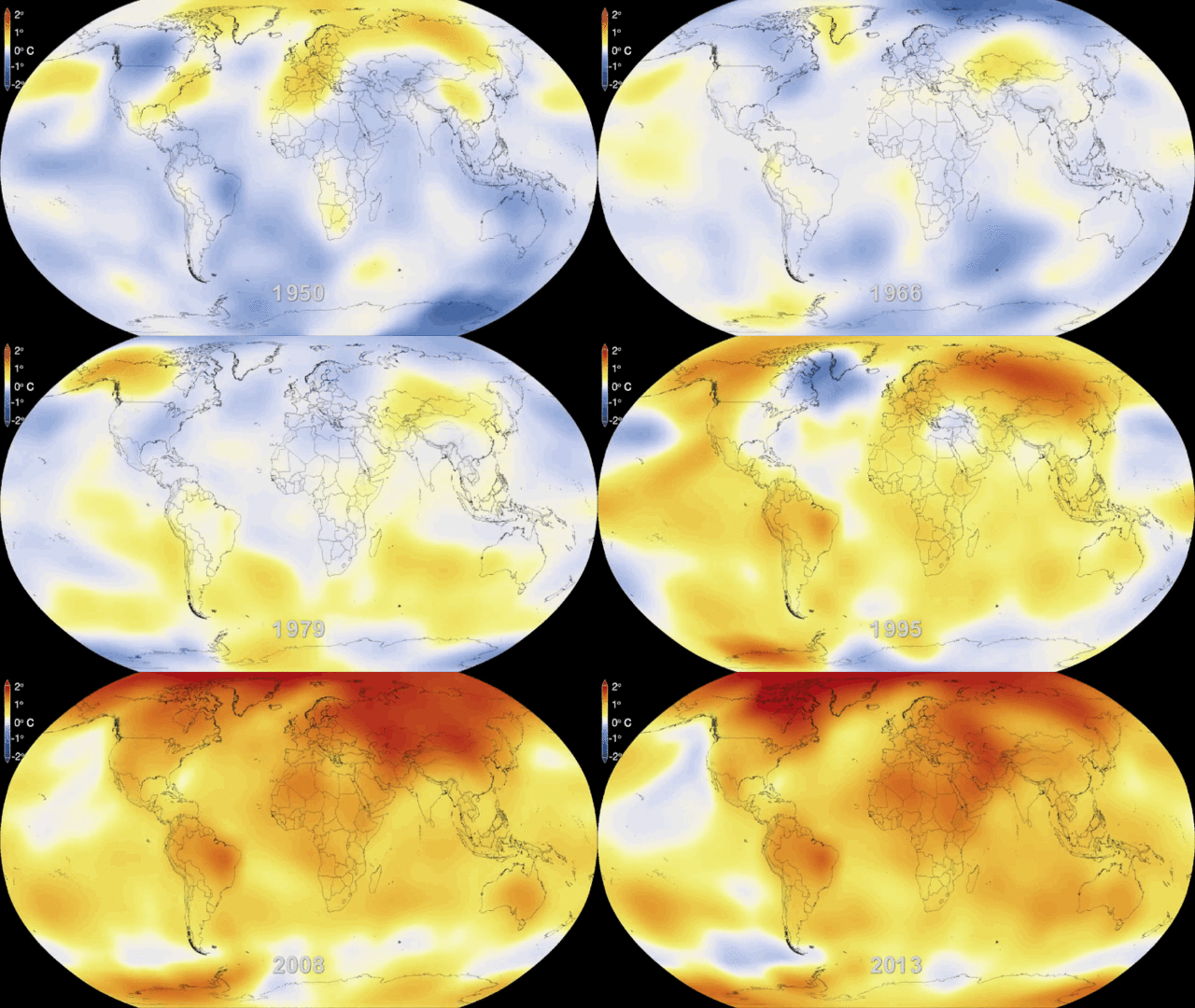
This visualization shows how global temperatures have risen from 1950 through the end of 2013.

The Montreal Protocol adopted by 196 countries to counter ozone depletion and its consequences is a success story of multinational efforts to mobilise and neutralise human harm on the environment.

Watch further:

How it works: Fixing the Ozone Layer (@AJEarthrise via Youtube)


Categories
Analysis

Vancouver’s YVR is Canada’s Most Efficient Airport

The ATRS Global Airport Benchmarking Report has identified YVR as Canada’s leader in efficiency. UBC’s Professor Tae Oum of the Air Transport Research Society (ATRS) reports that Vancouver International Airport charged airlines about $400 in landing fees for a Boeing 737-800 in the 2012 operational year, in contrast to approximately $700 at Montreal (YUL) and $2,000 at Toronto’s Pearson (YYZ).

The Air Transport Research Society was established in 1995 at UBC’s Sauder School to initiate research on air transportation. Its Global Airport Benchmarking Report was first released five years later in 2000. The report compares the operational efficiency and cost competitiveness of airports in North America, Europe, Asia and Oceania.

A US Airways domestic flight awaiting a cargo load at the gate.

The report indicates that higher efficiency airports are more likely to get a large share of total revenues from concession and other retail activities. Vancouver’s YVR receives 54% from such sources compared to 46% at Montreal’s YUL and 33% at YYZ in Toronto. Professor Oum adds, “We can also see that airports that outsource terminal services, ground handling and other services also achieve high efficiency.” The rankings are used by airport and airlines executives, governments, consultants, institutional investors and researchers and is reported to be the most comprehensive independent evaluation of global airport performance.

More efficient airports offer lower aircraft landing fees and reduced terminal services costs, allowing for the possibility that airlines pass on reductions on fare prices on to travelers. Airports with increased ability to do so are also indicated to receive a larger share of revenue from parking, office rentals, and real estate development. Vancouver charges airlines $14.11 per passenger, close to half that of Toronto which levies $33.34.

The stark difference in the price of seats on flights originating in Vancouver in comparison to those taking-off south of the US-Canada border, dampens demand and induces people to border-hop using cost-effective short-range buses (think Boltbus) in order to save on overall travel costs. The cost difference increases significantly when comparing long-distance intercontinental trips, with the airfare higher if the flight departs from YVR as opposed to Seattle (SEA), the closest international airport aside from Victoria, just of 200 km south of the metropolis.


Sources:

Global study ranks world’s most efficient airports (UBC News)

YVR top performing airport in Canada (Vancouver Sun)


Spam prevention powered by Akismet