Categories
Project Prospectus

Symposium on project-based and community-based learning

Inquiry Proposal – Dayonne, Kiran, Clayton, Natalia, Allison

Context:

We have learned that building a sense of ownership and relevancy for students is key to improving classroom motivation and meaningful engagement with materials. One area that we are all interested is in using project-based learning in which students are involved in long-term projects and are given the majority of responsibility for their own learning.  In addition, we would like to explore the idea of community-based learning in which students make connections outside of the classroom to enhance their learning experience. In this project our team will consider implementation of experiential, project-based learning, as well as building community links and partnership as a means of fostering ownership and relevance in education. We are all Language Arts teachers who would like to emphasize the human in the Humanities- the real-world application of reading and writing as a means for human connection.

Inquiry question: How do teachers implement effective project-based learning that connects classrooms with a broader community?

Subquestions:

Kiran: How can the use of literature in the classroom inspire students to become involved in humanitarian work?

Clayton: What are strategies for designing effective project-based learning environments? How can teachers support students in self-directed projects?

Allison: How can literature circles be used to build positive community both in and outside of the classroom?

Natalia: What are the different perspectives with regard to student-based learning? Why are teachers resistent in breaking away from the traditional teacher-centered model of education and what are the effects of this hostility ?

Dayonne: What are the challenges and benefits of involving language arts students in service-learning projects?

Goals:

1. Demonstrate the meaningful application of arts and humanities in
real-world contexts (Life Skills and Communication)

2. Provide strong rationale for alternative learning experiences. Connect
PBL with PLO’s and communicate value to variety of stakeholder.

3. Explore resistance to SBL and inspire future educators to pursue
alternative SBL projects.

4. Foster community links. Make space for learning outside of classroom.

5. Modeling real-world communities in online spaces.

6. Building positive community through group work and ongoing
self-evaluation of student learning, both academically and socially.

7. Foster understanding of broader social issues and empower students to
make a positive change/difference/impact.

Symposium Format

Doing research outside of class time (Field Work)
-Accessibility


The Living Breathing Bibliography:

Cubukcu, Z. (2012). Teachers’ evaluation of student-centered learning environments. Education, 133(1), 49

Freiberg, J.H. (2001). From tourists to citizens in the classroom. Educational Leadership, 54(1), 32-36.

Kain, D. J. (2003). Teacher-centered versus student-centered: Balancing constraint and theory in the composition classroom.Pedagogy, 3(1), 104-108. doi: 10.1215/15314200-3-1-104

Kelly, Deirdre M., and Gabriella Minnes Brandes. (2001). Shifting out of “Neutral”: Beginning Teachers’ Struggles with Teaching for Social Justice. Canadian Journal of Education, 26(4), 437-454.

Mitchell, Diana. (1997). Using Short Story Collections to Enrich the English Classroom. The English Journal, 86(8), 73-77.

Reupert, A., and Woodcock, S. (2010). Success and near misses: Pre-service teachers’ use, confidence and success in various classroom management strategies. Teaching and Teacher Education 26(6), 1261-1268.

Seixas, P. (1993). The community of inquiry as a basis for knowledge and learning. The case of history. American Educational Research Journal, 30(2), 305-324.

Watkins, C. (2006). Classrooms as learning communities: A review of research. London Review of Education, 3(1), 47-64.

 

Categories
Educator of the Week Monkey Messages

Educators of the Week

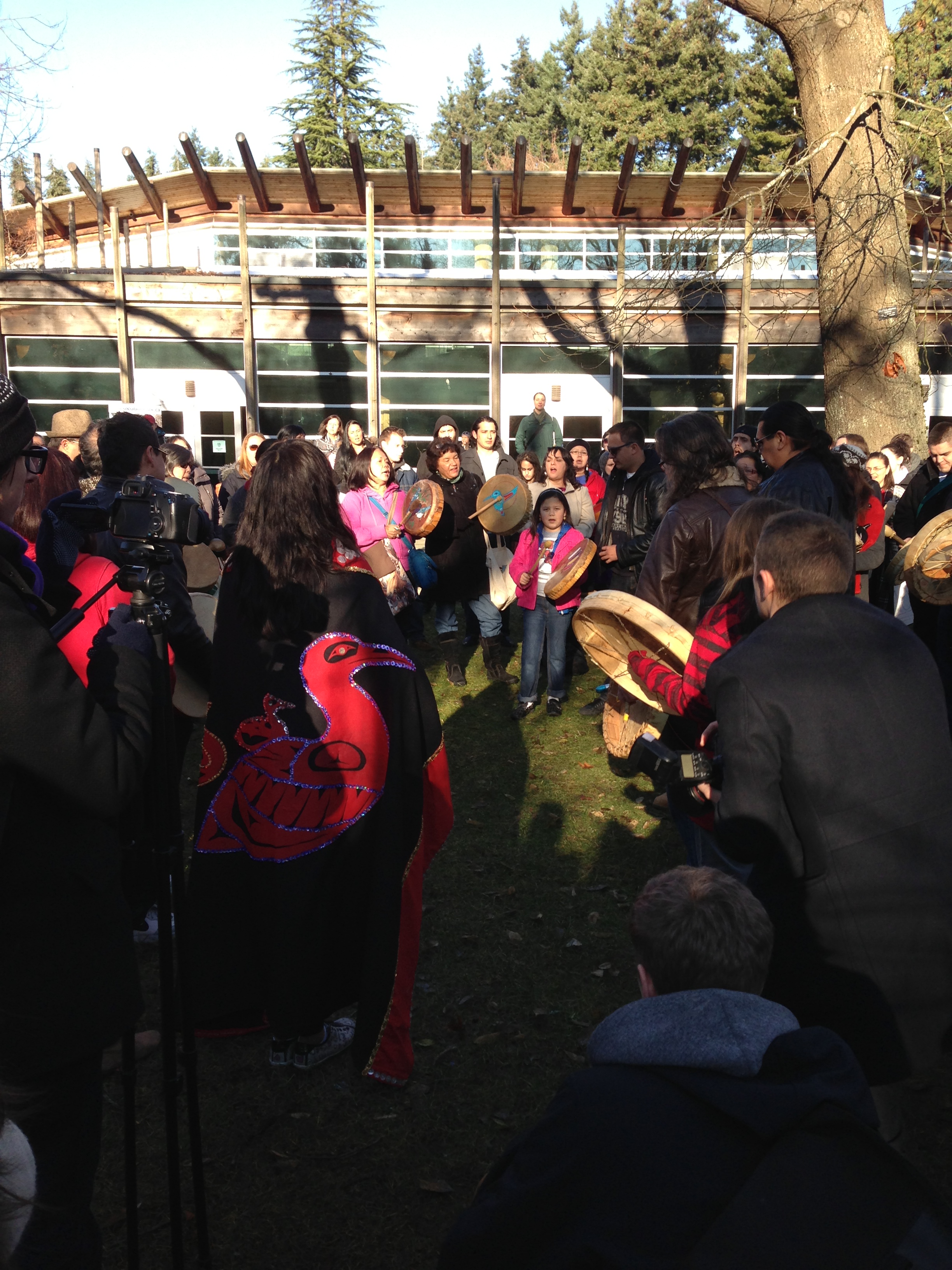
Thanks to the Musqueam people for wisdom and leadership, as well as for their ongoing generosity in hosting UBC on their traditional and unceeded territory.

Idle No More, First Nations House of Learning, Thursday, 3 January 2013.

Categories
Project Prospectus

Much Ado About Nothing: A catalyst for the exploration of gender inequality

For my inquiry project, I will be exploring literary criticisms of Shakespeare’s Much Ado about Nothing. I will focus on the central (and contemporary) issue of gender inequality in the play, and have already found a plethora of resources that provide excellent guidance.

I have decided to go this route because Much Ado about Nothing is what I will be teaching my grade 9 students, and I feel that issues of sexism and patriarchy will allow my students to see the universal and present day relevance of a play that was written hundreds of years ago. I also hope that through my research I will also be able to show my students, through my teaching, just how accessible Shakespearean literature can be. Furthermore, while some may argue that many Shakespearean characters are representations of weak women, I will argue that in Much Ado about Nothing, Shakespeare challenges the notion of societal produced gender roles through the characters of Hero and Beatrice.

As I have already mentioned, I have compiled a list of resources I will be using to aid my inquiry – the majority of which are scholarly journal articles. I will critically evaluate these documents and expect to conclude with the idea that Much Ado about Nothing is filled with copious examples of gender inequality, but that it is this sentiment that makes it an excellent illustration of a historical text that is very much relevant in modern-day society. I also hope to use my research towards modifying and perfecting my lessons for this play, with the end goal of having a well thought out and engaging unit plan.

*Works Cited attached in comments section*


Categories
Project Prospectus

Strategies and Methods for Teaching Holocaust Literature

In my upcoming practicum, I will be teaching Art Spiegleman’s graphic novel, Maus. Unlike many graphic novels which often focus on fantasy, Maus is a novel in which the author, Spiegleman, retells his father’s story as a Holocaust survivor. Given the delicate nature of the subject and the fact that it will be taught to a grade nine class with little prior knowledge of the Holocaust, it is of the utmost importance to teach the novel in a thoughtful and constructive manner. As such, my project aims to explore which methods and strategies are most effective for teaching the Holocaust so that students not only understand the social, political, and religious conditions which lead to the atrocity, but also the key themes of discrimination, survival, and family. (There are more themes, but for simplicity…) Additional issues that need to be explored include ways in which to present historical material: emotionally, or factually, as well as which supplementary materials to include.

In order to explore this issue, I intend to read and review a number of scholarly articles and book chapters which focus specifically on teaching Holocaust literature. Through this research I hope to create a theoretical and practical framework for a successful unit plan, which will include lesson examples to demonstrate the shift from theory to praxis. In all likelihood, the research will show that successful teaching of the Holocaust through literature requires incorporating additional first-person literary accounts, film, primary documents and artifacts, as well as survivor testimony, if available.


Spam prevention powered by Akismet