
Banana pancakes on a Sunday morning are the best thing in the world.
And maple syrup just made them even better.
Amen.

Banana pancakes on a Sunday morning are the best thing in the world.
And maple syrup just made them even better.
Amen.
Posted in Recreation, Wellness

Chose this icon just because I think it’s beautiful. Other things that have made me smile in the last week:
♥ Walking through puddles in the rainboots I got last year is still something sort of wondrous and delightful.
♥ Work is paying off! Feedback for the training weekends is turning out to be mostly positive — very much so, in fact.
♥ Ever heard of growing a bridge? Check this out!
♥ The free swing lessons offered by UBC Swing Kids on Tuesday night were such a great destressor. (If you’re interested, they offer classes on Thursday nights beginning next week, and AMS Minischool offers two classes Tuesday evenings.)
♥ My Musqueam language class is so much fun — we played Charades last night.
♥ Finally, an old, favourite clip of mine done by Rob Paravonian that always cheers me up on down days:
[youtube=https://www.youtube.com/watch?v=JdxkVQy7QLM]
Comments Off on Things I Love Thursday
Posted in Things I Love Thursday

What a flood of posts in the last few days — but I couldn’t ignore writing about the UBC Trek Program as yet another great opportunity to get involved.
The Trek Program focuses on connecting students to the community outside of UBC. Offering a number of volunteer positions in various schools and non-profit organisations based in the Downtown Eastside, Trek is an excellent way of breaking out of the university bubble and creating connections within the local Vancouver community.
Trek asks students to commit two hours a week for at least four months (one term). Having done a Reading Week Project at Grandview Elementary in 2008, I’ve wanted to make time for a more long-term commitment since, and have finally signed up as a literacy mentor. This was something I did in my first year through the One to One Literacy Society that I’ve missed.
If you’d like to be a literacy or maths mentor to elementary school children, these are always in high demand. There are also lots of positions in soup kitchens, working with the elderly, and in neighbourhood houses. Athletes and Science students are also always especially sought after.
If any of this sounds like something you’re remotely interested in, check out their website for more details and register for an orientation session! This will definitely be something different to what you experience on campus.
(Also, I think everyone who doesn’t hate children should do the Reading Week Project at least once in their UBC career.)
Comments Off on UBC Learning Exchange Trek Program
Posted in Involvement / Leadership

Over the summer, I had the excellent opportunity of interviewing a dozen or so applicants for our volunteer program. Sitting on the other side of the desk was a fascinating experience in finding out what an interviewer really sees and thinks. To that end, I’ve decided to put together a few of the most obvious, and yet most frequently unobserved, do’s and don’ts:
1. Arrive 10-15 minutes before your interview.
Being early indicates that you planned ahead and have good time management. While there is nothing wrong with arriving on the dot, it cuts too close to the chase for my comfort, and as for being late… well, let’s just say that an interviewer will notice if you are late.
2. Dress like you mean it.
One of the tips that Co-op taught me was to dress one level above the position you’re applying for. I personally prefer to go by the rule of dressing in business attire no matter what — the worst that can happen is appearing overdressed and ultra-serious about a position, which is no bad thing. Mini-skirts and flip-flops, on the other hand, are not appropriate interview attire, even for volunteer positions.
3. Do your research.
Be able to tell the interviewer what the organisation is about in more detail than what was indicated in the job description. Interviewers want to know if you’re serious about joining the specific organisation or if you’re just looking around for any opening that will take you. The more competitive the program, the more prepared you’d better be.
4. Always have questions.
Most interviewers will give you an opportunity at the end to ask them questions. Don’t say you don’t have any — this just reeks of general, uninterested applicant. I personally didn’t care if an applicant had a list in hand or memorised their questions, but I did mind if they never asked specific questions about the position, expectations, or what the experience will be like.
5. Send a thank you note afterwards.
While I always used to send follow-up emails to thank my interviewer and reaffirm my interest in the position applied for, I am now a converted believer in the power of the handwritten thank you card. One of my interviewees left me a card a few hours after I’d interviewed them, to my pleasant surprise and delight, and further raised my already positive impression of them. In a world where electronic convenience reigns supreme — and where, even then, no one else said thank you or sent any such follow-up — the extra effort goes a long way to contrasting you with your fellow applicants and making a positive, lasting impact.
Do you have any others that you’d like to share?
Posted in Careers / Work
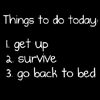
Last week, I accused my upstairs neighbour of acquiring a Clocky alarm.
Following an unfortunate incident this morning that involved a wonky toaster being left unattended for longer then expected because I had trouble re-entering the building and the single piece of toast inside becoming decidedly coal-like, I would now like to retract my previous statement and conclude that my said upstairs neighbour probably also set off the smoke detector in their room and was running around in panicked attempts to get rid of all evidence before the fire alarm for the entire building went off.
Lesson learned: Never leave the toaster alone. Also, possibly get a new one.
Comments Off on Let’s not meet Clocky
Posted in Residence Life
Blogged 2007-2012