Categories
Uncategorized

LOCKED OUT!

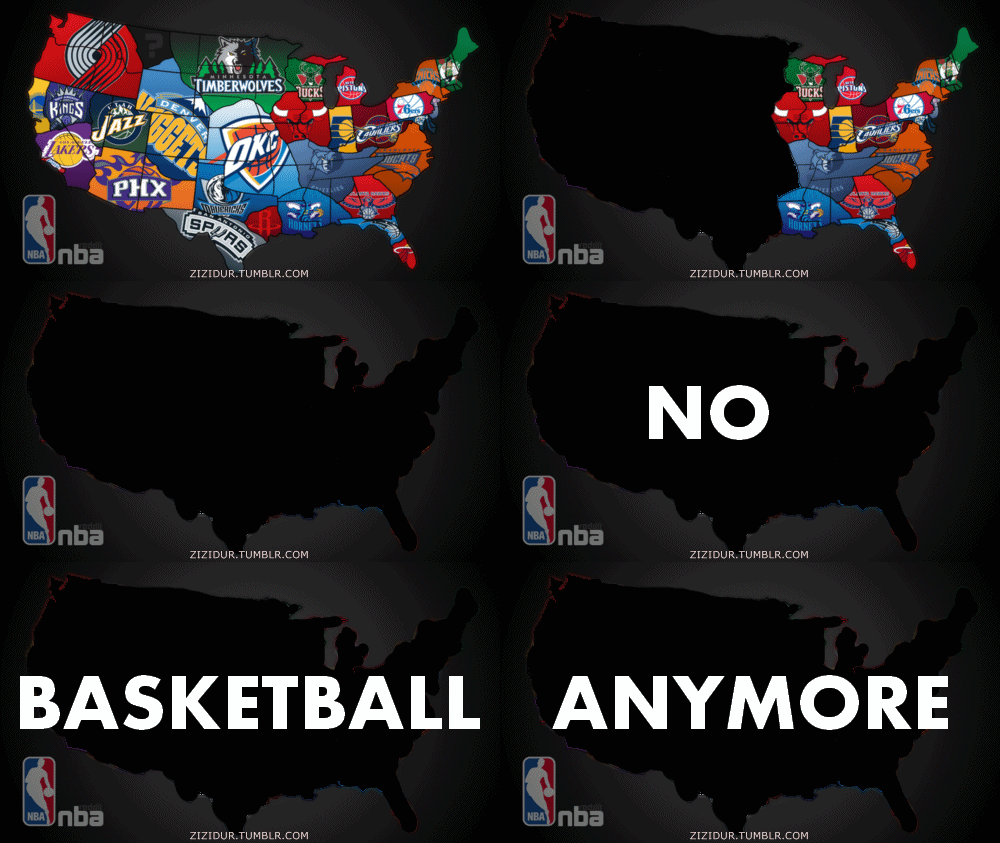
As a basketball player, Stephen’s recent post regarding the NBA Lockout caught my eye. In his post he talks about how the players would be the “losers” if the deal fell through as they ” will suffer more in terms of salary loss” in comparison to the owners.

Since his post [dated in October], both sides met for a few times in hopes of working out a deal. However, on November 14th it was concluded that all games through December 15th would not take place as the players refused the owners’ proposed deals and disbanded their labour union.

As a long time NBA fan, I am outraged. The league is proposing to replace the soft salary cap (58mil per team) with a hard cap (48 mil). Even though I understand the players’ refusal to implement these changes, but on average they have already lost $220,000 after missing the first month of the [regular] season. I agree with Stephen that the players are the losers here. They seem to forget that this is their job, and at the end of the day, if they don’t play, they don’t get paid.

Though the chances are slim, I am praying that a deal will be worked out and I can enjoy some games on Christmas Day.


Categories
Uncategorized

How Responsible Should Businesses Be?

Kevin Wong recently wrote a post about business ethics on his blog in which he questioned businesses’ right to allocate their investments “towards purposes that wouldn’t increase the return on their investments?” and profits “for social causes – without (the customer’s) knowing?” I agree with Kevin in that companies have no rights to support causes with their investor’s money or their revenue. However, I believe that businesses’ still need to find a way to express their interest in developing/maintaining social responsibility. A way for them to do so would be first finding a suitable and sustainable cause, notifying their investors of their degree of involvement, and then asking for their support. In my opinion, it is easier to find those who share similar values when requesting support (from both investors and customers), as they are more likely to provide financial assistance and less reluctant to purchase your product/service. An example would be TOMS Shoes, where the company has clearly advertised that a single purchase of a pair of shoes would result in another pair being donated to a child in Africa. Thus, it is more likely for consumers who believe in solving this problem (helping children in need) to purhcase a pair of TOMS as a means to support this cause.


Categories
Uncategorized

A New Idea: TV For the Blind

CEO Diane Johnson of Descriptive Video Works Inc. saw an opportunity to provide TV services for those who are visually-impaired. Her company provides video and audio descriptions with quality narration and production. For example, DV “plays on top of a show’s pre-programmed audio. “As a sighted person, we don’t realize all the nuances that might be missed on screen,” she says. “We might describe a scene by saying that a woman is wearing a red blouse, but what’s more important is that a woman is wearing a red blouse and has her back to the door.”” 
(Source: BC Business Article)

Diane is a successful entrepreneur because she took something as simple as TV and innovated it into a new product that is unseen and as as result, also created an entire new market with it. Her company has created a speed of wealth and experienced tremendous growth in the past year, with revenues increasing by 38 per cent and gross margin by 43 per cent.


Categories
Uncategorized

Downloading is Being Green.. Or is it?

The era of CDs has been long gone. For the past decade, the media industry has found a way for consumers to replace their buying habits with digital purchases. Music, movies, and even books and magazines can all be found online these days, and consumers have quickly adapted to these resources. The main two reasons why consumers have chosen buying digitally are the time saved from going into stores and the reduction of energy consumption it brings.

But what most consumers don’t realize is that their MP3 players (the ones they frequently replace) are made of heavy metals and toxic chemicals, which eventually end up in landfills. They also don’t realize the energy and carbon emission from the gigantic servers used to provide the platform. (with the size equivalent to football stadiums)

So even though the energy use and greenhouse emission of downloading music has less impact environmentally than music CDs, consumers need to take a look at the impact the use and disposing of MP3 players has on the environment.

This is rather interesting because consumers are often blinded by the limited information that is carefully packaged by the businesses and often don’t seek to explore further about the issue. If only consumers are willing to take the time to acknowledge the problem, their carbon footprints can be reduced even further.

Original article can be found here.

Spam prevention powered by Akismet