I was first introduced to the New London Group in ETEC 510 when I was designing a learning environment. My group used the New London Group framework and the four processes you listed in order to frame our project. I think that one think curriculum designers must understand is that all of these processes ARE achievable in an online learning context and once educators see that this is possible, then they will begin to see how important an understanding of multiliteracies is. Before I started this program I was unsure that an online learning environment could emulate a classroom learning environment. Now that I am almost finished the program I can see that it do so and also has made me more technologically aware – I suppose more technologically literate. As we move to relying more and more on the available information and communication technology, I am hopeful that teaching multiliteracies will play a more prominent role in literacy education.
Category: ETEC 540
Commentary #2 – In response to Michael Wesch’s video, “Information R/evolution” (Module 4)
Appropriately “hyper” for the purposes of framing hypertext and the changing technologies of writing and archiving information, Micheal Wesch’s Information R/evolution is a dynamic interplay of text technologies that incorporates both the hypertext discussion of Jay David Bolter and the organization discussion of Walter Ong. Wesch speaks to the evolution of the pre-typographic notion that information is “a thing… housed in a logical place… where it can be found” and how we have now moved towards a place where technology affords the ability for anyone to create, critique, organize and understand. Information R/evolution touches upon two interesting developments supported by the hypertext environment of our technological world: the nature by which information is stored and the nature of authority.
Information R/evolution starts out with images of the typewriter, standard filing cabinet and card catalogue. This is intentional as each of these three objects were, for many years, definitive symbols of the way by which information was recorded, stored and retrieved. In unpacking the information evolution, these images quickly transform into those of word processing programs, blogs and search engines. Wesch suggests that it does not take an expert to attend to organizational tasks; rather, we are all responsible for the tagging, bookmarking, categorizing and otherwise organizing of information. The organizational affordances of technology are illustrated in the video and echo Walter Ong’s discussion about categories and lists and how they create meaning out of space, impressing through “tidiness and inevitability” (Ong, 2002, p.120). Wesch illustrates this revolution as a true transcendence of place with regards to the means by which information can be rethought “beyond material constraints”. The ability to store information simultaneously in multiple places is not only crucial to the way information is stored but also crucial to the speed at which information is retrieved. Bolter (2001) further discusses this issue in his study of hypertext and cites hyperlinking as the process by which the reader can “continue indefinitely…through the textual space…throughout the Internet” (p.27). An interesting facet of Wesch’s video is that he does not rely on lengthy text to illustrate his point, rather, he demonstrates visually the remediation of print by modeling the organizational affordances of hypertext on a single computer screen, devoid of the paper trail that previously defined information technology.
The nature of authority is touched upon in Information R/evolution and it is suggested that the nature of modern typographic culture has broadened the constraints of previously established information authority (academics, librarians etc.). Information R/evolution raises the issue of how people, either for personal or academic purposes, come to find the information they are seeking and what format they are ultimately presented with. Simply put, “together, we create more information than experts”, is a powerful truth that highlights not only the responsibility of those posting on the web to categorize their information, but also the fact that authorship is seemingly more open. The boundaries of expert and non-expert were more defined in a chirographic and early typographic culture whereby there was an entire process surrounding how one became an author and therefore, an authority. Wesch encourages the viewer to think about authority in the context of this information revolution. While there exists scholarly access points through university libraries, Google Scholar etc., the mainstream user relies on search engines such as Yahoo and Google in order to find definitive sources of information. The breadth of information allows the viewer to view not only authoritative sites (National Geographic, BBC, etc.) but also collaboratively edited sites (Wikipedia) and personal sites (parenting blogs, personal interest sites, etc.) thereby creating a multidimensional approach to any given topic.
However, Wesch indirectly highlights the flip side, which is the uncertainty of the information found. The access itself may be much easier by being able to use one’s personal computer to access library catalogues and search engines rather than searching, in person, through an onerous card catalogue, however, the expanse of the web does lessen the power of established authority. Wesch cites Wikipedia as an example by stating “Wikipedia has 15 times as many words as the next largest encyclopedia, Encyclopedia Britannica”. While this is a seemingly simple statement, it has much larger ramifications for the growing debate about authority on the web, as Wikipedia is a collaboratively created encyclopedia that can be openly edited. More powerful than this statement is the fact that Wesch uses a live screen clip showing himself editing Wikipedia in “real time” and then adding one more person to the tally of the 282,874 contributors that appeared at the time, illustrating the very fluid and “living” nature of information on the Internet. While effective in drawing forth questions about authority and research, I would be interested to see Wesch explore, more closely, the nature of how one conducts research through a similarly styled video.
Bolter speaks of the “breakout of the visual” and in that spirit, Wesch shows that the dominating visual message of Information R/evolution can be just as powerful as written prose exploring the same topic. Wesch’s visual inspires reflective thought about the evolution of information but also the current revolution taking place in terms of information organization, conducting research and the nature of authority.
References:
Bolter, Jay David. (2001). Writing space: Computers, hypertext, and the remediation of print [2nd edition]. Mahwah, NJ: Lawrence Erlbaum.
Ong, Walter. (2002) Orality and literacy: The technologizing of the word. London: Methuen.
Wesch, Michael. (2007). Information R/evolution . Retrieved from https://www.youtube.com/watch?v=-4CV05HyAbM
View my research project here!
Writing directly on the web
I usually type my posts in MS Word and then paste them into Vista. Like you, I like the familiarity of the program but in addition, I like the “safety” of writing in Word. I know that my work will be saved within my own computer and only when I am really ready to unleash my thoughts on the public, will I paste into Vista. When I was in highschool, I used to always write my drafts on paper and then, when I was finally ready for the final product, would I type into MS Word. I see these two approaches as similar. I think the concept of a blog is changing this for people…. the idea that writing can exist as a direct stream of consciousness onto the web that is not necessarily polished is making it easier for some to go right to the endpoint in order to write. Social Media/Web 2.0 is taking a lot of the formalities out of writing in both a good and a bad way. Bad in the sense that many students seem to be losing grammar/spelling skills because of all of the online lingo but good in the sense that the process of writing itself is actually becoming easier for some students because they are so accustomed to pontificating on the web. The web is not the official place of formal writing but rather the place for anything and everything!
From my perspective, as someone who works with students that have learning disabilities, word processing has been a huge equalizer for those students with fine motor difficulties, dysgraphia or other disorders of written expression. The ability that students have to manipulate their words and be in a constant state of editing rather than churning out draft after draft, has made the writing process much easier for them. Being able to bold/italicize text, add bullet points, create charts in a matter of seconds has also made note taking a much less stressful process for these students as well. I know that there are critics who say that the reliance on computers is a bad thing in respect to the spelling and grammar abilities, but really, I think that word processing has made the learning process itself less onerous for these students and therefore “trumps” the issue of spelling and grammar. Bolter points to the issue of revising as being a huge affordance of a word processor and I agree – it is seemingly simple, but when we really think about the progression of the writing process, word processors have taken us a long way!
On to the web… and then back off?
I was reading this New York Times article about Pixable and it made me wonder if a similar trend will emerge in writing. Just as Pixable envisions getting images back off the web and into traditional photo albums, will technology provide the means by which we will get text back into tangible forms?
Writing spaces
A quick thought as I read through Module 3…. Bolter posits that “no technology, not even the apparently autonomous computer can ever function as a writing space in the absence of human writers and readers” (p.17). For me this sentence really brought some unity to the methods of writing cultures that we are exploring. From a generalized point of view, the writing tools and writing canvases change but the involvement of humans in the physical reading and writing has always remained constant. However, we remain as concerned with the foundations set in the past as we do of the pathway to future and in that regard, how will our definition of a writing space change in the absence of human readers and writers? If we can program computers to recognize words and read them and recognize voices and write (ie. Dragon Speak, Kurzweil 3000), then does Bolter’s statement still stand true when the computer is doing half of the work?
Commentary #1 – In response to: Ong-Orality and Literacy Chapter 3 “Some Psychodynamics of Orality”
Chapter 3 of Walter Ong’s Orality and Literacy addresses the characteristics of primary oral cultures in relation to residual oral, chirographic and typographic cultures. The crux of Ong’s argument in this chapter is that it is extremely difficult for literate people to truly understand the nature of a primary oral culture because understanding demands the complete suspension of knowledge regarding literacy. One of the most profound explorations within the chapter is the nature of traditional stories and characters and their relevance today, not only as immortal components of the storytelling culture but also as historical landmarks indicative of the orality or literacy of a time. Many of the classic stories modern literate cultures grew up with could be seen as lasting because of their abundance in print, but in actuality it is their ability to survive the test of orality that has solidified their place in history.
Ong explains that memory and the ability to repeat information without visual aids was crucial in primary oral cultures. Since “colorless personalities cannot survive oral mnemonics”, the description of people and events must contain bizarre figures, formulary number groupings and/or epithets in order to be memorable (p.69). These colorful elements that served as memory tools in oral cultures act as devices of fantasy for literate cultures; the same words play out differently as a result of levels of orality and literacy within a culture. Whereas such colorful descriptions would be part of oral rhetoric, they invoke the spirit of fantastical fiction, of fairy tales, myths and legends in modern literate cultures. Ong describes the nature of oral world as “highly polarized, agonistic… [defined by] good and evil, virtue and vice, villains and heroes” which supports the notion that these characteristics serve as mnemonic aids first and story elements only as residual effect (p.45). By invoking the likes of Mark Antony, Odysseus, Cyclops, Little Red Riding Hood and more, Ong draws upon characters that have withstood the test of time and forces the reader to examine them within the oral context.
If the opposite of agonistic name-calling in oral cultures is praise, then Mark Antony’s funerary oration confirms Ong’s assertions about the use of polarities as mnemonic devices. The lines directly following “I come to bury Caesar, not to praise him” are “the evil that men do lives after them; the good is oft interred with their bones” (III,ii). To a listener in oral cultures, these polarities have a sort of musical quality that commits the tune to memory, while to the reader, these lines are simply Shakespeare. Within the same short passage of Shakespeare comes multiple references to “honourable Brutus” and “ambitious Caesar”. In the true spirit of the oral world of both ancient Rome and 16th century Shakespeare, these mnemonic aids are indicative of the true content of an oration. In pointing out the origin of these subtle stylings, Ong lays the framework for a cognizant analysis of texts born from primary oral or residual oral cultures.
The importance of epithets is evident in the polarized oral world of heroes and villains. Ong refers to the presence of epithets as “formularly baggage which high literacy rejects as cumbersome and tiresomely redundant because of its aggregative weight”(Ong, 1977 as found in Ong, p.38). Modern conventions of English are weary of the kind of repetition that would suite an oral culture. However, it is an interesting feature of oral cultures that epithets were required in order to establish the foremost characteristic of an individual in order to make them memorable. Ong asserts that “once a formulary expression has crystallized, it had best be kept intact” although today, we might refer to this as oral typecasting (p.39). It is interesting that once an epithet or memorable expression is built up in an oral culture, it is almost impossible to escape. The nature of how oral communication dispenses means that it would be impossible to track everyone down who had heard something and correct their memory. However, literacy allows for the spread of the written word and while information is not erased in literate cultures, the dissemination of current information is much easier. A newspaper could proclaim a man guilty one day and then retract the next day and while a record would exist of both occurrences, the existence of a paper trail is the authority in changing appearances and opinion. Ong suggests that oral cultures kept oral epithets and formulary expressions intact because it would be very difficult to undo them under the authority of orality.
In literate cultures, Ong muses “you do not need a hero in the old sense to mobilize knowledge in story form” which is likely why stories that originated in a primary oral or residual oral cultures have a magical and fantastical quality about them (p.68). On the surface, texts and transcripts of facts and stories that emerged from oral cultures appear to have their own style, but Ong points out that the conventions of writing we abide by today were not in existence in oral cultures. Polarities provided structure in the oral world and Ong does an excellent job of unpacking the nature of communication in the absence of literacy.
References:
Ong, W. J. (2002). Orality and Literacy. London: Routledge.
Chapter 4 (“Writing Restructures Consciousness”) of Ong got me thinking about the role that distance plays in committing thoughts or spoken words to writing. Ong describes this process, almost like a burden by exclaiming that “you have to foresee circumspectly all possible meanings a statement may have for any possible reader in any possible situation” (p.103). The very fact that we are in the MET program means that we have put some thought into this – personally, I have compared this LMS contained learning environment to my face to face learning experiences and reflected upon the pros and cons of communication using both formats. While there is definitely something to be said for being able to engage verbally in an “immediate” setting, the writing environment that we engage in is no less calculated for the reasons that Ong mentions. Engaging in this digital setting (hopefully) means that writing will not disappear into archives but rather will be addressed because the web affords a “reply” button or comment box.
Earlier in the chapter, Ong says something about how writing was/is criticized because it “cannot respond” in the same way that oral environments afford (I believe Plato was a reference here). Now that we are moving from orality to literacy to digital literacy, I can see that a balance can be found in these critiques. This course has us committing our thoughts to writing but the environment in which we do so affords and encourages questioning and response. Not only can questions be asked, but conversing is recording and able to be referenced. The constraints of time and space that hindered oral cultures and the isolation and “silence” that is a part of the literate culture can seemingly be reconciled in a digital middle ground. Or perhaps this is too optimistic?
Invisible Ink
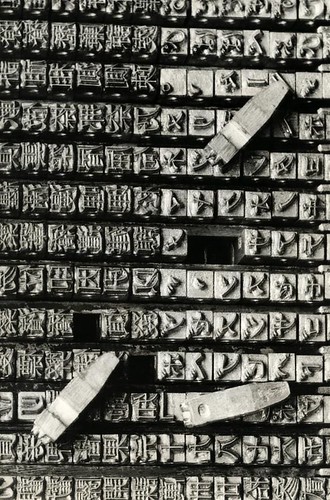
Japanse karakters / Japanese characters, originally uploaded by Nationaal Archief.
This image of Japanese characters caught my attention by mirroring my keyboard… in the past. These carefully crafted characters represent the painstaking process by which raw materials were transformed into symbolic characters which were in turn arranged to form meaningful text. Looking at the neat rows of letters on my own keyboard, I can see how technology has transformed not just the final product of texts, but also the mechanics by which we create text. The sophisticated technologies that have been developed since 1938 (when this image was taken) have removed the ink from the process of mass producing writing and have allowed the push of a button to summon and banish the components of text.