Categories
Pedagogy Practical Projects

Decolonizing Pedagogies Teacher Reference Booklet

Decolonizing Pedagogies Teacher Reference Booklet presents:

  • an overview what “decolonizing pedagogies” means;
  • how and why educational scholars and Indigenous educators suggest they be used to support learning in Aboriginal and non-Aboriginal education;
  •  examples of decolonizing pedagogies (especially in history education); and,
  • some challenges identified by educators and scholars in implementing decolonizing pedagogies.
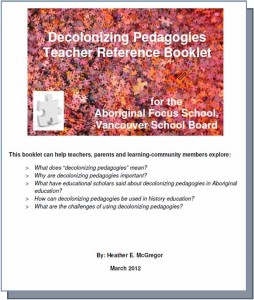
The project is based on a literature review using primarily Canadian sources, research that focuses largely on history education, and with reference to broadly/generally conceived notions of educational needs (rather than place- or community-specific). The booklet does not provide fail-safe formulas, but rather pieces of the puzzle that may help teachers, parents and learning-community members see a more comprehensive picture of connections between decolonizing education and making more space for Indigenous knowledge and pedagogy.

For a specific example of a decolonizing pedagogy, used as part of a grade 10 Social Studies module in Nunavut, see my blog entry “Material Traces & Decolonizing Pedagogies in Nunavut History Education.”

Heather E. McGregor

Categories
Healthy Schools

Health is Decolonizing the Spirit, Heart, Body and Mind

Health is a process of decolonizing spirit, heart, body and mind.  Understanding the history and processes of colonization and the effects on health and well-being (using a holistic model of health) is an important starting place when considering how to ensure current and future generations of Aboriginal youth will thrive as their ancestors once did (Waziyatawin, For Indigenous Eyes Only: A Decolonization Handbook, 2005).

Due to the history of residential schools and many other governmental interventions which have tried to destroy Indigenous cultures and peoples, schools are seen by some as an agent of colonization. Using a decolonizing lens to explore health and well-being in present day, we can identify ways to create healthy schools and communities that nurture rather than do harm; this involves learning about systems of wellness before colonization began, learning about the effects of colonization, and learning about present-day issues that continue to affect the health of Aboriginal people in BC and Canada.

Implementing the Vision: BC First Nations Health Governance is “an evocative documentary explaining issues in First Nations health and the efforts to address them.” Using a story-telling approach, the complex history and the progress in First Nations health in BC is told in four parts. In Chapter 1 – System of Wellness, some of the traditional philosophy of wellness are described by Elders and Aboriginal community menbers in BC:

Learn More: Resources

Spam prevention powered by Akismet