
Module 1 – Post 1: Reconciliation

As I no longer live in Canada, I am often unaware of events/national news. In this era of intense social networking, Facebook is usually my initial place for learning of things that are happening or being discussed ‘back home.’ Such is the case for the Truth and Reconciliation Commission. Friends, both Indigenous and non-Indigenous, have been posting about the TRC throughout this week on Facebook. Through my classmates in MET 521 and this weblog I have learned that this week is Reconciliation Week in Canada. The notion of a national week for reconciliation intrigued me and I began to read further.

I discovered Reconciliation Canada, a charitable project that was created as a ‘collaboration between The Indian Residential Schools Survivor’s Society (IRSSS) and Tides Canada Initiative Society (TCI).’ I am impressed to see an organization that is devoting itself and its work to the task of reconciliation. I am also incredibly interested in the importance that is being given to reconciliation. As a historian, I have studied many groups throughout the world seeking justice for wrong doings, recognition for mistreatment or simply an apology for what has been done in the past. To have created a group that endeavors to ‘engage people from every part of Canadian society in an open and honest conversation about our diverse histories and experiences in order to build vibrant, resilient, sustainable communities‘, is an inspiring step forward.

As my search continued I came across an article titled, “Reconciliation Week a chance for ‘critical conversations’ on colonialism” by David P. Ball. Initially I was interested in the reference to colonialism, but the article seemed to touch on much more.

The article begins by introducing Reconciliation Week and refers to testimony from residential school students. Ball notes that the final residential school closed in 1996. This astonished me. Historically speaking, 1996 is not that long ago. That a residential school still existed less than two decades ago challenges my own beliefs that residential schools were an archaic way of thinking and existed in a different time and a different mindset. To have one exist so recently, unnerves me.

Another key point of the article is the relationship between the TRC and prominent oil and gas companies. Ball points out that the TRC is sponsored by Kinder Morgan – a large oil and gas company. To some this questions the validity of the entire process of the TRC, to others it gives prominence and attention to an important step that has thus far not received the attention it requires. To me this echoes our discussions from last week on the cultural neutrality of technology and the idea of bias. The fact that someone, or a group, choose which information to include on a website, in an article etc. leads to biased information being accepted as truth.  The presence of oil and gas companies in the midst of the Truth and Reconciliation Commission can make on question their intentions and possibly benefits from being involved. Ultimately, this discussion on the involvement of these companies distracts from the main purpose of the TRC. It is not helpful to have the focus shift from truth and reconciliation to the intentions of oil and gas companies.

Although not easy to seek or achieve, a national movement for reconciliation is an inspired and important step forward. I hope that Canadians see the importance of having an open dialogue and are able to focus on moving forward.
Connecting Canadian Indigenous Issues to Viet Nam

Many of the struggles that Canadian indigenous people endure are shared by other indigenous cultures throughout the world. Since I am living in Ho Chi Minh City, I felt compelled to explore the current conflicts facing Viet Nam’s indigenous people.

In comparing the two indigenous cultures, I found there to be many similarities. Viet Nam’s indigenous people are marginalized and live in greater poverty than the rest of the population – as is the case in Canada. Throughout history, they have been discriminated against and treated as ‘second class citizens.’ There is also a significant disparity in education.

UNICEF recently conducted research in Viet Nam and discovered that “school dropout among ethnic minority pupils has become something like a predestined fate.” Even though the government mandates that primary school be free to all citizens, corruption runs rampant and many public schools will not accept students without bribes, which most indigenous families cannot afford. Due to poverty, most indigenous children feel pressure to dropout and begin working at a young age.

One notable difference between the plights of these two cultures may be the degree to which the government supports their freedom of expression. In one of our discussions, Keith explained that the Canadian government does not allow indigenous communities full Jurisdiction over their education system. In Viet Nam, the socialist government has full control over mass media, how information is portrayed and how its population is educated on the matter. This lack of freedom of expression certainly prohibits Vietnamese indigenous people from sharing their values, their feelings of bitterness or their stories of unfair treatment.

http://www.crin.org/docs/resources/treaties/crc.32/vietnam_indigenous_ngo_report.pdf

Intergenerational Impacts of Residential Schools

I would like to tread lightly on the topic of addictions, as it relates to Canada’s indigenous population. Deborah Chansonneuve has conducted research for the Aboriginal Healing Foundation and written an article entitled “Addictive Behaviours Among Aboriginal People.”

The article is well researched and includes several recounts from recovering clients of the Healing Foundation. These recounts suggest that addictive behaviours among Indigenous people are derived from this group’s strenuous history, and with the implementation of residential schooling.

One anonymous client spoke of how impacted she was by her mother’s experience in a residential school. Her mother had difficulty surmounting the anguish she felt toward mainstream society and was unable to support her own child emotionally. The client was therefore raised in foster and group homes for most of her life. Without a stable home environment, the client never learned how to express or manage her emotions – completing a cycle of abuse. The ultimate result was that she relied on alcohol as a means of ‘dealing with,’ or suppressing, her emotions. This correlates directly to what Dr. Lee suggested in his podcast, the idea that emotional awareness helps prevent addictions.

Evidence from Chansonneuve’s research has shown that “the most effective addictions prevention and intervention programming for Aboriginal people is grounded in the wisdom of traditional Inuit, Metis, and First Nations teachings about a holistic approach to a healthy life.”

The article outlines the impacts not only of residential schooling, but of other indigenous struggles throughout history, including the Metis resistance, the Indian Act of 1876 and the relocation of Inuit.

This article is informative and compelling. I would welcome anyone interested in the addictive behaviours of indigenous people to at least glance at some of the client stories it presents. It is well worth the read.

http://www.ahf.ca/downloads/addictive-behaviours.pdf                                                                **(pages 13-17 are particularly relevant to the topic)

Rabbit and Bear Claw: Teaching Indigenous Stories From an Insider’s Perspective

The topic of Canadian teachers teaching indigenous studies was brought up during this week’s discussion. I mentioned that it is difficult for some mainstream teachers to effectively teach indigenous ceremonies, customs and beliefs in their classrooms because not everyone can illustrate the spiritual element present in indigenous cultures. Heather also brought to light the difficulties facing mainstream teachers who are teaching indigenous students.

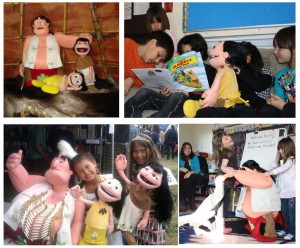
I met recently with a friend who has taught previously on a reserve in Northern Ontario. She described how difficult it was for her to be accepted and respected by the students. She also mentioned a man named Chad Solomon, who works for a company called “Little Spirit Bear Productions.” He travels to indigenous schools and performs interactive puppet shows that retell the traditional, oral stories of his ancestors. He has created two main characters named “Rabbit” and “Bear Claw,” who are the humorous heroes in these stories. Each story aims at building students’ character and encouraging them to be more mindful of how their behaviour impacts the people and nature around them. Some themes include bullying, greed, honesty and sustainability.

From my friend’s experience, Solomon’s teaching methods have been hugely successful. Even though most mainstream teachers would teach the same traits, indigenous students admire Solomon and respond more positively to him because he is from the culture, and not viewed as an oppressive outsider.

For more information about SOlomon and his project, follow the link below: http://rabbitandbearpaws.com/

Module 1 – Post 3 – A Sorry State

I strongly recommend taking the time to watch this documentary by Canadian filmmaker Mitch Miyagawa.  With a Japanese-Canadian father, an Aboriginal step-mother and a Chinese-Canadian step-father and three official Canadian government apologies to his family, he asserts that he has the most apologized to family in the country.  His exploration of his family history and the meaning of an apology is at times funny and light and at others very moving and heart wrenching.

http://ww3.tvo.org/video/184814/sorry-state

A couple of the conclusions he comes to are:

There is a difference between an apology and acknowledgement.  Sometimes, the acknowledgement is more important than the apology. 

Apologies are more about the future than about the past.  It’s about much more than just saying something. 

Apologies, acknowledgement, stories and all the memorials and other ways we have of dealing with the mistakes of our past, they aren’t about endings, they’re about beginnings. 

Module 1 – Post 2 – Margaret Commodore tells her story

In my previous post I wrote about the TRC’s BC National Event happening this past week in Vancouver.  In researching more about this event, I’ve come across blog posts written by a former journalist who highlights some of the stories that have emerged from the sharing circles.

This first one is especially meaningful to me because it describes the experiences of Margaret Commodore, who is part of the Sto:lo Nation and lives in my community.  In her testimony at the sharing circle she describes her abuse, how she suppressed it and the unexpected resurgence of the hurt roused by paintings that reminded her of the residential school.  She speaks of forgiving just about everyone, but not yet her abuser.

Margaret concluded with “I won’t apologize for my tears, because I deserve them.”

http://mickleblog.wordpress.com/2013/09/19/margaret-commodore-tells-her-story/

The next post from the blog author was entitled “Tears, but Laughter Too: Hearing from Survivors of Residential Schools”.  It followed a similar strain, highlighting some of the emotional testimony from that day’s sharing circles.  I won’t describe them all, but I thought I would include the paragraph that really jumped out at me:

“As many before her, however, she went on to tearfully apologize to her children for being a poor parent.  I was strict.  I didn’t know how to hug them.   After she got up to leave, her husband Rollie leaned into the mike.  She turned out to be a great grandmother he said.”

http://mickleblog.wordpress.com/2013/09/20/tears-and-laughter-at-the-trc/


The Truth and Reconciliation Commission – Module 1

Residential schools have left their mark on generations of First nations, Metis and Inuit Children, with over 150,000 individuals passing through these government-funded, church-run schools.  These schools eliminated parental involvement in the intellectual, cultural and spiritual development of Aboriginal children and in countless instances students were subject to emotional and physical abuse.  Today there is an estimated 80,000 former students living with the hurt that they suffered at the hands of the people her were charged with “educating” them.

As part of the Indian Residential Schools Settlement Agreement, The Truth and Reconciliation Commission (TRC) of Canada was established.  The TRC has a mandate “to learn the truth about what happened in residential schools and to inform all Canadians about what happened in the schools.”  “The Commission hopes to guide and inspire First Nations, Inuit and Metis peoples and Canadians in a process of truth and healing leading toward reconciliation and renewed relationships based on mutual understanding and respect.”

This past week saw the TRC’s British Columbia National Event running on the PNE grounds from September 18-21.  Throughout the 4 days there were a variety of both private and public sharing circles, information displays, videos, an Education Day for students, and a culminating Reconciliation Walk taking place today in Downtown Vancouver.

You can visit the TRC’s website here: http://www.trc.ca/websites/trcinstitution/index.php?p=3

First Peoples Principles of Learning

I taught as a teacher in a remote, First Nations community in BC for 4 years. During this time I have found there are some good, and some “not so good” resources that the Ministry of Education provides in the area of Aboriginal Education. One resource that applies to the topic of educational goals for First Peoples that I thought would be good to share is a publication by the BC Ministry called the “First Peoples Principles of Learning”. The principles outline the values in which many Aboriginal cultures place high and often differ from modern societal values.
First identified in relation to English 12 First Peoples, the following First Peoples
Principles of Learning generally reflect First Peoples pedagogy.
Because these principles of learning represent an attempt to identify common elements in the varied teaching and learning approaches that prevail within particular First Peoples societies, it must be recognized that they do not capture the full reality of the approach used in any single First Peoples society.
  • Learning ultimately supports the well-being of the self, the family, the community, the land, the spirits, and the ancestors.
  • Learning is holistic, reflexive, reflective, experiential, and relational (focused on connectedness, on reciprocal relationships, and a sense of place).
  • Learning involves recognizing the consequences of one’s actions.
  • Learning involves generational roles and responsibilities.
  • Learning recognizes the role of indigenous knowledge.
  • Learning is embedded in memory, history, and story.
  • Learning involves patience and time.
  • Learning requires exploration of one’s identity.
  • Learning involves recognizing that some knowledge is sacred and only shared with permission and/or in certain situations.

The document is available online at http://www.bced.gov.bc.ca/abed/principles_of_learning.pdf

References:

Aboriginal Education Home Page – BC Ministry of Education. (n.d.). Ministry of Education. Retrieved September 20, 2013, from http://www.bced.gov.bc.ca/abed/

Mod 1:1 Aboriginal Education

In 521 this week we reflected on the question: Educational goals: Are Indigenous communities different? The goal of education is to create well rounded individuals who contribute positively to society. I think that this is the goal of any of education system however the means by which we achieve our goals are different and the nature of the society we are contributing to may be different. It is easy to see that we are not achieving this goal with our current education system. According to the 2007/2010 Labour Force Survey, the dropout rate among First Nations people living off reserve, Metis and Inuit was 14% higher than non-Aboriginal people.

http://www.statcan.gc.ca/pub/81-004-x/2010004/article/11339-eng.htm

Our education system is doing things to close the achievement gap including specialized career training for aboriginal youth. Programs such as Harper’s Skills and Training for Aboriginal Youth  help First Nations youth get and maintain employment which is empowering for the individuals involved and for younger First Nations students who will benefit by having positive role-models and examples of success.

http://www.aadnc-aandc.gc.ca/eng/1371048149693/1371048172737 

Module 1 – Post 1: Residential Schools

Reading the Hare article pinched a nerve for me. It reminded me of a made for TV Canadian movie called Where the Spirit Lives (click to view in new window) which came out in 1989.  I remember my impression of the movie as a young boy coming to know the dark yet true past of Canadian Heritage.  As a Canadian born Chinese, who’s great great grandfather helped build the railroad, I think it made me somewhat more sensitive to this “painful legacy” that Canadians share.

Having watched the movie again in adulthood and learning about Indigenous Knowledge in Education, I think the film does a remarkable job in depicting what these schools were like, for students and teachers.  I’m sure much worse things happened that could not be presented in the movie, but it fits in with what Hare describes as “the denigration of indigenous knowledge that was embedded within traditional cultural practices, values, ways of living, and languages…and the inter-generational trauma it (residential schools) left for individuals, families, and communities.” (p. 98 & 101)

With my Christian background, it also saddens me how deceptive and powerful religious lies can be, and the danger of misguided zeal in many ‘missionary’ work – past and present. Well, I don’t have an answer for how we can learn from past mistakes, but as Lee Brown and Hare point out, there needs to be some kind of “nurturing of emotional, social, cognitive, and spiritual development” that promotes, rather than destroys community. And we are starting to really learn that the old industrial-age education model is outdated and needs serious reform.