Ephemeral Bodies
Ephemeral Bodies
VISA-582 & 583
November 20-27, 2025
FINA Gallery, UBCO
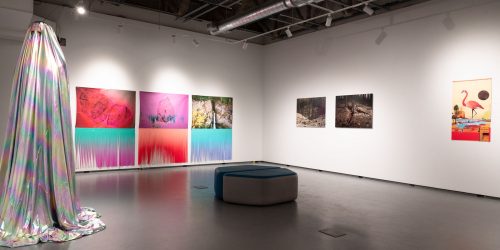
There’s something unique about the body. It absorbs. It senses. It glows. Although this exhibition wasn’t specifically curated around themes of the body, the idea has naturally emerged through the recent works of UBCO VISA Graduate students. The paintings, video installations, sculpture and digital media works presented in Ephemeral Bodies eloquently speak to what the body has to offer: pain, frustration, doubt, but also a sense of self and radiant energy.
Samuel Roy-Bois
VISA 582 &583 course instructor
alyené
Drawing on personal and familial histories alongside state archives and media, I reflect on how Indigenous identities and memories are shaped, silenced, and reclaimed. This project continues my work with archives and memory-making: can a memory be considered an archive? What forms does memory take within Indigenous worldviews? Through these questions, the project becomes a process of reflecting on the interconnectedness of time, relations, and connection to the land.
I am a PhD student and visual artist from the Sakha Republic with ancestral ties to both the Kolyma region and the central part of the republic, and I was raised in Zyryanka and Yakutsk. My practice engages themes of continuity, displacement, gaps, and absences within the cultural memory of the Sakha people and related Indigenous northern communities.
Sara Bursey
I am interested in blurring the lines between the external and the internal. I strive to give form to thoughts and memories, and to unveil complexities hidden beneath the flesh.
Sweet Nothings is an ongoing series of sculptures capturing how we collect and absorb pieces of others into ourselves through the process of loving and being loved. In short, how we become living, breathing collections of those ephemeralities. Each piece contains reproductions of items preserved from past romantic and platonic connections: parking receipts, chopstick sleeves, handwritten poems or letters. Together, they form a physical assemblage of lived experiences, lingering emotion, and indelible memory.
Spilling My Guts is a rag doll self-portrait responding to a stream-of-consciousness journaling session. It addresses notions of self-reflection, growth, forgiveness and sympathy for both a younger and current self. The figure is represented as if it has torn itself apart, bursting at the seams with so much emotion that it violently spills out. Her exterior lies peacefully, perhaps in relief, while her internal reality screams in desperation, pleading for someone to see the grotesque display before them and choose to hold her with care despite it.
These works invite viewers to reflect on their own internal worlds, to ask themselves what forms their ‘collections’, and ultimately to investigate the merit of what they have been preserving or deaccessioned.
Pegah Khor
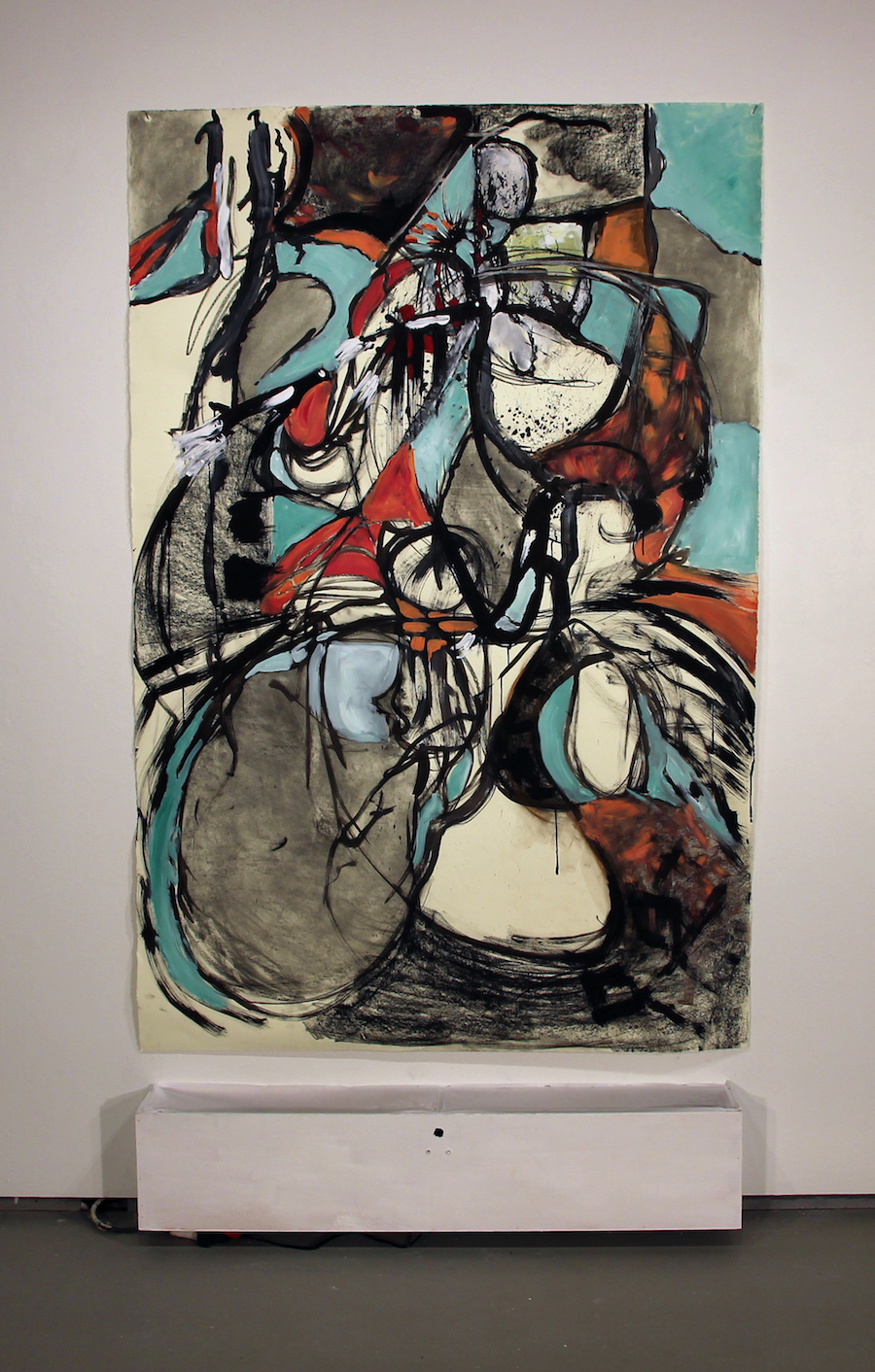
I speak of self-killing, over and over. I have torn through layers of myself, and each time I have reached a new part of who I am. When I speak of layers of myself, I can also refer to the layers of paper constituting my work, the ones caught between transparency and clarity, revealing and hiding. They seem afraid of being seen, yet they boldly scream their entire being. Still, they try to conceal parts of themselves. I exist in a psychological play with the viewer, a space of doubt, of uncertainty, of unfamiliarity that nonetheless feels tangible. My space is one of discomfort.
Space, as a central concept in my artistic process, remains a site for further exploration. In creating this work, my intention is to construct a space in which the viewer becomes engaged, sees themselves within it, and becomes part of that space. I no longer see my work as lifeless bodies, but rather as a living entity, one perhaps in the process of healing, or evolving into something new.
Wound is a visual translation of my grief. After losing my father and later leaving my home and country (Iran), I began to explore the capacity materials have to hold emotional residue. I am increasingly interested in how lifeless, partially destroyed papers could embody memory and emotion, or how torn and fragmented surfaces of paper could evoke the feeling of an open wound. These works exist in a space between presence and absence, speaking from a ponderous silence that follows separation and abandonment.
Samantha Wigglesworth
These research paintings are depictions of transgender and gender non-conforming individuals as forms of activism in a new chosen materiality. In the face of growing legislation across North America that restricts the rights of transgender people, my work aims to speak to the experiences of a marginalized group in a society that, at large, is working against them. As a queer nonbinary artist, I am committed to advocating for the rights and dignity of my fellow LGBTQIA+ individuals. Through the creation of portraits and nude paintings of gender nonconforming and transgender people I have come to know personally, I represent their powerful humanity in contrast to the dehumanizing and hateful surge of events they experience.
These works in this exhibition demonstrate and highlight the ongoing shift in my practice and approach, as my work is evolving as rapidly as the political climate. I have been working on cardboard boxes that I find, glue together and alter to create a support. Beyond the freedom and excitement this found material has brought, it suggests notions of displacement, a reality too often experienced by trans and gender non-conforming individuals. But references to motion go further: moving on, moving up, moving away, choice of moving, feeling immobilised, either physically or mentally.
David Zhen
My piece, Membrane, is a 3D video installation of two looped videos played on two television monitors. The piece discussed the themes of absurdity, isolation, and freedom.
Using 3D cloth simulation technology, I created a digital membrane that separates the figure within the videos from the audience. While the membrane obscures the figure’s facial expressions, I aim to express emotion through body language, showing anger and pain. The desire to break through barriers is met with futility; the first video is the emotional express of the second one.
The second video is a visual interpretation of the Myth of Sisyphus. It shows a figure also wrapped in fabric, struggling to climb upward, but continually sliding back. This situation is more hopeless than the myth itself: the figure’s limbs are restricted by the membrane, and he is isolated, unable to see or touch anything beyond a greyish void.
I am interested in directly expressing despair. The use of digital generation technology amplifies this feeling, as the digitally rendered fabric offers a sensation distinct from physical reality, therefore emerging as a material that can neither be torn apart nor cast off.