Categories
2.4 Six to Eight 6-12: Motor Skills

Motor Development

Although motor development (see full Glossary) slows down, children continue to refine their fine and gross motor skills. They are, in fact, quite energetic and need to move around quite a bit during the day.

GROSS MOTOR

(see full Glossary)

Most children at this age can:

  • ride a bicycle without training wheels (Fig. 1);
  • run very well;
  • stand on one foot for as long as a minute;
  • hop forward on one foot;
  • catch small and large balls from several feet away;
  • jump rope (Fig. 2);
  • combine two or more motor movements (For example: run and kick a ball at the same time);
  • perform somersaults (Fig. 3) and cartwheels (Fig. 4).
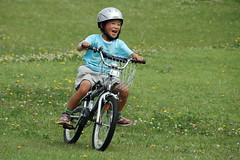
riding a bicycle without training wheels
Figure 1. Riding a bicycle without training wheels
jump rope
Figure 2. Jump rope
somersault
Figure 3. Somersault
cartwheel
Figure 4. Cartwheel

FINE MOTOR

(see full Glossary)

Most children at this age can:

  • write legibly;
  • copy words with ease;
  • hold a pair of scissors and cut complex shapes with it (for example, letters);
  • use the tripod position (Fig. 5) when holding a pencil or pen;
  • stay inside the lines when coloring;
  • type (Fig. 6)  sentences on a computer keyboard;
  • use an eraser without tearing the page;
  • tie a knot;
  • tie shoelaces (Fig. 7);
  • have good posture (Fig. 8) when writing.

tripod position
Figure 5. Tripod position

using computers

Figure 6. Typing

tie shoelaces

Figure 7. Tying shoelaces

good posture

Figure 8. Good posture

Did you know?

  • Children at this age engage in a lot of intense activities and require an average of ten hours of sleep every night.
  • A child’s muscles are much more coordinated at this age and he or she has good balance.
see References
Categories
2.5 Six to Eight 6-12: Social/Emotional Skills

Social/Emotional Development

SOCIAL/EMOTIONAL DEVELOPMENT

(see full Glossary)

Children between the ages of 6 and 8 are learning how to recognize and control (to a certain extent) their emotions. They are also learning to recognize the emotions of others. Temper tantrums are less frequent as children learn how to communicate their wants and needs, as well as their dissatisfaction, with words rather than actions.

SOCIAL

Most children at this age can:

  • have at least one best friend;
  • start to understand that others may have a different point of view;
  • enjoy taking on new activities and roles, but are still quite dependent on adults for guidance;
  • like to share toys and snacks with other children;
  • understand “privacy” (different cultures might view privacy differently);
  • ask for permission when they want to use an item that does not belong to them;
  • follow the rules, even if they do not like it;
  • are very affected by peer approval. They may do something they do not necessarily want to do, because of peer pressure;
  • share their thoughts and ideas with their peers, both inside and outside the classroom;
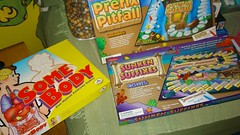
  • play simple card and board games (Fig. 1) with adults and peers;
  • enjoy cooperating with others and will play cooperative games where everybody’s role is important.
Board game
Figure 1. Board game

EMOTIONAL

Most children at this age can:

  • understand and express their own emotions (For example: “I am happy,” “I am angry”);
  • tell how others are feeling (For example: “Lucy is sad because her toy got broken.”);
  • do many things on their own, but may need help from others ;
  • be quite self-conscious (For example, they may worry that everyone is watching and judging them.);
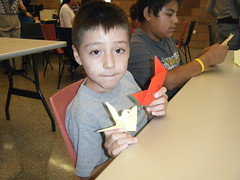
  • show off their work (Fig. 2) (unless not appropriate their culture to do so), and feel very proud of it;
  • exhibit some competitive and bossy behaviour;
  • receive positive feedback from others, and enjoy it;
  • have a fragile self-esteem, and may get overly upset if criticized.
Showing his work
Figure 2. Showing his work

Did you know?

  • It is very common for children aged 6 to 8 years to be afraid of the unknown such as death, failure or rejection.
  • Some children start to tell on others, in order to get adults’ attention.
  • Children at this age love to play board games. These make great gifts.
  • Children at this age are starting to be quite independent and it is important that you treat them accordingly. Make sure to give them responsibilities and chores to do at home.
  • They may not want to rest, even when they are very tired. It is important that you plan breaks for them.
see References
Categories
3.0 Eight to Ten 6-12: Academic Skills

Academic Skills

Academic Skills

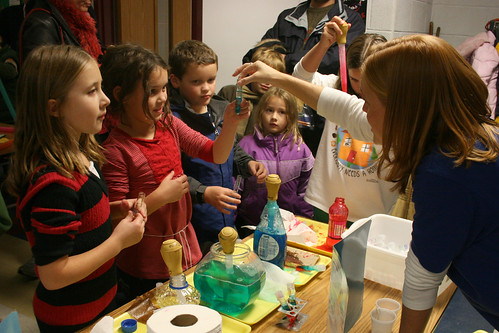
Between ages 8 and 10, children’s academic skills (see full Glossary) are developing and improving quite dramatically. They are now reading and writing, and for the most part they are enjoying it. They delight in their ability to read new and complex books, books without pictures, and even read stories to their younger siblings. At school, they are engaging in science experiments (Fig. 1) and going on field trips where they learn a lot about the world they live in. They become more and more independent, though they continue to need reminders to do their homework.

science experiment
Figure 1. Science experiment

READING

Most children this age:

  • read quite fluently, and for fun;
  • have a large vocabulary of sight words (see full Glossary);
  • guess the meaning of an unknown word from the context most of the time;
  • retell complex stories with a high degree of accuracy;
  • self-correct, when reading;
  • increase the size of their vocabulary, almost on a daily basis;
  • can summarize what they have read;
  • identify nouns, verbs, adjectives and adverbs in sentences;
  • use the dictionary.

WRITING

Most children at this age:

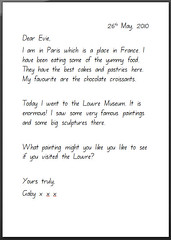
  • write long correspondence (Fig. 2);
  • write quite legibly;
  • spell familiar and unfamiliar words;
  • use punctuation to add meaning to sentences (for example, an exclamation point);
  • self-correct their writing;
  • may start to write poems;
  • can copy from a blackboard;
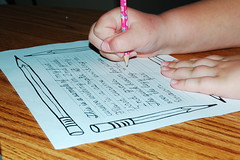
  • may start to write letters in cursive (Fig. 3);
  • may start to write email or text messages to their friends, and may even have a Facebook page.
correspondence
Figure 2. Correspondence
cursive writing
Figure 3. Cursive writing

MATH

Most children at this age:

  • add three and four digit numbers;
  • subtract three and four digit numbers;
  • use money correctly;
  • know how coins and paper bills are connected (Fig. 4);
  • calculate ahead of time how much a cashier will give them back in change;
  • tell time with both digital and analog clocks (Fig. 5);
  • measure in many ways (for example, using tape measures, containers, etc);
  • read a thermometer;
  • know basic multiplication;
  • start to learn about division;
  • compare numbers (which is bigger, which has more);
  • understand and use simple fractions;
  • know the difference between a shape and a solid (i.e. shapes are 2D and solids are 3D);
  • use basic statistical language (for example, “more likely to happen,” “less likely to happen”);
  • solve complex word problems ;
  • count down from two digit numbers (for example. 99, 98,97…).
coins and paper bills
Figure 4. Coins and paper bills
analog clock
Figure 5. Analog clock

Did you know?

Grade 4 is considered a transitional stage in the development of a child’s reading skills. It is described as the grade in which the shift from “learning to read” to “reading to learn” occurs.

 see References
Categories
3.1 Eight to Ten 6-12: Adaptive Skills

Adaptive Skills

Adaptive Skills (see full Glossary)

When a child is between 8 and 10 years old, basic adaptive skills are almost completely developed. Children are quite independent in their daily lives and rely very little on others for things like dressing and hygiene.
Children at this age can:

  • shower or bathe on their own;
  • clean themselves when they get dirty;
  • get ready for bed;
  • prepare their clothes for the next day;
  • brush and floss their teeth (Fig. 1);
  • dress and undress completely independently;
  • serve him or herself at the dinner table;
  • pour him or herself a drink from a jug at the table;
  • prepare a simple snack (for example, a peanut butter and jelly sandwich);
  • clean up his or her messes (may need a reminder or two).
brushing teeth
Figure 1. Brushing teeth
see References
Categories
3.2 Eight to Ten 6-12: Cognitive Skills

Cognitive Skills

Ages 8 to 10 years are a great time for cognitive development (see full Glossary). Although children at this age are still concrete thinkers, they are starting to toy with and understand abstract thinking (see full Glossary). They are able to multi-task cognitively and see the same concept, event, or item from many different perspectives.

Most children can:

  • pay continuous attention for about 20 minutes or so;
  • solve simple problems, independently;
  • solve complex problems with a little bit of help from an adult;
  • be very curious about situations and events around them;
  • know the difference between a fact and an opinion ;
  • know what is real and what is not (for example, Superman is not real, the postman is real);
  • have a tendency to exaggerate certain events;
  • observe and relate events with a large degree of precision (for example, will give lots of details about the class trip to the zoo);
  • classify objects based on three and four common characteristics (for example, will classify objects based on color, shape and size);
  • plan and carry out an “investigation” (for example, let’s try to see where all the cookies went);
  • identify different parts of a story (for example, this happened at the beginning, this does not happen until the end);
  • understand that things fit into small and large categories. This is called “class inclusion”.
  • use background knowledge to learn new things;
  • know which province (Fig. 1) they live in;
  • know the capital of their province.
map
Figure 1. Map of British Columbia and Alberta

Did you know?

Children at this age may overestimate what they are able to do. Please remember this when your child promises to do something and then does not do it.

see References
Categories
3.3 Eight to Ten 6-12: Language Skills

Language Skills

Children between the ages of 8 and 10 love language. They use it constantly and delight in playing word games.

EXPRESSIVE LANGUAGE

(see full Glossary)

Children at this age can:

  • include many details when describing their experiences;
  • delight in playing “morphology” games, such as finding the opposites (tall is the opposite of short), synonyms (small and little mean the same thing) and homonyms (the word skip has two different meanings: to jump and to miss out)
  • engage in complex and long conversations with adults and peers (if appropriate to do so, in their culture);
  • give complex but clear directions;
  • summarize a story;
  • use the regular and irregular past tense correctly;
  • use the regular and irregular plural correctly;
  • use figurative speech quite frequently.

RECEPTIVE LANGUAGE

(see full Glossary)

Children at this age can:

  • identify opposites (tall is the opposite of short), synonyms (small and little mean the same thing) and homonyms (the word skip has two different meanings: to jump and to miss out)
  • understand figurative speech ;
  • understand irony ;
  • follow complex multi-step directions.

PRAGMATIC LANGUAGE

(see full Glossary)

Children at this age can:

  • begin and end a conversation appropriately;
  • understand non-verbal (nodding one’s head in agreement) and para-verbal cues (saying: hmmm);
  • stay on topic during a conversation;
  • keep comfortable distance between self and others (if appropriate to do so, in his or her culture);
  • establish and maintain eye contact with others (if appropriate to do so, in his or her culture);
  • modify language, to accommodate audience (e.g. will often use much simpler language when speaking to younger children and pets).

ARTICULATION

(see full Glossary)

Children at this age can:

  • pronounce all sounds in their native language. A referral to a speech and language pathologist should be made if your child makes any sound substitutions in his or her speech.
see References
Categories
3.4 Eight to Ten 6-12: Motor Skills

Motor Skills

Motor skills (see full Glossary) are highly developed between ages 8 and 10, and in many ways, resemble the motor skills of adults.

GROSS MOTOR

(see full Glossary)

Children at this age can:

  • run smoothly;
  • walk on a balance beam (Fig. 1);
  • enjoy sports and may be part of a weekend sports team;
  • kick and catch balls of different sizes, from different distances;
  • perform somersaults (Fig. 2) and cartwheels (Fig. 3).
balance beam
Figure 1. Balance beam
somersault
Figure 2. Somersault
cartwheel
Figure 3. Cartwheel

FINE MOTOR

Children at this age can:

  • use real tools (Fig. 4) (for example, Dad’s tools or kitchen items) quite proficiently;
  • write legibly;
  • type complete paragraphs on the computer keyboard (Fig. 5) (if exposed to computers at home);
using real tools
Figure 4. Using real tools
computer keyboard
Figure 5. Computer keyboard

Did you know?

Children ages 8 to 10 years have a lot of physical energy that needs to be released. When planning their daily schedules, make sure you allow time for physical activity, every day of the week.

Categories
3.5 Eight to Ten 6-12: Social/Emotional Skills

Social/Emotional Skills

Social/Emotional Skills

(see full Glossary)

When a child is between 8 and 10 years old, friends (Fig. 1) become more and more important, and being part of a social group becomes a major goal in life. What they wear and what music they listen to become sources of pride or shame. It is important to keep in mind that these are stages that most children go through, some for a longer period than others. Eventually, most children come out of it.

Social Skills

Children at this age:

  • are highly social and usually have many friends;
  • are usually part of at least one social group;
  • enjoy playing complex social games (Fig. 2) that require keeping score;
  • may still prefer to be with friends of the same gender;
  • enjoy engaging in group work with their peers;
  • enjoy sharing their point of view with others;
  • understand a person’s right to privacy, but may spread a secret nonetheless;
  • may be a bit impatient when explaining something they know to someone who doesn’t know it;
  • may be a bit competitive, mainly because they have mastered a lot of skills (mainly academic) that parents value and they want to show them off;
  • usually able to resolve minor conflicts on their own;
  • understand and respect personal space (this is highly dependent on one’s culture).
friends
Figure 1. Friends
social games
Figure 2. Social games

Emotional Skills

Children at this age:

  • tend to be more resilient (see full Glossary) than they used to be;
  • may be highly critical of themselves;
  • have good impulse control (see full Glossary);
  • can identify and label their feelings;
  • can identify and label how others are feeling;
  • have a positive, but still quite fragile, self-esteem (see full Glossary).

Did you know?

  • Although children at this age have a better developed sense of self and are able to accept criticism, it is highly recommended that criticism would be given very constructively and very rarely. When a child this age makes a mistake it is best to redirect, rather than criticize because they still rely, quite heavily, on how others view them.
  • Despite the fact that they are now more resilient, they may give up on certain tasks very quickly. This may come from the belief that “if I can’t do it fast, I can’t do it at all”.
  • Morality is developing quite strongly and children of this age will often talk about “fairness” issues. Of course, often, what they consider “not fair” is anything they do not like.
  • Your children may accept suggestions from all adults around them, except you. This is perfectly typical at this age. They know that they still need help from adults, but want to show you how independent they are. As difficult as this may be, you must not take this personally.
 see References
Categories
4.0 Ten to Twelve 6-12: Academic Skills

Academic Skills

The ages between 10 and 12 years are an exciting time for academic skills (see full Glossary). Children are starting to think in abstract ways (see full Glossary) and they will soon be able to use complex terms, such as “democracy” and “freedom”.  It is a great time to be a kid!

READING SKILLS

Children at this age:

  • like to read;
  • read and understand complex texts well;
  • understand that books have different sections (For example, table of contents, index);
  • use the dictionary and thesaurus well;
  • self-correct when they make a mistake;
  • read and finish short books with no pictures.

WRITING SKILLS

Children at this age can:

  • write really well;
  • write long, complex and organized paragraphs;
  • self-correct when they make a mistake;
  • use punctuation well;
  • capitalize where needed;

MATH SKILLS

Specifically, children are able to perform the following:

  • solve complex multiplication problems;
  • solve complex division problems;
  • solve complex math word problems;
  • understand and use fractions.
see References
Categories
4.1 Ten to Twelve 6-12: Adaptive Skills

Adaptive Skills

By the age of 10 to 12 years, children’s basic adaptive skills (see full Glossary) are very similar to those of adults. They are quite independent when it comes to their basic daily needs.

Children at this age can:

  • bathe  or shower on their own;
  • dress and undress on their own;
  • prepare their clothes for the next day;
  • take good care of their personal hygiene;
  • clean up after themselves;
  • prepare a snack or a simple meal;
  • care for minor cuts;
  • manage their allowance (most of the time);
  • use a minor appliance (e.g. microwave oven).
see References

Spam prevention powered by Akismet