Categories
Do the right thing Multicultural life New Media Musings Whirling Dervish

Quick Tokyo Spin

commuters.jpg

The past weekend I took a brief trip to Tokyo, and it’s such an enormous, chaotic, mad elephant compared to our slow and peaceful existence in the Hokkaido mountainside. Oh yes, I was glad to come back to fresh air and quiet, but I really love Tokyo, too, for its vibrant energy and for its most excellent people watching opportunities. It appears as if some people in Tokyo have thrown off all their fashion inhibitions, and it’s great to see the results, like men in glittery ballroom gowns and horn-rimmed glasses and teenage girls in French Maid costumes with green knee socks and yellow platform sneakers.

I attended a very hilarious and moving documentary, “Recolonize Cologne,” by Sun-ju Choi, a Korean ex-pat director in Germany, about Germany’s colonial history in Africa and about the mistreatment of immigrants from Cameroon. It was part of the Refugee Film Festival, held at the Swedish, Italian, and French Embassies.

One of my favorite parts in the film was where she cleverly used Lego characters to re-enact the invasion and deceitful tactics of the German companies/government in Cameroon – adding irony and wit to what was a horrible and inhumane campaign. She managed, with a low budget, to capture the innate idiocy of claiming superiority over others.

I also loved her idea to have the main narrative involving an impromptu public performance of a Cameroonian German, who was carried through the Cologne streets in a makeshift throne, shouldered by stereotypical, blonde-haired Germans, acting as a reincarnated Cameroonian king. The King then staked claim to a small part of the public square, with those velvet ropes seen in movie theaters, and named it the Nation of the Multitudes. He then passed out his nation’s universal passports to the bemused and puzzled crowd, declaring them free to travel, work, and live wherever they wished in the world.

Along with the passports, his ‘servants’ passed out hot potatoes wrapped in tinfoil to the onlookers as well because, his ‘page’ announced simply, “we know Germans like potatoes.”

I just looked for an English link on the film, but only found one in German, but I did discover a multilingual site working on the behalf of migrants and refugees in Europe here.

Categories
Ainu rights New Media Musings Poems & art

Reminiscence

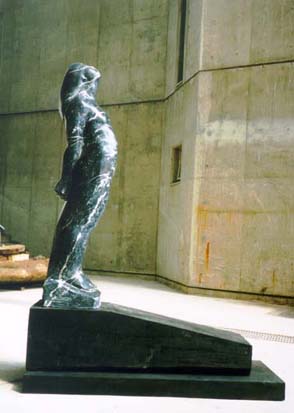
Reminiscence.jpg

This piece was made by the sculptor, Mikako Tomotari, in dedication to the Ainu lands submerged by the Hokkaido government-sponsored dam in the Nibutani area of Hokkaido. Her comments and then comments on her comments (in English) are here.

She had wanted to throw it into the waters, so that only by the elimination of the dam could it be revealed to our eyes.

I think I read somewhere else that it was set near the damn instead, though.

Her sculpture demands that we re-think how so-called technological developments impact our land and the people who live on it (though, to be honest, no one really knows the benefits of this particular dam, besides the construction company and maybe the pockets of a few politicians, since its reason to exist–a proposed industrial park–never came to be).

In a similar way, I think I am trying to use the classroom as a space for some Ainu people to meet and speak with the primarily wajin university students. By listening to other ways of seeing, we have the chance to deepen and expand our ideas about how to live and why we live.

This week we watched the film, BARAKA, in class, which also celebrates the beauty of our world and at the same time unites us as fellow humans trying to make a life as best we can for our short time here. One student said he understood better how Japanese Zen Buddhism must seem odd for others not from Japan, and he imagined it must be how he felt when watching the scene in Bali of the Javanese men moving and singing in synchronicity.

For me, I realized again that the power of seeing up close the eyes and faces of other humans, and even the faces of animals (in the film there is the close-up of the snow monkeys in Japan, and one old monkey in the hot spring meditates, with his eyes slowly closing, just as any human would). In these unedited close-ups I feel the connection between us, no matter how different we may seem superficially.

Maybe our world leaders need to watch this film for 3-days-straight, without food or water. Would they then re-emerge more aware of the world’s interconnectedness, more in-tune as to how a death–even if they wish to soften it by calling it ‘collateral damage’– happening way over in another country due to their policies impacts the entire planet, impacts everyone’s quality of life? We are all diminished by the deaths of war. Do they care how their decisions design so many deaths and so many miseries? I think they will all realize it someday, preferably long before their eyes glaze over in that last moment of awareness, and I hope they can alter their ways.

I sound a tad grim perhaps, but I am not feeling grim. I just wish for more sanity and love. Today, not tomorrow!

Categories
Do the right thing Multicultural life New Media Musings Reading Minds

Exploring new ways of seeing

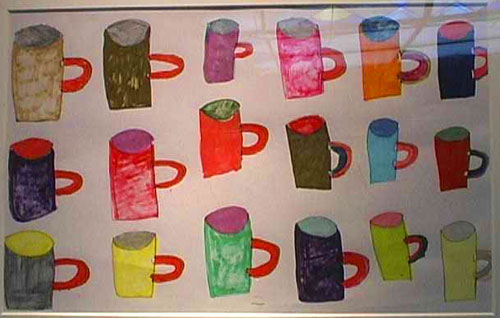
cups_libraryexhibit.jpg
anonymous artist – Outsider art exhibit at local library

I haven’t had the chance to get to this place lately. Been traveling about and reading books on the treatment of the peasant class during the pre-modern and modern era of Japan. Once again, I am opening my eyes wider to what is in the hidden history of Japan and starting to recognize important interconnections with the history of the Ainu here in Hokkaido and to the poor all over Japan and, ultimately, the world.

It seems to me quite obvious that the controlling power base tries to define as many differentiating (and often arbitrary) characteristics of others to weigh in as losers against their own perceived supremacy of group characteristics in order to justify the continued unequal and inhumane treatment of those ‘undesirables.’

The undesirables are meant to stay undesirable, in other words. Thus, the under-class has a role, it seems in part, to keep the elites feeling superior and justifiably self-righteous.

I have always found social history much more fascinating than the standard fare drilled in young minds. The book I mentioned I am in the process of reading above is Peasants, Rebels, Women, and Outcastes by Mikiso Hane. He argues that the road to modernization for the majority of Japanese was slow, and wretched, filled with disease, starvation and discrimination. I recommend it, but of course it won’t be a cheerful read! More like a bucket of ice water thrown on a sleeping bear.

I also met a woman scholar yesterday who trained at SIT in Brattleboro, VT, and is now an intercultural trainer. She built a website recently to open the dialogue up within Japan on multicultural issues. It’s entirely in Japanese but here it is! I was thrilled to see this sort of positive action being taken within Japan.

Categories
Ainu rights New Media Musings

Learning Ainu Language via Online Archives

Radio Archive of Ainu Language Lessons

Sapporo TV Radio hosts an Ainu language class with accompanying textbook (which you can order) every Sunday morning, from 7:05am to 7:20am, and repeated Saturday evenings from 11:15-11:30pm. They also have the lessons archived on Real Player audio files since it began in 1999.

A look at one lesson (November 20) showed the example of the grammar “Where are you heading/going?” I found the example answer they will teach quite strange:

Ex.: Where are you heading/going?
Answer: We are heading/going to a splendid (beautiful) village.

I don’t know about you, but this sounds not only awkward to me in English, but also in Japanese–I am not prone to say I am going to a splendid village, are you? See the below script:

1 エノン エソイエネ?
  enon  e=soyene?
  どこへ あなたが外へ出る
  (=どこへあなたは出かけるの?)
Where are you going?

2 ピリカ コタン オレン   パイエアン。
  pirika kotan or en    paye=an.
  立派な 村   のところへ 相手を含む私達は行く
  (=立派な村へ私達は行く。)
We are going to a splendid village.

I need to see if all of the lessons are as arcane as this. It sounds like we are learning to speak ‘fairy’, not Ainu. Could this language lesson actually be just another act of ‘othering’ conducted by the Wajin (mainstream Japanese)? It seems to be teaching the Ainu language as an archaic, lost romantic language. True, few native speakers remain, but does this lesson give their language justice? I don’t know the answer yet; this site was rather disappointing to see at first glance….

Categories
New Media Musings Reading Minds Space is the Place

What the BLEEP do we know?

I finally had the chance to sit down and watch a film I had read about in my New Media class discussions.: What the BLEEP do we know?, which is a sort of self-help film but also a film about quantum physics, too, and I liked it, and this is not without a critical eye, but because it talks about tough things: like victimization, the cycle of negativity, and how we could be following the path inward toward knowing who we are as humans. Such things not normally talked about in mainstream media or societies these days. Of course, the film simplifies it (108 minutes cannot explain a human life at all), but at least it draws us to question how we accept our lives as ‘fate’ and asks us to become more active in our designing.

It wasn’t a film anyone entrenched firmly in any one organized religion would like because it questions the static and rule-based limitations these religions use. It puts responsibility and action and agency square back into human hands, and says we design our lives in concert with the larger interconnectedness of the universe; that is, we are creative actors.

I was most interested in how the human cells have receptors for chemicals produced in the hypothalamus, and as the cell divides it produces more receptors for those commonly used chemicals associated with our emotions (love, empathy, sexual desire, anger, self-pity, despair, or whatever) and less receptors capable of taking in nutrients, minerals and proteins needed for our health. Thus, if we continuously feel negative, our physical cells will create more receptors to meet that demand of a need for negativity–thus we fulfill our sad design/destruction. I would like to start using this idea to lessen those negative ideas, and my occasional feelings of road rage (this is obviously not a needed emotion, so why do I have it?).

Anyway, I recommend it to anyone who wants to touch on what quantum physics is about and to perhaps see how a new type of living could result from such ideas: here’s the link

Categories
New Media Musings Reading Minds

Agamben’s ideas, pt.1

I spent some time today reading some works by Giorgio Agamben, a contemporary philosopher. He talks about finding the Entivicklungsfahigkeit in a work as his vocation as a scholar. This, he explains, is a term coined by Feurerbach that means the philosophical element in any work is an element that allows the capability of it to be further developed. It is, again in his idea, the unsaid, the undeveloped, or the potential for further thought–which Coleridge called the ‘ignorance’ of the creator/author left to be discovered by the audience.

I also learned a bit more about Foucault’s concept of the panopticon, which becomes his archetype or paradigm, for institutions of power, such as prisons and mental institutions, or as Agamben later argues, for concentration and refugee camps and ‘terrorist’ detention centers.

A panopticon, according to its originator, an Irishman by the name of Jeremy Bentham, it meant a design for an inspection house that would have one central figure watching and controlling the captured ‘inmates’ (1791), but Foucault saw this proposed building as the paradigm for the system of power that, once in place, operates as the control center of the power force and its individual players merely act out the designated (and defined) roles of warden and inmate. Thus, any singular historical phenomenon or object or person might be a paradigm (or example or symbol) for the larger world, and in this instance the panopticon is the model for a mechanism of power or for ‘panoptism.’

More later, but he also talks about the refugee as being the central figure (again, a paradigm) for the postmodern world. Interesting stuff (to me…), as in some ways, I fit his definition of a refugee, at least in the sense that I am someone who often chooses and prefers to be outside of the nation-state.

Categories
New Media Musings Space is the Place

New era of sentient things?

Do you believe we are entering an era of sentient
things? Or has technology always had a level of feeling
and compassion? Why or why not?

I struggled with this q at first because I thought “How
can we enter where we have already been?”

I mean, as humans, we seem to have started with a close
relationship to the natural world within which we
survived: the rocks, the air, the fire, the water were
seen as sentient things to us (often simplified as
Animism) and many indigenous peoples (such as the Ainu
in Japan) still make no clear distinctions between
‘thing’, ‘animal,’ ‘god(s)’ and ‘human’: the
inter-relationships are seen as a family relationship:
interdependence along with ‘taking only what is needed’
are still taught in such realms, but definitely it is an
antithesis to the ‘winner takes all’ lesson taught in
mainstream.

So then, we are re-turning to this belief in sentient
things? Yes, I believe so….and it means a turning away
from, in many ways, the categorical boundaries the age
of Scientific Rationalism and Reason constructed…but
it also allows the entrance of complex machines into the
realm of sentience, thus creating a complex new world,
which I believe theorists are calling ‘technoanimism.’

As for whether tech has feelings/compassion, it depends
on your definition of technology. If it is a socialized
process (ala Ursula Franklin) then yes, because humans
are intricately involved in the tech/we are the tech,
too. If technologies are seen as a mere ‘tools’, then
no, the technologies serve as mere reflections of human
feelings/compassion, I suppose…What do you think?

Categories
New Media Musings

Technosecularism?

What are the implications of technosecularism?

On our module 9 map, the following terms are listed
under Technosecularism: Agnosticism, Technotheism,
Rationalism, Theosophy, Cybernetics & Machine
Consciousness. Does this suggest they are borne from the
same stream of thought? I couldn’t figure that out as
some seemed oppositional: such as the terms Rationalism
and Theosophy….I couldn’t find a technosecular
definition, but I haven’t finished with all the links
yet, so…my answers are not etched in stone…

Secularism is a belief system that is not religious,
sacred or spiritual (Concise Oxford)…so with that,
I’ll attempt to define technosecularism for myself as a
belief that our technologies can provide us with enough
means to explain natural phenomena and enough means to
lead us to experience life directly and deeply…

In such a definition, to me anyway, there is a hole
missing in the center (interestingly what Varela claims
is in the center of the autopoeitic system, too). That
missing center would be, again for me, the unexplainable
mysteries of existence…technosecularism avoids that
paradox by focusing on the trappings and working of
current and potential technologies, but it is not
concerned with complex, spiritual or mystic unknowns.

Categories
New Media Musings

Technoanimism

How might technoanimism alter our views on technology
and spirituality?

As mentioned above, this term, for me, re-turns us to
our animistic beginnings, we can once again see the
object and the human as interconnected and
interdependent sentient beings. This might seem
blasphemous (as Feng noted in his Latour essay), but I
see it as a positive embracing of complexities.

I am not sure how technologies, such as our computer,
will fit exactly into an animistic schema yet, but if we
view technologies as family members, what are the
ethical implications? Can such a belief help us use the
technologies in the basic animistic tenet?: can we take
from it only what is needed and eliminate waste from the
equation; can we approach it with compassion and
respect?

A fascinating thought, if we could do it! Not
trying to offend anyone’s beliefs here with my musings,
but technoanimism seems like a possible path through the
thicket, but maybe one that could easily go astray if
misconstrued…

Categories
Lovely Luv New Media Musings Ordinary Miracles Space is the Place

Space chorus and spousal serendipity

sundagger_detail.gif

Chako Canyon sun dagger: from http://solar-center.stanford.edu/folklore/rockart.html

I failed to mention that Monday in the throes of last minute research for my Media 2 Production, I was looking at the juxtaposition of the word “Om,” believed to be the divine humming sound of the universe that Hindu meditation practioners claim to hear and the recent science that the Earth does indeed hum at an inaudible pitch (some say due to storm turbulence).

I also crossed some research that said the note B-flat has been recorded as a dominant chord in deep outer space, and that the solar system has various ‘musics,’ which is something I never thought of before. I guess I assumed it was all silent, like a black and white film. These connections I searched for are (maybe) not ‘rational science’ by any means, but they are fascinating to me as a poet and a dreamer.

Imagine my surprise then, later, when talking with my husband, I discovered that he had been (at the same time I was exploring my esoteric voyage in the Internet at work) actually listening to the sounds of space recorded by physicists. We had never talked about this topic before either. A bit like a Twilight Zone episode, isn’t it? Dee-2, dee-2, dee-2, etc. Maybe this comet crashing by NASA inspired us to explore space in parallel universes….

If you wish to hear some beautiful music from space, check this link out for starters: here. I am listening to the Jovian chorus right now and it’s strangely familiar and comforting…

Like Sun Ra has said many times (and I’ve quoted before), but I’m just now coming to comprehend more fully: “The Space Is The Place”, Baby…

Categories
Multicultural life New Media Musings

Iceland as the only nation-state

From class forum:

Thanks, Paula, for that illuminating entry from Wikipedia:
just goes to show how clumsy these terms can be when only
one nation-state, Iceland, can be said to exist.

Perhaps Wikipedia needs an edit because Japan is NOT
one homogenous nation that the world and Japan sell it as:
always have been ethnic minorities, but usually
ignored by media and gov’t. and world.

I’ll try to edit that wiki in August when life stops going
at ‘terminal velocity’ (Virilo, M&P 179), sigh.

Now to toot my horn (beep-beep, ) if you want to read
about this homogenous myth in the light of the Ainu
(indigenous people to Japan)see a paper I wrote last term.

Link here

When you combine an easier to define term
(state: an attempt at static bureaucratic organization)
with a tenuous concept (‘nation’: a group who upholds a
belief in a constructed (false?) shared culture/history),
few spots in reality can be called nation-states.
Always a myth?

Iceland, appears to have a pretty homogenous nation, but
also has a growing presence of foreign immigrants and the
problems/joys that entails.

Though I don’t entirely trust data of the US State Dept.
(since it never examines its own dirty laundry), their
site
gives more detail on the plight of the non-Icelandic
in Iceland.

Categories
New Media Musings Space is the Place

The Earth hums and spins

Hi all, sorry for the silence!

My absence from this blog can readily be explained: In two weeks I have given a public lecture, survived an interview, traveled to Hakodate and Tokyo, attended an intercultural studies conference, tended to my son who had a high fever all last week, had our car die from as yet unexplained circumstances, and all the while I’ve been reading, researching, and creating the second media production for my graduate class, New Media and Cultural Studies, at The University of British Columbia, Vancouver.

Check out Media 2: “Spiraling autopoiesis” here.

Autopoiesis is a theory by Francesco Varela (1991) that at the smallest unit of life (the bacterial cell) there is a self-sustaining, self-regulatory, ever-changing unit of competing behaviors, and this could be said about all life forms, too.

Of course, he acknowledges that that unit also exists as it does due to the outside environment’s constant invading or interrupting the cell’s systems. He claims there is no center to this cell’s ‘self’: it is only a ‘dialogic’ process that works or doesn’t (which is death, I suppose?). I am not sure about that last point though.

In Media 2, I was trying to ‘spin’ the common ideas and motifs (the spiral and concepts of life) found in various cultures, philosophies that have been re-appearing in ‘scientific’ discoveries or theories. Sort of built it from the ashes of last week’s entry, “Musings on immortality.”

There were so many possible similarities and parallels (and equally possible complexities within those similarities), that I couldn’t do much within the time constraints, but hope I captured the sense that science is not so separate from what we tend to call ‘mystic.’ We seem to be spiraling back to an origin. It was fascinating to try to get this point across, anyway….ciao for now!

Categories
New Media Musings

Musings on immortality

I still have a hard time imagining a human mind as separated from the body and from the natural, as a floating autopoetic code. For one, I don’t imagine such a type of projected immortal existence as pleasurable or advantageous for me (I actually like being ‘in’ this big happy/sad messy world and a cup of coffee is all I need for a jolt now and then).

Kurzweil, the AI (artifical intelligence) theorist, has a book called FANTASTIC VOYAGE, where he feels we now have the technologies needed to become immmortal. He imagines he will soon keep his body immortal as part and parcel for his immortal mind. As an AI researcher at Mirai Daigaku told me last week, Kurzweil is these days busily popping vitamins to preserve his body. But again, I can’t see the joy in being frozen physically or tweaked artificially by new intrusive technologies, although I know the argument that it already happens in much of western science/medicine and this is a logical progression. It seems such a life would be tedious and it seems non-stop intervention would be needed to maintain this kind of immortality.

I guess I can’t imagine not eventually aging–isn’t that sometimes a joy for humans, the returning to one’s feeble beginnings and facing death: is it always necessarily negative?

In sum, like some have mentioned in my graduate class, the egoism of such thinkers is somewhat blatant and narrow, as it seems to define life as something to be conquered and controlled. As long as their ideas remain self-focused, however, I see no harm in their choices. If such ideas were to be forced upon us as a society, then I would resist the idea more.

I am more in support of a theory of life as a cycle, with no exact end to be feared, thus we already have immortality in a natural sense, our bodies should return to the earth and return as whatever the earth found useful. We can help that cycle with technologies, slow that cycle with technologies, but I wonder if we should tamper with its overall shape/movement? Would that be true immortality then if we stop the cycle? Who would care for such entities? I am definitely not interested in being Kurzweil’s immortal babysitter! 😉

Categories
Ainu rights New Media Musings

If you wander, you will learn

I was traveling all over Japan last week, not able to
participate much in the class forum. But I
did try the chat bots as well and was not impressed with
them. Darth Vader as a chat bot seemed annoying and very
stupid to me, I wonder if he ever guesses correctly?
My thought he was to discover was ‘humility’ and he guessed
‘ivory.’ I guess it rhymed at least:-). It could be start
of a poem.

Eliza was an interesting bot and for someone who can’t
afford a real therapist, she might serve to help someone
express his/her thoughts/feelings, albeit in a contrived
way, and not always useful. It seemed odd to call her a
her, when actually it seemed more like a conversation
with one’s self in a sense.

I wanted to share a bit on two things I learned over the
week in my travels.

1)I had an interview at a modern technology uni here in
Japan and saw blips of an emotional division between
so-called creative types (art, intercultural, creative
thinking skills–where I exist comfortably) and the
so-called hard science types (AI, robotics, fuzzy logic,
physics–where I’ve gained some comfort due to the studies
we are doing at UBC–Vancouver).

Oh, most people were not divisive at all, thank goodness.
Yet odd to say, I couldn’t quite see much logic in such
cold delineations myself. Certainly, different
skills/protocol are needed for success in these fields,
but many similar thinking processes are shared, too. I
argued the need for interdisciplinary work, which the
uni ‘officially’ is aiming for, but it seems there might
be resistance from the a few conservative hard-science
folks–a sort of visceral disdain (dislike?) for the
arts. I won’t know if I got the job until late July, but
my guess is that it hinges on whether I could convince
the conservative faction to understand my belief that
without creative thinking and a broadminded approach
in the study of technology and science, the cutting-edge
research could never occur. I don’t know if I won them
over, sigh, but that’s on me, not them.

2) At a Tokyo conference, I asked an Ainu activist, Koji Yuki,
about the new supplementary government-sponsored textbooks,
which spend 99% of the pages to ancient history of the Ainu
and 1.5 pages to recent activism and modern (ala 1980’s) life
of the Ainu. I asked how he felt of that sort of representation
of a living culture. He said it was odd for him to see
how the Japanese often portray the culture an antiquated
and/or dead/dying when he lives it every day. He said
growing up only one line was in his textbook: “The Ainu
were once in Hokkaido.” He saw the 1.5 pages as an
improvement. He said something powerful to me then:
rather than worrying about the info taught in textbooks,
he said he hoped that eventually children would learn
naturally from their parents and community the truth
about the Ainu and their living culture. This he saw as
his work. An admirable aim…

Categories
New Media Musings

R u cyborg?

From class forum: I am still thinking (in media
res) through my argument here, but I think I can agree
with cyborg theorists that technologies (as we use the
more interactive ones more and more) become part of our
physical/mental selves and maybe this co-joining
strengthens us in some ways (we can ‘know’ facts
instantly via Internet search) but perhaps this same
bond weakens us at the same time physically (we get what
Donna Haraway calls ‘frighteningly inert’ (M&P, p.119)
and if the machines become so inter-dependent with us
and then were to lose their energy source (electricity
cuts, etc.); obviously we then lose a part of our new
(hybrid) selves: some would survive, some wouldn’t, in a
truly hybrid human/machine world.

No doubt, as you noted, we humans are often dramatically
resilient, and that is Andy Clark’s point in Nature’s
Cyborgs, really (Mod. 5 Interactivities revised #4).
That we alone have minds that are soft, plastic
(malleable/adaptable) and lately our developed
technologies are beginning to reflect
(complement/become) that adaptable and plastic side of
our thinking…he argues that eventually we won’t
distinguish between the human (skinbag) and the machine
(extension of our minds)
Source

But where does nature come into cyborg theory? We still
are far from controlling it; or I should say we control
it so poorly to the point of its and our destruction,
perhaps. I am interested in how nature will find its
balance in the interplay between man and machine. As we
get more immersed in higher interactive technologies,
will we forget to seek balance with the natural world?
Will we need that balance? I think we do and will…

Categories
New Media Musings Reading Minds

The Hybrid Self

This week we read about cyborg theory, a recent view that life as we thought we knew it (as the individual animal/human as a separate cohesive entity) is a myth and that all life forms are really collectives: we are each composed of many living organisms (cells, bacteria, amoebas, etc.), chemicals, electricity, and now technologies and their effects (Murphie & Potts, 129). This seems reasonable to me in the sense that we are actually a combination of all sorts of living matter, each unique somewhat in our DNA code patterning, but the theory fails to explain consciousness and free will to me (to them these are probably chemical concoctions or nonexistent?): cyber theorists see all life as an event not an entity…

Cyborg theorists then push this idea beyond the individual, and see the entire world as collective information being processed: living organisms that network and communicate and self-generate. They include machines and the technologies used by the living into the realm of the network (as part of life). To them, we have reached at state where machines/technologies are imbedded inside us and we inside them. In sum, they seem to see all of us as mere interconnected cyborgs (are we then one big planetary, galactic organism?), and they argue we cannot survive anymore without our machine technologies. I think this view of the human as a mere information being processed as limited and too dependent on the limiting computer metaphor to to explain a much more complex world.

Well, I guess I tend to take a broader picture also of what they see as technologies. A sharp rock, a spark to start a fire inside a cold cave are technologies and, yes, I think humans need such things to survive, but I also know that the vast majority of people on this planet live quite well without the so-called ‘high’ technologies. I think people enmeshed in the cyberworld always forget that important point. The cyberworld is really a tiny space inhabited by a few privileged(?) folks, and the investigation of DNA is in its infancy and has yet to provide us any real answers about what life is…and I fear with Bill Joy (M&P, 140-141) that researchers might be acting with too much confidence & without any foresight or ethical concerns about the consequences of their bumblings in the dark.

Thus, they, as in those very few who are obsessed with the latest technologies, are maybe in some ways part-machine, because of their constant interaction with them, and those of us mildly involved in using latest technologies might be convinced we are now interconnected with the machines, but probably about 80% of the world population is not so involved in a world of machines or technologies beyond the hoe and bicycle. I guess you could argue that they are impacted by those technologies and those who use them….mostly in adverse ways, too, unfortunately.

Yes, we are all interconnected, but nature, animal/human life, and the machines are not so evenly held in importance for the majority of humans. The patterns in nature are not so well understood, but computers are (at least by their makers). I think the imbalance between humans and the natural world has caused the increasing dependence on technologies to try to correct or control the imbalance we manufactured in the first place. Machines are our band-aids, but they are no match for Nature’s need to find balance. Humans will not outwit nature, I believe, because they haven’t the foresight and they can’t control their greed.

But has it reached a point where some of us need the computer and it needs us for survival? Certainly one hooked up to a lung machine needs it to survive, but is that the quality of survival we wish for ourselves? Is such technology really wonderful if that person can’t stand up and climb a mountain? I guess it is for that person to decide ultimately. Is being plugged into a computer 24-7 a worthwhile existence? For those who are, perhaps it is valuable (addictive), but isn’t it more of a virtual existence?

Does the difference between life and virtual life really matter? We could argue that reality is not real anymore: perhaps the world has turned into Baudrillard’s Simulacra (the world bears no relation to reality whatsoever, merely a sign for another sign)? With all the mediaspeak and sound bites, are we truly sure what is going on? If virtual reality is all that remains, then those of us who have ‘become one’ with such technologies will need to find an alternative to physical bodies because our bodies will wither away (or float-bloat) away. Computers are fun, fascinating, and challenging, but a lot simpler than the ecosystem of a forest. Cyborg theory falls short of theories based on bio-diversity, it sees life as interconnected information processes, but it doesn’t acknowledge the damage humans and their technlogies have had on the natural environment. We need to admit that humans are the major actors creating the many natural imbalances occurring.

In sum, reading about cyborg theory helps me re-think, re-evaluate how I live my life…to tell the truth…thinking about all of this made me choose the bicycle over the car this morning. I, for one, prefer to have my physical self united with my mind, even if that means embracing my fragile mortality! 🙂

Murphie, A. & Potts, J. (2003). Culture and Technology. NY: Palgrave Macmillan.

Categories
New Media Musings Reading Minds

Why r cyborg theories useful?

This cyborg theorizing appeared when we reach for ways to make
our machines/technologies more like us: we begin to
investigate what a human being is, and discover that DNA
sequencing and electrical synapse (information looping)
are the Human machines we will need to understand to
replicate or mirror life. This then brings us to
question what thought is, and whether is merely
limited to the biological region of the brain. Cyborg
theorists such as Hayles and Clark (M&P, Ch. 5) see mind
as not trapped but as an energy that can leave its
physical locus for our loci and loop anywhere there is
information to be had, really.

In response, I think these theories gained importance
when they moved beyond mere physical (6 Million Dollar
man/Terminator) conceptions of cyborgs, and into the
idea of machine and mind as intertwined collective
minds; something I hadn’t really considered before. Much
food thought to munch on.

Categories
New Media Musings

Nature’s revenge

I agree with Paula and Marianne that Nature vs. man’s
–and therefore technology’s–attempt to control it
(which seems to always fail in the end, too) runs
throughout the Science Fiction genre, and Donna Harwaway
mentions the omnipresence of Nature in SF
(see Murphie&Potts, pp.116-117):
Frankenstein’s beast comes to life from an electric
storm & rain permeates Blade Runner (also a film noir
motif–think Taxi Driver).

Westernized (highly technologized) people fear
‘unpredictable’ Nature because they can’t really control
it. Nature is not unpredictable at all, though, but a
natural movement toward some sort of balance, even if it
eventually excludes the pesky human race (probably needs
to…).

I believe those of us in the Western world have already
long ago reached that critical point where we can no
survive without our technologies of electricity, water
purification, sewage systems, antibiotics, etc. We are
cyborgs in this sense. Most westerners are no longer, as
members of the human race, physically strong. Some argue
this won’t matter; that we could upload ourselves as
binary code in a machine, but I disagree.

Ultimately the ones who’d probably best survive any
SF-esque catastrophe (viral or otherwise) wouldn’t be
the technologically complex people who wash their hands
with anti-bacterial soap, but rather those (the
majority) who still live a harsh, sustainable life of
daily physical struggle. Now I sound like a survivalist!
Maybe I am wrong, though…

Just rambling, but Nature, I think, seeks balance out of
the chaos, but sadly most tech-savvy humans don’t look
beyond their bank account. I place my bets that Nature will
get things back to where they need to be, with or without us.

Categories
New Media Musings

Creative thinking skills

I am very concerned about teaching
myself and my students to think much more critically
(and more importantly) creatively about all the data at
our fingertips and barraging us via new media.

I’ll give a talk in one week on creative thinking skills
at university–so this is big on my mind. To me,
creative thinking skills (CTS) are critical now. I
define CTS as similar to HOTS–higher order thinking
skills or meta-cognition skills, but also CTS are
integrated with ethics: i.e. does my idea of creating
new patterns with information (fancy words for a
creative thought and its potential creative
act/manifestation) benefit anyone more than another, who
might it benefit, why? Is that a good thing or
potentially harmful? In other words, thinking as best we
can about the potential impact of a creative idea/act
upon the individual and the society and the world is
more important than mere development of technology for
technology’s sake.

Not sure I make sense, but I agree with you that we need
to step outside of old-school scientific rationality and
logic and into searching for more complex analyses of
what technologies and humans are doing/will be doing to
this world.

Categories
New Media Musings

Virtual musings & Ramona

As part of the Cultural and New Media Studies Class, I am to keep a journal of things I discover as I go through the week’s readings, providing links to anything that sparked my interest or sparked some sort of reaction in me.

This week the topic is Science Fictions and AI (artificial intelligence), something I have never been very interested in, as it reminds me of greasy-faced teenaged boys with short-sleeved plaid shirts and junkfood diets. Maybe this is because I used to be a waitress on the night shift in high school, and the place from midnight to 4AM was frequented by Dungeons and Dragons fans (bad tippers, always too immersed to think about reality).

Some short links to some bizarre stuff. To show my lack of awareness of how far computer animation has gone (although I was amazed by the Matrix Animation film released, was it 1 or 2 years ago?): There is actually a trend of people building virtual humans to suit their fantasies. There is book by Peter Plantec (his name seems virtual to me as well) to teach you how to build your very own virtual person, with software included. For info click here

The same website, http://www.kurzweilai.net/, provides many links to people deeply involved in the building artificial humans and they argue about what consciousness is and what thinking is and what it means to be ‘alive’…things that frankly seem quite scary (because I know so little about it and because I don’t like to think of a machine as human–I have enough guilt about stepping on ants and dandelions, sigh). Lastly, there is a virtual woman there, with whom you can have live chats (Internet Explorer only), called Ramona, who is the alter-ego of the web site’s creator, Ray Kurzweil. As I personally hate using IE (long live Mozilla!), I only bothered thus far to look at the videos of her performing at a Tech conference, under the Learn about Ramona section.

Here I want to rant a bit about Ramona: first, she looks like a transvestite trying to impersonate Monica Lewinsky, and the creators dress her in tight red pirate laced t-tops and fishnets: very ugly and unattractive (but obviously someone thinks she’s sexy…sigh). Also, she is given that stereotypical (can a virtual human be stereotyped, hmmm…) enormous, disproportionate upper half. I think these creators need to take a walk outside and think outside the box more in their aesthetic choices. But, of course, she may be the perfect virtual dream of someone (of many?)!

Spam prevention powered by Akismet