
Our Research
Located in Vancouver, Canada at the University of British Columbia, the Wyatt lab specializes in lethal metastatic prostate and bladder cancer genomics. We study both liquid (i.e., ctDNA) and tissue biopsies, using novel bioinformatic techniques to discover and validate new biomarkers and to better understand therapy resistance and cancer evolution. We profile correlative samples from prospective clinical trials and operate a provincial blood bank to study real-world patients. Learn more about our research here.
Learn about our precision oncology approach
Uncovering Blood Mutation Risks in Advanced Prostate Cancer Therapies – Asli Munzur
Toward Informed Selection and Interpretation of Clinical Genomic Tests in Prostate Cancer – JCO Precision Oncology – Vandekerkhove et al.
From Blood to Diagnosis: the Role of ctDNA in Prostate Cancer Treatment – In this discussion between Alicia Morgans and Alexander Wyatt, the two delve into the complexities of using circulating tumour DNA (ctDNA) in the treatment of prostate cancer.
Recent publications
Germline CDK12 variants in aggressive prostate cancer

Led by Dr. Sofie Tolmeijer, this study examines inherited (germline) variants in the CDK12 gene and their relationship to aggressive prostate cancer. Although only ~1 in 1000 patients carry these inherited CDK12 variants, this is 11-30 times more common than the general population. Importantly, all carriers had CDK12-driven prostate cancer showing distinct CDK12-related “fingerprints” in their tumors, and all were diagnosed with readily metastasized disease at a young age (44-62). These findings support germline CDK12 variants are a new hereditary cause of aggressive prostate cancer and supports its inclusion on hereditary cancer screening panels. Read the full paper here.
Prospective multicenter study of ctDNA versus tumor tissue guiding FGFR-targeted therapy in metastatic urothelial cancer

Led by co-first authors Dr. David Müller and Andrew Murtha, across multiple Canadian sites, this prospective trial directly compared blood-based ctDNA testing to standard tumor tissue biopsy for identifying FGFR alterations that guide targeted therapy in metastatic urothelial cancer. This result supports ctDNA’s role in augmenting FGFR tissue testing in metastatic urothelial carcinoma. Read the full paper here.
Lutetium-177–PSMA-617 or cabazitaxel in metastatic prostate cancer: ctDNA analysis of the TheraP trial
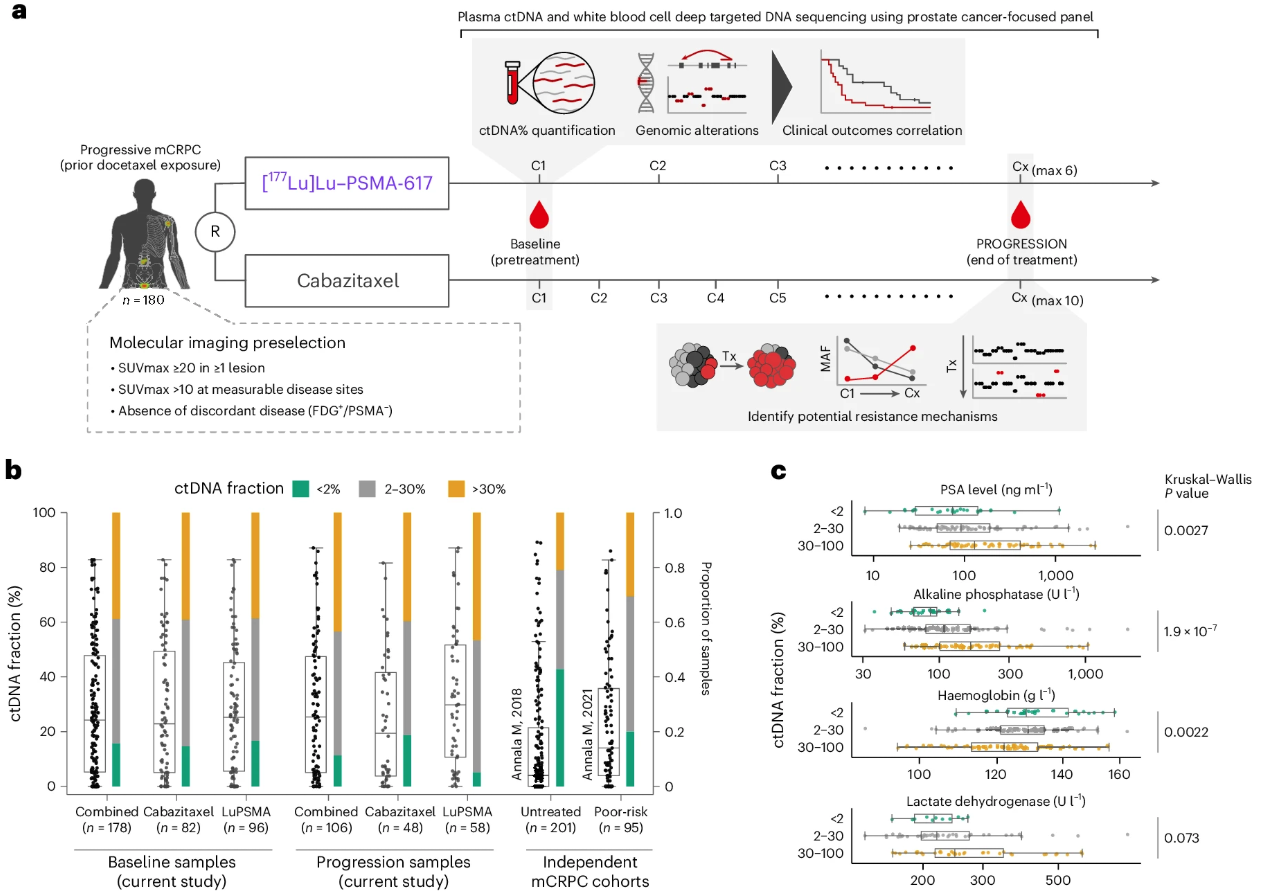
Led by co-first authors Dr. Edmond Kwan and Sarah Ng, this ctDNA sub-study of the randomized phase 2 TheraP trial compared men with metastatic prostate cancer treated with either targeted radioligand therapy (Lu-PSMA-617) or chemotherapy (cabazitaxel). By measuring ctDNA levels and specific gene alterations before and during treatment, the team identified blood-based features associated with better or worse response to each therapy, a step toward more personalized treatment selection. Read the full paper here.
Clonal Hematopoiesis after 177Lu-PSMA-617 Radioligand Therapy in Prostate Cancer

Led by Aslı Munzur, this study looks specifically at how radioligand therapy (Lu-PSMA-617) affects clonal hematopoiesis — mutations arising in blood cells with age — in men with metastatic prostate cancer, addressing a known concern that radioligand therapy may accelerate blood-cell mutation and elevate risk of blood cancers over time. Read the full paper here.
Repertoire and clinical hierarchy of AR locus alterations in castration-resistant prostate cancer

Led by co-first authors T. Virtanen and Dr. Edmond Kwan, this study catalogues the full range of alterations that can occur at the androgen receptor (AR) gene locus in castration-resistant prostate cancer and ranks their clinical significance, giving clinicians a clearer framework for interpreting AR-related genomic test results and anticipating resistance to hormone-targeted therapies. Read the full paper here.
Cabazitaxel Versus Abiraterone or Enzalutamide for Poor-prognosis Metastatic Castration-resistant Prostate Cancer After Docetaxel: A Phase 2 Trial with a Circulating Tumor DNA Analysis

Led by co-first authors Karan Parekh and Kim van der Zande, on behalf of the OSTRICh Investigators and the Dutch Uro-Oncology Study Group, this phase 2 trial compared chemotherapy (cabazitaxel) to hormone-targeted therapy (abiraterone or enzalutamide) in men with poor-prognosis prostate cancer who had already progressed on docetaxel, with a ctDNA analysis layered in to identify which patients are more likely to benefit from each option. Read the full paper here.