Categories
Sharing Your Ideas

Sharing Your Ideas

(To be completed online. Please follow online instructions.)

In this section of the learning unit, we ask you to share your ideas with other Aboriginal Head Start sites as one way of collecting new resources and ideas from colleagues. Your ideas should be submitted online, using the comment link. After clicking on the comment link, the comment box will open where you can type your ideas in the space provided. Then click on the ‘submit’ button.

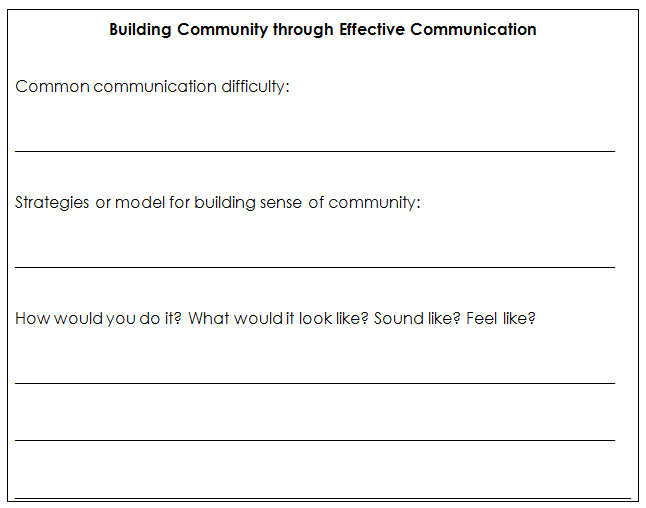
In this learning unit, you have explored and practiced effective communication strategies and skills that draw on Aboriginal culture and values. In the working space below, think about a common communication difficulty in your Head Start site that could be resolved through effective communication principles. Share the model that could provide a solution or strategy to resolve the problem. Describe how you would use the strategy.

Categories
Sharing Your Ideas

Reflection

Now that you have spent some time thinking about approaches to communication that value Aboriginal traditions and values and will assist you in your work with Aboriginal families, you may want to share ideas stimulated by different learning concepts and ideas in this learning unit.

We are asking you to reflect on your participation in this learning unit and the new knowledge shared here. Follow the online instructions to provide feedback. Please take time to comment on any of the following questions to provide us with feedback.

♦        What was helpful to you in this unit?

♦        What ideas for family literacy programming has this unit brought to mind?

♦        Can you share some of these?

♦        Do you feel you are better prepared for starting or re-visioning a family literacy initiative at your site?  Can you give details?

♦        Were parts that were not helpful?  Can you say why they were not helpful?

♦        What questions or doubts do you still have?

♦        What would you suggest we add to this unit to improve it?

Categories
Review

Review

This learning unit introduced you to concepts and processes related to models of effective communication. The importance of effective communication to families, communities, and institutions such as schools and Head Start sites is tied to positive relationships and strong community development:

  • Aboriginal culture embraces traditional communicative teachings.
  • Communication practices enhance relationships in communities.
  • Integration and application of multiple strategies and skills help to ensure effective communities and literacy initiatives that meet those needs.

This unit is intended to help you to become familiar with effective communication models that can be adapted and applied in Head Start sites during planning and implementation phases of program development:

  • Effective communication strategies provide methods for attentive listening, empathic understanding, and compassionate communication.
  • Aboriginal values and cultural beliefs are supported and sustained.
  • Human development and community growth are long-term objectives over time, achieved through effective communication.

This unit has provided an overview of various models of effective communication to help you plan and implement literacy goals and initiatives for Aboriginal children in Head Start sites.

Categories
Supplemental Resources and Readings

Supplemental Resources and Readings

Online Resources/websites

Four Directions Teachings

http://www.fourdirectionsteachings.com/

This website offers teachings from five First Nations across Canada. It is visually stunning and traditional teachings can be heard orally from Elders. In addition to the connections to effective communication and building community, the site has many connections to the previous learning units also.

The British Columbia Teacher Federation

http://bctf.ca/SocialJustice.aspx?id=17630

In the section called Ways to Challenge Racism they offer very useful scenarios for standing up against racism and is a great example on how to communicate in very difficult situations.

Teacher Guide English 12 FP

http://www.fnesc.ca/efp/Attachments/efp12/EFP%2012%20TRG%20April%2016%202008%20part%20A%20Units%201-5.pdf

This teacher’s guide offers many valuable teaching strategies and information on communications such as the guidelines for respectful interaction/communication.

Beyond Words: Creating Racism-Free Schools for Aboriginal Learners

www.bctf.ca/social/FirstNations/BeyondWords.html

Education is our Buffalo: A Teacher’s Resource for First Nations, Métis and Inuit Education in Alberta (2006)

The Alberta Teachers’ Association

http://www.ldaa.ca/assets/pdfs/freeResources/EducationIsOurBuffalo.pdf

Books

Armstrong, J. (1982). Enwhisteetkwa: Walk in water. Penticton: Okanagan Curriculum Project.

Brendtro, L., M. Brokenleg & S, Van Bockern. (1990). Reclaiming Youth at Risk: Our hope for the future.

Calliou, S. (1995). Peacekeeping Actions at Home: A Medicine Wheel Model for a Peacekeeping Pedagogy. In M. Battiste & J.Barman (Eds.), First Nations Education in Canada: The Circle Unfolds (pp. 47-72). Vancouver: UBC Press.

Phil Lane Jr., (1984). The Sacred Tree. Lethbridge, Alberta: Four Worlds Development Press.

Categories
Online Resources

Online Resources

Non Violent Communication

http://www.cnvc.org/en/user/reset/6200/1280345680/840bc8dad01e434ebe8b25…

The founder of The Centre for Nonviolent Communication is Marshall B. Rosenberg. This website gives a very clear explanation of what NVC is about. There is access to free information such as the first chapter on the book entitled “Non violent communication: a language of compassion”, which outlines the 10 steps to peace, and opportunities for training. Signing up for the site provides access to articles, lesson plans and other valuable resources that are free after you create a login.

  • Questions to ponder

1.      The language of compassion can be taught to young children. Think about the important ways you can use the first steps to peace, and how you would make connections to their lives.

Restitution

http://www.realrestitution.com/

Restitution was developed through the work of educator Diane Gossen. This website is an introduction to Restitution as Social Development. It facilitates the bringing together of various educational partners in order to enhance current educational practices in schools, institutions, community programs and correctional facilities.

It lists Aboriginal sites that already use the Restitution model. If you use Explorer as your browser, you can access school-based lesson plans from the Louis Riel School Division. Links to videos are very valuable, such as Respect Rap and Kids Rap on Conflict Resolution, done by children. Also notice the other video clips to see the language of restitution being used by Diane Gossen, the founder. The videos are called, ‘Could we have done worse?’ and ‘What do we believe?’

Circle of Courage

http://www.reclaiming.com/content/about-circle-of-courage

This website links to the Reclaiming Youth International website where you can access information on their mission statement, seminars, training opportunities such as Response Ability Pathways (RAP), Life Space Crisis Intervention, Developmental Audit and other customized training opportunities for purchase or professional development. You can find information on the Circle of Courage and the four core values. There is also free access to printable versions of the posters for use in your setting immediately.

  • Questions to ponder
  1. The three models for effective communication all have strong components of traditional Aboriginal values for child rearing and building community. Which model do you gravitate to when thinking about young children? When thinking about your Head Start site?

Research Summary: Communication Styles of Indian Peoples

Report by Mary Heit, originally printed in the AWASIS Journal, March 1987

http://www.lpi.usra.edu/education/lpsc_wksp_2007/resources/heit_report.pdf

This report has many good general guidelines and offers information on First Nations communication styles (1987). However, it should be noted that some of the communication styles described may not represent all First Nations. As in all generalized styles, we realize that there are differences between subsets of cultures as well as individual differences.

Some valuable quotes are below:

“It is inappropriate for anyone to speak for someone else, even if that someone is a child. Everyone is entitled to his or her own opinion and has a right to be heard.”(p.1)

“It is inappropriate to directly say that someone is wrong, again because of the value of arranging social situations so that no one is threatened and that individual autonomy is maintained. No one should be directly told what to do. Therefore, indirectly, inexplicit, general answers are considered appropriate in many cases because listeners can draw their own conclusions from them and make their own decisions. Herein also lies the value of the legend and of the oral tradition as a means of indirectly transmitting the values of the culture in story form (similar to an allegory).” (p.1)

Our Words our Ways: Teaching First Nations, Inuit and Métis Learners

http://education.alberta.ca/media/307199/words.pdf

This document offers some very useful information on Aboriginal communication styles, including strategies for educators, teachers, and support workers on how to best support Aboriginal learners. A wide variety of topics are presented on Aboriginal students and their families. It explains clearly such things as: Aboriginal worldviews, identity, learning styles, strategies for teaching students with learning disabilities, assessment and authentic reflections on learning. Although it offers very specific information on Alberta such as maps of treaty areas and Métis settlements, it also offers guidelines for talking circles, resource evaluation about Aboriginal Peoples, and Aboriginal parents’ advice for other parents. There are many other useful pedagogical tools such as graphic organizers and a glossary of terms.

[Permission is given by the copyright owner to reproduce this document, or any part thereof, for educational purposes and on a nonprofit basis, with the exception of materials cited for which Alberta Education does not own copyright].

Copyright ©2005, the Crown in Right of Alberta, as represented by the Minister of Education. Alberta Education, Aboriginal Services Branch, 10044 – 108 Street NW, Edmonton, Alberta, Canada, T5J 5E6.
Categories
Learning Into Practice

Activity #1

In Part 2 of this learning unit, three activities help you apply some of the concepts from the previous section. The templates for the activities can be found in the Appendix section at the end of the unit.

Circle of Courage: Our Families

Objective: To create a community circle of stories collected from the families in your Head Start site. As part of a family night, ask parents to share meaningful stories that tell of experiences and important life lessons about caring for children or one another. Record or write out these stories on a piece of paper. Print them out later on a computer. This family literacy activity will foster inclusion and build community.

  • Introduce the activity through a newsletter or message sent home with children. Let them know that you will ask them to share such a story.
  • Model the activity with a mini poster of your experience/lesson in a place where parents, (other parents), caregivers, and community can view it.
  • The stories can be represented in pictures, words, or artifacts.
  • Arrange the family stories in the shape of a circle onto a bulletin board.
  • Ask families and parents to identify the component of their Circle where the lesson or experience was focused: Belonging, Generosity, Independence, or Mastery.
  • Incorporate the language and colours of the Circle of Courage to show an inclusive community (black-Belonging; white-Independence; red-Mastery, yellow-Generosity).
  • The completed activity can be shared at a PAC meeting where the goals of this learning unit can be shared.
  • Share these life lessons with the children in the Head Start site. Use the stories as an invitation to incorporate ideas introduced in earlier learning units:

o   Photo picture books

o   Oral story telling

o   Felt board stories

o   Elder visits

o   Community building

Categories
Learning Into Practice

Activity #2

Creating a Social Contract

Objective: From the Restitution model you will create a social contract.

It is a process of using effective communication to arrive at a common goal based on community held beliefs and values. The shared picture for the group will emerge from each person’s personal contribution through a process of consensus—which celebrates diversity and views conflict as positive. The focus of the social contract is to build on common values the group identifies towards achieving a goal together.

Examples:

  • Our ideal program/preschool/community site
  • Our picture of effective communication in the work place
  • Our picture of an effective staff/team as community

The process of arriving at a social contract is more important than the content of the social contract. Here are some consensus building strategies in the process:

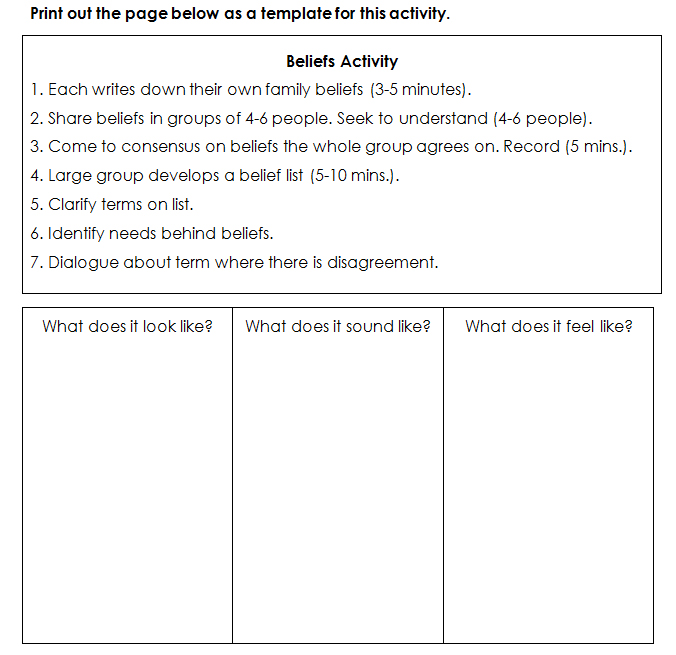
  1. Allow each person to share their personal/family beliefs and values that they would like to see incorporated in the Aboriginal Head Start program.
  2. Provide an opportunity for people to ask questions and clarify ideas and words that the person shares. The goal of asking questions is to understand the opinion of others through asking and listening.
  3. Once members of the group have shared their beliefs, decide together on a common goal for the program through a process of consensus. Reach consensus by revising the wording of the beliefs until all people can say they accept the belief.
  4. Relate the beliefs back to basic needs; love, power, freedom, fun and survival to help reduce conflict and achieve agreement.
  5. Spread the process out over two to three meetings with time in between for reflection and informal dialogue. Or, use this process to achieve different goals for children and families.
  6. On a chart, ask participants to visualize and concretize what a belief would “look like, sound like, and feel like”. On the chart you will answer “how”. If the group starts with a question about rules, ask “Why do we have this rule? Refer back to the group beliefs to move on.

Categories
Learning Into Practice

Activity #3

Objective:

From the Tribes model, this activity engages group members in active listening skills. Compassionate understanding and attentive listening are skills and attitudes that build community and foster inclusion.

Instructions:

1.            Have community sit in a sharing circle.

2.            Instruct the group members that each person will have one minute to tell an event or experience in his or her personal history. Remind the listeners to give full attention (remember body language) without interrupting.

3.            At the completion of the exercise, when every member has shared their one-minute story, ask participants the following:

Content/thinking

What did you learn about someone else in this activity?

What would you be able to retell from what a member in the circle shared?

What can we learn when we reflect on experiences in our lives?

Social

How can you tell that others were using effective listening skills?

Why was a minute enough/not enough time to share?

Did the people who shared later in the activity share more or less? Why?

Personal

How did you feel about sharing?

Showing Appreciation

Invite statements of appreciation:

“I liked it when you said…”

“I felt good when…”

“I was particularly interested when you…”

Categories
Introduction

Introduction

Learning Unit 6 introduces effective communication styles and strategies that aim to facilitate clear and meaningful communication in community and family settings. Specifically, this unit provides an overview of four models that can support initiatives for building positive communication and community relationships in sites such as Aboriginal Head Start. Exploring communication models that draw on Aboriginal traditions and values will contribute to positive and culturally relevant interactions among co-workers, children, families, and others who participate in our Aboriginal Head Start programming.

Key Learning Ideas

  • There are communicative practices that embrace Aboriginal culture and include physical, spiritual, cognitive, and emotional dimensions.
  • Effective communication involves attentive listening skills and techniques that focus on interrelationships among the children, families, and community.
  • Developing shared beliefs about effective and culturally sensitive communication enhance all relationships and meaningful interactions in Aboriginal communities, including Head Start sites.
  • Aboriginal philosophies of effective communication are based on cultural beliefs, values, customs, and traditional teachings.

Objectives of the Learning Unit

  • Understand the principles and rationale of culturally relevant communication skills and strategies for Aboriginal Head Start sites.
  • Gain knowledge and understanding of four communication processes and/or programs that are relevant to Aboriginal early learning settings.
  • Apply culturally relevant communication strategies within Aboriginal Head Start.
  • Recognize the role of Aboriginal values and teachings in effective communication, e.g. listening techniques and holistic learning.

Learning Outcomes

At the completion of this learning unit you should:

  • Recognize how effective communication plays an important role in building and developing strong relationships—work, family, community.
  • Integrate and apply multiple strategies and skills presented within Aboriginal early learning settings.
  • Share awareness of, and celebrate traditional communication practices that enhance relationships in Head Start sites with children, families and communities.
Categories
Readings and Powerpoints

Overview of PowerPoint #1

  • TRIBES – A New Way of Learning and Being Together

Approximate time to view PowerPoint is 20 minutes

Main Ideas:

  • Tribes’ engages participants in a process aimed at establishing positive cultural connections in a program and community.
  • Strategies can be woven into a pattern of interaction (with children, caregivers, parents, colleagues) that creates a caring environment.
  • Four principles guide community building and effective communication
  1. Attentive Listening — silently with full attention
  2. Appreciation – no putdowns – positive statements
  3. Right to Pass – provides courage, control, and decision making power
  4. Mutual Respect – respect for self, others, and individual qualities
  • Strategies aim to provide effective communication choices in groups—processes such as observing, listening, and reflecting on whole community concerns.
  • Aboriginal traditions and values within this program include community circle of sharing, respect, character values.

Spam prevention powered by Akismet