
You may know that your body is made of 65% oxygen, 19% hydrogen, and other heavier elements. But do you know where did all these elements come from and how they were generated?

An artist drawing of Big Bang. (via Google)
We know that the current theory states that the universe began with the Big Bang, an event that initially started at an extremely hot and dense point and that point expanded over nearly 14 billion to form the current universe. Right after the Big Bang, the universe contained only free floating subatomic particles such as protons, neutrons, and electrons. When the universe continued to expand, its temperature cooled off. Once the temperature was cool enough for the protons to catch the running electrons in this colder than before, yet still boiling universe, the first hydrogen atom formed. Similarly, helium and lithium were generated by the collision of protons and neutron. By that time the universe was made of mostly hydrogen, helium and trace amount of lithium.
After another long period of time, the region of the universe that was slightly higher in density started to attract any mass to form gas cloud by the force of gravity. As this cloud of mass got denser, it attracted even more mass. Eventually, the core became dense and hot enough for hydrogen atoms fusing together to form helium atoms and generating enormous amount of energy. Nowadays, we call this cloud of gas a star. As a star grows, more fusion reaction happened and more helium were generated. When there was enough helium accumulated in the core, all these helium started to fuse together and form carbon. After that, when there was enough carbon, oxygen started to form. This process continued until iron was formed.

An image of our Sun ( via Wikipedia)
Unfortunately, the stars can’t generate any heavier element than iron. This is because the nature of iron fusion does not produce energy but consume energy. Hence, when a star started to fuse iron, its core lost the pressure-gradient force against its gravity and the core collapsed. The result was a supernova: a stellar explosion.
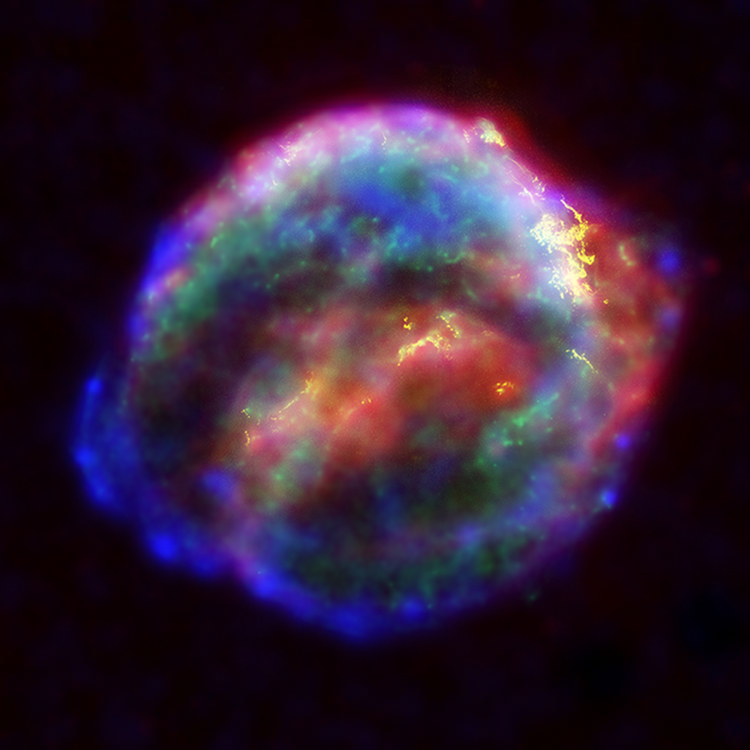
Kepler’s Supernova ( via Wikipedia)
That was the moment the rest of the period table elements were filled!
During supernova, atoms were exposed in more extreme temperature and pressure, allowing the formation of elements beyond iron in just a few second. Then, the star exploded into a cloud of gas: nebula.

Eagle Nebula (via Wikipedia)
This newly formed nebula can now give the raise of another star or stars and the debris that rotate around the newly formed star would become a planet and elements that you find on a planet, including yourself.
Now you can tell your friends that your body was once the core of stars.
By William Yang


