Category Archives: Uncategorized

Innovative Recycling is the Future

Do you have an overflowing cupboard at home full of flimsy plastic shopping bags which you’ll never use? There has been a push for using reusable canvas shopping bags, which are environmentally friendly and cut store costs but sometimes using the plastic disposable ones are the only option.  There have been  numerous news stories outlining how detrimental these plastic bags can be in the environment. A recent study shows that there may be a use for those hundreds of plastic bags, which would keep them out of the natural environment and out of your cupboard! [youtube]https://www.youtube.com/watch?v=en4XzfR0FE8[/youtube]

Diesel Pump via Google Images

This study shows how it’s possible to convert plastic shopping bags into diesel fuel. The study collected plastic shopping bags from local retailers and, through chemical processes, produced diesel fuel as well as what they believe are other oil based lubricants. The end diesel product is nearly identical to natural diesel fuels and has a substantially higher potential energy output then the energy consumed in its production. 

In an interview with Science Daily, Dr. Brajendra Sharma stated, “You can get only 50 to 55 percent fuel from the distillation of petroleum crude oil… But since this plastic is made from petroleum in the first place, we can recover almost 80 percent fuel from it through distillation.” The researchers were able to blend up to 30 percent of their plastic-derived diesel into regular diesel and “found no compatibility problems with biodiesel,” Sharma said.

It was discovered that only 13% of the approximately one trillion shopping bags used in 2009 were recycled, showing that we need to continue to push our communities to recycle. Discoveries and innovations in the fields of recycling and renewable energy, like the study discussed, are extremely exciting when we think about the future of our planet. In order for our modern society to survive at the same level of comfort we currently enjoy, we must continue to think of innovative ways to recycle and reduce our garbage.

Written by Andrew Hefford


Hey, Nice Smile

[youtube]https://www.youtube.com/watch?v=kfLSjobM9bg[/youtube]

A scene from the movie Mean Girls provides some interesting insight on the way we interact with each other. With a smile, Regina George compliments a fellow classmate and brightens her day. Seconds later, she rolls her eyes and says, “That is the ugliest effing skirt I’ve ever seen.” How was she able to pull off her lie so convincingly?

Through her smile.

Smiling has a long evolution history and is considered an inborn trait, meaning that we’ve developed the ability to smile from the time we were born. There are many reasons we smile and an important one is that it fosters communication between people. Moreover, we tend to smile when we are talking to people because we don’t want to give off the impression that we are unlikeable and hostile. Even though we know it’s impossible to like everyone and for everyone to like us,  we generally still try to appear friendly and polite, if not neutral, to avoid getting into any unnecessary confrontations.

Back in the 1800s, French physician Duchenne de Boulogne identified two distinct types of smiles. The first type of smile, called a Duchenne smile, refers to a smile linked to genuine positive emotion and involves contraction of the muscles around the eyes and the muscles that raise the corners of the lips. The other, the Pan Am smile, is a fake smile that involves contraction of only the muscles around the corner of the lips. Sounds relatively straightforward, right?

(Copyright Paul Ekman 2003, “Emotions Revealed,” Owl Books, 2007.)

Current research using neuroimaging techniques have indicated otherwise. A study by Calvo and colleagues (2013) measured the neuronal activity of participants using electroencephalograms (EEG) as they judged whether or not an assortment of faces were genuinely happy. The researchers found that there were no differences in brain activity upon seeing happy faces compared to seeing faces that combined a smile with fearful or neutral eyes. In other words, the brain was unable to differentiate genuine smiles from fake smiles.

In a different study, researchers tracked the eye movements of participants as they viewed images of faces with genuine and fake smiles and found that the majority of viewers fixated their gazes the earliest on the smiling mouth first, regardless of the type of eyes. Participants were also more likely to judge faces with fake smiles as genuine when they fixated on the smiling mouth first before looking at the eyes. The results suggested that the primary fixation on the mouth causes viewers to misinterpret the true emotion behind a face.

So, in conclusion, it is quite difficult to detect the sincerity behind a smiling face. This is how Regina George was able to deceive the poor girl. On the bright side, this means that no one really knows our real thoughts, either.

This really casts a new light on the saying, “Smile at your enemies, it confuses them”, doesn’t it?


By Joanne Shih


Elepants Have Learnt to “Understand” Human


Whether we realize it, African elephants (Loxodonta africana) are listening to us. It is recently found that African elephants are able to differentiate between ethnicities and genders, and can tell an adult from a child just by listening to the sound of a human voice. This is a very beneficial skill for the elephants that are often threatened by humans because they can protect themselves from human actions.

African elephants (Loxodonta africana)

A recently published study in PNAs (Proceedings of the National Academy of Sciences of the United States of America) last month by Drs. Karen McCombs and Graeme Shannon from University of Sussex provides evidence that African elephants (Loxodonta africana) can recognize human voices. By listening to our voices, elepants can determine our relative age and gender, tell different human languages apart and determine whether the people approaching them are a threat.

Their study was conducted in Kenya’s Amboseli National Park, and Elepants there are killed periodically by Maasi pastoralists (a semi-nomadic group that sometimes kill elephants). McComb and her colleagues wondered if the elephants are able to tell the voice of the Maasai men apart from Kamba people (crop farmers who rarely have violent contact with elephants). The researchers recorded voices of both Maasai and Kamba speaking in their native language “Look, look over there, a group of elephants is coming.” The researchers then played back the voice recordings to 47 elephant groups while observing the animals’ reactions. McComb and her colleagues discovered that Massai voices caused the elephants to smell the air or  huddle together twice as tightly than when they heard the Kamba voices.

Image of Maasai Men

Image of Kamba People

The elephants not only are able to tell the diffenrent ethnic groups apart, they are also able to recognize the gender and relative age of the voices. McComb found that elephants were less likely to run away when they heard Massai women or boys speaking as compared to Massai men. And this is because the Massai men is a much more serious threat for the elephants compared to Massai women or boys. Their research shows that elephants and other animals might be studying us more carefully than we are studying them as they have learnt to “understand” human in order to protect themselves from danger.

“Humans are undoubtedly the most dangerous and versatile predators the elephants are faced with these days,” said Prof McComb, and their research showed that elephants were “trying to adapt to human threats” by recognizing human languages.

[youtube]https://www.youtube.com/watch?v=wKWvlsRJVRI[/youtube]


Reference:

McComb K, Shannon G, Sayialel KN, Moss C. Elephants can determine ethnicity, gender, and age from acoustic cues in human voices. Proceedings of the National Academy of Sciences. doi: 10.1073/pnas.1321543111

By Simeng Alexandra Cai

You Who Came From The Stars

You may know that your body is made of 65% oxygen, 19% hydrogen, and other heavier elements. But do you know where did all these elements come from and how they were generated?

An artist drawing of Big Bang. (via Google)

We know that the current theory states that the universe began with the Big Bang, an event that initially started at an extremely hot and dense point and that point expanded over nearly 14 billion to form the current universe. Right after the Big Bang, the universe contained only free floating subatomic particles such as protons, neutrons, and electrons. When the universe continued to expand, its temperature cooled off. Once the temperature was cool enough for the protons to catch the running electrons in this colder than before, yet still boiling universe, the first hydrogen atom formed. Similarly, helium and lithium were generated by the collision of protons and neutron. By that time the universe was made of mostly hydrogen, helium and trace amount of lithium.

After another long period of time, the region of the universe that was slightly higher in density started to attract any mass to form gas cloud by the force of gravity. As this cloud of mass got denser, it attracted even more mass. Eventually, the core became dense and hot enough for hydrogen atoms fusing together to form helium atoms and generating enormous amount of energy. Nowadays, we call this cloud of gas a star. As a star grows, more fusion reaction happened and more helium were generated. When there was enough helium accumulated in the core, all these helium started to fuse together and form carbon. After that, when there was enough carbon, oxygen started to form. This process continued until iron was formed.

An Image of Our Sun ( via Wikipedia)

An image of our Sun ( via Wikipedia)

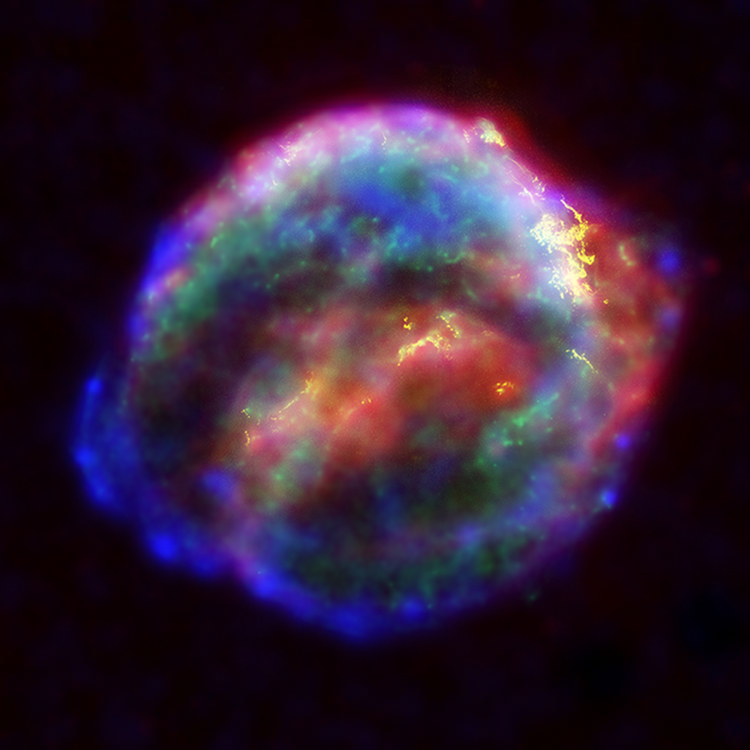
Unfortunately, the stars can’t generate any heavier element than iron. This is because the nature of iron fusion does not produce energy  but consume energy. Hence, when a star started to fuse iron, its core lost the pressure-gradient force against its gravity and the core collapsed. The result was a supernova: a stellar explosion.

An Image of Our Sun ( via Wikipedia)

Kepler’s Supernova ( via Wikipedia)

That was the moment the rest of the period table elements were filled!

During supernova, atoms were exposed in more extreme temperature and pressure, allowing the formation of elements beyond iron in just a few second. Then, the star exploded into a cloud of gas: nebula.


Eagle Nebula (via Wikipedia)

This newly formed nebula can now give the raise of another star or stars and the debris that rotate around the newly formed star would become a planet and elements that you find on a planet, including yourself.

Now you can tell your friends that your body was once the core of stars.

By William Yang

Going Extinct: What Really Killed The Dinosaurs?

D. Krentzel (2011), A Triassic archosaur. Flickr – CreativeCommons.

Let me set the scene. It’s a sunny day in Laurentia, present day North America, circa 65 million years ago (Ma). A gigantic yet graceful Triceratops casually munches away on a fern frond, unaware that life on Earth will soon be very different. Thousands of kilometers away, an asteroid 10 km in diameter impacts at the Yucatan peninsula in the Gulf of Mexico with over 100 million megatons of force, setting into action a dramatic series of events that will see the sun set on the reign of the dinosaurs.

NASA (2011), The Chicxulub Impact. Wikimedia Commons.

At least that’s the story we are probably all familiar with. Indeed, that is the generally accepted theory for the cause of the mass extinction that marked the boundary of the Cretaceous and Paleogene periods (K-Pg; previously known as the K-T boundary) and resulted in the extinction of some 75% of all species on the planet. However, the details of where the asteroid came from and what caused it to come barreling to Earth are still being debated. As a recent article in Nature reports, the answers might be found in the periodicity of our movement through space. Allow me to explain.

Just as the planets orbit the Sun, our Solar System is moving through one of the arms of our galaxy, the Milky Way. However, the movement of our Solar System through the galaxy is not as simple as you might think. Not only are we hurdling through space at 70,000 km/hr, but the Solar System is also oscillating vertically through the galactic plane – a densely packed disk that slices through the centre of the galaxy. In the latest paper on the subject, soon to be published in Physical Review Letters, Lisa Randall and Matthew Reece (2014) propose that this disk may be composed of dark matter and that our Solar System moves through the plane at regular 35 million-year intervals.

Movement through this dense layer of dark matter is thought to cause gravitational distortion in the Oort Cloud, which is a hypothesized sphere of millions of asteroids that lies about one light-year away and surrounds our entire Solar System. Specifically, it has been hypothesized that in the centre of the galactic plane gravitational pull from the dark matter ‘stretches’ the Oort Cloud and weakens the effects of the Sun’s gravity. As the Sun exits the plane, the cloud rebounds and, similar to an elastic band shooting a wad of paper, asteroids may be sent flying into the inner Solar System.

So, is this elusive dark matter really to blame for the dinosaur’s demise? Maybe, but as astrophysicist Adrian Merlott points out, “dark matter is a possible explanation, but it’s not clear that it’s explaining anything real.” While the Chicxulub Impact Event is believed to be proximately responsible for the mass extinction 65 Ma, scientists are still searching for an ultimate, astronomical cause.

D. Young (2011), Milky Way Galaxy. Flickr – CreativeCommons.

– Joseph Burant

How to Sleep

Trouble getting enough sleeping is a large problem for many people around the world. In fact, in the US 43.7% of Americans ages 18-25 have reported unintentionally falling asleep sometime during the day at least once in the past month in 2008 and in 2011 a poll done by the National Sleep Foundation found 60% of Americans age 11-64 report having trouble falling asleep. This issue is something I’ve started to accumulate as extremely late nights are more of an occurrence while feeling tired and fatigued during the day and choosing to pull “all-nighters” more and more. The severity feels that at some point I could develop a mild case of insomnia.

The average adults requires 7-8 hours of sleep per night. (Image via health.com)

This blog is focused on three topics in how to better improve sleep patterns, by limiting visual stimulants, and sleep aids prior to sleeping. They are methods or a simple checklist to better improve a nights sleep.

As a student, it is very common to be on the computer before sleeping, finishing off a daily assignment or studying. The use of electronic devices before sleeping greatly suppresses the production of melatonin, the bodies hormone for enabling sleep. It is well known that the use of electronic devices should be stopped one hour before sleeping to allow the body to begin producing melatonin and be able to have a full nights sleep. This however seems unlikely for many students , and in the world of social media might find it very difficult to shut down all devices for one hour before sleeping.

The use of electronics before sleeping hinders the quality of sleep. (Image via dailymail.co.uk)

Melatonin is the hormone produced by the body to enable us to sleep, melatonin is available in pill and spray form to help our body stimulate the hormones and assist in production. This allows us to fall asleep sooner and having a  better sleep. There are side effects to having external melatonin such as dizziness and fatigue in the daytime.

Melatonin is available over the counter at any drug store. (Image via latimes.com)

Tips on how to have a better sleep is endless, there are many methods to improving sleep.  The best way to having a better sleep is maintaining a healthy lifestyle both physically and emotionally. The sleep foundation has many more tips on how to get a better nights sleep on their website here.

Dr. Joseph Mercola recommends with his many tips that a person should go to sleep around 9-10, meanwhile I’m going to bed around 4-5.

[youtube]https://www.youtube.com/watch?v=gwwe5Zis6VI[/youtube]

Guan Qun Zhao


Image

A Need For More Carefully Regulated Marine Protected Areas

If you pay attention to recent news and environmentalists, you’ve probably heard that there is an ever increasing push to have a larger number of conservation areas for wildlife protection. This is extremely important in a world where populations are exploding and humans are constantly transforming rural areas into urbanized zones.  Globally there are 13 million hectares of deforestation occurring every year, with rare countries showing as much as a 28% increase of clear cutting. Although land protection is very important, it seems like less press time is given to the protection of marine habitats.

http://upload.wikimedia.org/wikipedia/commons/e/ea/US-NationalMarineProtectedAreasCenter-Logo.svg

In the last few year there has been a push for marine protected areas; however,  a disturbing, 6 year study from Australia published in nature, shows that these marine protected areas or MPAs are not having as positive an effect as we might have hoped. With the total fish biomass having declined by two thirds in fished areas it’s extremely worrisome that fifty nine percent of the marine protected areas studied were not “ecologically distinguishable from fished sites”.

The study chose 5 characteristics to describe a well run marine protected area, and found that only those MPAs which contained at least 4 of these characteristics were effective. These characteristics were that the areas were:  established for more then 10 years, allowed no fishing, were larger then 100km squared and are isolated by deep water or sand. When 4 or more of these were present it was shown that there was huge improvements in larger fish biomass with up to 14 times more shark biomass and 5 times more large fish biomass.

http://upload.wikimedia.org/wikipedia/commons/a/a6/Bunaken_Marine_Park.JPG

However 59% of MPAs were ineffective and  did not contain 4  or more of these characteristics, with only one of the 26 MPAs examined containing all 5. This means that simply saying an area is “a marine protected area” is not an effective strategy. The world must do more to ensure that these areas are researched to be important ecological areas and that these MPAs will be well enforced, allow no fishing, be larger then 100km squared and are isolated by deep water or sand.

Written by Andrew Hefford 


Taking a hit on HIV

A marijuana plant (via Google).

Recently cannabis, or more commonly known as marijuana, is being frequently debated on multiple talk shows in the United States with respect to legalization, but its medical aspects are being overlooked. Marijuana has been used in the past to treat chronic pain and weight loss, both symptoms associated with HIV. According to a study published in AIDS Research and Human Retrovirus, marijuana may be able to prevent the disease from spreading once the patient has been infected.

For 17 months, researchers at Louisiana State University were busy getting Rhesus monkeys high— well, maybe not exactly getting the monkeys high– but more like administering a fixed amount of THC, the active ingredient in marijuana, twice a day into the monkeys. All this was done while adhering to the NIH Guide for the Care and Use of Laboratory Animals. By including THC in the monkeys’ diet, researchers were hoping to discover how this chemical affects the spread of HIV in monkeys.

A Rhesus monkey. The monkey used in this study (via Google).

The monkeys used in the study were in the age range of four to six-years-old, and had to pass a physical and blood test before the study was conducted to confirm that they were not presenting a new variable to the study that could  cause the results to be scientifically flawed.

After the 17 month period, the researchers found the damage to lymphatic tissue in the gut area to have decreased. This is significant, as gut-associated lymphatic tissue plays a key role in HIV replication and inflammation.

Dr. Patricia Molina, a lead researcher in the study, stated “These findings reveal novel mechanisms that may potentially contribute to cannabinoid-mediated disease modulation.” These finding can be applied to humans as the direct injection of THC in monkeys has similar effects to humans smoking marijuana.


[youtube]https://www.youtube.com/watch?v=Xdt5mZMzHzE[/youtube]

Baltej Sekhon