Author Archives: vkwan

Revolutionary micro-rocket medicine to stop bleeding

Imagine medicine that can actively move. Medicine that are like fighter-jets transporting soldiers to a disaster zone. Clearly, this way of thinking challenges the traditional view of medicine where drugs are designed to absorb into the blood stream and flow with the direction of blood to reach sites all over the body. However, Dr. Christian Kastrup and his research team at the University of British Columbia are boldly challenging this traditional view. In collaboration with the Department of Emergency Medicine at Harvard Medical school, these researchers have developed a revolutionary micro-particle system that actively moves to sites of injury in the body. The system is a cream that can be applied on the surface of the skin. The hope is that these systems can be used to transport medicine deep inside wounds that are bleeding uncontrollably.

Medicine that can self-propel may be the next big breakthrough in pharmacological research. Image courtesy of Dr. Christian Kastrup

This new technology has exciting implications for saving lives in developing countries. In Africa, 1 in 10 mothers will die from severe bleeding during childbirth. In modern cities, this technology could reduce bleeding after a traumatic injury, buying the victim more time before reaching the hospital and having access to doctors and surgeons. In Canada alone, 15,000 people die each year from such traumatic injuries. Moreover, this technology could make life more convenient by substituting endless rolls of bandages and dressing with a thin film of cream coated on top of a simple band-aid. The next time you get your wisdom teeth pulled out by the dentist, you may not need to suck on uncomfortable pads of cotton! Rather, a cotton liner swabbed with cream may suffice to control the bleeding.

Layer upon layers of bandages may be a thing of the past! Image via Wikipedia

The system developed by Dr. Kastrup and colleagues works by immediately reacting with blood to fizz and foam up. To help you visualize this, the way it works is similar to Vitamin C tablets bought from pharmacies. When you drop the tablet into water, it bubbles and creates foaming (see youtube video below). This foaming reaction generates force which can be used to move medicine against outward flowing blood in situations where severe bleeding occurs.

[youtube]https://www.youtube.com/watch?v=mEKiF21abME[/youtube]

This research by Dr. Kastrup is the first to demonstrate effectiveness in reducing bleeding in living organisms. In two mice models, the micro-particle systems were shown to significant reduce the amount of bleeding. While these results are promising, further study will be needed to investigate proper dosages in humans and how to develop more selectivity in the pathway to which the micro-particle systems move. The latter is an important point as blood clotting in unintended regions may led to serious adverse effects (such as stroke).

We had the pleasure of interviewing Dr. Kastrup and graduate student James Baylis to learn more about this exciting line of research. Please see below for our podcast and video.

Video:

https://www.youtube.com/watch?v=4s89poehvmw&feature=youtu.be

Podcast:

https://www.youtube.com/watch?v=DXf0g_KFmVk

Written by: Group 2 (Vivian Kwan, Baltej Sekhon, William Yang)

My experience with presenting scientific research

File:Embarrassed woman.jpg

I am so embarrassed! (Image via Wikipedia)

I can’t believe this is actually happening… I rummaged in my backpack frantically looking for my script. Finally, I found it crumpled in the corner and shakily read out the rest of my presentation. How can this happen? I was utterly humiliated.

This was my first experience presenting research at a lab in front of the principal investigator, several graduate students, and other undergraduate research assistants. I froze mid-way during the presentation even though I had carefully memorized my entire speech the night before.

After this incident, I never wanted to present again. I had the idea that public speaking is for the gifted few who are able to magically deliver beautiful sentences with what seemed like no effort at all. Yet there was something in me that wasn’t ready to give up. For some very strange reason, I signed myself up to give an oral presentation at the UBC Multidisciplinary Undergraduate Research Conference (MURC) later that same year in 2012.

I remember the day of MURC very clearly. I was a nervous wreck waiting to present. “Why, why would you do this to yourself, why, why, why!?” was going through my head in an endless loop. The presenter before me finished, the audience clapped, and then my name was called. I was 100% sure that I would slur my words and stutter because I was just too nervous. But then an amazing thing happened. I placed my notes down on the beautiful wooden podium and looked out at an audience that seemed genuinely interested to hear what I had to say. I felt a new sense of empowerment and from there, delivered a very smooth talk.

Maybe what I have to say is worthwhile after all (Image via Flickr by Joe Hardy)

This was a defining moment for me because I realized that when you confront your fears, you take back the power it has over you. Communicating science in the form of a verbal presentation is a very powerful experience. You can inspire an audience, tell a compelling story about your research, and share knowledge with others that are eager to have you answer their questions. After presenting at MURC, it gave me the courage to pursue many other opportunities that I never had the confidence to go after before. I learned that being courageous isn’t not being afraid, it’s being scared to death but doing it anyways.

This past weekend, I presented another research project at MURC 2014. To my horror, a key slide in my powerpoint was missing during my presentation, causing me to stumble. But you can bet this won’t stop me from presenting again in the future! If you have been involved in some cool research and have thought about presenting, I encourage you to go for it! I bet you’ll be surprised at how well you’ll do! Here’s a fun resource with tips on public speaking by Zach Holman.

Written by Vivian Kwan

Using Neuroimaging to Understand the Impact of Seizures on Brain Development

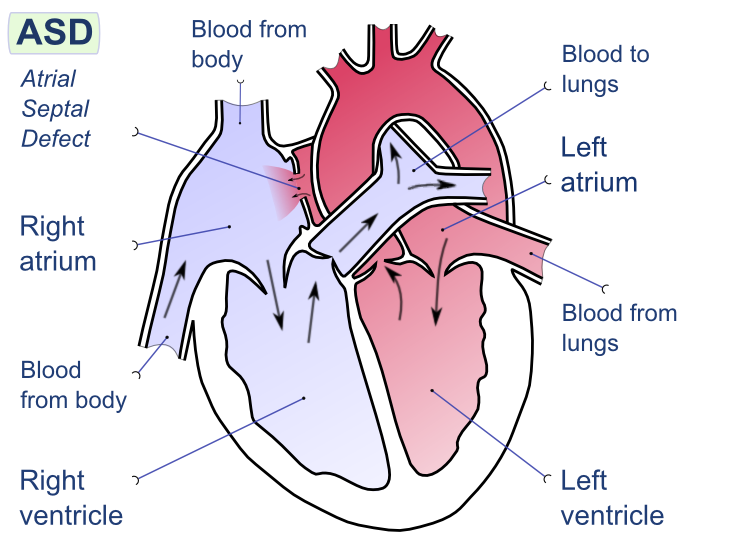
One of the most fulfilling experiences in my undergraduate career thus far is my  involvement in research at BC Children’s Hospital with neurologist Dr. Vann Chau. We are looking at how seizures affect brain maturation in children who have congenital heart disease (CHD). This is when a baby is born with abnormalities in their heart structure or function, which leads to problems with blood circulation. One example is “atrial septal defect” (see image below)

File:Atrial septal defect-en.png

Atrial septal defect is where the septum separating the right from the left atria is missing (Image via Wikipedia)

After open-heart surgery, 15% of infants will have seizures— the most common neurological complication. Previous research using animal models has found that seizures can induce lasting brain injuries (Holmes, 2002). However, it is not known whether this is true in human newborns.

Cardiac surgery operating room at BC Children’s Hospital (With permission from Dr. Kenneth Poskitt)

Seizures are treated using anti-epileptic drugs which decreases excitation in the brain. However, there is a high risk for adverse effects when treating a newborn with anti-epileptic drugs. Thus it is not clear to doctors just how aggressive they should be with seizure treatment since it is unknown how seizures affect brain development in the first place.

This is where our study comes in. We are examining whether cases of CHD with seizures, compared to those without, is associated with disturbed brain development. If we do find that seizures are associated with alterations in brain development, then this would be compelling evidence that improved management of seizures may lead to better neurological outcomes.

So how exactly are we assessing brain development? We are using neuroimaging methods which I will write about for the remainder of this post!

(1) Standard Magnetic Resonance Imaging (sMRI)
This method allows us to detect stroke and white matter (nerve fiber) injury by looking at differences in the alignment of protons in the brain. Below is an example of a stroke injury.

sMRI showing a stroke injury in the upper left region of the brain (With permission from Dr. Kenneth Poskitt)

(2) Diffusion Tensor Imaging (DTI)
This is a specialized application of MRI which uses properties of water diffusion to visualize neuronal tracts (bundles of nerve fibers) in the brain. Below is an example of a DTI image.

DTI of the human brain. To the left of this image is the frontal part of your brain. (Image via Wikipedia)

(3) Magnetic Resonance Spectroscopy (MRS)
This method looks at differences in resonant frequencies to determine the concentrations of key metabolites in selected regions of the brain. Below is an example of a MRS spectra.

MRS spectra showing different peaks for each metabolite which appears at a known frequency (Image via Wikipedia)

Written by Vivian Kwan

Empowering Autonomy in Scientific Education

When you think about undergraduate education, what do you visualize? In my mind, I picture large lecture halls filled with many students sitting shoulder-to-shoulder, in the fold-down chairs with the fold-up tables. At the front of the room, the professor lectures away while students quietly take notes for an upcoming exam. Sounds familiar, doesn’t it?

Typical university experience? (image via flickr by Alan Levine)

Don’t get me wrong- I’m not suggesting that lectures are unacceptable or a waste of time. Certainly, lectures has its place at large universities such as UBC. In fact, I think lectures are great because it allows many students to learn from incredibly knowledgeable professors. I will argue, however, that this should not be all there is. There needs to be more opportunities for student-centered learning, especially in science where discoveries depend on creativity, critical thinking and effective communication rather than passive accumulation of information.

Carl Rogers describes student-centered learning as a shift in power from the expert teacher to the student learner. Lea et al. (2003) emphasizes the importance of active learning where participation and involvement is essential for quality education. In recent years, the term student-centered learning has been increasingly used, along with flexible learning, experiential learning and self directed learning. The emergence of this proactive approach in education reflects today’s society where choice and democracy are important concepts.

But the fact that active learning is good is not breaking news. Rather, it’s quite obvious! So what’s the big deal anyway? The big deal is that “many institutions or educators claim to be putting student-centered learning into practice, but in reality they are not (Lea et al., 2003).” However, I do believe that UBC is indeed an advocate for student-centered learning.

This semester, as part of the UBC student directed seminars program, I am leading a course on the topic of traumatic brain injury. The UBC student directed seminars program allows undergraduate students to create their own 3-credit course for a 15 person maximum class. As I have strong interests in neuropsychology, I created a course that explores in depth how a traumatic brain injury can profoundly impact an individual’s life. From project conception to execution, UBC has provided me with all the resources, guidance and support I need to succeed.

The experience leading a seminar so far has taught me a lot regarding how to effectively communicate science. Our motto here at UBC is “Tuum Est” which means “make it yours”. Our undergraduate careers are too short (and expensive) to spend passively learning what we’re told. There are ways to personalize the experience of how we learn about science whether it’s through a hands-on research project, a student directed seminar or even service in the community. It’s important to find your passion, but it’s also important to then pursue that passion from different facets outside the traditional lecture.

Tuum est “Make it yours” (via UBC branding)

Written by: Vivian