Tag Archives: Sun

You Who Came From The Stars

You may know that your body is made of 65% oxygen, 19% hydrogen, and other heavier elements. But do you know where did all these elements come from and how they were generated?

An artist drawing of Big Bang. (via Google)

We know that the current theory states that the universe began with the Big Bang, an event that initially started at an extremely hot and dense point and that point expanded over nearly 14 billion to form the current universe. Right after the Big Bang, the universe contained only free floating subatomic particles such as protons, neutrons, and electrons. When the universe continued to expand, its temperature cooled off. Once the temperature was cool enough for the protons to catch the running electrons in this colder than before, yet still boiling universe, the first hydrogen atom formed. Similarly, helium and lithium were generated by the collision of protons and neutron. By that time the universe was made of mostly hydrogen, helium and trace amount of lithium.

After another long period of time, the region of the universe that was slightly higher in density started to attract any mass to form gas cloud by the force of gravity. As this cloud of mass got denser, it attracted even more mass. Eventually, the core became dense and hot enough for hydrogen atoms fusing together to form helium atoms and generating enormous amount of energy. Nowadays, we call this cloud of gas a star. As a star grows, more fusion reaction happened and more helium were generated. When there was enough helium accumulated in the core, all these helium started to fuse together and form carbon. After that, when there was enough carbon, oxygen started to form. This process continued until iron was formed.

An Image of Our Sun ( via Wikipedia)

An image of our Sun ( via Wikipedia)

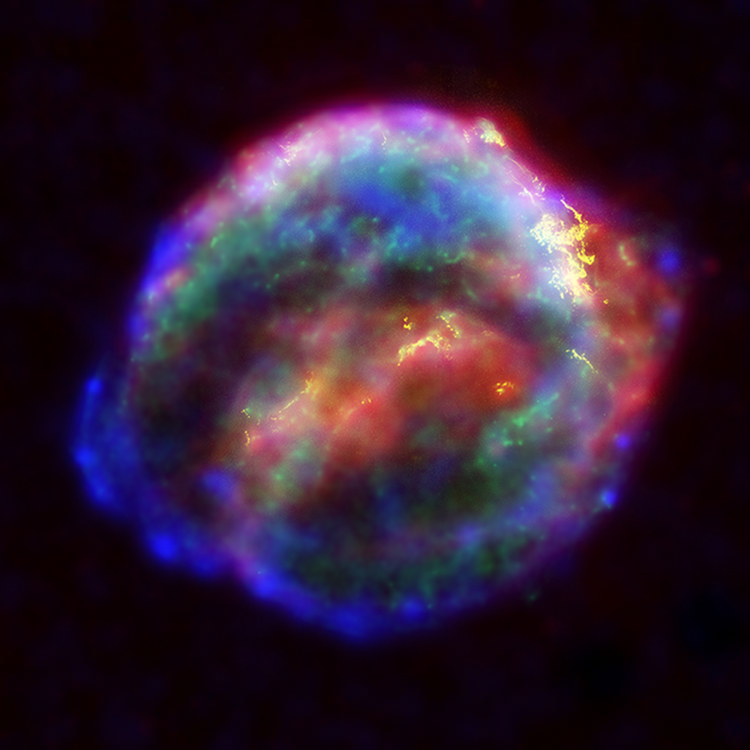
Unfortunately, the stars can’t generate any heavier element than iron. This is because the nature of iron fusion does not produce energy  but consume energy. Hence, when a star started to fuse iron, its core lost the pressure-gradient force against its gravity and the core collapsed. The result was a supernova: a stellar explosion.
An Image of Our Sun ( via Wikipedia)

Kepler’s Supernova ( via Wikipedia)

That was the moment the rest of the period table elements were filled!

During supernova, atoms were exposed in more extreme temperature and pressure, allowing the formation of elements beyond iron in just a few second. Then, the star exploded into a cloud of gas: nebula.


Eagle Nebula (via Wikipedia)

This newly formed nebula can now give the raise of another star or stars and the debris that rotate around the newly formed star would become a planet and elements that you find on a planet, including yourself.

Now you can tell your friends that your body was once the core of stars.

By William Yang

What is the Possibility of Living On The Neighbouring Planet: Mars

Since 2012 when NASA landed the Mars Exploration Rover the whole nation questions whether or not the planet next to us is capable of supporting life. If our planet ever comes to a dooms day or judgement, knowing that there is a life-sustainable planet right next to us can help ease the anxiety created by the fear that the world can come to an end. Based on all the recent articles released by the press it seems as though scientists are hinting us that Mars is habitable.

Personally I enjoy believing that Mars is a planet human can “run to” as a second home when Earth cannot support a total population of eight million people that is increasing at an exponentially rate. Let’s face it the Earth is getting over populated with all of its resources getting depleted and trained to the very bits. One of the sources that allow Earth to be sustainable is the almighty Sun that radiates its solar energy on our planet’s surface, making it possible for primary gases like carbon dioxide and ozone to form and produce a habitable atmosphere. Recently researchers hypothesized that in approximately two billion years the heat radiated from our Sun may make it possible for Mars to become habitable. Years later when the heat emitted from the sun is in a perfect temperature range, enough to boil carbon dioxide (CO2) and produce an atmosphere sustainable to life.

Image of Mars from outer space

Image of Mars by NASA via Flickr


Another possibility comes from the analysis of the oldest minerals discovered by the Mars Rover show that billions of years ago Mars had liquid water that could lead to liveable planet. For now the temperature on Mars is still too cold for liquid water to be produced and provide support needed for life. If water every formed on Mars there must have been livable mud that existed on the planet. Chances are that if Mars had once had the ability to produce liquid water and sustainable mud then in future years it is possible for our neighbouring planet to do it again.

Below is a question&answer video from Dr. Emily Rice who speaks about whether heat from our Sun make Mars habitable

[youtube]https://www.youtube.com/watch?v=aSAr3An01Go[/youtube]


Even if these ideas are only possible billion of years later, the hint that researchers been trying to tell us is that Mars will eventually be a habitable planet. The question is whether the history of human race will survive long enough and develop state of the art technology that can transfer a great number of lives to Mars.


Mars in 2050

Mars in 2050 via Flickr


-Blog post by Tien Vu