
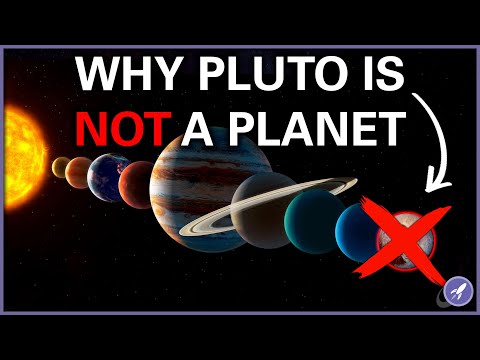
In 2006, thousands of astronomers around the world gathered in Praha to vote for the fate of the ninth planets in our solar system, Pluto. 76 years after its discovery, the planet was removed from the list of the nine planets in our solar system. This may not be new to you, but do you know why was Pluto demoted?
Prior to the discovery of Pluto, astronomers had mathematically predicted the existence of a ninth planet based on the perturbed orbital motions of Neptune and Uranus. After tracing the shadows of the planets for several decades, in 1930, astronomers finally confirmed that they had found the ninth planet, Pluto. It is only approximately 0.21 percent of Earth’s mass and it has five known moons. Pluto seems to share all the properties of the other eight planets, except for one: it has a very eccentric orbit.

Pluto under a 14” telescope from Earth. Photo credit : via Google
Over the span of half a century, telescopes are starting to get more advanced. As a result of that, astronomers have accomplished observing more than 10,000 of the small asteroids or icy bodies with a radius over 100km around the orbits of Pluto. The radius of the largest asteroids discovered, Eris, is 27 percent greater than that of Pluto. Astronomers began having problems classifying these huge asteroids. Hence, they decided to vote on the definition of a planet on the 26th General Assembly for the International Astronomical Union in 2006.
The new definition of a planet is given that
- The celestial body must orbits around the Sun
- It must have enough gravity to pull itself into a spherical shape
- It must have cleared all other celestial bodies on its orbit
- Any non-satellite body that meet the first two requirements but not the third one is classified as a dwarf planet.

What would happened if the definition of a planets is unclear. Photo credit: Flickr user Wesley Fryer via Flickr
Now let’s see if Pluto meets the above requirements.
We know that it orbits around the Sun and maintains itself in a spherical shape. Although the first two requirements are met, it does not meet the last one as it has over thousands of asteroids on its orbit. Soon after the approval of the new definition of a planet, Pluto was crossed out from the list of planets in our solar system. However, this dwarf planet, Pluto, will still be orbiting in our solar system for a long time.
To learn more about classification of Pluto, here is a short video.
Written by: William Yang

