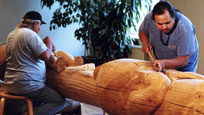
This film, Totem: the Return of the G’psgolox Pole, is such a wonderful story and example of respect and cross cultural collaboration. I know from speaking to people in this community what an important moment it was for the Haisla and how much respect and healing resulted from the entire process. In addition to this film, you have to love how comprehensive a resource the NFB site is, for First Nation subject matter and beyond. Yes, as taxpayers it often seems we have to pay dearly to be Canadian, but cultural resources like this one make it seem worth it.

Urban Native Girl Stuff
After watching the Amy Parent interview, I wanted to learn a little more about urban youth. This was one of the sites that I came across, and it has a number of posts on the page about designer clothing, jewellery, and purses inspired by traditional aboriginal clothing or traditions. The posts are more than just “here is the latest!” though. The author takes time to consider how the commodification of her culture impacts how it is viewed by others and how (or if) the history behind the items has been considered.
• Great Cowichan Debate entry: http://www.lisacharleyboy.com/2010/03/great-cowichan-debate.html
• Feather Pendant entry: http://www.lisacharleyboy.com/2010/09/feather-dusters.html
• Native Inspired Fashion category: http://www.lisacharleyboy.com/search/label/Native%20Inspired%20Fashion
In addition to blogging about native inspired fashion, the author also talks about living an urban life in Toronto. All in all, it is another interesting look inside the life of urban aboriginal youth.
This site has some good information on stereotypes. While it is based around issues and stereotypes facing Australian aboriginal peoples, much of the information is still applicable when considering Canadian indigenous populations. A list of common stereotypes is included, as well as a discussion around how the media reinforces these stereotypes. The page also includes a look at how Australia’s tourism industry represents aboriginal cultures. Even though they try to use respectful and inclusive images, the advertising does not line up with reality. I thought this was an interesting perspective, as it seems to me that BC’s tourism industry – and Canada’s, for that matter – also places an emphasis on aboriginal peoples. But is it the right one?
http://www.creativespirits.info/aboriginalculture/people/aboriginal-australia-stereotype.html
Media Indigena
MediaINDIGENA is a blog written for and by indigenous peoples in Canada. It features a ton of content, on everything from arts and culture to politics and the economy. I stumbled onto the page as a link from another blog I discovered while searching about the controversy surrounding the commodification of the Cowichan sweaters during the 2010 Olympic Winter Games in Vancouver. The perspective on the page is a really interesting one to read – the authors/contributors are well versed in the issues facing Canadian indigenous peoples, and approach the issues with a pop-culture lens. The site has lots of interesting and interactive add-ons, including a Facebook page, Twitter feed, and other content-sharing applications such as StumbleUpon, Reddit, and Delicious. In reading through some of the entries, I had the sense of being up-to-the-minute, and it felt very current. For that reason, I wanted to share this site.
Native Web
” NativeWeb is an international, nonprofit, educational organization dedicated to using telecommunications including computer technology and the Internet to disseminate information from and about indigenous nations, peoples, and organizations around the world; to foster communication between native and non-native peoples; to conduct research involving indigenous peoples’ usage of technology and the Internet; and to provide resources, mentoring, and services to facilitate indigenous peoples’ use of this technology.”
You will find tons of information and links to other sites nicely “packaged” into categories (e.g. environment, women) or by nation (e.g. Inuit, Pomo) or by geographic region (e.g. Canada, Greenland). Very useful!
Photography – Phil Borges
Phil Borges uses his photography to bring attention to indigenous peoples and the cultural issues they face. His work is stunning! Phil is the founder of “Bridges to Understanding” and co-founder of “Blue Earth Alliance.” Bridges to Understanding uses digital storytelling to empower youth and create cross-cultural understanding. Blue Earth Alliance uses photography to affect change.
Amazon Watch
This organization is dedicated to preserving the nature and culture of the indigenous peoples living in the Amazon basin – Bolivia, Brazil, Colombia, Equador and Peru. A focus of Amazon Watch is to prevent the creation of “mega-projects” that destroy the land and the people living there. Amazon Watch works in partnership with the local organizations to provide funding and help to represent the needs and desires of the people being affected.
Australian Museum
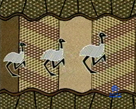
The Australian Museum has done a nice job in re-creating the “Stories of the Dreaming” from Indigenous Australian culture in a respectful way. Some stories cannot be re-told or shared because they are sacred.
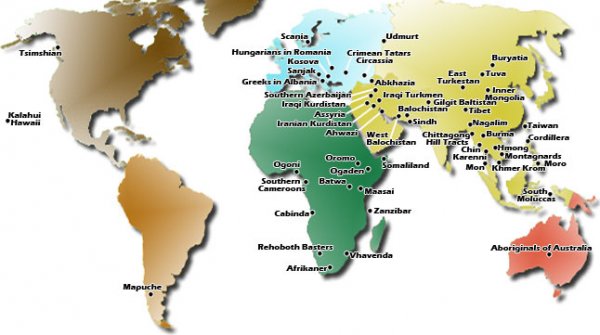
The “Unrepresented Nations and Peoples Organization” is dedicated to providing nonviolent solutions to problems affecting indigenous peoples and minorities around the world and to protecting and promoting human and cultural rights. The website (and this organization) is a good example of how technology can provide the means to draw attention to issues that might otherwise have gone unnoticed.
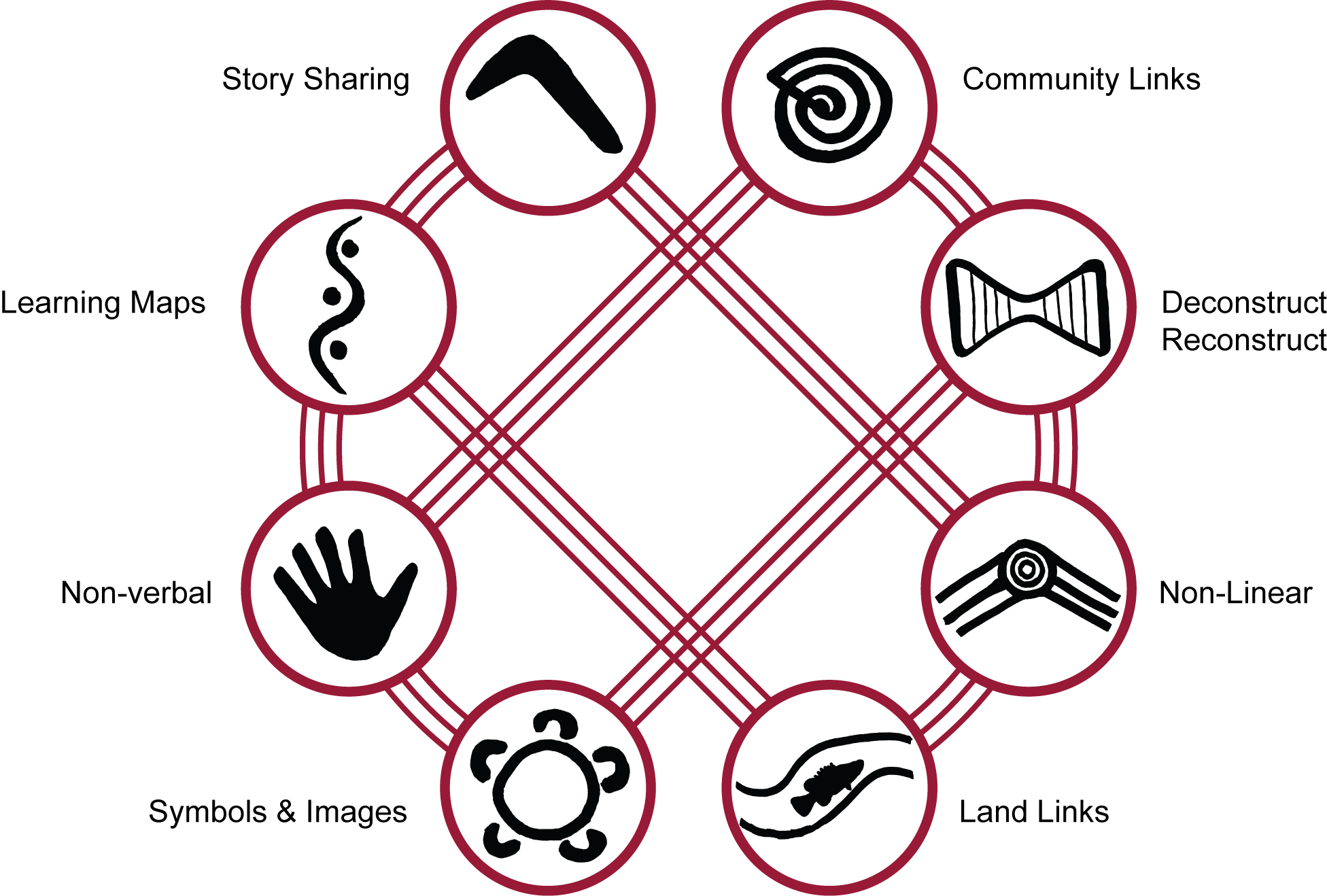
I came across this site while searching “aboriginal education”. It is a site designed and maintained by the Western New South Wales Regional Aboriginal Education Team and James Cook University in Australia. It is a pedagogical framework for teachers to be able to teach Aboriginal students in a meaningful way. It discusses and has resources about Aboriginal perspectives and how to include them into the core curriculum that is set by the school boards and governments.