Module 3.1. Indigenous Knowledge and Intellectual Property Rights

“What Protection Of Traditional Knowledge Means To Indigenous Peoples”, is an Intellectual Property Watch article, which combines two interviews with two indigenous groups attending the Intergovernmental Committee on Intellectual Property and Genetic Resources, Traditional Knowledge and Folklore (IGC).
According to the article, both indigenous groups reported that their knowledge (a part of which they consider sacred), had been published, used, and sometimes misappropriated, without their consent. These indigenous groups are demanding that their knowledge be protected through an agreement on international legal tools that prevent “colonizers” from placing their knowledge in public domain.
“When you receive it, you don’t receive it freely to do whatever you want with it, you have obligations to the land, to whatever it is referring, to the spirits or the ancestors. This is a real problem with the public domain. Tribes have often shared their knowledge in the past but they shared it with people who had similar views and concepts and understood these obligations. But now we are in this world with 7 billion people on the Internet”, says Preston Hardison, policy analyst representing the Tulalip Tribes.
Source:

Module 3: Post 3 – Australian Aboriginal Land Map

As I have limited knowledge of Australia’s Aboriginal people I am researching to learn as much as I can. Yesterday I decided to do a basic search to acquire some basic information on Aboriginal peoples in Australia.

I was surprised to see National Geographic be one of the first results in an internet search. The link takes you to a recent article on Australian Aboriginals. The article centers around author Michael Finkel’s experiences with an Aboriginal community in the Northern Territory.

What I found most interesting on this site was the link to a map showing Australia’s Aboriginal communities across the country. The map states that since the 1970s Australian Aboriginals have been returning to their ancestral homelands. The map also claims that this return ‘home’ sees healthier communities with lower rates of addiction and lifestyle related diseases. A stark contrast to the information presented in Pilger’s articles. The map highlights both the remoteness of the land as well as the low population of the land in comparison to other parts of Australia. These are interesting demographics to consider. Why is it that Aboriginal peoples seem to leave in isolation from Australian society?

A brief introduction to Australian Aboriginal peoples/land, and a good generator of questions about Australia’s Aboriginal peoples.

Module 3: Post 2 Aboriginal Opera

As I was reading the Guardian today, I unexpectedly came across an article on Aboriginal Opera singer, Deborah Cheetham. Cheetham is an accomplished opera singer who has performed across Australia and at major events such as the opening ceremonies of the Sydney Olympics and the rugby World Cup. She is believed to be the only professional opera singer of Australian Aboriginal descent.

The article notes that Cheetham was frustrated by the lack of Aboriginal voices in opera so she decided to write an opera for and about Aboriginal communities. Opening in 2010, Pecan Summer has been successful across Australia. The opera tells the story of the 1939 Cummeragunja mission ‘walk off’ where 200 Aboriginal peoples living in the Cummeragunja mission left the mission in protest of the poor living conditions and strict control. The seemingly simple step of walking away from the mission is an important step in the struggle for Aboriginal rights.

I was also interested to see in this article that Cheetham is part of Australia’s Stolen Generations. She was adopted at three weeks old and later told that her birth mother had abandoned her in a box in a field. It wasn’t until she was 22 that she discovered that she wasn’t abandoned and that she was able to find her birth mother.

I find this article very intriguing as it’s current, related to the topic that I am researching (Stolen Generations) and so interesting to see an Aboriginal woman bringing Aboriginal people and stories to opera.

Module 3: Post 1 – Utopia

John Pilger, journalist, author and film maker, has created a new documentary, Utopia that highlights the life and struggles of many Australian Aboriginal peoples. The documentary is set to explore several topics that seemingly highlight the racist treatment of Australia’s Aboriginal peoples.

In press related to the documentary Pilger describes an area of Western Australia that is experiencing a mining boom. Advertising shows Aboriginal peoples working the land. Yet Pilger finds that a fraction of the monies earned from the natural resources benefit Aboriginal people. In fact, many live in poverty. He notes in particular the health issues Aboriginal children face.

Pilger also discusses a trip to Rottnest Island. Rottnest Island is today a tourist destination, geared towards families. In the past it was the home of a prison populated by Aboriginal peoples. Today, tourists have no idea that the hotel/spa they stay at was once a prison, and that the site of a country club is actually over a mass grave. Pilger further points out that the former head of the prison, a violent man who murdered two prisoners, is now a celebrated historical figure on the island.

Pilger also discusses his own education in Australia and the knowledge he gained of Aboriginal peoples. The textbook that he studied history from stated that Aborigines were “completely amoral” and that “we are civilized and they are not.”

I am very intrigued by Pilger’s documentary and the articles I have read thus far. It seems to connect with so many of the themes we have discussed in this course and is a very real reminder of the horrible ways in which Indigenous peoples have been and continue to be treated around the world.


Module 3-post 1 : A great listing of readings

Reading about the aboriginal culture is interesting as it yields a lot of novel ideas in understanding the culture and its people. The topic discussed in the third module focuses on the researching and researchers who belong to the aboriginal community. The way the aboriginal community looks at researching is instrumental in forming their opinion about the person who is doing it. One of the interesting sources of information that I found useful is the:

http://aerc.usask.ca/education/researchmethods-links.html

The site is the official platform of Aboriginal Education Research Centre. It doesn’t offer articles or readings about the research theme but it does offer a rich bibliography that can be important in pursuing the theme of research and aboriginal people.

This excellent listing of literature can be very helpful in building a constructive understanding of the issue of research in the aboriginal community

Hussain

Mod 3. Post 1. “Urban Reserves and Expansion of Lands for First Nations”

On my drive to work today, I was listening to a professor, Dr. Judith Sayers of the University of Victoria and her take on the latest proposal by the Canadian federal government related to expanding reserve lands, regardless of their location. To hear her full interview (8:21 in length) click here.

Squamish Nation Pow Wow 2011 a Full Regalia First Nations Drumming and Dancing Family Affair at Capilano Indian Reserve in Vancouver

Historically, reserve lands could be expanded on, but expansion was limited to lands neighbouring the reserve area. This proposal will potentially see other lands, separate from First Nation reserve lands, subject to sale to become incorporated into First Nations reserve and fall under First Nations jurisdiction. While this is an exciting development in regards to further steps of reconciliation, it has raised alarm bells and a flurry of questions. Municipalities are concerned over loss of tax revenue, policing, fire, city planning, and much more.

In my community, the First Nations population is the fastest growing demographic, and I think that such a proposal could result in wealthy First Nations tribes, such as Cowichan Tribes, regaining many lost territories which are not recognized as being their lands. With land being so integral to our indigenous peoples, it will be interesting to watch how society receives – how it welcomes or resists – such change to who controls lands.

Mel Burgess.

Module 3 – Post 3 – Voices in the Wind Productions

Voices in the Wind Productions is the website of Dr Judy Iseke, who is the Canada Research Chair in Indigenous Knowledge and Research and Associate Professor, Faculty of Education, at Lakehead University in Thunder Bay, Ontario.  Dr. Iseke’s work is focused on “challenging the appropriation and misrepresentation of Indigenous Knowledge in mainstream art and media.”  Dr. Iseke received a $500,000 grant in 2012 for Michif language research, the results of which will be presented on the website.  The site also contains some short films (descriptions sourced from the website) with aspects of storytelling and traditional knowledge:

How the Spirit Moves – In this animated short film, we see the human beings who enter the lodge in their spirit form and the animal spirits who help them heal.

A Living History of Metis Families as told by Dorothy Chartrand – Dorothy Chartrand, a Métis grandmother, tells the story of her Metis families as their lives are affected by the political and social change that impacted Métis lives in the 1800s to today.

Grandmothers of the Metis Nation – This film shares Metis grandmothers stories and histories told by the grandmothers and a narrator, to understand the complex roles and responsibilities of Metis women in the past and today.

Understanding What Life is About – Storytelling with Tom McCallum – Tom McCallum (White Standing Buffalo), Métis Elder and storyteller, explains that stories are a history of our people from many lifetimes and that stories are real. In English, with some Cree, he shares 6 entertaining stories which have been animated.

Paper Mache Totem Poles – Misrepresentation, appropriation, and denigrating Indigenous knowledge is still common practice in educational institutions despite efforts of critical educators to challenge these practices.

If you have time for only one, I recommend “Paper Mache Totem Poles”, as it does a nice job of exposing problematic representational practices common to Western education

.


Module 3 – Post 2 – Longhouse Media


Longhouse Media

Image Source: http://www.longhousemedia.org/about.html

After viewing this week’s video, “March Point” I wanted to try to find out more about its origins.  Through an internet search, I discovered that March Point is a production of Longhouse Media, a Washington State non-profit organization.  The production was completed as part of their “Native Lens” program.

“The mission of Longhouse Media is to catalyze indigenous people and communities to use media as a tool for self-expression, cultural preservation, and social change.”

The Longhouse Media website provides information on the organization’s current and past video productions (including March Point), their mandate and rationale, latest news and upcoming events, and also links to many other Indigenous artists and Native Organizations.

I found the website to be visually appealing, quite user friendly and easy to navigate.  I liked the fact that the website was very positive in nature, and seemed to be based around a message of hope.  I also really appreciated the information provided on the “About Us” and “News” pages as they give a lot of background information as to both the history and future of this talented and dedicated group.

The website can be found here: Longhouse Media

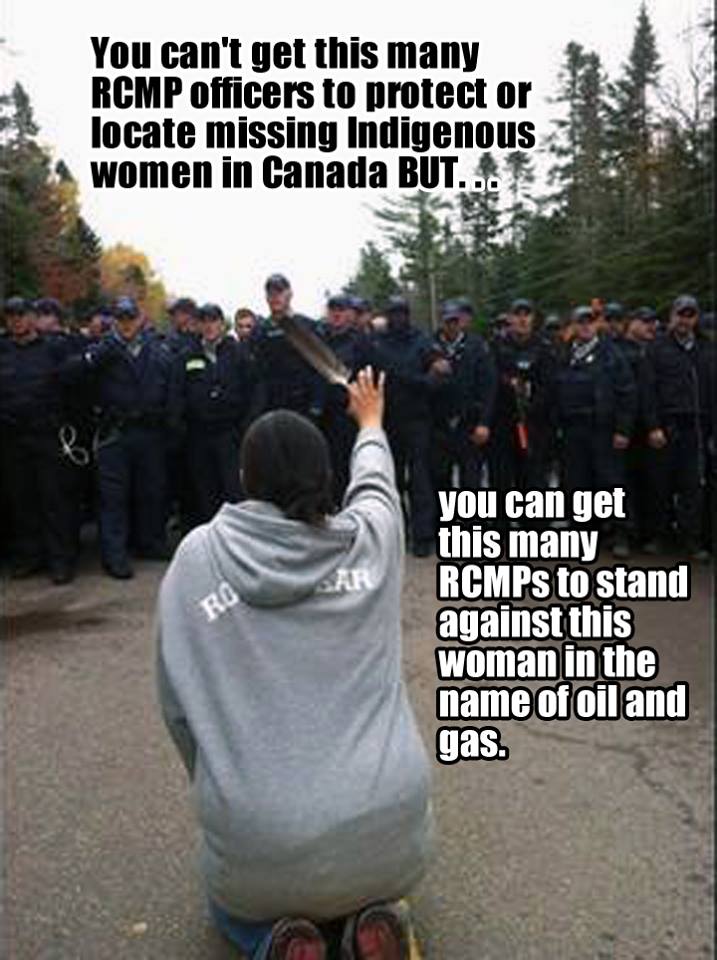
Mod 3:1 Protests and First Nations Coverage

http://montreal.mediacoop.ca/story/elsipogtog-clashes-300-years-making/19357

This picture is not from the article however they are about the same thing. I was impressed to see this picture make the rounds on Facebook especially since it was posted by friends who I wouldn’t have guessed would be interested. I think that the more that social media shares things about First Nations causes, the more awareness there will be. I found this article posted on Facebook as well and I think they complement each other well.

Module 2 Post 2 – Residential School Promotional Film (CBC)

The link below is to a YouTube clip of a residential school promotional video. The clip shows the school as a fun place for the students where they enjoy their daily lessons and outdoor activities.

All of the activities are ‘Canadian’ – the children are playing ice hockey outdoors, table tennis, and exercises. Note the western style haircuts and clothing, as well as they lessons they are learning (science lessons on the movement of the sun, for example).

Of course, nothing shows any of the atrocities that are claimed by so many aboriginals in Canada from this period. The school does look like it is doing its job, however, in assimilating the children to Canadian culture.

YouTube Link.