
Module 1 – Post 1: Minute cultural details count!


This is my first blog posting in this course. After reading the other postings and after spending sometime in regard to the password to get into the blog, I feel I am a bit focused now on a lot of some important points that are considered essential in understanding the ups and downs of technology when it comes to the First Nation culture. I am an ESL teacher. I have been teaching ESL or ELSA ( this is for adults) for more than 20 years now. I taught English in many countries. The two main countries I worked in for a longer time was Russia ( ten years) and Yemen ( three  years). My students in Yemen were Yemenis only. Actually the unifying point here is that most of the students in Yemen belonged to tribes.  In Russia 80% of my students were Russians and the rest were from different ethnic backgrounds. What attracted my attention to the Russian educational system is that it was unified by centrality of the political system at that time. Whether you are Russian or not you need to follow what is given in class. Failing to do so will not secure a good job. I am not hailing this system and I am not condemning it as it was the only educational system in the country. Any changes to it at that time would be looked at a dangerous step.

In Canada the situation is a bit different because the First Nation people are not obliged to follow the main stream educational system. Actually this step might lead to more lapses in handling this delicate case. As a result of that I feel that the Canadian ( and probably the American and Mexican )educational system(s) is more flexible in containing any educational issues in regard to educational technology and First Nation culture. I am not saying here that these issues are solved. The case is much more complex than saying that. There are a lot of minute cultural details that need to be taken into consideration  before suggesting any solution.

Here are some good sites that I found useful:

http://www.firstnations.org/program-main
http://www.fnesc.ca/  
Module 1 – Post 3 – The Metis Centre

I found the Metis Centre when researching for articles on Metis health.  The website hosts a large, searchable database that include census referenced statistical tables and a great deal of literature on Metis health and well-being.   Also included on the website are links to current projects, cultural videos, fact sheets, and a Metis Newsletter.  The Metis Centre’s moto is, “Our Health: Strengthened by Sharing”.

From the website: “The Métis Centre is one of three population-specific centres within the National Aboriginal Health Organization (NAHO). Incorporated in 2000, NAHO is an Aboriginal founded and guided institution whose aim is to advance and promote the health and well-being of First Nations, Inuit, and Métis.  The Métis Centre strives to develop accessible, culturally relevant and safe health and well-being information for a variety of audiences including, but not limited to, researchers, governments, and Métis individuals, families, and communities.”

The Metis Centre would be a great jumping off point for any heath related research of the Metis community.

The website is located here: The Metis Centre

Mod 1:2 Community Schools in SK

Community Education is a concept that acknowledges that education does not stop at the school. Community Schools in Saskatchewan are schools that have been designated by the provincial government due to the high enrolment of First Nations youth. These schools are not only schools but places where other community organizations come together to support families. Part of their mandate states:

Community Education is a unique education concept that embraces these beliefs:

  • Education is a lifelong process;
  • Everyone in the community – individuals, businesses, public and private agencies – shares responsibility for the mission of educating all members of the community; and
  • Citizens have a right and a responsibility to be involved in determining community needs, identifying community resources, and linking those needs and resources to improve their community. (Community Schools – About us)

One of the questions that we reflected on during Module one was whether educational goals are different in First Nations communities. The goal of our educational system is to create healthy, contributing members of society and I believe that this is universal goal. I think the route to this goal is necessarily different for First Nations youth and we are learning how to acknowledge the differences. Our system isn’t perfect but schools with frameworks in place to support First Nations youth and families are starting the process of healing for First Nations Communities.

Module 1 – Post #5 – Sharing Insights

Media Indigena  is a multimedia magazine which began as a collective of 7 Aboriginal bloggers from Canada, but seeks to aggregate and debate Indigenous news and creative/interactive works from across the world.

The site offers multimedia content and commentary on current issues in Indigenous arts and culture, business and politics. Of all the sites I have visited so far in my research, this one has presented some of the most interesting snapshots of Aboriginal contributors exploring expressions of their cultures and the relative states of their traditions and knowledge. One of the posts from June of last year is titled Why there ain’t no such a-thing as “Aboriginal culture”. This post touches on the important distinctions between terms such as “nations”, “confederacy”, “bands”, etc. It also demonstrates the challenging balance of interests between uniting against colonialism and maintaining strong identities as individual and unique cultures. This is a theme that I’m sure we will return to throughout this course.

As I proceed through my research, I’m sure that the voices that come through in this online magazine will provide important benchmarks against which to check my assumptions.


Connecting Statement – eLearning and Traditional Indigenous Health Literacy

Due to systemic neglect and forced efforts at assimilation, the disparities between the health status of the indigenous and non-indigenous population are significant with poorer health outcomes for Indigenous peoples. One of the key obstacles in achieving good outcomes in health care is the health literacy of the individual. Indigenous peoples, with their background of residential schools and exposure to racism have had difficulty in utilizing Western models of health literacy. Our Western definition of health literacy is the ability to read, understand, and use healthcare information to make decisions and follow instructions for treatment. The Indigenous learner, health literacy is defined as being aware of one`s own emotional health and in addressing one`s emotional needs one heals the body. A learner who uses this emotional knowledge model is frequently at a disadvantage in a health care system that is not sensitive to this reality due to a lack of educational resources. The goal of this research project is to create an online eLearning course that will educate and engage the user in the most common issues regarding indigenous health care and what be done at a local level to improve them.  This eLearning module will seek to demonstrate unique Indigenous perspectives in the transmission of knowledge regarding emotional health literacy. By using eLearning courseware, this project will serve as a means by which contemporary learning technology can be used as an educational tool for traditional Indigenous practices.


Module 1 Post 2 – Firstnations.com

I found this site really helpful in keeping up to date with First Nations news across the country and globe – http://www.firstnations.com/rss/google-news.php. It provides newsfeeds of FN news from various news sources.

One of the stories I came across http://www.cbc.ca/news/politics/harper-government-on-collision-course-with-first-nations-1.1862819 talks about the ongoing battle between the Assembly of First Nations, and the government of Canada in land disputes and education rights. With education, AFN are fighting for more legislative rights to control education for their own people, and in the wake of annual event in B.C held by the Truth and Reconciliation Commission, they believe the abuse in residential schools would never have happened if “had FN been in control over their own education”. FN is still seeking a “fair and lasting” resolution to the legacy of Indian Residential Schools. Past traumas are still alive and active today, and have profound impact on FN fight for autonomy in their communities.

Module 1 – Post #4 – The Value of Cooperation

Collaboration and cooperation are key elements of Indigenous culture that have come up in our Module 1 readings. As I have continued my research into storytelling through rich media, I encountered a great posting from Australia about Victorian Indigenous Communities and Digital Storytelling .

The post is an entry on a site called “Screening the Past”, a site which is devoted to:

  • the history of photography, film, television and multimedia;
  • the representation of history on/in these media;
  • the role of these media in social history;
  • the history and development of critical and theoretical analysis in these areas

(Retrieved on 22nd September 2013 from http://www.screeningthepast.com/about-us/)

The post includes a great story about how a reluctant “Aunt” (term for female elders in Victorian Indigenous Communities) was supported and encouraged to participate in a digital storytelling workshop by two “Uncles” (term for male elders in Victorian Indigenous Communities), who offered up photos and stories of their own. As one of the writers of the post states, “…behind every one of these individual stories is another story about how the film was made, and that’s a story about being in the community.”


Module 1 – Post 5 – The Altai and the Land

A  vivid examination of the importance of the local Indigenous connection with the land can be seen in the following video:

http://vimeo.com/7111821

The focus in the video is of the Altai people in central Russian and how they are seeking to rebuild their connection with their knowledge and customs that have suffered due systematic neglect and Russian colonization. This short documentary focuses on the environmental knowledge of the Altai, yet one of the most striking aspects of this piece is that it shows how differing types of knowledge is transmitted between members of the community as well as the profound connection that the speakers have to the place they live in. What is inspiring about this video is that it also represents a restoration of traditional knowledge and practice.

This film, sponsored by United Nations Diversity Project is a very effective reference tool in understanding the universal challenges confronting First Nations peoples globally and their struggle to  reclaim their ancient heritage and traditions.

Module 1 – Post 4 – Approaches to Healing

On the journey to understanding the idea of Indigenous knowledge and how it pertains to interaction with technology, I repeatedly came across the term of ‘Traditional Knowledge’. In order to understand this term better, I found a fascinating paper from the International Indigenous Policy Journal that examined Traditional Knowledge, Spirituality, and Lands. It can be accessed here:

http://ir.lib.uwo.ca/cgi/viewcontent.cgi?article=1042&context=iipj

What’s very interesting about the article is that it explores the means through which knowledge is transmitted throughout Indigenous communities with a strong emphasis on health care. Due to the severe disparities in health care outcomes between Aboriginal and non-aboriginal peoples, the means through which to improve this lies in understanding the proper role and historical context of traditional healing in Indigenous society. This information could be useful as a foundation for the development of curriculum regarding Indigenous health care issues and their possible solutions.


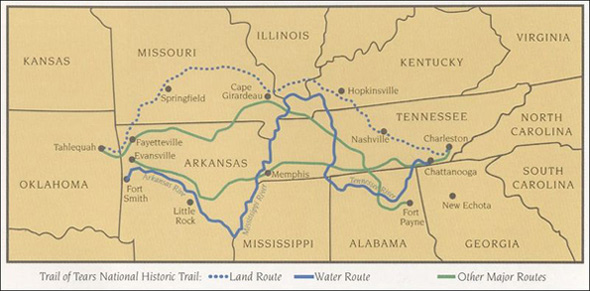
Module 1 – Post 2 – The Trail of Tears

While driving home from work the other day, listening to CBC Radio, I heard a heartbreaking story about the “Trail of Tears”

The “Trail of Tears” refers to the forced removal of the independent Cherokee Nation from their established homeland in Northern Georgia.  Despite being known as one of the 5 Civilized Tribes, the Cherokee were cheated out of their lands and forced to relocate a thousand miles to the west beyond the Mississippi.  This forced exodus of the Cherokee, during the winter of 1838, had a deadly toll, with as many as 4,000 deaths.

What really struck me was that even though the Cherokee had tried to assimilate into the new culture – they lived in frame houses in the city, produced a bilingual newspaper, farmed, and wore European finery – they were still not considered to be sovereign citizens under the Indian Removal Act of 1930 by the government of President Andrew Jackson.

The link to the CBC story is here: Trail of Tears