Categories
Uncategorized

Better late than never!

Sorry guys. I know this is past deadline but I wanted to post about my experience anyways.


I had never read a Graphic Novel before, and to be honest, I was not interested. I have never been interested in comics, video games, ereaders. I could probably be called a “lit snob”. I was all about novels, poetry, and film. I had nothing against other forms of literature for other people, I just personally wasn’t interesting in them myself. I can definitely say that I have changed my mind.


Like Sarah and Katie, I also read American Born Chinese by Gene Luen Yang. I couldn’t put it down! I was hooked from the first page. I must say, though… I had a TERRIBLY hard time looking at the pictures. I just wanted to read the words. I was so interested in what was going to happen and since I always read books that are strictly text, that was the way I knew to find out what was happening. I had to force myself to look at the pictures.  Even still, I want to go back and read the entire thing again. I am sure there are some pictures that I entirely skipped over! This was definitely an eye-opener. I am sure most of my students will not have this problem! Something to be aware of.


That being said, I thought it was an amazing book. Sarah and Katie have already touched on a lot of the major issues that the novel addresses so I will try not to be too repetitive. I found the message about accepting who you are to be such an important one. Even as an adult, I sometimes struggle to be myself and not what I think someone else wants me to be. As much life experience as I gain, I am not sure if that is something I will ever outgrow completely. I would LOVE to teach this in high school. It was such a quick easy read and super relate-able. As a white, Christian woman, I wasn’t sure how much I would relate to a story about a young Chinese-American boy. There are, however, allusions to the Christian faith that made me feel super connected to the story. There were a lot of powerful messages and allusions that I feel made it so pretty much anyone could read and connect to it.


I am very happy to have lost my graphic novel virginity. I can’t wait to read more and find ways to bring them into my classroom.

Categories
Visual Literacy Weblog Activities

Graphic Novel Convert?

I have a bookshelf. And it neatly boasts a modest display of books that I have purchased or that others have been given to me over the course of my adulthood. I believe that the books reflect both my literary likes and dislikes as well as potential likes and dislikes. I love owning books I have read or have yet to read. I never fear purchasing a book only to find that I didn’t enjoy it – perhaps it comes from a place of wanting to own that experience as well. However, I will admit there isn’t a single “unconventional” piece of English literature on my shelf.

When we were assigned to read a graphic novel, I felt uneasy. But I found comfort in the excitement I felt when I spotted the one titled “American Born Chinese”. Neither an “ABC” nor a “CBC” (commonly used initials in Asian communities), but still Asian-Canadian, I am always either on the look out for or excited to see representations of Asians in a North American context. I am eager and curious to see how Asians are being represented in various media forms, be it in movies, TV shows, novels, and now even graphic novels. In particular, when I watch a movie or TV show, I’m always quick to notice the “token” Asian actor or actress, and to observe the ways they are represented in the film or TV show. More often than not, I find that in mainstream media, Asians are rarely cast in lead roles, unless the film has to do with some form of martial arts or Asian cultural history.

There were many interesting things that struck me in this graphic novel, but what I could relate to on a personal level was the idea of Jin dating the stereotypical all-American, yellow-haired white girl or white boy in order to validate his assimilation into “white culture” or the erasure of his “Asianness”, which comes into magical fruition when he gets his wish of turning into the handsome white boy from the nerdy Asian boy he once was. When I was a teenager and a new immigrant to Vancouver, I used to tell my friends (and even myself) that I would never date an Asian because I convinced myself that they were unattractive. (What a racist I was!) At one point, I was convinced I was going to marry a Backstreet Boy. But deep down, I felt that dating a white person would somehow solidify my cultural identity as a “Canadian”. Thankfully, I grew out of that and learned how completely misguided I was. Therefore, it’s refreshing and interesting to observe these perhaps cultural-specific, yet universal identity struggles that many youth experience depicted in Gene Luen Yang’s graphic novel in an accessible and humorous manner.

Reading this graphic novel reminded me of a YouTube video “Yellow Fever” that I would like to share for your viewing pleasure, which pokes fun at racial stereotypes in a similar vein that Yang’s story did. I’m glad that LLED 368 has given me what I feel is a safe and comfortable space to explore literature that I too often steer away from. My initial prejudices about graphic novels as trivial and reductive texts have been effectively debunked, and it’s now a safe bet that they will be making a debut appearance on my colourless bookshelf.

Categories
Uncategorized

A potential change in teaching – American Born Chinese

I added this youtube video from the creater, Gene Luen Yang. He is talking about his own struggles, and being able to express it all on paper is a great way to deal with stress. I know that I used writing to express myself in high school…through pieces that I will never share, but I used it as a coping mechanism, a way to see the light through all the darkness.

Trying to find an identity, no matter who you are, or where your from, is tough. Growing up we all want to have friends, be liked, have a talent of some sort, and make it through the day in a relatively happy format. We all want to fit in. Through out our high school lives, or at least through mine, I remember feeling lost, inadequate and ashamed of anything that made me different from every one else. I used writing poetry and short stories to express myself, deal with struggles and pain, and as a way to help me sort out all of the thoughts in my head. I find that even now I use this a technique to plan and deal within my adult life.

Using a book like this in high schools, I feel, could be potentially life changing for some kids. By using not only the element of writing, but of pictures to express struggle, I feel this could push kids to put pen to paper instead of other modes of dealing in negative ways. Many teens turn to drugs and alcohol to mask and hide behind, and some always will, but what if they could write stories, or draw pictures to make sense of their own personal chaos. Giving kids an outlet, that isn’t just writing, may allow some to explore graphic novels if they never had before.
Graphic novels can do so many things. They can tell a story of the past, create images for the present, and evoke dreams for the future. I feel that now that graphic novels are being recognized within the school system, that they have the potential to reach more kids because they are using the same literature, but displayed in a different type of language.

-Sarah

Categories
Uncategorized

American Born Chinese

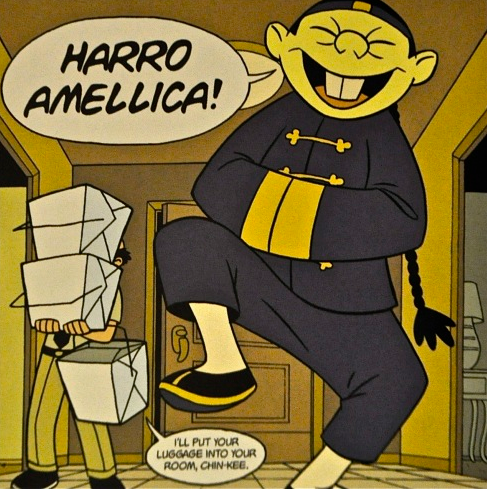
When we were asked to choose a book it was so hard to pick one because they all looked so interesting. I ended up choosing “American Born Chinese” by Gene Luen Yang because the pictures when I flipped through the book interested me a lot. specifically this one:

I thought, this must be about racial issues in America… (because there is no way it would depict a Chinese person in this way without some indication that racism is wrong) So, I really wanted to see how the author would wrap up the novel.

There are 3 stories within the book, which alternate and connect as you move throughout the book; they target different reactions to racism.

The first is about the very proud and self righteous monkey king who experiences racism (or a form a prejudice where he is seen as lesser for being a monkey). The monkey king handles it by lashing out and taking drastic measures to hurt the people who hurt him. This one interested me because it drew on how Chinese culture often uses myth and parables to tell stories. He also goes on to study the highest levels of Kung-Fu, which gives an even stronger tie to Chinese traditional culture.

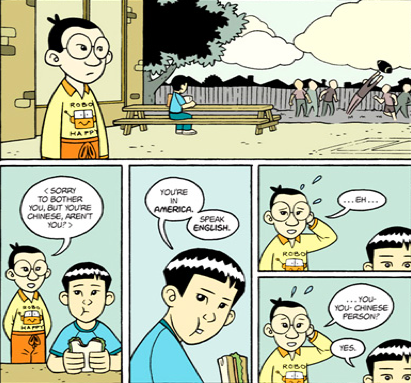
The second story is about a Chinese boy, Jin Wang, in an American class – this is the story we can all relate to the best. It shows the type of racism that probably happens all the time in our high schools. The Chinese-American boy is singled out and not accepted by the white students (even though he was born in America and speaks English fluently) He ends up suffering silently, not having friends and wishing he were white. He lacks confidence and can’t see what others value in him.

The third story is about a white boy, Danny, who has a Chinese cousin “Chin-Kee”, Chin-kee is the ultimate stereotype of a Chinese person or “F.O.B.”. In this story, Danny is extremely embarrassed of Chin-Kee and his Chinese way of acting; he believes that he will lose all of his friends and the respect of the whole school and he will eventually be teased so much that he will need to switch schools. This Chinese stereotype was displayed in Chin-Kee’s language: R and L (shown in the above picture), the food he ate: which had a cats head in it, the jokes he made: which were just weird, his name: Chin-Kee, and the way he appeared: buck-teeth, school uniform, slanted eyes, etc.

All of these stories do, in fact, tie together in the end and make a very nice conclusion that promotes acceptance. It would be an excellent way to bring an alternate form of literature into a classroom and discuss the effects of racism with students.

-Katie
Ps. Sorry for posting late, I was having major internet problems.

Categories
Uncategorized

Fall Haiku

falling to the ground
I watch a leaf settle down
in a bed of brown

~ Anonymous: Source)

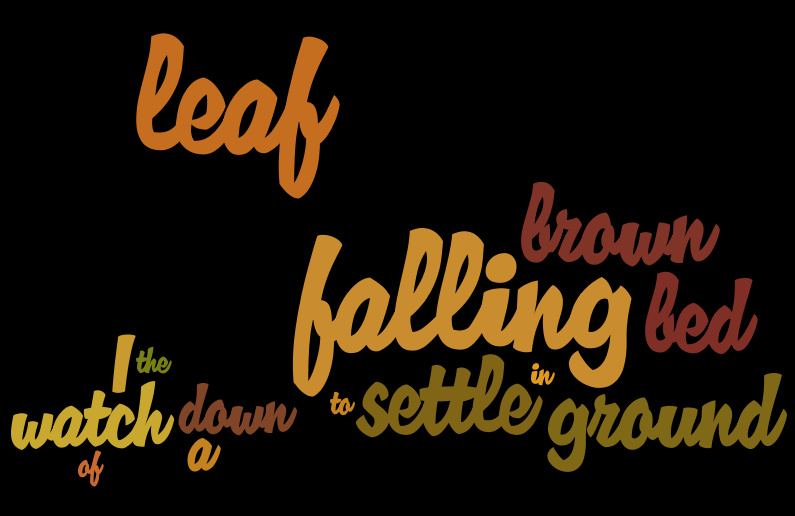
Following from our discussions last week, I selected a short anonymous Haiku from the UCLA Asia Institute site and identified certain words I felt carried greater weight: “falling,” “ground,” “leaf,” and so on. I created a text file, pasted in the original poem and then repeated words I wanted to emphasize. I pasted the resulting text with some words repeated many times into Wordle and manipulated the display using the “layout” and “randomize” features. Here’s the text I used:

falling falling falling falling falling falling falling falling
to the
ground ground ground ground ground
I I I I
watch watch watch watch
a
leaf leaf leaf leaf leaf leaf leaf leaf
settle settle settle settle settle
down down down
in a
bed bed bed bed bed
of
brown brown brown brown brown

The resulting adaptation may not be particularly effective in conveying the sense of the original Haiku; however, does it have any merit on its own? And does the above text, as an intermediary step, have any aesthetic merit?

I’d be interested in seeing more explorations of visual adaptations of poetry for this week’s seminar on literature and image.

Teresa

Categories
Weblog Activities

The Cat and the Maus

I’m an avid graphic novel fan and have wanted to read Maus by Art Spiegelman since I first heard about it in high school. However, getting my hands on a copy of the novel was harder than I thought and I eventually forgot about it. Now, almost five years later, I finally had the opportunity to read Maus and my whole experience shifted between laughing at Art’s father’s antics and crying at the horror that was the Holocaust.

Throughout Maus, Spiegelman uses the “cat and mouse” metaphor to portray the Nazis and Jews, respectively. As expected, the mice are victimized thtoughout the comic, paralleling the events of the Holocaust and the victimization of the Jewish people at the hands of the Nazis.

Spiegelman uses very somber black tones and heavy black shadowing all through the graphic novel, a visual for the oppressive atmosphere of the second world war itself. Along with the extensive use of black shading, is the shadowy portrayal of the cats that are the Nazis. In particular, the title page for “Prisoner of War,” the third chapter of the comic, shows the menacing figure of the cats are they stand over the body of Art’s father.

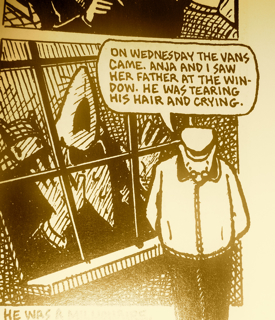
Running parallel to the story of the Holocaust recounted by Art’s father, is the story of Art’s relationship with his parents. As Art’s father, Vladek, continues to talk about his experiences, the reader notices the subtle tensions that exist between Vladek and Art. Most obvious, are the differences in their attitude towards money. Without generalizing Vladek’s experience, it is still plain for the reader to see that his opressive experience during the war has left him wary of spending money too often, while Art – who has had no such experience – is not bothered by a need to be thrifty. Spiegelman emphasizes the differences between Art and Vladek by often drawing them sitting on opposing sides of the desk or facing each other across a table, rather than showing father and son sitting side-by-side too often. Moreover, like his relationship with his father, Art’s relationship with his mother, Anja, was also strained. Halfway in Maus, Spiegelman showcases a smaller comic that features Anja. The art in this comic called “Prisoner on Hell Planet,” while the characters are drawn with more a humanoid appearance, is just as alien and dark. The four-page comic discusses the circumstances surrounding Anja’s death.

Although it took me almost five years to read Maus, I’m glad I had the opportunity to experience the first part of Spiegelman’s interpretation of the Holocaust. Maus has both historical and artistic merit as a perspective of the second world war. The graphic novel highlights the victimization, horror and opression of the war through the eyes of the one of the world’s smallest creatures – a mouse.

-Kiran Heer

(P.S: To see the specific artwork I’ve refered to in the article, click on the hyperlinks provided.)

Work Cited: Spiegelman, Art. Maus. New York: Random House, 1986. Print.

Categories
Uncategorized

Maus — the horror and fragility of an open mouth!

This is the first graphic novel I’ve ever read and I couldn’t put it down. It is in fact a novel I have heard much about and had intended to read over the years. I am glad to have had the opportunity to do so now.

Interesting how Spiegelman uses the traditionally “low” form of the comic book to treat a very very serious and grave subject matter. Subversive!

I found the “visual rhetoric” striking and powerful. Spiegelman’s specific animal representations are potent. First off, the choice to portray the Jews as mice of course brings up the Nazi representation/metaphors of Jews as rats. The cats (Nazis) and the pigs (Poles) elicit associations of cunning and greed/plenty; also of cat as aggressor/oppressor and mouse as victim/oppressed. There is something reductive and stereotypical about the visual representations, which reflects the horrific reductive nature of Nazism and anti-Semitism.

The visual/graphic format itself also recalls the “Protocols of the Elders of Zion” – Nazi anti-Semitic propaganda.

Interesting how many different types of texts lie within the text: diagrams, photographs, detailed plans, and maps… There are narratives within narratives, and a fluid interplay between image, narrative, and dialogue.

In my own reading, I noticed that I am far more text centered than image centered. My eyes followed the words and I actually found myself forcing myself to slow down and pay attention to the illustrations at times. The image that won’t leave me is that of Anja, mouth agape. Throughout most of the book, the mouths of the characters  (mice) are closed. When they’re open they are portraying cries and screams, lending a humanity and vulnerability that is heart wrenching.

Categories
Introductions

Weblog entry in response to the Frey & Fischer article “Using Graphic Novels, Anime, and the Internet in an Urban High School.”

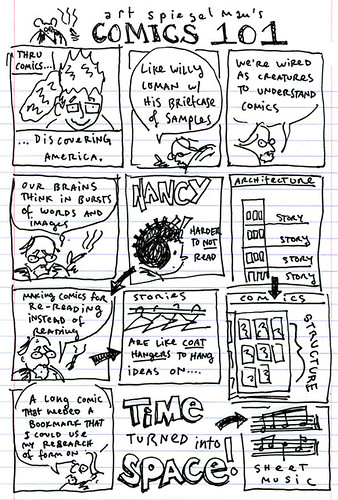
Art Spiegelman Comix 101

(Image uploaded from Flicker under creative commons license originally posted by Austin Kleon)

Writing prompt: “How is meaning made at the intersection of word and still image?”

Following Messaris, visual language (i.e., the still images in graphic novels) “obeys semantic conventions, but those conventions are rarely, if ever, entirely arbitrary, and the syntactic rules of visual language (i.e., the conventions of editing or montage) are so fluid and open to change that at times it can appear as if there are in fact no such rules at all.”

Since the semantic conventions of images are not entirely arbitrary but more a result of cultural (“multiple”) literacies – as opposed to the specialized discourse of highbrow literature and literary criticism – the ESL students that Frey and Fischer studied were able to construct meaning in ways that written text often does not allow. Graphic novels/manga/anime are said by Frey & Fischer to have “provided a visual vocabulary of sorts for scaffolding writing techniques, particularly dialogue, tone, and mood.” Judging by the results, the authors differing pedagogical approaches were largely successful in expanding on what the kids already knew.

In regards to Art Spiegelman’s Maus in particular, his use of masks (here is link to a piece on the subject with a .gif image from the novel to illustrate: http://wellread1.blogspot.ca/2008/10/maus.html) by some of the characters is brilliant, presenting just such an opportunity to scaffold, in this case to engage the students in an inquiry around the word/idea “persona”.

Simon Schama, in a review of Spiegelman’s Metamaus (a follow-up to the novel – here is a link to the publisher’s book trailer http://www.youtube.com/watch?v=ql4oZtLruFE) opines that “Maus succeeded where so many more grandiose attempts to convey the enormity of genocide have failed, partly by side-stepping the adequacies, or inadequacies, of mere words to represent literally unutterable horror.”

I tutor kids in essay writing – many for whom English is also a second language – and have been quite resistant to including graphic novels in my practice, mainly because I thought they made textual interpretation easier for precisely the reasons mentioned above. My thinking was that, since students would be tested in the provincial exams and on the SAT on their abilities to analyze and produce without visual aids/prompts, it would be useless to allow them a crutch. After reading Maus and reflecting on what others like Schama (a very well respected art critic/theorist) have said, I’ve come to see the genre differently: just because graphic novels like Maus re-imagine biography and history (or whatever “classic” genre) as fable does not invalidate the genre. In other words, if you want kids to succeed in the future they will create, give them tools they need by any and all means, not just using the ones you learned/value. Part of this is facing the fear that you do not have total command of these emerging literacies either, as (thankfully) we have often admitted in class (I have challenged myself to learn how to use Prezi to fashion my next weblog entry.).

Another reason why I’m beginning to think differently about graphic novels has to do with the inevitability of the cultural shift. The momentum is inexorable, and eventually the school curriculums will be forced to change as a result. A quote from one of the articles I read to write this weblog (entitled “On the Origin of Adaptations: Rethinking Fidelity Discourse and ‘Success’ – Biologically’.) sums up my thinking on this (as per Messaris, ‘analogically’ speaking…): “As in biological evolution, descent with modification is essential.”

Finally, I want to share the postscript to the “Using Graphic Novels…” article entitled “EJ 75 Years Ago”. The postscript is a quote from a contributor to EJ by the name of Wanda Orton (from 1929!): “Do you try to break the age in which you live or do you try to understand it?” Clearly, we have a responsibility as educators to not only understand, but actually master the age; but in the end, can we really expect to stay ahead of the kids we are trying to teach? Perhaps the best we can expect of ourselves is to “denaturalize” the semantic/syntactic connections our students unconsciously make when presented with visual imagery (to paraphrase Messaris)?

Works Cited

Bortolotti, Gary R. Hutcheon, Linda (2007). “On the Origin of Adaptations: Rethinking Fidelity Discourse and ‘Success’ – Biologically’. New Literary History, Volume 38, Number 3, pp. 443-458

Frey, N. and Fisher, D. (2004). “Using Graphic Novels, Anime, and the Internet in an Urban High School.” The English Journal, 93(3), pp. 19-25.

Messaris,P. (1994). Visual literacy: Image, mind, reality. Boulder, CO: Westview Press.

Orton, Wanda (1929). “Released Writing.” The English Journal, 18(6), pp. 465-73.

Schama, S. (2011). MetaMaus. FT.Com, , n/a. Retrieved from http://ezproxy.library.ubc.ca/login?url=http://search.proquest.com/docview/905055822?accountid=14656
Categories
Uncategorized Visual Literacy

Wordle Poetry


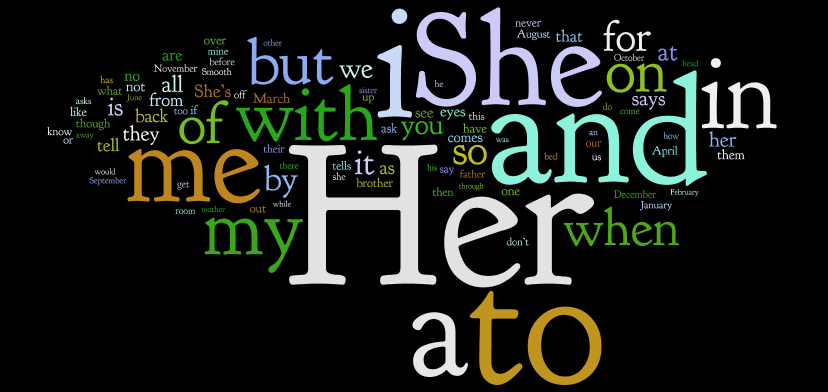
here is a worlde reading of one my poetry projects. because i consider “the common english words” to play a pivotal role in the work, i decided it should be included. the word “Her” actually appeared more frequently in the text, than “the.” In the attached picture i was able to cut out “the” so to put more emphasis on the other words. this alternative method of actually ‘reading’ my own poetry brought forth many aspects of the work that i either was not aware of, or would not admit to. for instance, my choice of words prove the work to by quite lyrical. In some sense even clique.


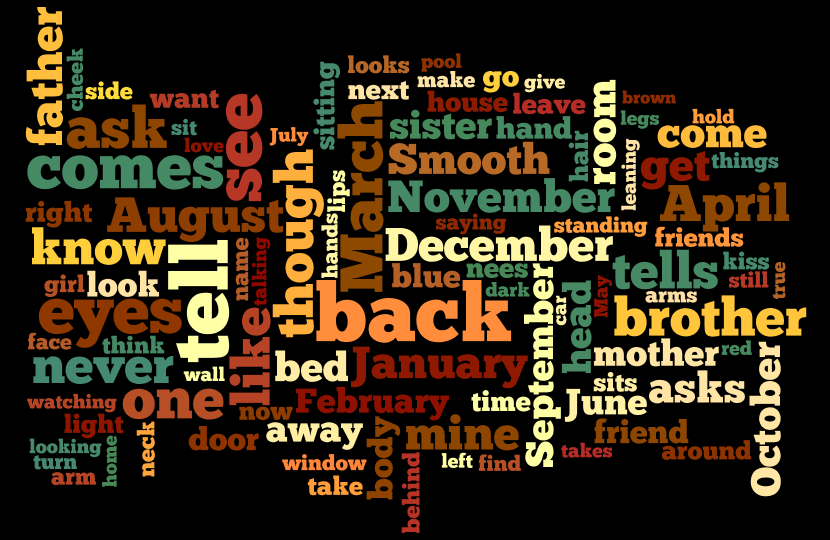
in the following picture, i removed the “common words” and was surprised to see a few things. to begin with, the months that are part of the poems chronological titles seem to play a larger role in this reading. now i see the work to be a lot more confined to a temporal framework that i had assumed.


my preoccupation with the human frame, also, easily comes through, with words such as: body, eyes, face, hand, arm, arms, legs, cheek, hair and so on.


another aspect that surprised me was a domestic undertone, with words like brother, father, sister, and mother, which i had otherwise not intended nor noticed.


the first rendition of the words, including the common words, it self looked like a poem. i unfortunately lost the image, but it even made syntactic sense.

Categories
Visual Literacy

Visual Literacy and Social Media

In “Visual Aspects of Media Literacy,” Paul Messaris discusses the importance of acquiring visual literacy – or the ability to critically examine visual messages. Messaris provides two views of visual literacy, an optimistic and pessimistic one. Positively, visual literacy can broaden an indvivual’s knowledge base and the tools they can utilize to express their own creativity. However, a negative outlook expresses the concern that visual literacy can be nothing more than a way to resist the messages inherent within visual media. Nevertheless, visual literacy is required to understand the subtext within advertisements, films and photographs. Messaris terms the connection between a visual and its subtext “analogical” and states that an analogical representation does not need an clear simiarity between the picture used and what it is meant to symbolize. Moreover, an analogical representation is not confined to abtract concepts. Analogical representations could be used for visualizing quantitative information, such as within graphs, creative interpretation, or conveying controversial messages. Moreover, unlike verbal language, visual language does not have a common set of rules and often needs to utilize words to clarify its messages, such as lines in films that state the passage of time or words on advertisements, such as slogans. Considering the heavy presense of visuals in media, it is importance for educators an scholars to be visually literate and teach visual literacy.

While reading Messaris’ article, I found myself agreeing with his claim that it is necessary to teach students to be visually literate. Looking back on some of my own experiences, I realize visually literacy is not just important so that students can understand the subtext under what is being represented in media, but also so they know how they represent themselves in social media. For instance, social media sites – such as Facebook and Pinterest – rely heavily on visuals to create interest. In most cases, the first thing an individual sees before “friending” someone on Facebook is a profile picture. In this instance, the profile picture is a visual summary of an individual and therefore, it is important for students to realize how they are representing themselves online. Teaching visual literacy is significant in increasing ot just a students understanding of the world at large, but also themselves in relation to social media.

-Kiran Heer

Work Cited: Messaris, P. (1998). Visual Aspects of Media Literacy. Journal of Communication, 48(1), 70-80.

Spam prevention powered by Akismet