Categories
Uncategorized Visual Literacy

What about Internet Memes?

“An ‘Internet meme’ is a form or concept that spreads via the Web, whether through email forwarding, viral videos or blogs.… Although they may recede from view, memes never fully cease to exist, surviving … in the ever-expanding network of servers that make up the Internet. In the realm of digital memory, what seems to have disappeared may simply be lying dormant in the recesses of a hard drive.” (Copeland, 22)

Internet memes come in many different genres. Like the quotation says, they can be email forwards, videos, blogs, and other things. These days, photo memes are everywhere. This is partially because they are so easy to make and distribute.

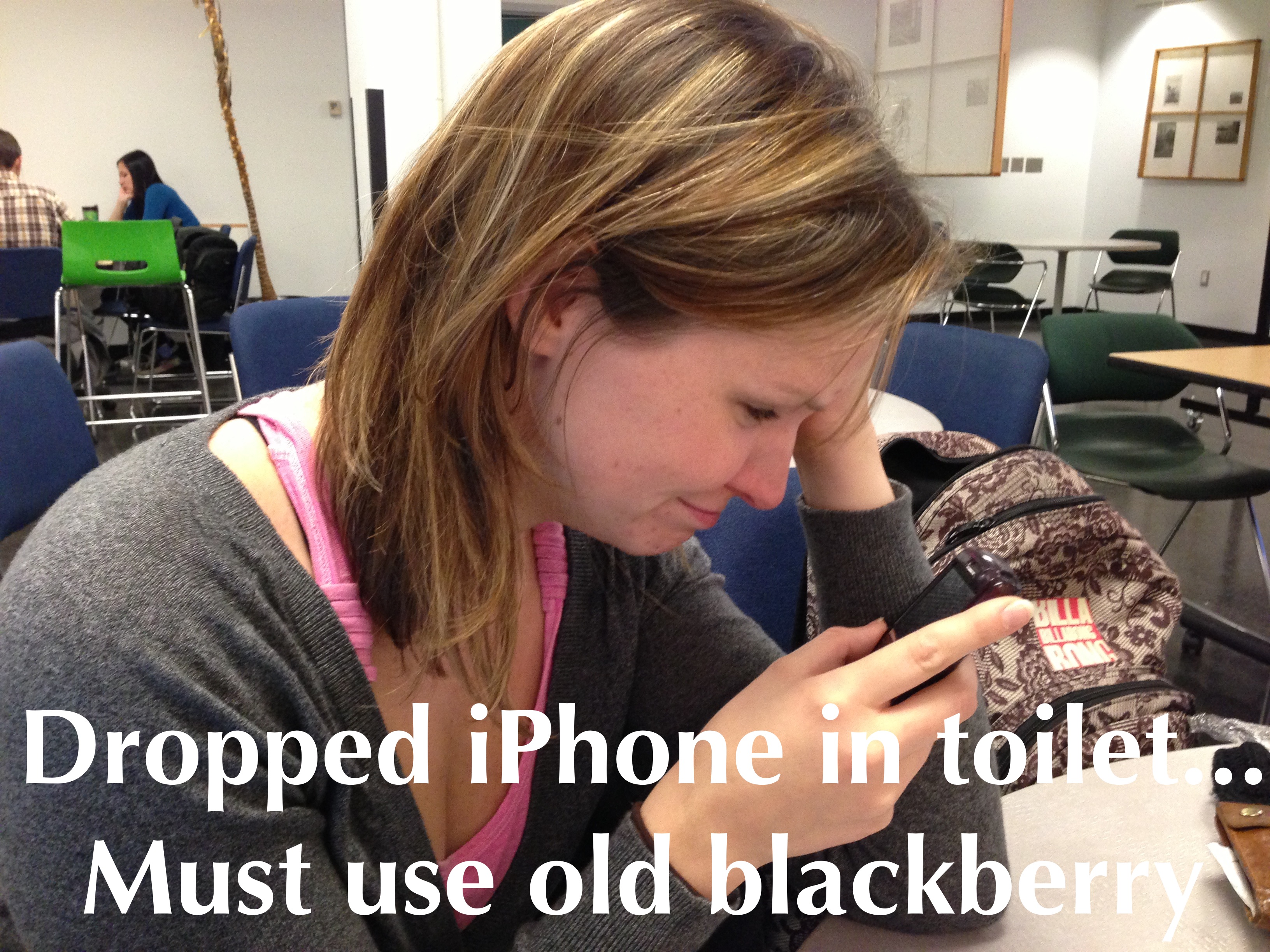
For example, I downloaded a meme creator onto my phone and made a meme in about 10 minutes. This meme is one of the “first world problem” memes. I used a situation that happened to one of our classmates… and she agreed to model for the picture.
Furthermore, to emphasize just how quick and easy memes are to use and how important it is to teach students to use and create memes carefully, here is a little story. For those of you who are familiar with meme characters, you may know that there is one meme character named “bad luck Brian.” Brian is a normal kid from a high school who happened to have an awkward school photo taken. One of his classmates got ahold of his photo and created an internet meme out of it. Brian never agreed to be in a meme, but now his face is known by millions of people and there is no way for him to change that. Here is one of the memes about him:

Actually, there are many meme characters already in use. Here is a photo of some of them… it is inviting you to use the characters to create your own memes.

And here is a video of where some of these faces came from:

Where did the Meme characters come from?

If you are interested in creating memes for possible classroom use (or even to teach children appropriate use of memes) here is a website you could use:
http://memegenerator.net/Meme-Creator

And the iphone app I used to create Melissa’s “first world problem” meme is called “just meme it”

-Katie

………………………………
COPELAND, C. (2011). MUTATING MEMES. Afterimage, 39(3), 22-23

Funnyjunk contributor: TexasChainsawDisco (2011). Meme Faces. Funnyjunk. http://www.funnyjunk.com/funny_pictures/1698834/Meme/

Mobil contributor (2012). Bad luck Brian. Mobilbeta. http://memegenerator.net/Meme-Creator

Youtube contributor: Duffbeer96x (2012). The origins of meme. Youtube. https://www.youtube.com/watch?v=z07TAM5Cc3A
Categories
Uncategorized Visual Literacy

What is your game?

Before you begin to read, here is some music by “Next Alex” to get you in the mood
Next_Alex_-_Super_mario_bross_remix

I grew up (unlike Sarah who posted before me) with a great love of video games. I had an older brother who influenced me to play and I enjoyed watching him play. I developed a deep love for Mario, Sonic the Hedgehog, and others.

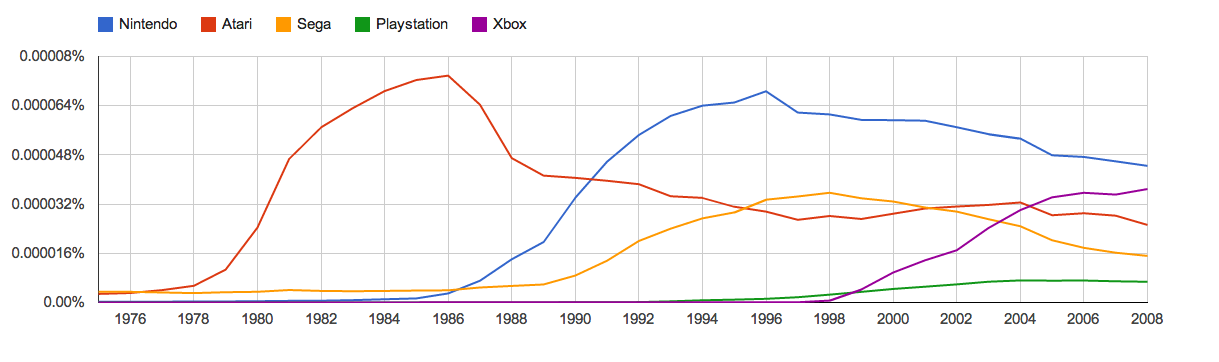
I thought it would be interesting to take a quick look at the Ngram viewer to see approximately how popular each system was (at least in literature).

The Ngram viewer tells us that the Japanese video game companies are by far the most popular. Atari, the first system to become popular, was created during Japan’s famous “bubble period” (in which the property in Ginza, Tokyo was valued at JPY 90,000,000 or $750,000 per square meter.) Of course, Atari’s presence in literature quickly dropped as Nintendo’s rose to almost the same popularity as Atari had had. Since then, at least in literature, Nintendo’s popularity has never been surpassed. It is also interesting to check out the height of popularity of Sega, Playstation and Xbox. I personally was never interested in Playstation or Xbox, but I thought I was an anomaly; I was shocked to find that Playstation’s popularity in literature was so low! It makes me wonder which, if any, video game consoles our classmates have owned.

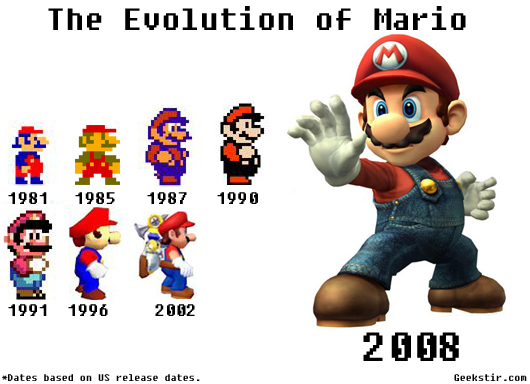
For those who know their video games, you know that the technology advancements of original Nintendo compared to the current Nintendo Wii are huge! It went from a very low quality visual and basic controller to a realistic and 3 dimensional graphic with a motion sensitive controller. Even the characters in the games, which have been updated as or more often than the consoles, show a huge amount of digital evolution. A great example of this are the following images of how the Nintendo character “Mario” has changed since he was created.

……….

If you have a chance to answer this question, please do; I would like to see if our class can compare to the results of the Ngram viewer.

Which, if any, video game consoles have you owned?
Which one do you prefer and why?

– Katie

……….

Grafiti, Codi. Flickr Blog. http://www.flickr.com/photos/digitalcodi/4261845216/

Joe. Housing Japan: Real Estate Market Japan, Real Estate News. http://housingjapan.com/2011/11/10/a-history-of-tokyo-real-estate-prices/ Accessed Nov 26, 2012.

Next Alex. SOng “Super Mario Bross Remix” http://www.jamendo.com/en/search#qs=q=super mario Accessed Nov 26, 2012.

Categories
Uncategorized

You Wanna Be On Top?

Having seen a few episodes of America’s next top model I saw that this season brought in something new. Usually they had 4 judges at the panel to decide which models were moving on and which were leaving the competition. This season, however, they brought social media and fans onto the panel.

Now each model receives a score out of 10 from 3 judges plus the average score out of ten given by the members of the fan-site. Even fans comments get shown on the TV show.

Here is the link to the website:
http://cwtv.com/thecw/antmvoting

-Katie

Categories
Uncategorized

American Born Chinese

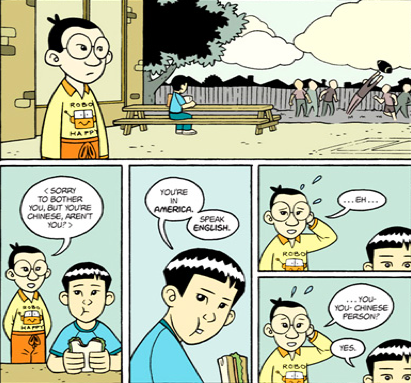
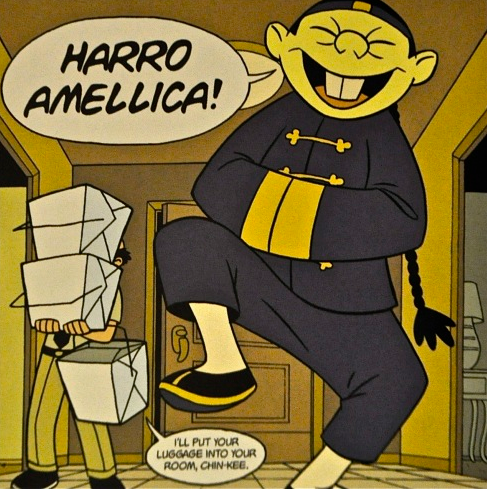
When we were asked to choose a book it was so hard to pick one because they all looked so interesting. I ended up choosing “American Born Chinese” by Gene Luen Yang because the pictures when I flipped through the book interested me a lot. specifically this one:

I thought, this must be about racial issues in America… (because there is no way it would depict a Chinese person in this way without some indication that racism is wrong) So, I really wanted to see how the author would wrap up the novel.

There are 3 stories within the book, which alternate and connect as you move throughout the book; they target different reactions to racism.

The first is about the very proud and self righteous monkey king who experiences racism (or a form a prejudice where he is seen as lesser for being a monkey). The monkey king handles it by lashing out and taking drastic measures to hurt the people who hurt him. This one interested me because it drew on how Chinese culture often uses myth and parables to tell stories. He also goes on to study the highest levels of Kung-Fu, which gives an even stronger tie to Chinese traditional culture.

The second story is about a Chinese boy, Jin Wang, in an American class – this is the story we can all relate to the best. It shows the type of racism that probably happens all the time in our high schools. The Chinese-American boy is singled out and not accepted by the white students (even though he was born in America and speaks English fluently) He ends up suffering silently, not having friends and wishing he were white. He lacks confidence and can’t see what others value in him.

The third story is about a white boy, Danny, who has a Chinese cousin “Chin-Kee”, Chin-kee is the ultimate stereotype of a Chinese person or “F.O.B.”. In this story, Danny is extremely embarrassed of Chin-Kee and his Chinese way of acting; he believes that he will lose all of his friends and the respect of the whole school and he will eventually be teased so much that he will need to switch schools. This Chinese stereotype was displayed in Chin-Kee’s language: R and L (shown in the above picture), the food he ate: which had a cats head in it, the jokes he made: which were just weird, his name: Chin-Kee, and the way he appeared: buck-teeth, school uniform, slanted eyes, etc.

All of these stories do, in fact, tie together in the end and make a very nice conclusion that promotes acceptance. It would be an excellent way to bring an alternate form of literature into a classroom and discuss the effects of racism with students.

-Katie
Ps. Sorry for posting late, I was having major internet problems.

Categories
Introductions

E-ink

ebook

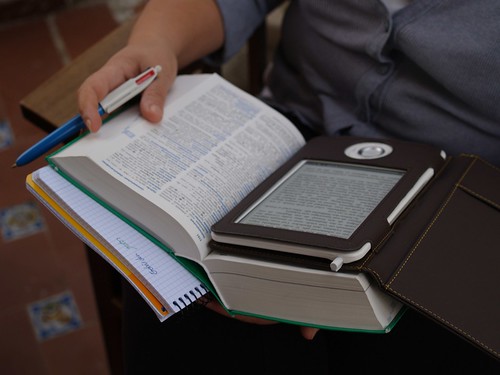
This photo is a great representation of the way the world is moving. When I first saw it I thought it was a new version of that old trick of hiding your magazine or comic in a novel so that no one knows what you’re really reading – but now the trick is to hide your electronic book (I quickly realized that this in fact is not what the picture shows). However, it made me laugh because there is a bit of a stigma around e-readers and the lack of authenticity when reading from an electronic source (Of course, they cannot replace the wonderful sensation of flipping old, ripped pages and smelling that old book smell). I have even seen commercials defaming e-books, saying that they will cause the end of the written word and the death of the author. It annoys me when I hear things like that because since I bought an e-reader, I have bought and read more books than ever in my life. I believe that these new technological mediums for literature have been and will continue to be more and more effective in things like sharing, spreading and enjoying.

I chose this photo because not only is it important for us to remember and teach how to use the old methods, like looking up a word in a great big paper dictionary, but also the new. In this modern world we cannot look at technology as a threat, but rather as an aid, a way to make our lives easier and possibly better. I am excited to be taking this course because I love the idea of learning new and exciting way to bring modern ideas into the classroom.

Spam prevention powered by Akismet