Hi everyone,
Here is the link to our Google Maps which we will be using for our media project tomorrow. Happy poetry hunting!
– Katrina, Samantha, Zlatina, Dominic
Hi everyone,
Here is the link to our Google Maps which we will be using for our media project tomorrow. Happy poetry hunting!
– Katrina, Samantha, Zlatina, Dominic
Some children in my neighbourhood drew some pictures that reminded me of the class, and how much media is present in today’s
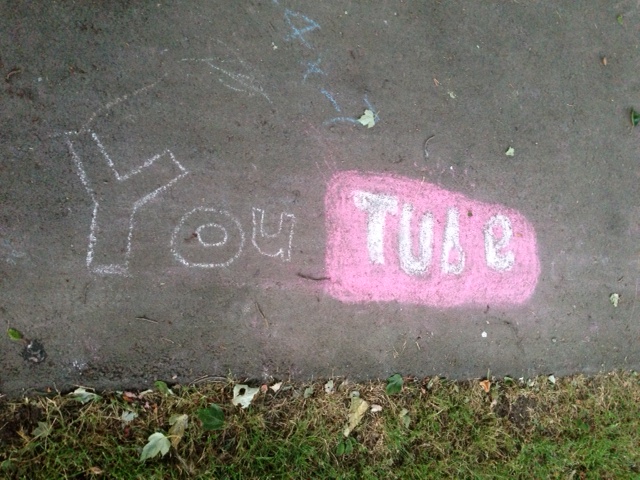 childrens’ lives.
Hi y’all,
Feel free to check out our first ‘children’s book’ How to Howl at the Moon along with an explanation of how and why it was created.
Let us know if you have any questions/ comments!
Ellis & Annie
Here is the link to my post for our hypertext story on UBC Wiki. It’s a weird story and may disturb some readers–my apologies in advance.
– Katrina
If you’re interested, check it out when you have an hour or so. Ayiti: The Cost of Life.
James Paul Gee’s article “Good Video Games and Good Learning” has provoked many of my childhood memories about gaming and learning. I remember playing my first video game when I was in Grade 5. It was a role playing PC game that was immensely popular at that time. I can still feel the excitement and the fear when I turned on the computer screen. Needless to say, I “died” many times and failed many tasks. However, what kept this experience alive in my memory is not the excitement nor the storyline, it is the skills that I learned from playing this video game which have benefited me throughout my teenage years.
Gee’s article provides the potential links between playing good video games and school based learning. However, I would like to take this notion back for a bit and discuss about how video games enhance (teach) their players the essential (or advanced) computer skills and knowledge. When I played my first video game, computers were a new technology. Learning how to use a computer was quiet difficult sometimes. I adored people who could type very fast or easily go surfing on a computer. To be able to play my first video game on a PC, I forced myself to learn how to install the game, how to properly turn on the game, and how to fix it whenever it does not display correctly. During the game, I learned to type faster and read faster as the game was an interactive game and I was always so anxious to know what happens next. Before long, my computer skills were improving rapidly. As a result, I was able to obtain a higher grade in my computer class and develop an interest in computer skills and knowledge. These skills have helped me in many occasions and served as a fundamental knowledge for many other knowledges I was interested in.
Another interaction with gaming and learning that I had occurred during my 8th grade (I am not an advanced game player since I don’t have a good fine motor skill). At that time, I was still in ELL and was looking to improve my English. During the summer time, my friend suggested me to play an online game called “Gundum”. I was very fascinated by the setting of the game and was quickly immersed in it. Soon after, I found out that everyone uses English to communicate with each other (it was a team based game). I was terrified at that moment as I did not want other players to know that I cannot speak English that well. The solution I found to this problem was to always have a dictionary beside me so whenever I was not sure how to spell something, I could quickly go to the dictionary to check for the correct spelling. At the end of the summer vacation, my spelling had improved enormously.
Video games have benefited my learning process in many different ways. I would encourage my students to play good video games as I know they will learn from it. However, the issues of content appropriateness and time management are still some areas educators and scholars need to focus on.
Sarah Wu
Blog Post #2
Gee brings up the interesting point that after playing video games for “eight straight hours” he found it to be a “life- enhancing experience without even knowing what [he] meant by that. This demonstrates the power of video games as discussed in David Perry’s TED talk titled “Are games better than life?” In his talk, Perry explores the potential of video games to explicate emotion from its player. The ability for video game stimuli to make one feel happy, sad, nervous or whatever other emotion is created through the player’s ability to interact with their environment while creating a fluidity between reality and virtual reality.
Perry mentions another interesting point that propaganda and brainwashing can have more success if done through video games as opposed to traditional means. The ability to connect with the masses in a “fun and engaging” (Perry) way that “leave[s] the brain vulnerable to programming”. The ability for video games to ignite an emotional response from the player can a powerful tool.
The following are a few facts about video gaming from 2006. Some of the facts disspel some myths. [Perry’s TED talk was given in 2006 and Gee’s book was published in 2003]
-43% of gamers are female
-the average age of gamers is 30 years old
-the people who buy the most games are 37 years old
-83% of games do not contain mature content (i.e. violence)
According to the Entertainment Software Association these statistics have minimally changed (this data was collected in 2012).
-45% of all gamers are female
-the average age of gamers is 30 years old
-the people who buy the most games are 35 years old
However, with smartphones (purchase of apps) and increased use of social networking games this area accounted for 40 percent of game sales in 2012.
It is interesting to note that although there is constant debate over whether violent video game content makes players violent- parents are present when games are purchased or rented 89 percent of the time.
I wonder as educators, what our role is in the real/ virtual landscape? As video games become more complex and contain layers that players explicate a lot of meaning, it is necessary to educate our students on video game literacy. Asking students how they feel after playing a game and what created these feelings. Discussions we had on film studies need to occur with video game studies and the same questions need to be asked about emotion, design, etc. As many of our students are fully engaged in the world of video games, it is imperative we incorporate video games and discussions of video games into our teaching practice.
Fatima Ali
Blog post #2
Works Cited
Gee, J. (2005). “Good Video Games And Good Learning.” Phi Kappa Phi Forum, 85.2, 33-37
“David Perry: Are games better than life?”. Youtube. TED talk. Feb 2006. Web. July 15, 2013.
As I started reading James Paul Gee’s article, Good Video Games and Good Learning, I was expecting some sort of general look at why playing video games can actually be good for learning. I am a gamer, so I didn’t anticipate any big revelations or ‘a-ha!’ moments about how video games aren’t actually the worst pastime you can have.
However, I was surprised to find the article so inspiring in terms of actual change that could be happening in the education system that so many of us are currently trying to find work in. I’m so intrigued by the idea, not that we should be having more video games, but that we should be using the “learning principles” (p. 34) that video games use to improve the way we teach students.
From Gee’s list of sixteen principles, there are a few that really stood out for me. The first on the list, Identity, is a hugely important concept for high school students. The comparison he makes between an in-game identity and the identity of a scientist or furniture-maker connects also to the idea that being a student is another form of identity that young people adopt while they are in school. The unfortunate part of this is that so much of that student identity is determined by outside forces – some of which can be actively hostile towards young people! How great it could be to have students proud of their educational identity and engaged in improving within it.
The fourth principle is Risk Taking and it put me in mind of the feedback provided to students by teachers. I’m thinking more specifically of English classes where students often submit work that isn’t marked by a simple ‘right’ or ‘wrong’. While I was on my practicum I often felt that there was not enough time to adequately use the feedback I had for students’ writing assignments in order to help them improve their writing. There were times that I had to just hope they would read and absorb my comments so that their next assignment could be better. Yet, the mark they received on that first assignment had consequences that might inhibit a student from doing just that. This is very much related to principle eight, Challenge and Consolidation. The learning that Gee describes sounds to me a lot like an apprenticeship – or, similar to experiences I’ve heard about graduate school. The anxiety of failure is lessened and students are encouraged to master a topic and are given the personal learning space in which to become dedicated to improvement.
There was definitely a great deal in this article that had me thinking twice about educational reform and from what arena the inspiration for it should come. In fact…I think I might head to the library and take a look at Gee’s book!
-Cristina R.
As a self-identified gamer, I am willing to say that I am thrilled to discover the incorporation of “gaming” into the educational curriculum. I believe it is a fitting that the gaming sphere should be incorporated into education considering the different types of learning that is discovered in video games. When I was a child, my grandfather bought my sister and I a Nintendo; however, my sister found no entertainment with it, but I discovered the different interactive functions of the game. It was Super Mario Brothers the original edition. The game was the foundation of the start of my educational building: the foundation being the problem solving skills and quick thinking strategies. As the years progressed, I challenged myself with more difficult games, pushing my capability to do so. I can’t recall where I have seen it (perhaps in the Anthropology of Education course at SFU), but James Paul Gee states in a video about the evolution of video games in the education system that this genre pushes children to progress through harder levels. The more difficult the game, the more problem solving and quick thinking the player has to do in order to achieve the completion of the level. With how complicated games are becoming, it requires more thinking and problem solving to complete certain levels and/or missions. Games have evolved from the side-scrolling platform to a range of genres that children can choose from. In my case, I do enjoy the occasional retro games (Super Mario Brothers, Castlevania, Mega Man etc.), but at my age I enjoy a good first person shooter (Mass Effect, Left 4 Dead) or a Mass Multiplayer Online Role Playing Game (MMORPG) such as World of Warcraft (WoW) or Diablo 3. In this case, these games require quick thinking, multitasking, problem solving as well as additional traits that can be incorporated when playing these types of games. What is profound is the interaction ability and challenge and consolidation capability Gee mentions in his article “Good Video Games and Good Learning”.
I believe that is a fascinating feat for players to “become” their character. From experience, as I play my Pandarian Hunter on WoW, I escape into a world of fantasy and I become the character. Through this game, I help create the story, as Gee states that not only are the players the “readers” but we are also the “writers” as well. We create our own narrative and it is through WoW that I can create my story. There is also the sense agency and responsibility when playing the game: I am in charge of the strategies I use in order to complete different quests and raids that I partake. The quick thinking does come into play. There are also times that I find my gaming to be pleasantly frustrating. With the mistakes I make, I can see what I have done wrong in order to correct it for the replay, just as Gee states. Gee mentions WoW for the class specialization aspect. Having only played the game for three years, I can see the complications of the different classes. In order to play my Pandarian Hunter, I have to know the specializations, the weapons and armor needed, how I need to reforge and gem my gear as well as consider the rotation and cooldowns I need while I am in raid. If I were to play my Night Elf Monk that would be a different situation where I would need to research the specialization for this class. This is a great learning tool for those that are entering the game, as they are able to use the various gaming strategies that Gee mentions. With the cross-functional teams, WoW incorporates the methods of collaboration and control in which teammates must work together in strategic and defensive methods in order to “down” a raid boss. Not only are the members helping one another, but also communication is passed on and knowledge is transmitted to one another to help better their characters and their class.
The incorporation of video games in the education system is a fascinating and exciting concept that should be intergraded in the secondary curriculum, particularly in the English department. The story lines of each characters would be great study and this form of text would engage students further for the English classroom.
–Stephanie
Within the first page of his article, Good Video Games and Good Learning, James Gee says, “all of my Baby-Boomer ways of learning and thinking did not work, and I felt myself using learning muscles that has not had this much of a workout since my graduate school days in theoretical linguistics” (Gee 2005, 34). I’m pretty sure I’m not a Baby-Boomer, and I know I’ve never taken theoretical linguistics, but I’ve definitely been in this same situation. My gaming experience includes : Mario Party, Mario-kart, and Paper Mario, all from the summers of my childhood. Since then I have not interacted with gaming at the level that Gee discusses in his article. I appreciate his research and many of the point he makes, especially when he says “customized curricula in school should not just be about self-pacing, but about real intersections between the curriculum and the learner’s interests, desires, and styles” (Gee 2005, 35). From what I understand, gaming helps students recognize these interests and styles through creating a character and game customization. These were the two things that stuck out to me because I believe that they would be the most useful for bringing into the classroom. As the article mentions, I don’t believe that games necessarily need to be brought into the classroom (even though that would be great as well) but the classroom needs to be “more game-like in the sense of using sorts of learning principals that young people see in good games everyday” (Gee 2005, 37). I think that giving the students the power of customizing their classroom setting and the curriculum is so important. If students are able to customize themselves within games and the games themselves and they enjoy themselves and are succeeding, why not offer them the same challenge and experience in school. I went to a self-paced high school were I was able to plan my schedule every week and plan a lot of my own unique projects as well. While it didn’t always work out, (see my last posting re: the MSN Macbeth catastrophe), I truly enjoyed filling out my day planned every Monday in homeroom while figuring out what subjects I need to work on in order to meet my weekly goals. I was able to design my week, choose where I wanted to work and what kind of work I wanted to do. I realize that this may seem like a subtle connection between gaming and schooling, I believe that the fact that I was able to create and explore within a learning model that I had some say in was truly beneficial for me. I definitely had some struggles but for the most part they were, like Gee mentions, “pleasantly frustrating”, school was always do-able and the challenging aspect added motivation.
Through this article I’ve realized that you don’t need to be a gaming expert in order to find ways to draw connections between the learning that students experience in gaming and the learning that they experience in the classroom.
Gee, J. (2005). “Good Video Games And Good Learning.” Phi Kappa Phi Forum, 85.2, 33-37