Academica Group

Academica Group is a Canadian based research and marketing consultancy focused on post-secondary education. They conduct research, and highlight trends for post-secondary institutes to help them map out the changing roads ahead. They provide a free subscription service called Top Ten, a daily news brief. Many post-secondary institute leaders, managers and administrators subscribe to this service for daily updates. I have been scanning the daily updates of Top Ten for a while and have noticed since starting ETEC 521, that there is a fair amount of news related to indigenous education in Canada. Here are some recent news items that came up with the following search terms:

First Nations:

Aboriginal:

Indigenous:

Native:

Inuit

Metis:

My favorite part of the Academica site is the work of Ken Steele, Senior Vice-President, Education Marketing. Ken does a roadshow and if you ever have the chance to see one of his presentations on the future trends in post-secondary education, it is well worth the time spent. Ken has U-tube channel where he gathers higher education commercials and lip dubs including UBC’s LipDub. Many of these commercials are thought provoking including Ontario Colleges Obay commercial.
Defenders of the Land

Defenders of the Land is a network of Indigenous communities and activists that stretches across Canada.  It includes Elders and youth, women and men, was founded in Winnipeg in 2008.

According to the group’s website, Defenders is the ‘only’ organization of its kind.  The group is:
  • Indigenous-led
  • Free of government or corporate funding
  • Dedicated to building a fundamental movement for Indigenous rights.
From their website:
“We reject the extinguishment of Aboriginal title through treaty, and any interpretations of historical treaties which falsely claim, against the united voices of our elders and ancestors, that we have extinguished title to our traditional territories.”
On June 24, 2010, the day before G20 summit in Toronto, Defenders of the Land and other Indigenous groups, marched in protest against the hosting of the summit on stolen native (Mississauga) soil and made the following demands:
1. Canada must adopt and fully implement the UN Declaration on the Rights of Indigenous Peoples
2. Canada must change its Comprehensive Land Claims policy
3. Canada must stop criminalizing Indigenous Peoples for defending their rights
4. Canada and the provinces must take coordinated action to investigate the ongoing murders and disappearances of Aboriginal women
5. Canada must comply with our right to say no to all activities on Indigenous territories that commodify the sacred: air, land, water, animals, plant and genetic materials, and our traditional ecological knowledge.
The march drew some media attention, but ended up being overshadowed by the G20 riots. The use of media by Defenders (a website, You Tube postings) has been met with limited public engagement.  Despite the group’s ambitious agenda, Defenders of the Land is not widely recognized in Canada.  Some in the left wing media, impressed by the activist agenda of this group, have tried to increase the profile of Defenders; however, this type of publicity and promotion has not been very successful.  The group is a good illustration of how unconventional Aboriginal groups can end up being marginalized by the mainstream media.

Nanisiniq: Arviat History Project

[youtube]https://www.youtube.com/watch?v=kQSknLrmRoU&feature=player_embedded[/youtube]

Nanisiniq: Arviat History Project

This website is an excellent example of indigenous Inuit attempting to preserve their own culture themselves, through the use of technology.  They have used Tumblr to post their work.  There are a great number of images and videos, lots of multimedia, used on the website.  Interestingly, their work is done in conjunction with some UBC faculty and graduate students.

In their own words, here is what the Arviat History Project is all about:

‘The Nanisiniq Arviat History Project is a joint venture involving youth and Elders in the Inuit community of Arviat, located on the southwest side of Hudson Bay, Nunavut. The project is co-ordinated in Arviat by Tamar Mukyunik and by Professor Frank Tester of the School of Social Work, University of British Columbia.

For decades, Inuit Elders have expressed concern about the knowledge Inuit youth have of their own social history and culture. This project brings together Inuit youth and Elders in an exploration of their history and culture from an Inuit point of view. The progress of the project and the insights and discoveries of Elders and youth are documented on this website. Elders and youth are also filming their experience and interviewing, not only Elders in their community, but Qablunaat who came north in the late 1950s and 1960s, a period of phenomenal change among Aviarmiut.

In about 10 years the Inuit of Arviat went from tents and igloos, land-based camps and a predominantly hunting culture, to living together in the settlement originally known as ‘Eskimo Point’ and now called Arviat. This is possibly the fastest rate of change for any group of Indigenous people, anywhere in the world, in all of recorded history. The impacts on culture, physical and mental health, social relations and well-being have been dramatic.

Join us in a journey of discovery, documented by Inuit youth,  Elders and researchers on this website.’

Mutna,

Team Nanisiniq

UBC Aboriginal Portal

UBC has an Aboriginal Portal that provides information about anything Aboriginal at UBC. The landing page has a welcome video from Larry Grant, Musqueam Elder, Resident Elder at UBC First Nations House of learning and Adjunct Professor in the First Nations Language program. Of particular interest to module three, are the research pages. This includes current faculty, student and community research projects. The site also has access to the Xwi7xwa Library; the only dedicated Aboriginal branch of a university library in Canada.

The faculty pages include Bios of all UBC Aboriginal Faculty members including Michael Marker in the Faculty of Education. Hey Michael, you don’t have your picture posted.

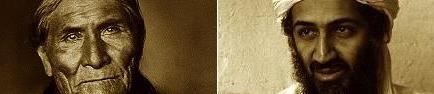
Geronimo is not dead – he was not killed in Pakistan

On May 1, 2011, Osama Bin Laden was tracked down and killed by U.S. Navy Seals in Pakistan.  In confirming their kill, the Seals sent a short, coded message to President Barack Obama which read:

“Geronimo-E   K.I.A.” [Killed in Action]

To many Indigenous people around the world, the use of the legendary warrior’s name as a stand-in for the notorious Bin Laden was an insult. For Dallas Goldtooth and Ryan Red Cord of the sketch troupe ‘the 1491’s’ that code inspired more than outrage — it led to a performance poem entitled ‘Geronimo-E K.I.A.’ that has become popular on YouTube.  (the 1491’s hail from Oklahoma and Minnesota).

Click here to play a recent radio interview given by Dallas Goldtooth to Rick Harp, host of Urban Nation Live on Winnipeg’s Streetz FM.

In the interview Dallas describes Geronimo as a powerful symbol of RESISTANCE to American imperialism and development.  Geronimo represents the fight against destructive forces in Aboriginal communities.

Naturally, Geronimo is revered by some, but not all.  Some First Nations dread the man because of his violent ways, specifically towards opposing tribes.  To Goldtooth and Red Corn, the persona and icon of Geronimo represents much more.

Goldtooth explains: there is anger and frustration to what was communicated to the President and the poem is a response to that, but it also conveys the idea that Indian people have not been defeated. In the present, many Aboriginals do significant work towards change, and in doing so they prove that Geronimo was not killed in Pakistan.

Central to the poem is the belief that Indigenous people around the world are part of the resistance that was once displayed by Geronimo.  The video concludes with the following poignant message:

“We chase his legacy, not his truth.  Neither will be caught, but one of them can be made up.”

Why the U.S. military would use Geronimo as a code name for Bin Laden is mind-boggling. Aboriginals have struggled mightily and this incident is symptomatic of the struggle by mainstream America to marginalize First Nations cultures.  The creative use of YouTube to respond to the hurt caused by the insensitivity of the U.S. military makes this endeavor worth studying if researchers are interested in the evolving relationship between Aboriginals and the media.

image source: http://www.mediaindigena.com/

RedWAY BC News

http://www.spiritlinking.com/products-services/redway-bc-news-e-zine

RedWAY BC News is a free monthly on-line magazine.  It has been published since 2003 by Spiritlink Communications.

According to the founder of RedWAY, Kristen Kozuback the mission of the publication is to build relationships based on respect and recognition and to celebrate the diversity of cultures, talents and strengths of Aboriginal people..

Many of the recent efforts by RedWAY focus on ways youth can build media technology skills and develop the experience necessary to start careers or businesses as writers, editors, videographers, and photographers.  RedWAY‘s YouTube channel and video productions (made by youth) can be found here.

Here are some of the regular sections from the magazine:

  • JPEN – Job Postings & Employment News
  • From the Streets and RHR: readers helping readers
  • Smoke Signals: a community announcements page
  • International Indigenous News: often self-governance items

Readership Demographics:  most of the readers and contributors are Aboriginal youths who reside in British Columbia – 85% self-identify as Aboriginal; 80% live currently in BC; over 45% are under age 30; 70% have their own social networking site.

Teaching Tip: In coordination with Spiritlink, RedWAY, and the First Nations School Net Program, 7 youths attended the 2008 Gathering our Voices Conference held in Victoria, May 17-20, 2008.  These youths were provided with hardware (laptops, cameras) + software + brainware (training) + spiritware (encouragement and empowerment) and the result was a significant ‘earning and learning’ experience.

Adele Alexander commented on her reflection the conference in a holistic way.  Her posts describe the influence the conference had on her:

  • intellectually
  • emotionally
  • physically
  • spiritually

I found this to be a very interesting way of having students look back at an experience. It transcends the mere ‘lessons learned’ and gets into a more authentic reflection of any experience.  Researchers looking into innovative, grassroots efforts to empower Aboriginal youth through media should definitely take a look at RedWAY.

The Belinda Stronach Foundation

The Belinda Stronach Foundation (TBSF) website discusses the One Laptop Per Child (OLPC) program with reference to providing laptops to Aboriginal students in Canada. On this website the positive aspects of providing laptops to aboriginal youth is supported through a variety of quotes from sources such as the Minister of Aboriginal Affairs. The TBSF website describes programs which have been developed to be used with the laptops provided to Aboriginal students. The focus of these programs involve literacy, a virtual library, financial literacy, physical education, nutrition, water safety, mental health issues, and a science of sound program. The main goal of Canada’s OLPC program is to increase the connectivity between people living in Aboriginal communities. I found this website very intriguing because it discusses the provision of laptops to Aboriginal communities as entirely positive. This website does not discuss any potential negative aspects of providing laptops to Aboriginal communities nor does it discuss any of the contention which surrounds technology and Aboriginal culture.

http://www.tbsf.ca/aboriginal_youth-34.html

http://www.olpccanada.com/

Module 2: Indigenous People’s Summit on Climate Change

http://www.indigenoussummit.com/servlet/content/introduction.html

This particular link is for the 2009 Summit, but I’m hoping that this is an annual event!  Here, indigenous people gather to discuss the changes they are seeing and the strategies they are trying to employ to cope.  Indigenous people tend to live in the harshest environments thanks to colonization, and thus they are receiving the brunt of the climate change.  In addition to coping with the rapid changes Mother Nature is throwing at them are the rapid economic and social changes that have been ongoing.

What is becoming interesting as my research progresses is the statement that indigenous people rely so heavily on the land.  The statement seems to suggest that non-indigenous people do not rely on the land nearly as much, and of course this is erroneous.  The difference is that non-indigenous people are not as connected to the land.  The resources come from the exact same places, but the connection is far more removed for non-indigenous people likely making them feel less vulnerable.  Also, non-indigenous people tend to live in less severe climates due to colonization practices, and are likely not feeling the effects of climate change as harshly.

The National Aboriginal Role Model Program

The National Aboriginal Role Model Program website (http://www.naho.ca/rolemodel/) provides a positive source of information for aboriginal youth.  The NAHO website facilitates an ongoing search for aboriginal youth who are role models for other youth because of the positive contributions they have made to their communities. Each year the website holds a nomination call and the website provides an online nomination form. I believe the NAHO website is an excellent resource for aboriginal youth because it provides a platform for aboriginal youth to be recognized for their achievements. Also, the website emphasizes positive stories of aboriginal youth and aims to strengthen the sense of pride among aboriginal youth.

Module 2: Climate Change: Who to Trust?

https://www.youtube.com/watch?v=lDaRHTpX8ws[youtube]https://www.youtube.com/watch?v=lDaRHTpX8ws[/youtube]

This video from Alaska identifies the irony between traditional knowledge and climate change and scientific knowledge and climate change.  Aboriginal people in Alaska have been discussing climate change for over 40 years, but supposed modern science has only started seeing a trend in the last 20 years and only in the last 5 has the gravity of the situation begun to sink in.  The Aboriginal people of Alaska are seeing new species that do not like the cold waters of their oceans and new diseases in the animals.  Also pressing to their situation are increased deaths due to fragile ice–it’s melting sooner and faster.

I particularly like how advanced the traditional knowledge of climate change is here versus scientific knowledge.  I’m wondering if the connotations of “traditional knowledge” imply too much antiquity and render it less reliable than scientific knowledge, or if it is a ethnocentric stubbornness that is preventing scientists from working with Elders.