Categories
Media Project II

Media Project II: Favourite Book Quotations

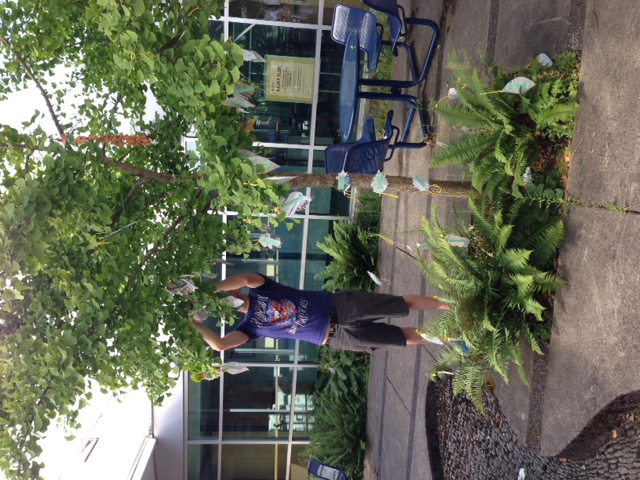
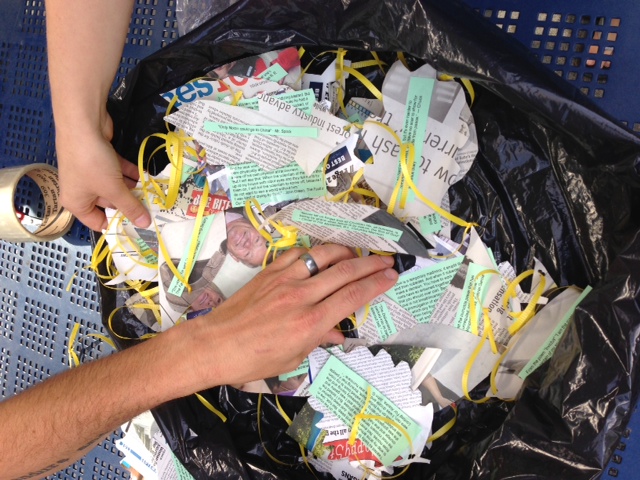
This project entailed collecting favourite literary quotations via various social media venues and creating an installation of the quotations in a public space. Some images documenting the project are below; the attached PDF explains the process.

hands

tree

A link to the write-up for our second media project:

Media Project II

Categories
gaming

A new light on video games

As someone who is very much unfamiliar with video games, today’s presentation, along with James Gee’s article, was quite eye opening.  Video games have acquired quite the negative image in our society and in the media, being demoted to something that steals adolescents’ time away from more productive activities.  Gee, however, proposes an interesting parallel between the characteristics of a good video game and an effective school curriculum.  He analyzes video games in a way that I have never considered before and offers valuable suggestions for ways in which we can improve our teaching, and in general, our approach to education.

I think that some of the most interesting points that Gee makes were in regards to identity and production.  It seems like a large part of the reason for people’s deep involvement and commitment to video games is the fact that they have developed a new identity through one of the characters in the game.  Gee suggests that if students were to take on different identities in different disciplines, it would be much more appealing and intriguing.  I had never thought of approaching the curriculum in this way before, and also wished that Gee provided some practical examples of helping students to become more active and immersed in the activities in the curriculum.

Gee also talks about the effectiveness of having players contribute to and influence the virtual worlds in video games, tying this to the way in which students must also be able to do the same with the curriculum in school.  This notion also ties in with the need for customization, leading students and gamers alike to feel like they have a sense of agency.   Students have to see themselves reflected in the curriculum to feel recognized and valued; by tying the content to their lives and their interests and giving them room for choice, the curriculum becomes something worthwhile to explore.  Gee’s analogy is an interesting way to approach teaching and certainly gives me a new perspective on the value of video games.

-Adrienne

Works Cited

Gee, J. (2005). Good Video Games and Good Learning. Phi Kappa Phi Forum, 85(2), 33-37.

Categories
Uncategorized

txting=the massacre of English as we know it?

The two articles for this week raised a lot of questions for me and were really interesting to read through.  I was somewhat surprised that while both articles were published in 2005, we seem to still have the same anxieties and intense reactions to the effect of txting on what we deem “standard” or “normal” English.  It clearly remains a controversial and heated issue today.

I really liked how Victoria Carrington (2005) pointed out the need for literacy educators to rethink what it means to be literate in today’s society, remembering that “the ultimate purpose of literacy lies outside the classroom” (p. 171).  She believes that students will need to be competent and be able to manipulate a variety of genres indifferent contexts, which means that educators need to be prepared to incorporate and recognize a multitude of literacies in an educational context.  I think my struggle with this is how it’s meant to look, at a practical level, in the classroom.  While I understand the importance and value of developing a strong grasp of multiple literacies, I find it difficult to imagine the role and function of new literacies, such as txting, in the classroom.

I must admit that, while working on the first media project (translating Macbeth into tweets), I was quite unfamiliar with Twitter (and with most social media, for that matter.  #socialmediahermit), and had to really pause and think about how I would go about composing a hashtag.  While I understood it’s basic premise and purpose, I felt like it had changed over the course of time to have a different function.  In class, Teresa mentioned possibly discussing with students the rhetorical function of hashtags; perhaps this is a way in which we can incorporate new genres in a way that is analytical and thoughtful, and encourages students to think critically about the form and function of a language.

Whichever way we choose to widen the literary horizons of our students, I agreed with Naomi S. Baron (2005), who states that txting may be “[n]o harm, but only if these same teachers ensure their students develop a solid grasp of traditional writing conventions as well” (p.31).  I suppose incorporating new forms of language does not necessarily discount more traditional forms, but as Carrington argues, we need to have more conversations about how these different forms of language will interact with each other and possibly co-exist.  It seems that txting is just one of the ways in which language has progressed, but as such a prominent mode of communication, deserves more discussion and exploration into its role and function in our society and how it can help develop a more multi-faceted literacy program in our schools.

Works cited

Baron, N.S. (2005). Instant messaging and the future of language. Communications of the ACM, 46(7), 30-31.

Carrington, V. (2005). Txting: the end of civilization (again)? Cambridge Journal of Education, 35(2), 161-175.

Adrienne
Categories
graphic novels Seminar Prompts Visual Literacy

Visual Texts in the Classroom

The use of alternative genres in the classroom can be a powerful tool for students to develop their literacy skills.  Texts such as graphic novels are motivating to read for reluctant readers, providing manageable amounts of texts while at the same time presenting complex issues and ideas.  Graphic novels contain many of the same literary elements as their written counterparts.  In addition, the analytic skills that students develop in thinking critically about the visuals in the text can be applied across all disciplines.  Gene Yang, the author of American Born Chinese also explains that since most students are immersed in visual media in their day-to-day lives, visual texts resonate more strongly with them.  Graphic novels, then, serve as a way to “bridge the gap between the media we watch and the media we read” (Yang 187).  It is an effective way to connect readers with a text while developing literacy skills.

While there seems to be an increase in the use of alternative genres in the classroom, it still often feels as though visual texts such as films and graphic novels are often overlooked in the curriculum in favour of written texts.  Perhaps there is still a stigma attached to genres such as the graphic novel, which may appear to some as merely a comic book with inherently less value than a traditional novel.  Particularly when an iconic, classic work of literature has a graphic novel equivalent, some tend to still place a higher value on the written form.  I think that these different versions of the same text offer an opportunity for effective differentiation.  I remember teaching Romeo and Juliet to a class comprised of English Language Learners, and using the graphic novel version of the play was an effective way of teaching many of the same concepts while at the same time exploring the interplay between text and image, and how the images supported the text and conveyed meaning.  When the students felt like the text was manageable, they were much more motivated and engaged with it.

Works such as Shaun Tan’s “The Rabbits” is also refreshing in that it provides students with a complex idea and presents it in the form of a beautifully illustrated text.  Introducing students to different forms of representation is a key aspect of literacy and encourages greater creativity.  I think that challenging students to use the same analytic skills used in reading novels and applying them to different genres of texts creates a more well-rounded literacy program.

In conclusion, visual literacy is a powerful skill that encourages critical thinking and deep analysis.  As an educator, I would definitely like to continue to learn how to incorporate a wide range of visual texts in a meaningful way in the classroom to promote literacy.

Adrienne Law

Questions for discussion

  1. How have you or might you use graphic novels in the classroom?  Consider also texts that have a graphic novel counterpart.  What are the benefits, and what might be some potential challenges?
  2. What skills would students develop with visual texts that would help them to succeed with other forms of literature?


Works Cited

Frey, Nancy. and Fisher, Douglas.  ” Using Graphic Novels, Anime, and the Internet in an Urban High School.”  The English Journal.  93.3 (2004).

Yang, Gene.  “Graphic Novels in the Classroom.” Language Arts.  85.3 (2008).

Spam prevention powered by Akismet