Categories
Social Media

Another thought on “Blogging as Participation”

Although the discussions on the “Blogging as Participation” article by Lankshear and Knobel may have moved on, I was just recently reminded of an interesting tool that may be used in the classroom- its called “TodaysMeet”. It is a tool that tries to bring the ‘Backchannel’ to the forefront of a presentation. On their website TodaysMeet identify Backchannel as “everything going on in the room that isn’t coming from a presenter” (todaysmeet.com). They further state that the backchannel is where people ask each other questions, pass notes, get distracted, and give you the most immediate feedback you’ll ever get”. I find this to be a fascinating tool because it may allow for a speaker or presenter (which we sometimes find ourselves being in a classroom ie. we take on that role, although hopefully not for too long at a time!) to see what people in the class may think. Its timely and inclusive, so that people who may not be entirely comfortable speaking up in a regular setting may comment in the this new type of chat room. That is one benefit that I see to using it. Also, it allows students to have even further in depth discussion in another medium. Another benefit is that its immediate and timely feedback to the presenter (in this case the teacher). However, is it effective and does it really help the teacher? I’m sure that a lot of the backroom is some banter that may be deemed unimportant, which in turn may be a distraction. Also, is it a distraction to the students? Are the participating in more Backchannel than would usually happen?

We ran an experiment with this tool in my LLED 361 classroom last semester, and there was alot of conversation in the Backchannel that was very interesting. We would comment about what the instructor was doing, what we thought of the videos she was showing us, made connections to our lives, etc. However, there was also lots of joking and ‘fluff’, so to speak. Was it interesting? Yes. Was it necessary? I’m still not sure. Would I try it in a classroom? Perhaps. I am interested to know if anyone else has tried it before or if you have any ideas on how it can be used effectively as a classroom tool.

Although this may not be a blog per se, I find that it is definitely an important development in the Web 2.0. It is interactive, timely and participatory. The two main ways that Lankshear and Knobel define blogs is their ability to have a large pool of participants with the right tools for accessing it for and of partipation (7). I’m not TodaysMeet is a blog. it is more like a chatroom. It brings the same issues of participation, multiple literacies and creation of knowledge that blogs can in the age of the Web 2.0.

-Zlatina Radomirova (blog post #2)

Works cited

Lankshear, C. & Knobel, M.  ”Blogging as Participation: The Active Sociality of a New   Literacy.” American Educational Research Association. San Francisco, CA. April 11, 2006. Web.


Categories
computer-mediated communication

Text-language as a new way of communication

There are several things that I would like to reflect on after reading both Baron and Carrington’s articles. First, as both articles were published in 2005, I was very interested in discovering whether or not the issues discussed in these articles have changed over the past few years. As I read Baron’s article, I found that the issue the article addresses (using IM) seems to be a declining trend. Drawing from my own experience, I remember that using IM such as MSN was immensely popular during my early teenage years (around 2001-2007). During the past few years however, I rarely find myself using a computer program that is sole developed for the purpose of IM. I am not suggesting that IM is not a common form of communication nowadays, what I am suggesting is that IM seems to take other forms (facebook chat, skype, twitter, etc.). These new forms of CMC allow users to not only use words, but also other forms of language (image, video, audio) to communicate with other participants. In this sense, multipurpose CMC is taking over the dominance of the single-purposed IM.

Second, I am drawn to the notion of teachers “as custodians of a particular ‘correct’ version of English” (Standard English) presented in both articles (Carrington, 170). I do agree with this notion, however, I think teachers are not only the custodian of Standard English, but also a bank of resources where students can learn new ways of communication, including short hand writing like the text-language which can be very useful under certain circumstances. On the other hand, as stated in Baron’s article, teachers should ensure students use Standard English in formal settings unless the perception of  Standard English changes among the society as a whole.

Last, I would like to propose a question under this topic. During my practicum, I have communicated with both my SAs through texting in a number of settings. In some occasions, they have used text-language to communicate with me. However, I have never replied them using text-language as I am not certain if it implies any notion of impoliteness. My question is that does using text-language depend on the social status of the participants? Does text-language imply any notion of impoliteness when it is used by a participant who has a lower status compared to another participant, for example, employer and employee?

Sarah Wu

Blog post #1

References

Baron, N.S. (2005). Instant messaging and the future of language. Communications of the ACM, 46(7), 30-31.

Carrington, V. (2005). Txting: the end of civilization (again)? Cambridge Journal of Education, 35(2), 161-175.

Categories
computer-mediated communication Uncategorized

OMG txtin’

Litextracy?

In the current digital age, texting and literacy come together to form a paradoxical relationship. While our youth are reading and writing more than ever, their various forms of electronic communication are generally disregarded as “not real writing.” We have to understand that language is constantly changing, and texting has become the written lingua franca of our youth today. In “Instant Messaging and the Future of Language,” Baron argues that linguistic and behaviour innovation often begins with adolescents (30). Real writing or not, it is an inevitable change that is accompanied by changes in educational, cultural, and social attitudes and values.

Wts wrng w/ txtin’?

There is no doubt that texting is often perceived as a corruption of language and the root cause for our youth’s degrading literacy skills. Teachers notice texting language slowly creeping into formal writing assignments. Not only does texting affect student work, it also affects student performance and work ethics in class because of the distraction.

However, pushing those thoughts aside…

AFAIC, txtin cn b a gr8 thng

We have to reconsider what literacy means. As Carrington states in “Txting: the end of civilization (again)?”, we must understand literacy today to “extend beyond the ability to encode and decode print” (172). Literacy is the ability to decode information in various formats, make meaning from it, and encode it into ideas to be communicated to others. The language of text is a register in its own right, and it is not exactly dictated by Standard English grammar and spelling rules. In the wake of constant and rapid technological advancements throughout the past century, what we are witnessing is an evolution of language. In fact, I see potential in texting for literacy development.

We as teachers should understand that because texting is a mode of communication most common to high school students today, it would be almost ridiculous to disregard and ban the cellphone. While this new technology brings on new challenges for teaching and learning, new opportunities exist as well. The most crucial thing to do is to “make certain [our students] understand the difference between creativity and normative language use” (Baron 31). We have the responsibility to hold discussions with our students on the importance of knowing our audience and how that affects the language we use when we communicate in different contexts.

L8R,

Christina (blog post #2)


Baron, N.S. (2005). Instant messaging and the future of language. Communications of the ACM, 46(7), 30-31.

Carrington, V. (2005). Txting: the end of civilization (again)? Cambridge Journal of Education, 35(2), 161-175.

Categories
computer-mediated communication Seminar Prompts

Texting and the Future of Language

Summary:

“Instant Messaging and the Future of Language” by Naomi S. Baron

This article illustrates the notion of whether or not computer-mediated communication (CMC) is affecting the use of standard English among the young generation. The author demonstrates how the use of standard English has evolved through the Middle Ages and the Renaissance to the modern days. The author also conducted a study at American University in Washington, D.C., which investigated the use of instant messaging via America Online Instant Messenger (AIM) among undergraduate students. The research suggested that “IM conversations serve largely pragmatic information-sharing and social-communication functions rather than providing contexts for establishing or maintaining group identity” (30). The author suggests that parents and educators play a significant role in ensuring the use of formal English among adolescents and that IM is unlikely to have any profound role in changing the writing standards as long as the society does not accept this form of writing as the new standard.

“Txting: the end of civilization (again)?” by Victoria Carrington

This article begins with the author’s recent interview on an Australian radio channel regarding an essay that was fully written in text-language, submitted by a 13-year-old Scottish schoolgirl. The author was asked to discuss the issue of the “legitimacy” (or not) of txt as a form of text. Consequently, the author uses discourse analysis to analyze the initial article and another article regarding texting that was published the next day. The author finds that the articles contained fearful language regarding texting, which she described as a “rhetoric of crisis” (171). The author then illustrates how teachers play an important role in keeping this “correct” version of English and that teachers “are increasingly monitored and controlled” to fit this role of guarding the use of Standard English among teenagers (169, 170). In her conclusion, she proposes that txt should not be dismissed; it is one of many texts that students should become familiar with and fluent in.

Our Standpoint:

 Is texting really a threat?

  • No, texting is not a threat to the English language or to our students’ literacy.

  • Text language is just another register that students learn to use in the appropriate setting.

  • There are many different types of literacy, text literacy is one of them. Students need to be multiliterate.

  • Students should be learning and using forms of communication that are relevant to today’s technologies and ways of interacting.

  • There are many useful web tools that facilitate teacher-student discussion through texting, in which even shy students feel confident participating.

Connecting texting to Language Arts:

  • Writing dialogue through texts in creative writing:
    How to incorporate text-messaging into narratives? Has anyone read any new novels that incorporate text-messaging in the story? Writers are having interesting conversations online about how to represent text-messaging in their novels and short stories.

  • There is also the growing popularity of the “cell phone” novel genre.

Discussion Questions:

  1. What are your thoughts towards students using texting as a form of communication with the teacher?  Have you had any experience in this context?
  2. Is using text-language becoming a more dominant way of how children communicate these days? Do you think this will affect their use of formal language?
  3. Do you think teachers are the “gatekeepers” of language? Why might they be perceived this way?
  4. Can you think of some other ways that texting or text-language could be used in the classroom?

Activity:

  • Use discussion question #2 as an example on Poll Everywhere and have everyone text in their answers.
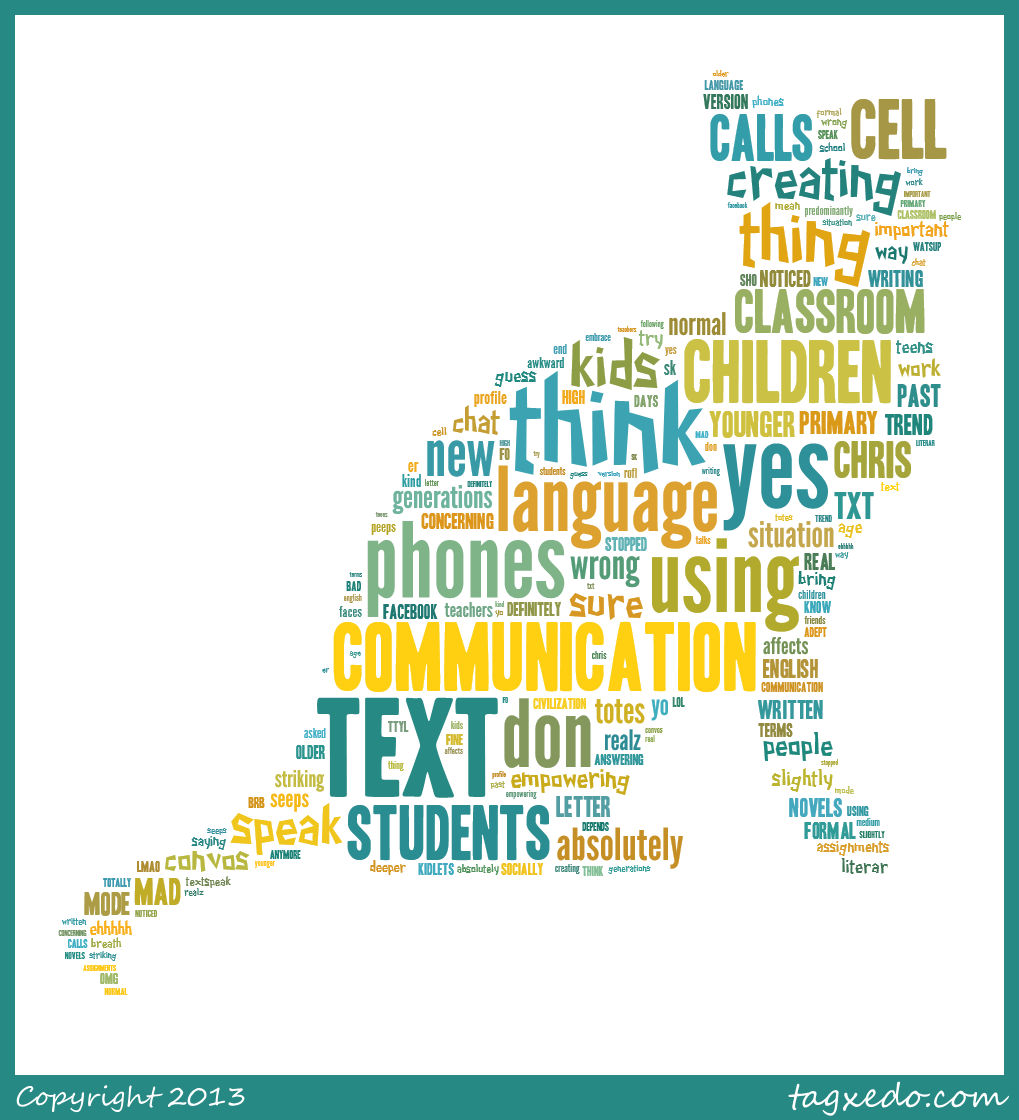
  • Transfer responses to Tagxedo.

Our result: Communication Cat 🙂
Thanks for your participation!

References:

Baron, N. S. (2005). Instant messaging and the future of language. communications of the ACM, 48(7), 29-31.

Carrington, V. (2005). Txting: The end of civilization (again)?. Cambridge Journal of  Education, 35(2), 161-175.

– Christina Lee, Melanie McKenna, Dayonne Wegner, Sarah Wu

Categories
gaming

Gaming and Education

The Gee article “Good Video Games and Good Learning” presents the value of video games in education in a unique way.  Gee explains that the value of video games lies not in the games themselves, in their potential for educational application, or in their explicit educational content.  Instead, the value of video games to education is how we as teachers can apply game-like qualities to enrich the classroom.  In bringing about “gaming practices” into the classroom, Gee suggests a number of focus areas that video game practice and classroom practice share:

Identity:

In starting a new video games, a gamer will assume a ‘new’ identity within the game, whether it is already a pre-established character, such as Snake from Metal Gear Solid (Gee, p. 34) or build their character (i.e. name, attributes, abilities) from scratch, as in games like Mass Effect and World of Warcraft (Gee, p.34). If we were to adapt this to the classroom, as teachers, we should be encouraging students to explore their identities as a learner, a person, and a student. In doing so, it allows students to become more comfortable with who they are in the classroom.

Interaction:

As a gamer plays the game, they will interact with the world (i.e. characters, environments, etc.) and in turn the world will provide them with feedback. As such, the gamer becomes fully engaged with the game’s world as the game progresses and allows the gamer feel as if they are a part of the actually game world itself. Hence, Gee argues that by encouraging students to engage with their textbooks in the same way (i.e. providing ‘real world’ contexts to the material in the textbook), it allows a back and forth interaction with the written text and the material they are engaging with.

Production:

In larger world games (i.e. Role Playing Games or Massive Multiplayer Online), gamers are actually producing and adding to the game’s world, creating new content in the form of characters, narrative, and physical spaces (i.e. buildings, structures, etc.). And, in some cases, gamers can even modify or ‘mod’ a game to such an extent that they create a new games (i.e. Valve’s Half Life was modified into a new game called Counter-Strike, both of which are hugely successful).  If we, in turn, encourage our students to contribute to the content that we are teaching to them (i.e. allowing students to provide feedback on course content), then it allows students to feel like they are more a part of the class.

Risk Taking:

This particular value, which Gee argues is seen more so in games than in the classroom (Gee, p. 35), is a really important one to focus upon. While gamers are willing to take more risks in the games that they play, because there are either no repercussions and the gamer is rewarded for such an act, in the classroom, the student is instead punished for taking risks. Hence, I think it is important that as teachers we encourage our students to take risks with their learning so that they may explore more than just one path of education.

Customization and Agency:

Tying into the value of production, Gee states that gamers can often customize their characters within games, particularly in role playing games, developing every minute aspect (i.e. hair/eye colour, personality, voice, etc.). In this regard, I think it is important that we allow students the opportunity to customize their curricula to an extent, as I mentioned in ‘production’.  This is not to say that they develop the entire course themselves, but that when creating the curricula of a course, we allow the process to be two-way, with interaction between student and teacher. By doing so, we are allowing students to feel a sense of agency over their education and learning, something that Gee argues is very uncommon within the classroom. (Gee, p. 36)

Well-ordered Problems; Challenge and Consolation; and “Just-in-time” and “On Demand:

In any game, the player will engage countless problems and challenges along the way, whether it is a puzzle or a moral dilemma (i.e. Telltale Games’ The Walking Dead: Season One). However, regardless of these challenges, gamers are able to solve these challenges/problems because the game instinctively prepares gamers to face them as the game progresses. (Gee, p. 36) It does so by providing the gamer with “just-in-time” instruction, requiring gamers to act in a hands-on way. Or, it will sometimes provide games with “on demand” cues, or ‘hints’, to allow gamers to learn as they go along. By doing so, gamers on continually developing newer skills without necessarily realizing it.  In regards to the classroom, Gee argues that we should provide a constant challenge to our students, but also provide them with the skills and materials that they need throughout. (Gee, p. 36) In doing so, we are, as educators, utilizing the “zone of proximal development”, and encouraging our students to slowly step outside of their ‘zone of comfort’ and to develop new skills to face newer challenges without burdening and/or scaring them with these challenges.

The article explains that people learn best when they can relate and apply new information in an experiential context.  Scaffolding of information is highly effective in this way, as it is provided only in relevant contexts.  Students then, are not over-loaded by too much frontloading, and instead are able to apply relevant information as they are given it; thus strengthening their connection to the material.

Performance before Competence:

The final argument that Gee makes is that in video games, the gamer is given the ability to perform an action before they are competent (i.e. being able to jump before being told how to), hence encouraging gamers to experiment with their character and its abilities before properly knowing how to. (Gee, p.37) Yet, in education, we require our students to be fully competent before we allow them the opportunity to perform an action within their field (i.e. students must go through the scientific method before conducting an experiment). Though we cannot necessarily allow students the opportunity to perform an action in their field of study before being fully competent, we can at least show them real world examples of such.

In our own understanding, video games in essence are a form of interactive escapist fiction. Many have storylines options that allow the character to participate in episodes or chapters that must be completed before the story can progress. This allows students who have difficulty with the written word a way of interacting with fiction in a way that is tactile and understandable. Video games work when they, like novels, are able to pull the reader/user into the story when they have a certain amount of believability.

Many video game developers are coming out with games that are very similar to choose your own adventure books that were once featured in my elementary school library. Each user/player is able to “write” their own version of the story and have their own experience with the material. Video games can also be a great tool in the classroom by looking at different aspects of video games.

Our group is curious about how the elements presented in Gee’s article can and/or have been applied into modern classrooms.  Furthermore, we are curious about the following questions:

  1. What kind of effects do video games have on our students?
  2. What kind of effects do video games have on the 21st Century classroom?
  3. In your teaching experience, have you been able to bring gaming technology or principles into your classrooms?
  4. Would it be beneficial for students to have as much input into their own learning, as they do in the context of a video game?  Are there any repercussions?


Link to Prezi Presentation:  http://prezi.com/cadscfbsxjtj/?utm_campaign=share&utm_medium=copy


–Christa, Chris & Cat


Works Cited:

de Castell, S., Jenson, J., & Taylor, N.  (2007).  Digital Games for education: When Meanings Play.  Situated Play, DiGRA Conference, Tokyo, Japan.  590-599.

Gee, J.  (2005).  “Good Video Games And Good Learning.”  Phi Kappa Phi Forum, 85.2, 33-37.
 

Categories
computer-mediated communication

Texting

In Carrington’s and Baron’s articles, they discuss how the new literacy of text-messaging is perceived by society and its possible effects on language. My first thought on these two articles is that they speak far more to our society’s fear of linguistic change than they do to any actual change. The “rhetoric of ‘crisis’” (2005 p.171) that Carrington discovers in the newspaper article towards texting shows that our society still view literacy in a singular way. It seems as if people believe there is only type of literacy and if students do not master it, our civilization will collapse. In opposition to this belief, this multiliteracies course has taught us that there are many different types of literacy that students need to master, and that there are literacies that students have already mastered which serve their communication needs very well. From this point of view, it is important for teachers to be asking: “What does it mean to be ‘literate’ in contemporary economies and cultural landscapes? What kinds of texts will the students in our classrooms find it necessary to ‘read’ and manipulate and produce in order to effectively participate in civic life?” ( Carrington 2005, p.172) For teachers to condemn these modes of communication as detrimental to students’ wellbeing is to underestimate their capacities to work between and with many literacies.

Consequently, my second thought about these two articles is that becoming fluent in texting language is very important in today’s world. It is becoming more and more uncommon to call people on the phone so we need to be able to text information quickly and efficiently. If we write everything out in full sentences, it would take forever to have a text conversation. Also, on a side note, it is pretty embarrassing (for me, anyway) when someone texts you an acronym that you don’t know. It would be very interesting to know what kind of attitude business people have toward texting since blackberries have become the main mode of communication in business.

Lastly, I’m not sure why people are so afraid of texting language when university students have been writing in short-hand code for their note-taking for years and years. We can still write essays as well. It seems that Baron is right when he writes that, “IM is unlikely to play a significant role in altering writing standards—unless we as parents and educators let it” (2005 p.31). This quote raises the troubling question: are we, as teachers, the gatekeepers of new literacies and of progression and change?

– Dayonne (Blog post #2)

Baron, N.S. (2005). Instant messaging and the future of language. Communications of the ACM, 46(7), 30-31.

Carrington, V. (2005). Txting: the end of civilization (again)? Cambridge Journal of Education, 35(2), 161-175.

Categories
Seminar Prompts

E-literature posting

The aim of my group’s presentation was to educate pre-service teachers on the nature and value of the little-known genre of e-literature. Through reading Hayles’ article and browsing the e-lit collections I was able to understand that e-literature is uniquely different from the popular digest of “ebooks”. That is, electronic literature is an entirely different platform for presentation of ideas; it involves moving parts and flashing signs that are all supposed to illustrate an abstract idea.This, admittedly,  made me nervous at first. How could I ask students to analyse a piece of e-literature when I myself am completely new to its format? The format of eliterature seemingly pervades typical literary analysis….I am completely unprepared to teach my students. Yet, the processes of teaching and learning are paradoxically connected; to teach is to learn and to learn is to teach. Thus, why should it be difficult to introduce this into a classroom setting—even if the teacher admits that she/he is still unfamiliar with the subject?

The issue with e-literature for me lies in its uncommonness. How will it be received by students and parents who are yet to become comfortable with comic books in the English Language curriculum? Most e-literature, that is, appears to be ‘a game’ or ‘video’ —not an ‘educational tool’ for most parents. How do we overcome these barriers? What’s shocking to me is the fact that through all my education I have never heard of e-literature. This is possibly due to the fact that its production involves a digital skill base that not all artists are familiar with. Whatever the issue, the fact that there lies scant review of the genre despite its age makes me question the value of e-literature. What more, I found that most of its works were too heavy-handed in their depiction of the abstract—there’s essentially little for the students to guess and unravel in most works. Sure, there are some solid artistic pieces such as “Girls Day Out” (the one Prof.Dobson showed in class) but for the most part, I wouldn’t use more than two or three pieces within the course of a school year. I enjoyed looking at this subject and exploring vintage computer operating systems, but ultimately, I would not throw out classical texts anytime soon.


–Katarina


Categories
e-literature Uncategorized

e-Literature Post

As discussed in class on Friday, here is a link to my post for the hyper-text we created on the UBCWiki.

Enthroned

Media Project #1: “The Lottery” — A Dramatic Performance

Here’s the link to our performance information – enjoy!

The Lottery Dramatic Performance


—– Adam, Irene, Katarina, Natalia and Natasha 🙂

Media Project #1: Pirdle (Poem Visualization)

Here is the PDF file with our media project, write-up, and link to the Pirdle.

By: Samantha, Katrina, Zlatina, and Dominic

LLED 368 Media I Project WRITE UP

Spam prevention powered by Akismet