Categories
Introductions

More Mediums=More Messengers?

:: McLuhan 100 Anos - Capa ::

A student skilled in multiliteracies will be able to create, interpret and utilize multiple sources/units of information including, but not limited to, electronic, spacial, visual, audio, (multi)linguistic and gestural literacies. They will be able to do so within their own unique, transitioning, socio-political and cultural environs.

What interests me in this shift in how we are experiencing literacy is this: no matter how far we’ve come, how advanced we are technologically, regardless of how many apps we have on our iPhone, there are huge segments of our student population who will have greater access to acquiring these multiliteracy skills than will their peers.  This divide in accessibility has long-lasting impact on how much power (economical/consumer/political) these students will yield throughout their adult lives.

Of course, gaps in access to knowledge is not a new form of societal injustice. Harold Innis (a colleague and contemporary of Marshall McLuhan) described how historically various forms of media and information have long been used by institutions/governments/monarchies to monopolize knowledge; dating back to ancient civilizations, using clay tablets, and Papyrus.  (Bias of Communication, 1951).

So while this issue of equitable access to knowledge is certainly not new, it is dangerous.  The current tagline is that new literacies/Social Media and their accompayning technologies, are somehow “levelling the playing field” and that “everyone” has access to global information and knowledge, and this is far from the truth. So, yes: we have increasing modes in which we can host/transmit/acquire and share information, but the systemic barriers that limit who has access to these modes of information sharing, and to what end, are firmly established and therefore we face a greater disparity than ever in terms of who can experinece and access information. Simply; being “poked” on Facebook does not mean you have punctured the manufactured obstructions limiting access to elite knowledge.

The challenge is then, for us as future educators of multiliteracies, is how will we best address these issues in our pedagogical approach?

I look forward to examining this (and other difficult questions) with you.

All the best to you all for a successful year of shared inquiry.

Maya
Categories
Introductions

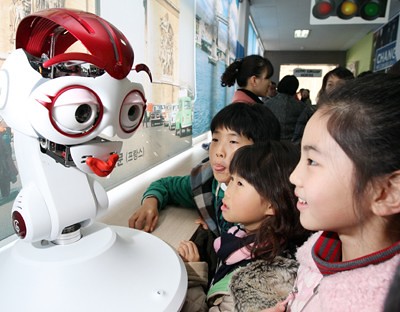
Meet SIL-BOT, the little robot that could … teach English.

teacher-robot-south-korea

I have just spent the past two years teaching English as a foreign language in a satellite city just outside of Seoul, South Korea. Thus far, it has been one of the most educational, eye opening, and fulfilling experiences in many aspects of my adult life. In particular, my teaching experience in Korea has especially allowed me to build my confidence in the classroom, and taught me the importance of being culturally sensitive, and self-aware as a teacher. Moreover, I have come to love and appreciate many things about South Korea largely through my experiences with the students I taught. I have learned many invaluable life lessons and I treasure and made significant memories by being immersed in the country and its culture. I will always view South Korea as the place that first enriched my growth as an educator as well as a person.

However, this image represents and embodies my deepest fears about technology and education. Sil-bot is a recent product that was developed by the Korean Institute of Science and Technology. The robot is designed to teach English to Korean children in rural areas of the country. When I first heard about Sil-bot, a flood of questions plagued my mind about my future as an educator and the impact of advancing technology will have on my life and the world. My first instincts towards technology are generally fear and hesitancy and they eventually lead to disinterest. Being born in the mid-80s, and being a part of the older spectrum of the Millennial generation, I have many reservations about new technologies and I am not quick to embrace them. However, I gather that a lot of my fears and disinterests in technology are rooted in ignorance. Therefore, I hope that this course will provide an assuring and encouraging space for me to explore and become familiar with the multiliteracies that are evolving and will continue to evolve our classrooms and our world.

Categories
Introductions

Reading After Dinner

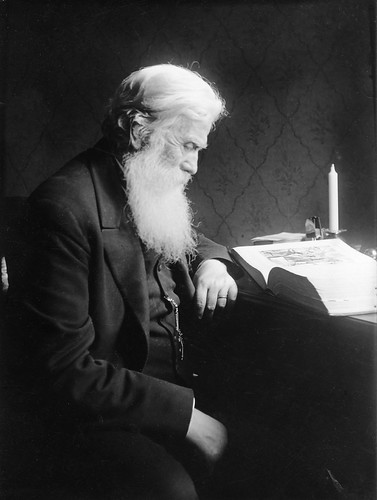
Reading man, Sweden

This picture reminds me of what my philosophy teacher would tell us of her habits: that she would sit down after dinner every evening for good 2 hours of fine, rigourous reading. When I heard her say that, as though it was a commonly accepted practice, I aspired to do the same. But the internet or the TV never let me.
It is all too often that I feel I have wasted precious moments of my life, which otherwise could have be occupied by “fine, rigourous reading,” to be navigating through Facebook or simply receiving a movie as passively as possible. Despite all these forces that held me back, I still did manage to sit down at times and read a book. My academic career, mostly, made sure of that.
But now I wonder at the fate of the young people that I will teach. How and when are they to find time, or the energy necessary to combat the contrary forces, to sit down and actually read. Perhaps, the answer to my fearful wondering lies in what I have referred to as contrary forces. Perhaps it is within the platforms of social media or among the nonsense found in the confines of a television that these young people will experience what the man in this picture is experiencing from his wooden technology.

Categories
Introductions

Communication

http://www.flickr.com/photos/22936119@N03/5414826575/


When it comes to images, the element of esthetics is potent. In this photo, I was struck by the color scheme (contrasting red on grey), the composition, parallelism, scale. The initial esthetic impulse then propelled me into a closer dialogue with the structures represented in the image and their relation to the title “Communication”. What a transformation communication has undergone over recent decades. The phone booth and the mailbox that stand out against the backdrop evoke a sense of nostalgia, a mode of communication that belongs to yesteryear. They also evoke a sense of intimacy that is sometimes difficult to forge in today’s technological web of mass media communications. Today, we have the marvelous opportunity to share knowledge, thoughts, and feelings instantly on a public platform. This can be to our benefit or detriment. The Internet is remarkable for its ability to allow us to share knowledge and to communicate it to a vast audience. But what of communicating with one another, with individuals? In the instruments displayed in this image, one’s thoughts/words (vocal or written) enter an enclosed space and are designated for a single recipient, in sharp contrast with our present day public pronouncements on social media sites, where we are often connected but not connecting.

Don’t get me wrong. I’m no social media prude. I spend far too much time being updated on what my “friends” ate for breakfast.  I guess there’s just something about this “old school” image that appeals to my aspiration for intimacy and simplicity.

And I love the red! I like that the idea of communication (of relating to others) is boldly highlighted and underscored.

Of course I eagerly look forward to learning how incorporate the vast opportunities inherent in new technologies in the classroom

Categories
Introductions

Burning Man Tree

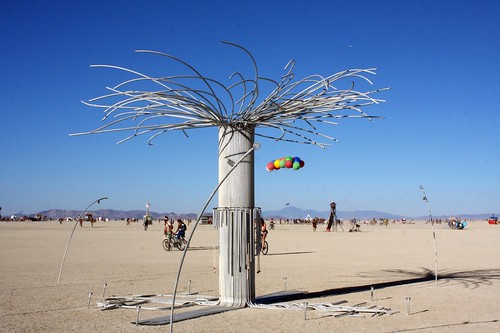
Burning Man 2011

I haven’t had a chance to be in class yet so bear with me if my post is not responding in the correct tone!

I thought about my own multiliteracy, or what I think of when I think of ‘multiliteracy’ and what remained in the forefront of my thought was the idea of the dichotomy between nature and technology. Personally I fully embrace social media, modern technologies, and the evolution of the computer into our lives as human beings; one of the reasons being that I can pinpoint the exact day that I realized that technology had become an important adaptation into my family’s life. I decided to search images from the annual arts festival Burning Man. I have never been but would very much like to in the near future. What I know of burning man is that it is about creating art and respecting the space hosting the event. Artists from all over the country, continent, and I’m sure world come together in a communal space of active artistry and respect. At the end of the festival everyone comes together to burn a large statue of a character man to symbolize the end of another year. Following this the desert is restored to it’s natural place and everyone returns to their lives.

This photo in particular makes me consider this juxtaposition and interconnectivity of nature and technology, or simply human nature. We as evolving beings create and develop within the world. I believe this photo is that of a tree, of creation, music, community and so many other things. Also the knowledge that it no longer exists makes me consider the fleeting life of our own nature and existence. I hope we can discuss the role that technology plays within our roles as educators and how it can be used as an extension of ourselves. I wonder how can we teach young minds to adapt these technologies for good rather than evil…

Categories
Introductions

Misconceptions About Literature

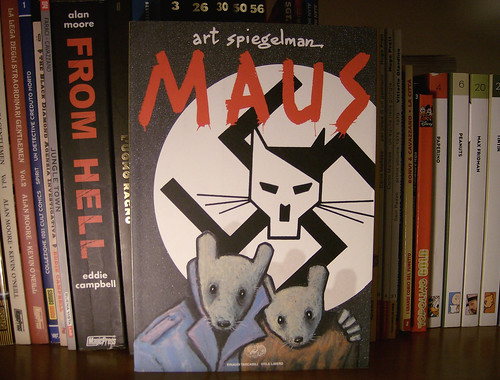
art spiegelman - MAUS

Due to copyright laws, I was unable to use an original image from Art Spiegelmen’s Maus, so instead, through the CC branch of Flikr, I found a fan’s snapshot of the book itself.  I chose this image because it is the first book that forced me to question one of my many pre-conceived notions of what constitutes literature and that was the belief that all literature worthy of reading should consist solely of words. Spiegelmen’s Maus is a semi-autobiographical graphic novel about his father’s experience as a Polish man, forced to live in concentration camps during the Holocaust.  Until I came across this novel, I had understood that a book that consisted mainly of images used to tell a story was simply a comic book, the fast-food of the literary world, consumed quickly with no lasting intellectual value.  As a child and teenager, I had read many Marvel comics and MAD magazines, but I would have never deemed them as literature.

I came across Maus as an adult, and the book had a profound impact on me.  It is a moving, beautiful piece of literature. What is fascinating about the text itself is that it deals with a disturbing time in history, but the story is told from the perspective of a mouse that represents the Jews.  The Germans are replaced by cats and the Poles are depicted as pigs.  Many questions spring to mind.  By depicting these races as animals, does this format trivialize the experience?  Or is it somehow more accessible?  Would a format such as this speak to students moreso than a traditional text like The Diary of Anne Frank?  The possibilities of analysis of this text from an academic viewpoint are endless, and I hope to work through them in my upcoming presentation, but I thought I’d share this with you initially, as my introduction.  I’m looking forward to this class and working together with all of you!

Kiran Aujlay

Categories
Introductions

My child is going to play with sidewalk chalk…


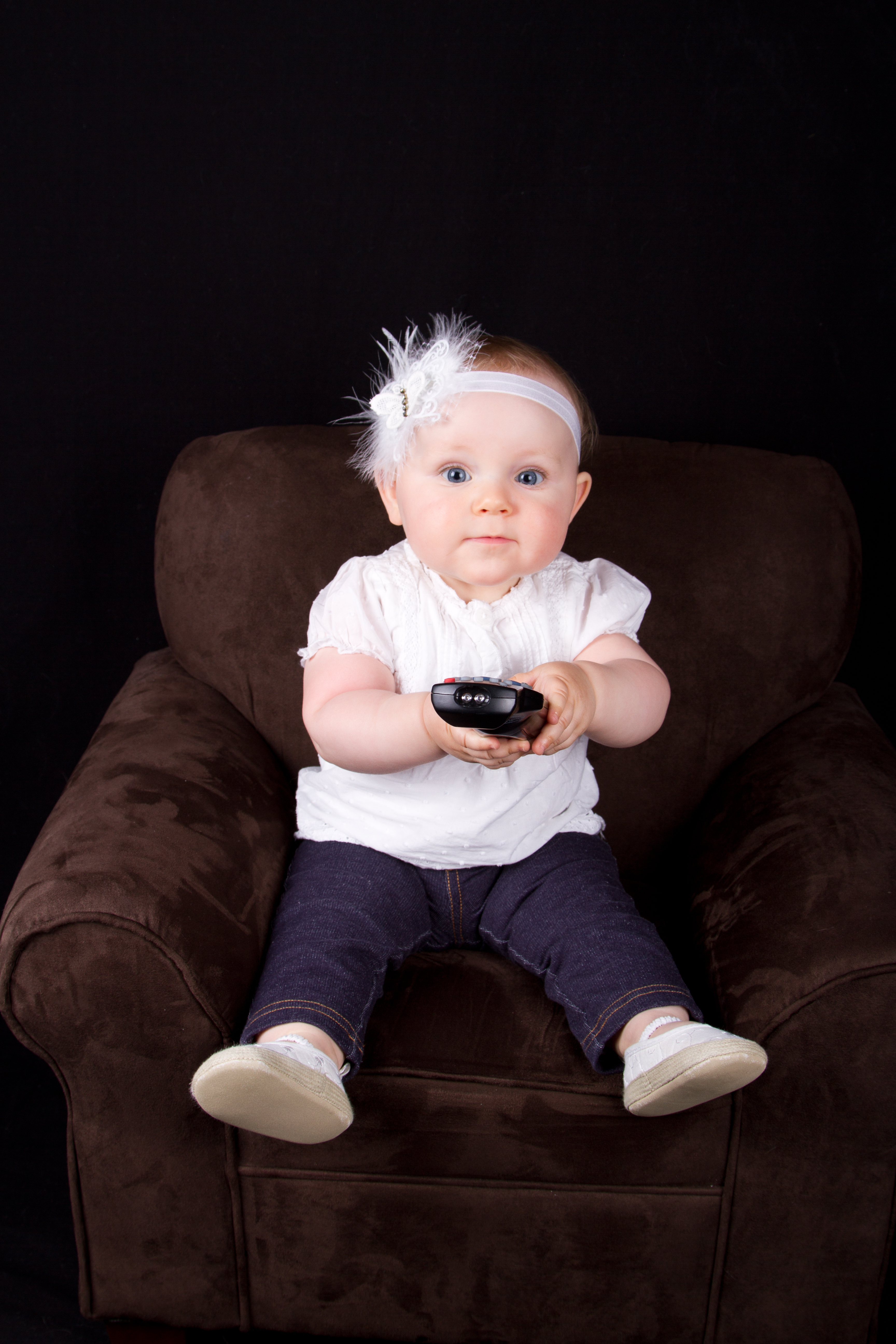
I spent an hour on Flickr and could not find a single image that inspired me so I decided to use a personal image (I hope that is alright).  This is a photo taken of my daughter in June. She was just shy of 9 months and yes, she is demonstrating that she knows exactly how a television remote works.

I have spent years watching my nephew become addicted to technology. I always said that when I had children, there would be a restriction on the amount of technology introduced to them. While I recognize that we are in a digital age and technology is everywhere, I was always determined that my child would have the same upbringing I did: playing in the cul-du-sac, games of hide and seek, drawing hop scotch with my sidewalk chalk, creating my own musicals to perform for neighbours, etc. And yet, at 11 months old, my daughter knows how to guide her finger over my iPhone and point a remote at the television DESPITE my best efforts to limit her exposure to these things.

Becoming a parent has really changed my perspective on technology and how much we can control its role in the lives of our own children and the children we teach. It has also brought to light, as has been mentioned by others, just how behind I will be technologically compared to my students despite growing up myself with access to computers and internet for most of my childhood. My daughter has changed a lot about me over the past year but specifically, she has changed the way I think about education, and consequently, the role technology has in education. I am now finding a middle ground where I am excited for the opportunities that the new technologies present while also being passionate about the relevance of my less high-tech upbringing. I will go out on a limb and state that I fear some parents rely on technology in place of their own time evidenced by how much children watch television, how much they play video games, reading social networking sites instead of books, etc. We will be seeing the effects of this in our classrooms. I am interested in the ways we as teachers will provide our students with the most positive aspects that technology has to offer while combating the negative effects such as reliability on spell check, addiction to cell phones, etc.

That being said, I have a LOT to learn about how we can use technology positively in our classrooms and I am excited to do so in this class.


Categories
Introductions

A new age

'New Technology'

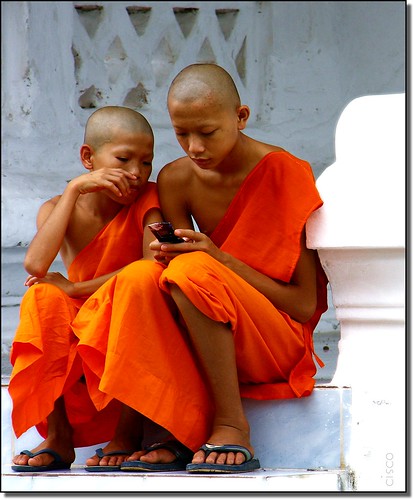
I chose this photo for a variety of different reasons. When I typed “new technology” into the search bar I wasn’t exactly sure as to what I was looking for. I have grown up in this technology world and I was trying just to find a photo that spoke to me. This was one of the first that showed up. It caught my eye first and foremost for its color, the orange jumped off the page and intrigued me. The second reason I choose it is that it made me smile. I have done some traveling through South East Asia and have met and spoke to many monks. When I asked about their lifestyles they always spoke of simplicity and nature, along with meditation would help lead us all to calm and serene lives. These monks were mostly older men, much older in years then myself, and I believed them to be so wise. However, these 2 boys are obviously a new generation of monks. They are a perfect mixture of the old and new world. They are embracing the dress and appearance of monks of generations past, and holding what I can only assume as a cell phone, they are showing that the future is also apparent in their world.

Through our teaching and within our lives we have a pull from the old and the new. Our students are going to be leaps and bounds ahead of many of us when it comes to technology, however, with many of us being comfortable using actual books, and simpler methods to teaching I can see a great relation between the old and new world happening in our classrooms. Even on my own, I know that I am not 100% competent in this technology age and am looking forward to learning more throughout LLED 368, and being able to relate these skills not only into my own life, but also into my teaching.

Categories
Introductions

E-ink

ebook

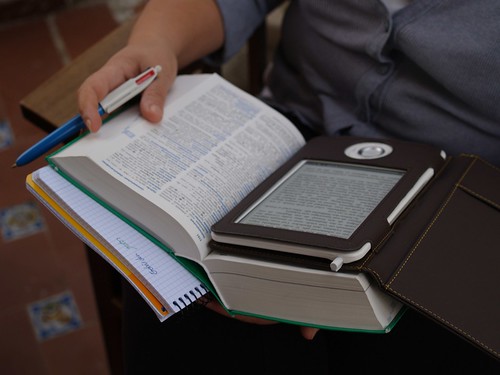
This photo is a great representation of the way the world is moving. When I first saw it I thought it was a new version of that old trick of hiding your magazine or comic in a novel so that no one knows what you’re really reading – but now the trick is to hide your electronic book (I quickly realized that this in fact is not what the picture shows). However, it made me laugh because there is a bit of a stigma around e-readers and the lack of authenticity when reading from an electronic source (Of course, they cannot replace the wonderful sensation of flipping old, ripped pages and smelling that old book smell). I have even seen commercials defaming e-books, saying that they will cause the end of the written word and the death of the author. It annoys me when I hear things like that because since I bought an e-reader, I have bought and read more books than ever in my life. I believe that these new technological mediums for literature have been and will continue to be more and more effective in things like sharing, spreading and enjoying.

I chose this photo because not only is it important for us to remember and teach how to use the old methods, like looking up a word in a great big paper dictionary, but also the new. In this modern world we cannot look at technology as a threat, but rather as an aid, a way to make our lives easier and possibly better. I am excited to be taking this course because I love the idea of learning new and exciting way to bring modern ideas into the classroom.

Categories
Introductions

Linking Past and Present

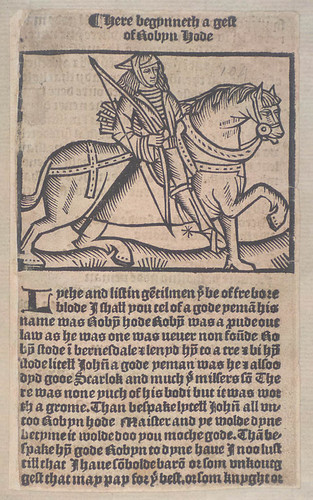
'A Gest of Robin Hood'

This passage from Robin Hood was first printed somewhere between 1510 to 1515. The woodcut itself shows the first likeness of Robin Hood. Now, over five hundred years later, the character of Robin Hood has appeared in various texts, television shows, films and games. Digital media has the potential to both preserve and evolve stories. Although most children would not have read the original text of Robin Hood, they will be familiar with the character through his appearance in the 1973 Disney film Robin Hood which has been aired on television numerous times.

Digital media and other new mediums have the ability to link past and present and to make teaching about the past that much more relevant to young students. It is my hope that I learn new strategies and methods of integrating new media into my lesson plans through my time in the LLED 368 “Multiliteracies in English Language Arts Classrooms” course.

Spam prevention powered by Akismet