Here’s a piece by Abe DeLeon from the Warner Perspective blog at the U of Rochester that deconstructs what counts as political participation in the USA and offers up a direct action approach to “active citizenship”.
Rouge Forum Update
Dear Friends,
The call for proposals for the Rouge Forum Conference, “Education, Empire, Economy & Ethics at a Crossroads,
May 14-17, 2009, at Eastern Michigan University, is linked here: http://www.rougeforumconference.org/. Proposals are due February 1.
In addition, following on our recent Rouge Forum Steering Committee decisions, here is a note from our Curricula Committee Coordinator, Doug Selwyn:
“Even in these dark and educationally repressive, testing driven times, there are educators doing extraordinary work in helping their students to understand what is really going on in their world, and helping them to come into the knowledge and power that enables them to act. The Rouge Forum invites you to share what you are doing so the rest of us can learn from you, on behalf of our students. We are asking for your most successful and useful lessons, units, methodologies, resources, and anything else that might help us to be more effective in our efforts to help our students to truly understand why things are the way they are, and to develop the knowledge, skills, and strategies for acting effectively to bring change.
We will do three things with what you send us. First, we will share some of the lessons, via Rich’s updates, on a monthly basis. Second, we will be organizing them into what we hope we will become a published anthology. Third, we will make all of the materials available, on line, at some site to be determined.
Also send a wish list of topics, issues, and themes you want to get ideas, resources, and lessons about, which might encourage a more focused response to this call.
We know that we are largely on our own when we work to carry out real education with our kids. It’s not going to come from those in power (who want to stay there), from textbook companies (who want their profits), or from the majority of your colleagues. It’s up to us. Send your lessons, ideas, resources, and “wish list” to Doug Selwyn (doug.selwyn@plattsburgh.edu).
http://richgibson.com/educationcurricular.html
With 1.2 million people losing jobs this year so far and what are likely to be massive education cuts on the near horizon, we need to project what impact Obama will have on schools and society. He promises tax cuts, massive spending projects, and wider warfare in Afghanistan. We know our union leaders are unprepared. Indeed, the AFT leadership promises to support Obama’s plans to expand merit pay. Which way for education activists, and others?
The debate is framed well in three responses that detail radical and liberal approaches for the near future. Here is one by Steve Strauss and one posted by Susan Ohanian on her website: “Optimism and Obamagogue”.
And another, “The Third Clinton Administration,” by Ralph Nader .
Thanks to Adam and Gina, Greg and Katy, Amber, Joe(s), Bill (s), Wayne, Perry, Marc, Preston, Shelly, Tally, Candace, Tommie and Bob, Craig, Doug, Bonnie, Kathy K, Henry, Joshua, Weird Eric and Dirty Edd, Suzanne, VP, PM, Dave H, Glenn, Anil, and Ravi.
All the best, r
Pirates and Emperors “Schoolhouse Rock” style
The New York Times edition I’m waiting for…
BOP on NYT Hoax:
Many of you will have recognized that this Times “Special Edition” is an
example of the situationist tactic of “detournement”. For information on
this tactic, see these two articles:
“A User’s Guide to Detournement”
http://www.bopsecrets.org/SI/detourn.htm
“The Situationists and the New Forms of Action Against Politics and Art”
http://www.bopsecrets.org/SI/11.newforms.htm
Then compare and contrast the “New York Times” scandal with situationists’
notorious “Strasbourg scandal”, which helped prepare the way for the May
1968 revolt in France:
“On the Poverty of Student Life”
http://www.bopsecrets.org/SI/poverty.htm
“Our Goals and Methods in the Strasbourg Scandal”
http://www.bopsecrets.org/SI/11.scandal.htm
Call for Proposals: Rouge Forum Conference 2009
CALL FOR PROPOSALS
Education, Empire, Economy & Ethics at a Crossroads
Eastern Michigan University
Ypsilanti, MI
May 14-17, 2009
The theme for the 2009 Rouge Forum Conference is: “Education, Empire, Economy & Ethics at a Crossroads: What Do We Need to Know and How Can We Come to Know It?”
Bringing together academic presentations and performances (from some of the most prominent voices for democratic, critical, and/or revolutionary pedagogy), panel discussions, community-building, and cultural events, this action-oriented conference will center on questions such as:
✴What is the nature of the crossroads, where do the different paths lead, what are our choices and how do we implement them?
✴What does education for liberation look like compared to education for empire? Class struggle?
✴Are we at a turning point in history? Has the rightward shift stopped or will the economic crisis push the ruling class towards fascism?
✴What are the implications of 2008 election ballot initiatives?
✴How do education, empire, economy, ethics, and democracy intersect in classrooms and schools?
✴How do we learn and teach to get from where we are to where we need to be?
✴How can we educate to liberate ourselves from the impact of empire? OR, How are we teaching to push back the imperializing of our classrooms?
✴How do we stand up for the correctness of our ideas?
✴How does change happen (individually, within a school, within a district)?
✴What support, what conditions facilitate teachers being willing to take the step towards correct action?
To learn more about the conference, please contact any of our conference organizers:
Joe Bishop (joe.bishop@emich.edu)
Greg Queen (rumbagarden@ameritech.net)
Adam Renner (arenner@bellarmine.edu)
Wayne Ross (wayne.ross@ubc.ca)
Rich Gibson (rgibson@pipeline.com)
Submissions:
Review of Paper Proposals treating any of the above questions will begin 1 February 2009. Please send a 250-500 word proposal to Joe Bishop (joe.bishop@emich.edu), describing your work/project/manuscript, how it connects to one of the conference questions, and what participants might take away from attending your session. Classroom teachers and students are strongly encouraged to send their proposals.
Performance Proposals should also be forwarded to Joe Bishop (joe.bishop@emich.edu) by December 15, 2008. Please describe your art/performance and how it may relate to the conference topic/questions.
A great example of the idoicy of the testing craze
The Broad Foundation, on the major backers of the test-based accountability has given the $1 million Broad Prize for Urban Education to the Brownsville (Texas) School District on the same day the that Texas authorities announced that the district had failed to meet achievement targets for two years under the federal No Child Left Behind law.
Is it good news that test-pushers realized that indicators other than test scores are best in judging school quality?
See the story in The New York Times.
Workplace #15 (New Issue Announcement)
The editors of *Workplace: A Journal for Academic Labor* are proud to announce our latest issue, which is now available online at http://www.cust.educ.ubc.ca/workplace/. The issue begins with a special “Mental Labor” section, which was generously compiled and guest edited by Steven Wexler. We express our heartiest gratitude to him, as well as to web designers Stephen Petrina and Franc Feng.
The lead section includes:
(I’m)Material Labor in the Digital Age
by Steven Wexler
Autonomy vs. Insecurity: The (Mis)Fortunes of Mental Labor in a Global Network
by David B. Downing
Extreme Work-Study, or, The Real “Kid Nation”
by Marc Bousquet
From the *Grundrisse* to *Capital* and Beyond: Then and Now
by George Caffentzis
Ideology and the Crisis of Capitalism
by Thomas A. Hirschl, Daniel B. Ahlquist and Leland L. Glenna
Gender, Contingent Labor, and Our Virtual Bodies
by Desi Bradley
Our regular segment of “Feature Articles” contains the following:
Capitalism, Audit, and the Demise of the Humanistic Academy
by Charles Thorpe
Troubling Data: A Foucauldian Perspective of “a Multiple Data Source Approach” to Professional Learning and Evaluation
by Mark C. Baildon
And our “Book Reviews” section, edited for the final time by William Vaughn, features four new entries:
*Pedagogy and Praxis in the Age of Empire: Towards a New Humanism*
Reviewed by Dana Carluccio
*Taking Back the Workers’ Law: How to Fight the Assault on Labor Rights*
Reviewed by William Vaughn
*Three Strikes: Labor’s Heartland Losses and What They Mean for Working Americans*
Reviewed by Philip Eubanks
*Teachers as Owners: A Key to Revitalizing Public Education*
Reviewed by William Vaughn
The editors are extremely thankful to William Vaughn for years of fine work with the Book Reviews, and we are sorry to see him go. We are pleased to report, however, that Steven Wexler will take on the role of reviews editor in the coming issues.
Thank you for your continuing support of the journal, and please keep *Workplace* in mind as a venue for your future scholarship. Send submissions to cscarter@ou.edu or wayne.ross@ubc.ca.
Solidarity,
Chris Carter
Wayne Ross
Stephen Petrina
Co-editors, *Workplace: A Journal for Academic Labor*
From the tooting your own horn department…
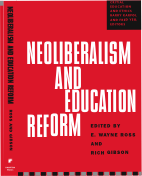
Neoliberalism and Education Reform has been chosen for the 2008 Critics Choice Book Awards from the American Educational Studies Association.
Published in June 2007 by Hampton Press, Neoliberalism and Education Reform examines how market-based economic policies affect teaching, curriculum, and the structure of schools and universities in North American and the United Kingdom. This book undertakes two primary goals: a critique of educational reforms that result from the rise of neoliberalism, and to provide Marxian alternatives to neoliberal conceptions of educational problems and solutions.
Rich Gibson (San Diego State University) and I are the co-editors and the book includes contributions from: Richard Brosio, Gilbert G. Gonzalez, Dave Hill, David Hursh, Les Levidov, Pauline Lipman, Peter McLaren, Glenn Rikowski, Patrick Shannon, Kevin D. Vinson, and John F. Welsh.
Here is a listing of the books receiving Critics Choice Awards this year:
Biesta, Gert (2006). Beyond Learning: Democratic Education for a Human Future. Boulder, CO:
Paradigm Publishers.
Dillard, C.B. (2006). On Spiritual Strivings: Transforming an African American Woman’s Academic
Life. Albany, NY: SUNY.
Gabbard, D. (2008). Knowledge and Power in the Global Economy: The Effects of School Reform in a
Neoliberal/Neoconservative Age. Mahwah, N.J.: Lawrence Erlbaum Publishing.
Giroux, Henry, A. (2007). The University in Chains: Confronting the Military-Industrial-Academic
Complex. Boulder, CO: Paradigm.
Hare, William, and John P. Portelli (Eds.), (2007). Key Questions for Educators. San Francisco: Caddo
Gap Press.
Hyslop-Margison, Emery and M. Ayaz Naseem (2007). Scientism and Education: Empirical Research
as Neo-Liberal Ideology. Springer.
Joshee, R. and L. Johnson (Eds.), (2007). Multicultural Education Policies in Canada and the United
States. Vancouver, BC: The University of British Columbia Press.
Kellner, Douglas (2008). Guys and Guns Amok: Domestic Terrorism and School Shootings from the
Oklahoma City Bombing to the Virginia Tech Massacre. Boulder, CO: Paradigm Publishers.
Lather, Patti (2007). Getting Lost: Feminist Efforts Toward a Double(d) Science. Albany, New York:
SUNY.
Mayo, Cris (2007). Disputing the Subject of Sex: Sexuality and Public School Controversies. Rowman
& Littlefield Publishers, Inc.
Noguera, Pedro (2008). The Trouble with Black Boys. San Francisco, CA: Jossey-Bass.
Robbins, Christopher, (2008). Expelling Hope: The Assault on Youth and the Militarization of Schooling.
Albany, NY: SUNY.
Ross, E. W., & Gibson, R. (Eds.). (2007). Neoliberalism and Education Reform. Cresskill, NJ: Hampton
Press.
Salvio, Paula (2007). Anne Sexton: Teacher of Weird Abundance. State University of New York Press.
Saltman, Kenneth (2007). Capitalizing on Disaster: Taking and Breaking Public School. Boulder, CO:
Paradigm.
Schultz, Brian (2008). Spectacular Things Happen Along the Way: Lessons from an Urban Classroom.
Columbia, NY: Teachers College.
Solomon, R. P. and D. N. Sekayi (Eds.), (2007). Urban Teacher Education and Teaching: Innovative
Practices for Diversity and Social Justice. Lawrence Erlbaum Associates.
Yosso, Tara (2006). Critical Race Counterstories along the Chicana/Chicano Educational Pipeline.
Routledge.
Villegas, Malia, Neugebauer, Sabina Rak and Kerry R. Venegas (Eds.), (2008). Indigenous Knowledge
And Education: Sites of Struggle, Strength, and Survivance. Harvard.
World’s first heavy metal conference hits Salzburg
The Guardian: World’s first heavy metal conference hits Salzburg
Salzburg to play host to the world’s first scholarly conference on heavy metal, the brainchild of UK academic Dr Niall Scott
The quaint alpine city of Salzburg is used to two kinds of musical visitors: fans of Mozart or the Sound of Music. It is, after all, the birthplace of both.
Next week, however, musical devotees of an altogether different sort will assemble under its baroque towers – and they’ll be sporting ponytails, leather jackets, boots and black t-shirts emblazoned with images of skulls and gore.
Salzburg will be host to the world’s first scholarly conference on heavy metal, the brainchild of UK academic Dr Niall Scott.
Headbangers from universities in Britain, Turkey, Canada and Indonesia will present research papers on heavy metal aesthetics, sub-cultures and politics.
Their studies will include “comparative empirical studies” on bands such as Led Zeppelin, Black Sabbath, and Metallica.
Research papers include Suicide, Booze and Loud Guitars: The Ethical Problem of Heavy Metal; Controlled Anger and the Expression of Intensity and Authenticity in Post-modern Heavy Metal; and Heavy Metal in a Muslim Context: The Rise of the Turkish Metal Underground.
“It’s painful to submit to our bosses; it’s even more stupid to choose them!”
One of the most dysfunctional myths perpetuated by social studies teaching and curriculum is: voting = democracy = freedom.
North American electoral politics and voting diverts the vast majority of people from acting for themselves. Even if you are in a position to have your vote actually counted (http://www.stealbackyourvote.org/), voting is not participation, but abdication of power to others. The outcome is captured in the May 1968 slogan:
Je participe.
Tu participes.
Il participe.
Nous participons.
Vous participez.
Ils profitent.
This is a slogan that number of us have resurrected as part of our efforts to learn about equality, democracy and social justice as we simultaneously struggle to bring into practice our present understanding of what that is. As we seek to build a caring inclusive community which understands that an injury to one is an injury to all. At the same time, our caring community needs to deal decisively with an opposition that is sometimes ruthless (http://www.jceps.com/index.php?pageID=article&articleID=97).
Below you’ll find a post from the Bureau of Public Secrets, which I thought some folks on this list might be interested in. I am not necessarily against voting, as the BOP author concludes: “By all means vote if you feel like it. But don’t stop there. Real social change requires participation, not representation.”
THE LIMITS OF ELECTORAL POLITICS
http://www.bopsecrets.org/recent/beyond-voting.htm
Roughly speaking we can distinguish five degrees of “government”:
(1) Unrestricted freedom
(2) Direct democracy
(3) Delegate democracy
(4) Representative democracy
(5) Overt minority dictatorship
The present society oscillates between (4) and (5), i.e. between overt
minority rule and covert minority rule camouflaged by a facade of token
democracy. A liberated society would eliminate (4) and (5) and would
progressively reduce the need for (2) and (3). . . .
In representative democracy people abdicate their power to elected
officials. The candidates’ stated policies are limited to a few vague
generalities, and once they are elected there is little control over their
actual decisions on hundreds of issues — apart from the feeble threat of
changing one’s vote, a few years later, to some equally uncontrollable rival
politician. Representatives are dependent on the wealthy for bribes and
campaign contributions; they are subordinate to the owners of the mass
media, who decide which issues get the publicity; and they are almost as
ignorant and powerless as the general public regarding many important
matters that are determined by unelected bureaucrats and independent secret
agencies. Overt dictators may sometimes be overthrown, but the real rulers
in “democratic” regimes, the tiny minority who own or control virtually
everything, are never voted in and never voted out. Most people don’t even
know who they are. . . .
In itself, voting is of no great significance one way or the other (those
who make a big deal about refusing to vote are only revealing their own
fetishism). The problem is that it tends to lull people into relying on
others to act for them, distracting them from more significant
possibilities. A few people who take some creative initiative (think of the
first civil rights sit-ins) may ultimately have a far greater effect than if
they had put their energy into campaigning for lesser-evil politicians. At
best, legislators rarely do more than what they have been forced to do by
popular movements. A conservative regime under pressure from independent
radical movements often concedes more than a liberal regime that knows it
can count on radical support. (The Vietnam war, for example, was not ended
by electing antiwar politicians, but because there was so much pressure from
so many different directions that the prowar president Nixon was forced to
withdraw.) If people invariably rally to lesser evils, all the rulers have
to do in any situation that threatens their power is to conjure up a threat
of some greater evil.
Even in the rare case when a “radical” politician has a realistic chance of
winning an election, all the tedious campaign efforts of thousands of people
may go down the drain in one day because of some trivial scandal discovered
in his (or her) personal life, or because he inadvertently says something
intelligent. If he manages to avoid these pitfalls and it looks like he
might win, he tends to evade controversial issues for fear of antagonizing
swing voters. If he actually gets elected he is almost never in a position
to implement the reforms he has promised, except perhaps after years of
wheeling and dealing with his new colleagues; which gives him a good excuse
to see his first priority as making whatever compromises are necessary to
keep himself in office indefinitely. Hobnobbing with the rich and powerful,
he develops new interests and new tastes, which he justifies by telling
himself that he deserves a few perks after all his years of working for good
causes. Worst of all, if he does eventually manage to get a few
“progressive” measures passed, this exceptional and usually trivial success
is held up as evidence of the value of relying on electoral politics, luring
many more people into wasting their energy on similar campaigns to come.
As one of the May 1968 graffiti put it, “It’s painful to submit to our
bosses; it’s even more stupid to choose them!”
–Excerpts from Ken Knabb’s “The Joy of Revolution.”
The complete text is online at http://www.bopsecrets.org/PS/joyrev.htm
* * *
SOME CLARIFICATIONS
My intention in circulating these observations is not to discourage you from
voting or campaigning, but to encourage you to go further.
Like many other people, I am delighted to see the Republicans collapsing
into well-deserved ignominy, with the likelihood of the Democrats
recapturing the presidency and increasing their majorities in Congress.
Hopefully the latter will discontinue or at least mitigate some of the more
insane policies of the current administration (some of which, such as
climate change and ecological devastation, threaten to become irreversible).
Beyond that, I do not expect the Democratic politicians to accomplish
anything very significant. Most of them are just as corrupt and compromised
as the Republicans. Even if a few of them are honest and well-intentioned,
they are all loyal servants of the ruling economic system, and they all
ultimately function as cogwheels in the murderous political machine that
serves to defend that system.
I have considerable respect and sympathy for the people who are
campaigning for the Democratic Party while simultaneously trying to
reinvigorate it and democratize it. There are elements of a real grassroots
movement there, developing in tandem with the remarkable growth of the
liberal-radical blogosphere over the last few years.
But imagine if that same immense amount of energy on the part of millions
of people was put into more directly radical agitation, rather than (or in
addition to) campaigning for rival millionaires. As a side effect, such
agitation would put the reactionaries on the defensive and actually result
in more “progressives” being elected. But more importantly, it would shift
both the momentum and the terrain of the struggle.
If you put all your energy into trying to reassure swing voters that your
candidate is “fully committed to fighting the War on Terror” but that he has
regretfully concluded that we should withdraw from Iraq because “our efforts
to promote democracy” there haven’t been working, you may win a few votes
but you have accomplished nothing in the way of political awareness.
In contrast, if you convince people that the war in Iraq is both evil and
stupid, they will not only tend to vote for antiwar candidates, they are
likely to start questioning other aspects of the social system. Which may
lead to them to challenge that system in more concrete and participatory
ways.
(If you want some examples, look at the rich variety of tactics used in
France two years ago — http://www.bopsecrets.org/recent/france2006.htm .)
The side that takes the initiative usually wins because it defines the terms
of the struggle. If we accept the system’s own terms and confine ourselves
to defensively reacting to each new mess produced by it, we will never
overcome it. We have to keep resisting particular evils, but we also have to
recognize that the system will keep generating new ones until we put an end
to it.
By all means vote if you feel like it. But don’t stop there. Real social
change requires participation, not representation.
BUREAU OF PUBLIC SECRETS
P.O. Box 1044, Berkeley CA 94701, USA
http://www.bopsecrets.org