Latest Poll Reveals 430 New Demographics That Will Decide Election
In may ear…since April and favorite CDs of 2008 (so far)
It’s been a while since I’ve updated my listening habits here, April to be exact.
Anyway, I continue to love listening to Napster via my Sonos. It’s paricularly fun to stream the new releases on Tuesday mornings as I read reviews of the latest CDs in the paper. And Soma Fm, especially the “Groove Salad” channel, which is as they say “a nicely chilled plate of ambient beats and grooves,” has become a staple or dinner time listening.
Here‘s what I’ve picked up CDwise since April.
Here are a few albums that are favorites of the 2008 releases:
Ry Cooder, I Flathead
Shelby Lynne, Just A Little Lovin’
Billy Bragg, Mr. Love & Justice
Black Mountain, In the Future
The Racontuers, Consolers Of The Lonely
R.E.M., Accelerate
Alejandro Escovedo, Real Animal
My Morning Jacket, Evil Urges
Jim White, Transnormal Skiperoo
Daniel Lanois, Here Is What Is
Ray Davies,Working Man’s Cafe
The Best Of Bobby Womack – The Soul Years
The Baseball Project, Volume 1: Frozen Ropes and Dying Quails
Nick Cave and the Bad Seeds, Dig!!! Lazarus Dig!!!
Death Cab For Cutie, Narrow Stairs
Al Green, Lay It Down
Texas school district will allow teachers to carry guns
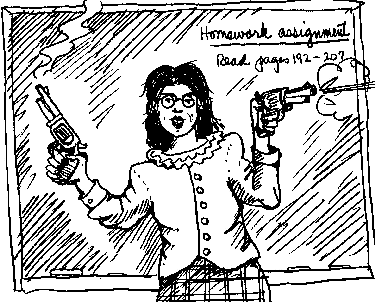
Teachers in Harrold, Texas will be allowed to pack heat in the classroom beginning this month, another advance in school reform in the USA. The AP reports that “For employees to carry a pistol, they must have a Texas license to carry a concealed handgun; must be authorized to carry by the district; must receive training in crisis management and hostile situations; and must use ammunition designed to minimize the risk of ricocheting bullets.”
At first I thought I this was a horrifying idea, but if they use low ricocheting ammo then I guess it’s okay.
So I guess teacher educators in Texas will have to start revising those classroom management syllabi.
U.K. Fires U.S. Testmaker for Incompetence
Here the link to the story in The Times of London: ETS loses contract after failure to deliver SATs test results on time (published August 15).
Here is some background on the significance of this development from FairTest‘s Bob Shaeffer:
This story has global implications because the Educational Testing
Service is a major player in the U.S. college admissions, K-12
assessment and teacher licensing markets as well as plans for aggressive
international expansion. Based on FairTest’s more than twenty years of
experience, ETS screw-ups in the U.K. are not unusual. For example:– ETS had to pay prospective teachers more than $11 million U.S. to
settle a lawsuit about systematic mistakes in scoring its PRAXIS
licensing exams which gave false failing scores to more than than 4,000
educators. Here’s a link to a summary of that issue:http://www.fairtest.org/ets-pays-11-1-million-settle-teacher-test-lawsuit
– Also, ETS recently lost the contract to deliver the Graduate
Management Admissions Test (GMAT) due to repeated administrative and
scoring mistakes .http://www.fairtest.org/ets-loses-gmat-contract
– ETS has also encountered significant difficulties in launching new
international versions of the Test of English as a Foreign Language
(TOEFL) and Graduate Record Exam (GRE)http://www.fairtest.org/new-gre-cancellation-reveals-ets-flaws
A cross-cutting pattern is that ETS submits low bids to win new testing
contracts but then lacks the technical competence and qualified staff to
deliver on its promises The same behavior appears to be typical for
other major testing companies, including Pearson, McGraw-Hill, etc., all
of which have also had major scoring problems.
CFP: Democracy & Education (Teacher Voice in Today’s Schools—Why Is it Critical?)
Democracy & Education
CALL FOR MANUSCRIPTS
Teacher Voice in Today’s Schools—Why Is it Critical?
Deadline: October 15, 2008
Publication: March 2009
We are seeking manuscripts that explore the role for teachers’ voices in today’s classrooms. Manuscripts might address themes captured in the following questions:
* How has the role of teachers’ voices changed over the last century?
* What does it mean to be an activist teacher in a democratic
tradition? What is the role for these teachers in the coming decades?
* How do teachers’ voices and student’s voices balance each other?
What are models of collaborative conversation that involve student
voices in the decision-making process? How do these models assist
in the teaching and learning of democracy?
* How do teachers communicate with the larger community connected to
schools (parents, community groups, other schools)?
* Teachers are busy people. When do you have time to talk with and
collaborate with other teachers? How does that conversation look?
How can teachers bring their voices together to make change?
* With national, state, and district mandates, where is there room
for the teacher’s voice? What are examples of innovative ways that
teachers have ensured their voices are heard?
We invite educators to explore these issues in theory (essay), to suggest pedagogical approaches (teacher file), or to share your own classroom experiences (reflection). To learn more about the categories for article submissions, or to submit a paper, please visit our website and read our submission guidelines. Please feel free to forward this call for papers to any colleagues, students, or peers that might be interested in submitting an article for consideration.
—
Hanna Neuschwander
Editorial Director
Democracy & Education
Lewis & Clark Graduate School of Education and Counseling
0615 SW Palatine Hill Rd. MSC 93
Portland, OR 97202
tel: (503) 768-6054
fax: (503) 768-6053
Online campaign to help Gaza’s students reach their studies abroad
Currently, hundreds of Palestinian students are trapped in the Gaza Strip – unable to reach the universities around the world to which they have been accepted. Since June of 2007, Israel has imposed a closure on the Strip, violating the right to freedom of movement and other rights for which freedom of movement is a pre-condition, such as the right to access education.
Faced with pressure from world leaders outraged over the ban, Israeli officials declared recently that they would allow exit for just a few dozen students in Gaza holding “recognized scholarships” as a gesture to “friendly countries” but will continue to prevent hundreds of other students from reaching their studies. With each passing day, Gaza’s most talented young people risk losing their places in universities abroad – and losing their chance to pursue their dreams of building a better future in the region.
Further information on this issue is available in Gisha’s report issued in June 2008 and in Gisha’s July 2008 Power Point Presentation.
With the new academic year fast approaching, Gisha – Legal Center for Freedom of Movement is working to persuade Israeli authorities to cancel the ban on students leaving the Gaza Strip and to allow Gaza’s students to reach their studies abroad. One of the ways we are doing so is via a new internet campaign, in which banners featuring the students (see an example of one which I’ve attached below) are passed along through mailing lists and posted on blogs. Clicking on the banner then leads to the campaign’s minisite: www.trappedingaza.org, where visitors can send a message to Israeli leaders in support of the right of Palestinian students in Gaza to reach their studies.
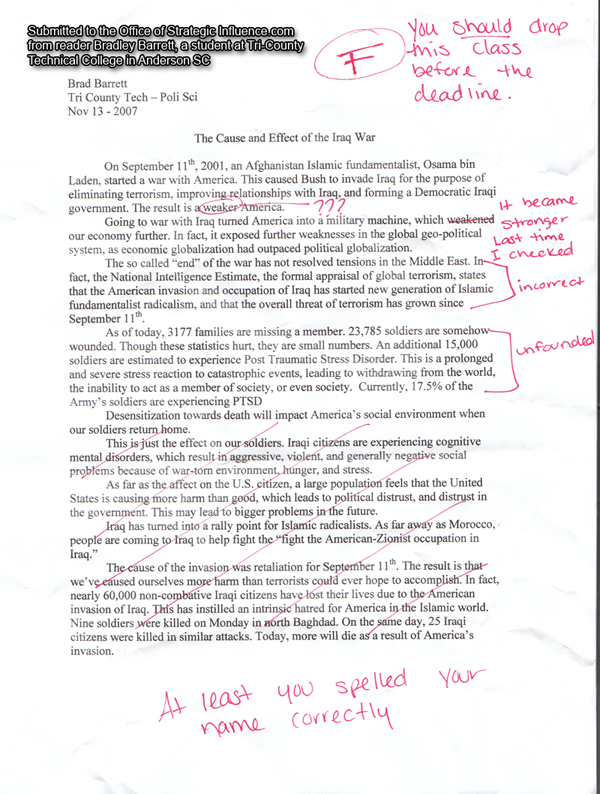
Brad Barrett’s Iraq Paper
The Office of Strategic Influence:
I guess Tri-County Tech hasn’t heard that all of higher ed is supposed to be dominated by tenured liberals.
Brad Barrett’s Iraq Paper
One of our readers sent us a scan from an old paper of his. The topic was “Cause and Effect of the Iraq war” and I’m guessing the teacher wanted their students to write a puff piece about how awesome we’re kicking ass in Iraq. But this teacher is from South Carolina. What do we expect.
Rouge Forum Update
Dear Friends,
The Rouge Forum No Blood Oil web page is updated. As of this writing, the wars have cost $541 billion.
Of particular interest is Joe Lucido’s idea of visiting Teacher Stores, now, where teachers are stocking up, meeting them with petitions to urge opt outs from the NCLB-driven high stakes exams. Here is a link to one of many petitions.
Chicago students are being urged to conduct a school boycott on the opening day of school, time to be spent applying to schools in the well funded suburbs. Perhaps this action will set the stage for a year of resistance, something well beyond what the organizers now foresee.
In Detroit, the FBI is investigating DPS finances while chaplains invade the schools seeking to pray their way out of one of the most profound social and economic crises in the US (see the comments on the articles as well as those on Susan Ohanian’s web site.
In Kansas City, educators are already picketing for a contract
.
This is Stephen Krashen on Reading First: Hooked on Phailure .
Here is Chalmers Johnson on the emergence of fascism, militarism, mercenaries, and the promise of endless war. Besides Johnson’s Nemesis Trilogy, people might want to review his early, 1960’s book, Revolutionary Change and, for an update on the many uprisings in Pakistan, Afghanistan, India, and Central Asia, see Rashid, Descent Into Chaos.
And Ravi Kuman reviewing, in brief, the state response to uprisings in India.
The Rouge Forum Steering Committee will meet in Detroit, the weekend of September 27. Suggestions for our work can be sent to rumbagarden@ameritech.net
And don’t forget the spectacular Last Chance to Eat Before School Starts And the Sky Falls PotLuck Dinner in Southern California, at our house, on August 9. Be there or be square, and RSVP!
Thanks to Wayne, Kevin, Amber, Susan, Sally, Steve, Ash, Ravi, Dave and Dave, Perry, Shelly, Paul (especially for the correction) Candace, Bob and Tommie (don’t forget to send that stuff), Connie and Doug, John and Mary, Paul and Mary, Sandy and Van, Victoria, Eva, Chris, Toby, and Sharon.
If you’re on Facebook, join the Rouge Forum group.
All the best,
r
Richest Americans See Their Income Share Grow
Wall Street Journal: Richest Americans See Their Income Share Grow
By JESSE DRUCKER
July 23, 2008; Page A3
In a new sign of increasing inequality in the U.S., the richest 1% of Americans in 2006 garnered the highest share of the nation’s adjusted gross income for two decades, and possibly the highest since 1929, according to Internal Revenue Service data.
Meanwhile, the average tax rate of the wealthiest 1% fell to its lowest level in at least 18 years. The group’s share of the tax burden has risen, though not as quickly as its share of income.
The figures are from the IRS’s income-statistics division and were posted on the agency’s Web site last week. The 2006 data are the most recent available.
The figures about the relative income and tax rates of the wealthiest Americans come as the presumptive presidential candidates are in a debate about taxes. Congress and the next president will have to decide whether to extend several Bush-era tax cuts, including the 2003 reduction in tax rates on capital gains and dividends. Experts said those tax cuts in particular are playing a major role in falling tax rates for the very wealthy.
Sen. John McCain has proposed extending the lower tax rates of 15% on long-term capital gains and dividends that apply to most taxpayers, while Sen. Barack Obama has said he will seek to raise them to at least 20%, the rate before the 2003 cut, and possibly higher.
[Go to poll] QUESTION OF THE DAY
• Vote: Do the rich pay their fair share of taxes?
According to the figures, the richest 1% reported 22% of the nation’s total adjusted gross income in 2006. That is up from 21.2% a year earlier, and is the highest in the 19 years that the IRS has kept strictly comparable figures. The 1988 level was 15.2%. Earlier IRS data show the last year the share of income belonging to the top 1% was at such a high level as it was in 2006 was in 1929, but changes in measuring income make a precise comparison difficult.
The average tax rate in 2006 for the top 1%, based on adjusted gross income, was 22.8%, down slightly from 2005 and the fifth straight year of declines. The average tax rate of this group was 28.9% in 1996, and was 24% in 1988.
As the wealthiest Americans’ share of income has risen, so has their share of the income-tax burden. The group paid 39.9% of all income taxes in 2006, compared with 27.6% in 1988. In the most recently reported five years, however, the share of income reported by the very wealthy has risen faster than the group’s share of income taxes.
The IRS data look only at so-called adjusted gross income, which is reported on tax returns, and focus only on income taxes. A report by the Congressional Budget Office late last year, which used wider definitions of both income and taxes, found similar trends.
Joel Slemrod, a tax economist at the University of Michigan’s business school, said that some portion of the increase in income for the top 1% could stem from the increasing shift to entities such as partnerships, which means some income previously reported by businesses is now reported by individuals. Larger factors likely include changes in trade policy and other aspects of the increasingly global economy, he said.
As if we didn’t already know this, but…Scott McClellan Exposes Fox Network
From Daily Kos: