Categories
World Music Studies

Malanka! Not. Or maybe so.

It’s that time of year again, when Ukrainians in the homeland and the Canadian prairies celebrate their culture by mounting a party called malanka. I was reminded of this occasion when I watched a recent episode of the Rick Mercer Report where Rick attended a malanka party in Saskatoon. If you are lucky enough to be invited to a malanka, you will find yourself in a spirited and noisy evening of dance and music in a hotel ballroom or community rec room, full of all generations. Think wedding reception. Sprinkled throughout the evening are interludes of entertainment, especially Ukrainian folkloric dance in spectacular costume – women wearing peasant dresses and streaming ribbons, men in Turkish trousers, and everybody wearing shiny red boots. Or not. I’ve seen the dancers simply strut their stuff in street or party clothes. Here in Vancouver, Ukrainian malanka makes barely a ripple on the cultural landscape, but on the Canadian prairie arctic that is Edmonton, Saskatoon, Regina and Winnipeg at this time of year, it is the biggest event in the January’s social calendar, in the cities and out in the countryside. The reason is because Ukrainians in massive numbers settled in that part of Canada in the late 1800s.

Malanka celebrations (Malanckyn Vechir) occur on New Year’s Eve according to the Julian calendar, which runs a little more than a week later then the modern Gregorian calendar. That puts the date on January 13. It is part of a constellation of day-time festivities called Shchedryi Vechir (Generous Eve) where people share in carol singing (shchedrivky), dancing and feasting. The fun high day follows similar festivities about a week earlier on Christmas Day (Sviata Vecheria) when carols (koliadky) are sung at home and during Christmas house-visits, koliadnyky. Think wassailers.

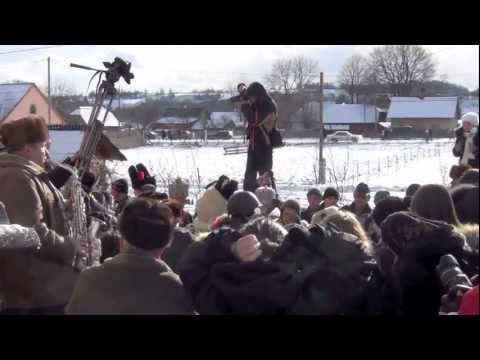
Both Christmas day and New Year’s Eve festivities feature mummers plays. The plays and their associated shenanigans have a heightened spin in Western Ukraine among the rural Hutsul people of the Carpathian Mountains. Rowdy young men go house to house with ritualized greetings, group singing, dancing (hutsulka, kolomyjka, both shoulder-to-shoulder round dances) and of course, a mummers play.

The Christmas Day event is called vertep (related to the Russian petrushka – Stravinsky alert), centred on the nativity scene. Sombre re-enactments of the Jesus’ birth are contrasted with hilarious skits about the shepherds, the antics of the animals (especially the goat, koza, which also had a story of its own), and the comic characterizations of the accompanying costumed stereotypes – a local policeman, a blacksmith, the gypsy, a chimneysweep, etc.. The mummers play at New Year’s Eve is called malanka, and features many of the same stereotypical, comic characters.  In each instance, the accompanying characters make brief appearances, where they are announced by the performance of their defining songs (in the style of koliadky).

The malanka play is named after the central character. According to the song lyrics, she is beautiful, shy and on the look-out for a worthy husband. According to the lyrics. But in reality, “she” was a male dressed in shabby women’s clothing, blustering and wreaking havoc in the kitchen, pretending to clean it up, until “she” was persuaded to sit down and have a drink. Other, even shorter skits could be invoked, with specific songs performed during the mimed antics of one or more of the other comic characters who accompanied malanka. Food and drink would be consumed copiously and couple dances would spontaneously break out, much to the delight or chagrin of the females in the house. Behind the façade of merriment was an opportunity for the young people of the town to size each other up for potential romances and dalliances. The narrative of the play is concerned either with a portrayal of pre-nuptial ritual or a knock-about re-enactment of a myth about a young woman who finds herself caught in a web of intrigue similar to Persephone.
YouTube Preview Image

When I became a morris dancer, I learned that many English folk arts (such as morris dance) were also timed to coincide with high days in the festive year, like malanka and vertep. I also learned that at Christmas time in England, mumming was far more prevalent than morris dance, so in order to go deep into this performance art I became the foreman of a mumming troupe drawn from morris dancers in our organisation. I quickly discovered that mumming was the equal of morris dance with its complex representations and vigorous performativity. And just as I had done in my later comparative studies of ethnic dances in relation to morris dance, I found a multitude of astounding examples of ethnic theatre resembling mumming. I hasten to add that is almost all “street” theatre and “kitchen” theatre, not the high tone productions found on stages, performed by professional actors and thoughtfully written by playwrights exploring human dilemmas, triumphs and hubris.  The examples of folk theatre I found were usually brief, physical and brimming with the kind of rough-and-ready humour Mikhail Bakhtin called Carnival Laughter.

It was during my mumming phase that I discovered traditional malanka. But, no sooner did I revel in this discovery, I became bamboozled by the malanka that I was seeing and hearing about on the prairies.  It had virtually no resemblance to the malanka I had read about.  What’s more, when I began to make inquiries in the Ukrainian communities I visited, I discovered that many of the malanka celebrants were entirely unaware of the traditional malanka.

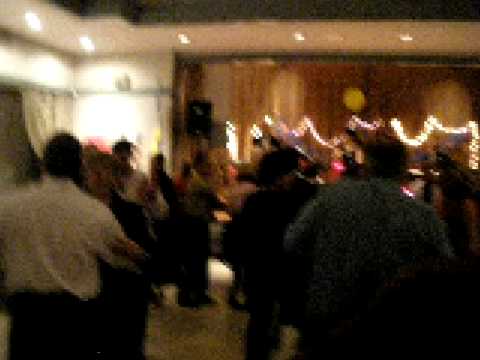
The Malanka that one sees today is a party of an entirely different colour. Instead of “folk” it is “dance club” with music performed by a polka or soft rock band.  Although the event resembles a supper club, the many generations of people in attendance make the event more like a wedding reception. Granted, a typical malanka New Year’s party will have guest appearances by the local Ukrainian dance troupe, and party-goers may even have a go at a traditional dance and sing-along. Ukrainian language even makes an appearance at these events. Obviously the original kitchen “party” component has morphed into something more contemporary, in the tried and true manner of all folk customs that adapt to changes and modernity in general. I have no problem with that, but what I did find alarming was the seeming ignorance among many young Ukrainian-Canadians about the origins of their malanka.
YouTube Preview Image

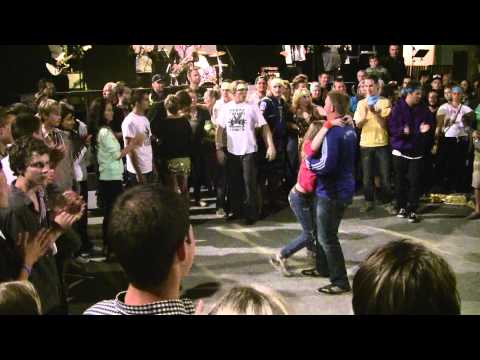
Of course, the picture is never black and white. One finds videos on YouTube with young people having a whale of a time, pumped up by the hot music of young Ukrainian-Canadian musicians like Zirka. And come to think about it, the fun seen in internet videos suggest that young people are still sizing each other up at malanka parties.
YouTube Preview Image

The gap between the old and the new does not stop at the parties. I had heard of a video performance of a malanka play that was produced by the Ukrainian Canadian Congress in 1995 for sale to educational institutions across Canada. Imagine my disappointment when I found myself watching a dance-mime performance of the story of the “pagan goddess malanka” who was portrayed by a slim young ballerina dressed in beguiling Ukrainian costume, being escorted across the dance floor, and through the narrative, by gallant young men, also in traditional folkloric costume. The choreography was a mix of ballet and modern Ukrainian “folkloric” dance. I sat back in astonishment, pondering the thousands of young people in grade schools and universities who would use the video as the basis for their papers and multicultural presentations.

Young third and fourth Ukrainian-Canadians may have been unaware of the roots, but not the generation of their grandparents. The older the informant, the more aware they were of traditional malanka. But there was also a kind of shame and reluctance that tempered their fond memories. The grandparents seemed uneasy about the transvestism of malanka, and the general  foreign-ness of the event, given their desire to become “Canadian”. That is, Anglo Canadian, a hybrid of America and Britain. The internment of Ukrainians during World War II also made those mixed feelings even more complicated.

How times have changed. A traditional Malanka would be greeted with open arms today, if she could be found. I despaired of seeing or hearing about a real Malanka until a few years ago when I visited a small town in central Saskatchewan, almost entirely populated by many generations of Ukrainian-Canadians. There I discovered that the original Malanka and her troupe were alive and thriving. I also learned that researchers and scholars in the Ukrainian Studies department of the University of Alberta in Edmonton were delving deep into the mysteries of the original malanka play, just like scholars in England (and Newfoundland!) were investigating the roots of mumming.

When I began teaching at the School of Music at UBC, I dreamt of engineering a centre for ethnic music, dance and theatre where all the seasonal traditions like old malanka would be studied and performed. Given that they touch upon domains found throughout the Arts Faculty, they would make excellent cross-faculty fodder. The explorations would start with Old World (i.e., European) examples and then perhaps branch out to similar events around the world. For example, Sestubun in Japan has remarkable points of commonality.  You can find the project in my blog under Ethnomusicology ensembles.

Now, conditions may not be right. The tide of diasporan communities from Asia seem to have no interest in these hold-over cultures from Europe, and the latest generation of born-and-bred Canadian children have long since separated from the homelands of their European grandparents.  For example, it is typical to speak to children of English parents who have never heard of morris dance or mummers plays. I suppose each of these segments of modern society is re-shaping Canada into a transcultural image more suited to their needs.

Readings

Robert Klymasz (1970), The Ukrainian Winter Folksong Cycle in Canada, with music transcriptions by Kenneth Peacock

Robert Klymasz (1985) ‘“Malanka”: Ukrainian Mummery on the Prairies,” in Canadian Folk Music Journal, volume 13 (1985), pp. 32-36

Orest Subtelny (1991) Ukrainians in North America: An Illustrated History

Tamara Livingstone (1999) “Music Revivals: Towards a General Theory,” in Ethnomusicology, volume 43, number 1 (Winter), pp. 66-85

Phil Ryan (2010) Multcultiphobia

Cheryl Avery, Mona Holmlund (2010) Better Off Forgetting? Essays on Archives, Public Policy, and Collective Memory

Music

Tafiychuk Family

Hutsulshchyna No 1 Music of the Ukrainian Carpathian Mountains (Koka)

With a family line from the Hutsul village of Bukovets, between Kosiv and Verkhovyna in the Ukrainian part of the Carpathian Mountains, this family has been cultivating local music traditions for decades. Their repertoire is recognized as a canon of Hutsul folklore. This first CD consists of ritual wedding music – kolomyikas and ritual games and spontaneous, archaic dances sung and performed on violin and instruments such as sopilka, floiara, telenka among others. This CD also includes a small booklet with a short story about the creation of the world.

Hutsulshchyna No 2 Music of the Ukrainian Carpathian Mountains (Koka)

Volume two of the music by this family from the Hutsul village of Bukovets, between Kosiv and Verkhovyna in the Ukrainian part of the Carpathian Mountains, focuses on songs and improvisations of traditional melodies performed on violin and instruments such as sopilka, floiara, telenka among others.

These CDs and similar music productions are available at CD Roots.


Categories
Teaching

Are Live Lectures Becoming Redundant?

Online versus conventional lectures; that is the question (not asked by Hamlet). The recent issue of UBC Reports (January 2, 2013) has several senior administrators musing about the future of university education. What looms large is the assumption that online instruction may become the equal, if not the superior, mode of delivery.

My course material is now almost entirely online, and my office is virtual (via Connect and Skype). Everything in my courses (readings, lecture descriptions, word lists, bibliographies, exams, assignments) can be accessed online from the comfort of a living room or a coffee shop.

YouTube Preview Image


All, that is, except for one crucial component- the lectures.

Online lectures

The next and final step would be to deliver my lectures online. But how? Most of the online courses that I have seen are text-based. The student buys the course, opens up the course modules, reads a whole lot, and then completes the assignments. Borrring. And very likely redundant, given that so much information is available online, and for free no less, starting with Wikipedia.

Lectures via webinars might be a solution, but they are tied to particular time on a calendar. Then there are the audio podcasts which involve listening to somebody reading the text of a lecture. Borrring.

The most likely candidate is the video podcast, which a student could access 24/7 until the final day of the course. It gives new meaning to the idea of cramming, where a hapless, last-minute student spends umpteen non-stop hours in front of a screen before the posted last date to complete the final exam, and hyper-ambition, where the student completes the course in 3 days of non-stop viewing and assignment completion. For students who properly pace themselves to take full advantage of the video podcast, the experience is somewhere between reality TV and a Ted lecture.

The obvious advantage of online lectures is the convenience. An online form of instruction must seem very attractive to those students who truck in from distant homes and sit row upon row to listen and make notes, especially if all they want is 3 credits and a pass so they can get on with the business of graduating and finding a job. Rote-learning is served well by this method.

Another advantage is the false sense of personalisation that comes from one-on-one lectures – you and me on your computer screen.

My third and fourth year courses require a rather large population (30-40 students) to be financially viable. In other words, they lie somewhere between the massed classes of 200 or 300, and the cozy seminars with 6 or less students around a table. They are still relatively crowded with each precious consciousness in danger of being lost in the crowd, so the lure of the video podcast is strong.

The living lecture

With all this in mind, what’s the point of lectures? Enter in, the timeless role of the teacher. University professors are certified as PhDs, Doctors of Philosophy, They frame their academic expertise in the context of a philosophical point of view.  Their real-time musings, pacing, change of mind, tangents, and other instructional ticks reflect the organic nature of their experience of the discipline. In the end, the experience of them in real time is similar to visiting say the Ryōan-ji in Kyoto, as opposed to going there virtually, online.

YouTube Preview Image

Teaching reminds me of the power of oral transmission. I learned about this form of music education in Japan when I was there to learn how to play the shakuhachi. I quickly discovered that the music notation contained about 30 per cent of the information needed to perform each piece. The other 70 per cent was supplied by instruction from the teacher (sensei). In the process of instruction, sometimes by demanding nothing more than direct imitation, the teacher insured that the spirit of the music was conveyed, as well as the technical requirements.

The drudge of the commute and the inconvenience of the scheduled visits to the campus are offset by the experience of the teacher first-hand. Think of the difference between a CD or video production of a pop star’s music, versus the live experience of seeing them on stage. Or more cogently, and relevant to WAM (Western Art Music) students, imagine learning to play the piano or whatever instrument from self-help manuals or online instruction, using the notation that is readily available in any music store, versus living lessons.

But the 21st century teacher must not slip back to the 20th century where instructors simply downloaded factoids, to be uploaded on a written exam later. Millennials want experiences before facts. University instructors must also come to grips with the reality of 21st century presentations where the entertainment industry inevitably influences public talk. Even if a teacher is not charismatic, they need to explore the kind of personal development that comes from instruction similar to good old Dale Carnegie, or Toastmaster Clubs.

YouTube Preview Image

Gone are the days (I hope) where students are required to overlook eccentric, even anti-social behaviour in a teacher in order to glean the expertise encased in the teacher like gold in dross.

My particular solution to the challenge of teaching in the 21st century is to blend live lectures with student presentations and end-of-the-week tweets (in Connect) where students can speak their minds about the course.  And just to make it worth the time, I make those weekly contributions worth a mark towards the final mark. Does it get any better than that? If so, please send me a line using the comment function, below.

Readings

Anne Dhu McLucas (2010) The Musical Ear: Oral Tradition in the USA

James A. Davies, editor (2012) The Music History Classroom

Categories
World Music Studies

M328C World Music, the 2013 version

Good news.

The university has scheduled one of my courses for May-June of 2013. Last summer, they chose my Popular Music course (M403J); this year they’ve opted for my version of the study of World Music (M328C). It is designated with a “C” because it keeps company with the same course taught by the other excellent instructors in the department of ethnomusicology, marked A or B, depending on the teacher. My version contrasts with theirs because of the unique content. Interestingly, because of the differences, students are welcome to enroll in all the various versions of M328. From my vantage, that option is a somewhat intimidating, given that the comparison of teaching styles is inevitable.

So what will be unique in my version of M328 in 2013?

The heart of all my teaching, past and present, is triangulation – the comparison of WAM (Western Art Music), the heart and soul of a School of Music or conservatory, with the sounds, contexts and performance practices of music from different parts of the world. I discussed this personal take in a previous post in this blog, and I review the concept in the first lecture.

The course will begin with an overview of the music of the world. Given that the such a perspective is vast, and in constant danger of degenerating into a Cook’s Tour of World Music (“if it’s Wednesday, it must be Belgium”), I have chosen to illustrate how music ideas have flowed around the world in the form of cultural diffusion. My examples are from the Black Atlantic and Eurasia from south to west.

This excursion into ancient globalisation will be followed by some in-depth presentations. I’ll begin with a topic that has never been more urgent – First Nations music and dance. As the Idlenomore movement gains traction (as of January 2013), Canadian citizens are in need of a greater depth of understanding of First Nations culture as aboriginal people empower themselves. Because this is a music course, the vehicle to achieve this greater depth of understanding is the music that accompanies the intertribal Powwow. Common throughout Canada, the Powwow and its heartbeat, the drum, has deep historical roots but it is also a living, vibrant cultural expression that has adapted and kept pace with modern times.

YouTube Preview Image

Next will be a foray into Canada’s candidate for musical Intangible Cultural Heritage. UNESCO has stimulated a lot of interest in various exotic music and dance productions that are often identified as symbols of specific nationalities. Some examples of ICH are even imperilled, gasping for air as the tsunami of Anglo-american pop culture washes over them. So does Canada have an ICH? According to the Federal government, the answer is “no”. When the answer was “yes” in the long ago, it was the fiddle, played by First Nations and successive waves of immigrants from coast to coast to coast.

YouTube Preview Image

We will review that perspective, and then show how an up-and-coming contender, the jing-hu, may take its place beside the fiddle as a member of Canada’s twenty-first century panorama of multicultural musical symbols.

Following the familiar we will travel to the exotic – Zen Buddhism in the service of music. Zen can make an enormous contribution to make to the life and times of a WAM musician, from its attitude to its quintessential meditation skills. But how? All will be revealed.

YouTube Preview Image

Then, we will jump from the easternmost island nation of Eurasia, Japan, to its westernmost isle – Great Britain and England in particular. Who would have thought that Ol’ Blighty was “ethnic”? But surprise, surprise, it has maintained a form of “ethnic dance” that is as intriguing as flamenco or any other ethnochroreography . Called morris dance, it is a variant form of morisco that has been around since the Middle Ages .

YouTube Preview Image

In order to lay the groundwork for a proper understanding of morris dance, students will be introduced to Country Dance. Jane Austin fans are in for a treat.

Being the 21st century, all the lectures will not be just wall-to-wall blah blah. Volunteer students will provide mini (20 minute) presentations that describe their musical passions and guilty pleasures, followed by questions from the class and more revelations. Each week ends with a twitter festival (using Connect) where everybody comments on the content of the preceding week’s lectures and presentations. Each individual weekly contribution is worth a precious mark, so it’s time well spent. Six weeks; six marks.

Building on the lectures, students will be challenged and immersed in music recognition assessments, reading submissions, online (yes online!) exams and a final assignment to show the results of their 6-week discoveries. If all goes well, certification and 3 precious units will be the final outcome, not to mention a new point of view that will stay with them for the rest of their musical lives.

Categories
World Music Studies

Belly Dancing Men

Lately I’ve rekindled my interest in frame drums. My first encounter was with the tambourine – a frame drum with some added tonal colour provided by miniature cymbals called jingles. Back then, I had decided to challenge myself by writing a high-brow academic paper about a seemingly trivial, low-brow music instrument, the tambourine. What a wonderful adventure that was. It may be trivial in the hands of Mr. Tambourine Man, but in the Middle East and the Mediterranean it is very sophisticated low tech. You can read about some of the results of this research in my blog entry entitled Ethnomusicology by and for Women.

A few weeks ago I encountered a frame drum that was new to me. It was massive – perhaps the bass drum of the frame drum world.  Although normally played while holding it in an upright manner, a brilliant frame drummer percussionist named Glenn Velez devised a new ergonomic model of playing with the drum resting on the knee. Regardless of the playing position, the frame drum, called daf, tar, deff, duff, shares the same musical vocabulary as the doumbek and other Middle Eastern drums (and even South Asian drums).

As I marvelled at the drum, I asked myself, “Where do the players play this drum?” That question led me to belly dance. Suddenly I had a perfect point of discussion and debate for my teaching module on ethnochoreology, presented in my course entitled Introduction to the Study of World Music.

Dance of the belly

“Belly” is a crude way of describing the muscles of the hips and intercostal muscles (i.e., the belly, aka the six-pack), that “dance” to the rhythmic beat, instead of the feet. Whereas many choreographies outline geometric patterns on a stage, ice rink, swimming pool or whatever, by travelling through space in a forward or backward motion, mobility in belly dance is virtually non-existent. It shares many of the same “hip” movements as hula dance, but the mimesis of the hands is very different. In hula, the fluid gestures tell a story; in belly dance they simply outline an arabesque around and above the body, enhancing the shimmer and beats of the hips and stomach. Oddly enough, belly dance seems to share some of the same body choreographies gestures as bhangra. And its relatively stationary dance location resembles hip hop!

The history of belly dance is fraught with Orientalism, as evidenced by the term, “belly” (actually derived from the French la danse du ventre). One has to look past the sometimes dark moments of Oriental Othering (while acknowledging that they happened) and see the modern hybrids and historical re-enactments that have arisen. There are roughly two camps of belly dance,  approximately categorized as Raqs Sharqi, the hypersexualized cabaret style originally from Egypt that eventually became the most prominent form of Western belly dance, and Raqs Baladi (or Beledi), the vernacular (aka folk) version that de-emphasizes the hypersexuality while maintaining the essence of the motions. Baladi  is fully participatory, with all dancers welcome on the dance floor, while Sharqi is strictly presentational. The prominent element of hypersexuality in Sharqi has been transformed by many women into an exploration and discovery of sexuality and sensuality, completely inverting the dominant male gaze into pro-active Third Wave Feminism. Some Westerners and Middle Eastern male dancers have created a hybrid of both styles, using the modest dress of Baladi with the presentational aspect of Sharqi.

What particularly interests me is the fact that Baladi is also the kind of belly dance that is the common to the Middle Eastern everyman, and everywoman, at celebrations like weddings and parties. In most Middle Eastern countries, the gender differences are highlighted because both genders rarely dance together, not because of any interest in hypersexuality. Men dance in the company of men; women ibid, even if the opposite sex is present, simply watching and admiring. This form of belly dance is difficult to research, no doubt because it is of limited interest to the West and its fascination with Sharqi.

Frame Drums

I discovered that frame drums are commonly used to accompany belly dance. They perform this unusual accompaniment role by utilizing the rich and complex vocabulary of Middle Eastern Rhythmic modes.  These modes consist of additive metres as long as 10 or more beats of sound and silence, consisting of smaller units of twos and threes that are made richer with breath-taking improvisation, even to the point of disguising the beats. The rhythm of the dancer and the drummer is a tour de force of unison and layered rhythms.  Imagine a familiar dance, such as waltz or salsa, with only the accompaniment of percussion? Perhaps a crazy idea, but I think very intriguing. That is not to say that melody instruments do not join in the fun of Belly Dance, only that they are equal partners, and even ancillary at times.

Dancing Male Bellies

So having determined that the frame drum accompanies belly dance, is a performer restricted to accompanying females? For some men that might seem like heaven, and for women players, it must seem liberating. But, the answer is “no”.

Male belly dance – the outermost region of acceptability for many heterosexual men. Homosexual males have a long history of belly dance in the Turkish courts, but after much poking around, one discovers that Middle Eastern heterosexual guys from every walk of life, from soldiers to taxi drivers, are also comfortable dancing with their hips and bellies. This casual, participatory style is in addition to the male versions of hypersexual Sarqi which is a major hit in some cabarets and restaurants (including Greek restaurants!) around the world and in Vancouver. Given the hybrid form of belly dance performed by both men and women, abroad and in the Middle East, the distinction between homosexual and heterosexual presentation is blurred to the point of unidentifiable.  A six-pack is a six-pack, regardless of gender preference.

Male versus Female Bellies

So the next question posed is this. Is there a mimesis of gestures that are distinctly male, in opposition to female gestures? The answer appears to be “yes”, as seen in the video instructional entitled Learn the Art of Male Belly Dance, by Wesley Gomes. Although the beat is still highlighted by the hips, the gestures are masculine, although subtly so.

Still, Mr. Gomes is in the business of presentation. Is there a male form of social Baladi that avoids hypersexuality? According to an un-named informant, there is.

YouTube Preview Image

So could a male Physical Education, sorry Human Kinetics instructor in a high school, introduce belly dance to a mixed class? Could there be a club at university devoted to convivial belly dance performed by both sexes. Given that the dance form does not involve couples, would it would resemble a typical free-for-all of a downtown club? Probably not in my lifetime.

This entire discussion does not take into account the wishes and needs of Muslims from the Middle East which is another, far more complicated and necessary investigation for another day.

Readings

Jennifer Fisher and Anthony Shay, editors (2009) When Men Dance: Choreographing masculinities across borders

Anthony Shay, Barbara Sellers-Young, editors (2005) Orientalism, transnationalism, and harem fantasy

Stavros Stavrou Karayanni (2004) Dancing Fear and Desire: Race, Sexuality, and Imperial Politics in Middle Eastern Dance

Categories
Pop Music Studies

Merry Kitschmas

As I mentioned in an earlier posting, editors Sheila Whiteley and Brian Miller have produced thought-provoking collections of essays that revel in the myriad contradictions of Christmas in our global village. But the articles are academic and demanding. A fast track to the reality of Christmas in the 21st century is found in the books and blogs that explore Kitschmas. “Kitsch” is a favourite topic of mine, and also figures into one of my lectures on popular music (week 7: High and Low).

For those very, very few of you unfamiliar with the term kitsch, Wikipedia and then the internet can be your guide. You will discover that irony and nostalgia are its fundamental attributes, and garden gnomes are its poster child. For one person, the doll-like statue is a highlight that contrasts the beauty of a floral bed display with a dash of whimsy and memories of childhood fantasies. For another, it is a vacuous icon that trivializes nature and bastardizes sculpture. Ibid black velvet paintings, naugahyde upholstery, Spanish Colonial decor, the Carpenters, North Korea, etc. Rather than express outrage, the ironist simply shrugs his or her shoulders and smiles the smile of pomo scorn. The ironic shrug is the default mode in Canada’s current environment of cultural relativism.

If your particular pleasure is the target of the kitsch cognoscenti, you can defend your taste vigorously, open your eyes for the first time, or ignore the slings and arrows.  “Ignore” seems to be the reaction of choice. Vancouver’s most famous, if not notorious example of kitsch is the domestic architecture known as the Vancouver Special, a genre of  house construction built in the last 40 years that is optimal in its use of space, while being remarkably, if not mind-boggling cheesy in its architectural façade.  The more budget-conscious the neighbourhood; the more frequently it is seen.  Despite the scorn that is heaped on the Specials, they and their successive variations sell like hot-cakes.

Christmas music is a feast for culture-vultures with a penchant for kitsch. The musical high ground is occupied by the lofty likes of Handel’s Messiah and the Ceremony of Carols heard in King’s College, Cambridge.  However, the mainstay repertoire consists of classics like Away in a Manger, Silent Night, and a host of similar titles first brought together in 1871 and entitled Christmas Carols Old and New.

The low ground is where you find the kitsch – crooners from the 50s, Mel Torme and Bing Crosby, all the way to Jingle Bell Rock and Phil Spector’s LP A Christmas Gift to You. (Wait. I’m just now listening to Schubert’s Ave Maria sung by Luciano Pavarotti, which goes to show that musical cheese can indeed be found on the high ground.) Kitschmas music consists of sentimental lyrics set to every imaginable genre of popular music, including blues and funk. Listen to James Brown’s Merry Christmas Baby. Ironically (there, I said it!), the rock and soul music versions are often first rate in their musical settings and painfully tacky in their lyrics. So much so, in fact, that they may very well be an unspoken parody. However, the Christmas music fodder heard in the mall and you parent’s radio is overwhelmingly soft adult and soft pop.

The Catch

The conversation about Kitschmas music would normally consist of a bottomless pit of “my taste versus your taste” argument with no conclusion in sight, except for two difficult problems that demand a resolution.

First up is the high ground of Christmas music, including the vast carol repertoire, which hangs on a singular thread – Christianity. Anybody associated with intense multicultural communities like grade schools, public service, and governments knows that the observance of Christmas celebrations can no longer privilege Christianity or any other religion for that matter, and even atheism. So the safe Plan B is to program secular, non-Christian musical fare like Jingle Bells and Chestnuts Roasting o’er the Open Fire. Enter in, Kitschmas.

The second problem is found in the modern-day family. Traditional Christmas sets out to celebrate a concept of family that is largely derived from the Victorian twin cults of domesticity and the child. The former defined women as consumers, home-makers and subservient, and the latter replaced childhood’s original sin and primal wildness with inherent innocence. Both understandings are still with us today, albeit highly contested, unlike the past. Enter in, nostalgia.

Kitschmas occupies a neutral zone where multicultural sensibilities are not offended and nostalgia functions unfettered. It is also the Lowest Common Denominator, or so say the ironists and culture vultures. But, like everything from the 80s and 90s, irony is now viewed with suspicion. Signs that point to this re-assessment are seen in articles about the death of irony, beginning with an article in Vanity Fair dated September 18, 2001. X-gen and Y-gen (millennials) wonder if irony is actually a peculiar cultural trait of the boomer generation, now hoary and incongruous.

Many traditional cultures, especially from South and East Asia, do not recognize irony, as evidenced by their unalloyed devotion to melodrama. Also, the aural transmission of their traditions and customs is not a wistful memory, but an ever-present fact of life. The sanctity and cohesion of the traditional family, called Family Honour, may suffer the usual strains of generational differences, but rarely fractures, unlike the West. For them, and their diaspora cousins living in Canada, Western Kitschmas is benign, seemingly genuine, and easily enculturated. Further, immigrants newly arrived in Canada will have memories of Western Kitschmas exported long ago to their homelands, along with other forms of soft adult and soft rock. Its inherent nostalgia has even been “melodramatized” into a sentimental vehicle for young lovers. For example, in Lee-hom Wang’s music video Kiss Goodbye, the protagonist laments a lost love while singing at the piano with a Christmas tree as a backdrop. These expressions of sentiment do not function in binary opposition to irony, as they do in the West, so their appearance is strangely vacuous to outsiders like critical theorists. The opposite pole is seemingly occupied by their own, imperilled vernacular culture.

YouTube Preview Image


The Future?

As the millennials and the zeros arrive at their moment in history, they will likely be served almost exclusively by popular music’s secular messages while (Christian-based) carols and soft-adult seasonal music will move inexorably into a specialized niche populated by rapidly shrinking audiences. The soft pop music fare fueled by nostalgia will likely be challenged by new Christmas popular music that adopts more meaningful lyrics, stripped of clichés. In the process, Kitschmas will evaporate. But will Christmas survive? If we accept the evidence of Western May Day, which evolved from the most celebratory day of the year to an empty long week-end holiday, the prognosis is not good.

For those who just can’t wait for the evolutionary change from Kitschmas to Christmas music, I recommend Fairy Tale of New York by the Pogues.

YouTube Preview Image


Readings

Melodrama and Asian Cinema, edited by Wimal Dissanayake (1993)

Irony, by Claire Colebrook (2003)

The Way We Never Were: American Families and the Nostalgia Trap, by Stephanie Coontz (2000, second edition)

It’s a Wonderful Christmas: The Best of the Holidays 1940-1965, by Susan Waggoner (2004)

The Innocent Child and Other Modern Myths” by Henry Jenkins , in The Children’s Culture Reader, edited by Henry Jenkins (1999)

Spam prevention powered by Akismet