Categories
Module 2

Traditional Knowledge Revival Pathways

Looking for more information about place-based education, I came across this You Tube video describing the importance of securing traditional knowledge for the benefit of community and country. The 5 minute, 36 second video was created by Luke Stanford, narrated by Victor Steffensen and filmed in Australia.

Some of the themes discussed are:

  • The importance of showing a visual of what the elders are trying to explain
  • Understanding that different forms of language + body + verbal are all significant and must be preserved
  • That Aboriginal knowledge is  not recognized by the mainstream and therefore an even greater sense of urgency to preserve this knowledge
  • A sustainability theme where we’re not just saving this knowledge for Aboriginal people but for all – i.e. Aboriginal knowledge as a means to better understand global warming and other environmental issues
  • People are currently detached from the environment but in reality “Man is not different from nature, Man is nature”

https://www.youtube.com/watch?v=wvEcjmTwH_0&feature=related

Categories
Module 2

Living Well: Aboriginal Women, Cultural Identity and Wellness

This research project by an Aboriginal Women’s Health Research Committee, supported by Prairie Women’s Heath Centre of Excellence (PWHCE) was designed to advance the current understanding of the positive impact of cultural identity on the wellness of Aboriginal women in Manitoba. In addition, an additional objective was to extend understanding of the ways that Aboriginal women have sought to heal themselves and their families through cultural values, teachings and knowledge.

The study included a literature review of the current research followed by group discussions and individual interviews with the women in the study. The study concluded that the women in the study take care of their physical and emotional health by maintaining balance between all aspects of their lives, including the physical, mental, emotional and spiritual. The approach is very reminiscent of the medicine wheel approach to holistic health. The findings concluded that the women’s identities are inseparable from their family, history, community, place and spirituality, and understood in the context of their whole lives. The approach/findings were reminiscent of Lee Brown’s ideas around the emotional health and the whole person.

livingWell[2]

Categories
Module 2

Yellowknife Education District No. 1

As a means to better understand how culture-based education is being implemented, I researched the Northern community of Yellowknife to view their school district page. The district Website reports that Aboriginal students account for approximately 25% of enrolment in Yellowknife Education District No. 1 and that they are spread out across eight schools.

The school district lists their YK1 Strategic Direction as:  

To ensure that students and staff are engaged in, and value Aboriginal Language and Culture-Based Education.

The following strategic goals indicate how the strategic direction will be implemented:

  • To support staff to integrate culturally relevant learning opportunities into instructional programming
  • To build capacity to increase the human resource base for the instruction of Aboriginal Language and Culture-Based programs
  • To develop and support programs that promote the social and emotional well-being of Aboriginal students
  • To promote and support Aboriginal Language and Culture- Based Education for all students
  • To strengthen relationships with the Aboriginal community
  • To revise Board procedures for the delivery of Aboriginal Education

 http://www.yk1.nt.ca/#Scene_1

Categories
Module 2

Aboriginal children : the healing power of cultural identity

After viewing the Lee Brown video, I was particularly interested in reading more about linkages between cultural identity and educational success. During my reading I came across a Public Health Agency of Canada Website entitled: Aboriginal Children: the healing power of cultural identity.

This site describes several aboriginal initiatives across Canada that are working to promote cultural identity in Aboriginal children, the devastating effects of past injustices such as residential schools, how communities are working together to help restore identity, and the importance of elders to the processes. The site concludes byoffering the following list of suggestions aimed to foster a child’s sense of identity:

  • Learn as much as you can about the specific culture of the child – its traditions, strengths and challenges. Aboriginal cultures are diverse (there are approximately 50 different Aboriginal cultural groups in Canada) and there is also diversity within each community.
  • Try to balance the physical, mental, emotional and spiritual dimensions of the child.
  • Support the child to learn and maintain his traditional language.
  • Provide regular opportunities for her to take part in traditional activities. Fish, gather berries, prepare and eat traditional foods together.
  • Provide regular opportunities for him to take part in community events. Attend ceremonial and ritual events.
  • Encourage meaningful interaction with Elders from her community. Children can learn respect and wisdom from Elders.
  • Support him to learn traditional stories and legends.
  • Provide her with books, videos, traditional games, dance and music that reinforce her traditional, family and daily life.
  • Speak frankly to him about discrimination.
  • Network with other Aboriginal parents, colleagues and Elders to share experiences and ideas.

http://www.phac-aspc.gc.ca/dca-dea/programs-mes/aboriginal-autochtones-eng.php

Categories
Module 2

Landmark accord on the Education of Indigenous Peoples in Canada to be Signed at Congress 2010

I came across the attached document and found it to be of highly relevant to our current course readings. Here is an excerpt of the announcement of the accord document to be signed at Congress:

“Montreal/May 31, 2010 – A landmark agreement on the education of Indigenous peoples in Canada will be signed June 1, at the Congress of the Humanities and Social Sciences hosted by Concordia University in Montreal. The Accord on Indigenous Education provides for a new framework under which university programs will be reviewed and partnerships with Indigenous communities forged in order to better reflect the educational purposes and values of Indigenous people. It will lead to the development of teaching methods that respect –and, indeed reflect‐ the specific cultural needs and references of First Nations people.

 The agreement was developed between leading representatives of First Nations communities and The Association of Canadian Deans of Education (ACDE), which is meeting at Concordia during the 2010 Congress of the Humanities and Social Sciences, continuing through June 4.”

 This accord gives one hope. I’ve attached the full announcement here:

media release-Congress Indigenous Signing (3)[1]

 For the full Accord document, navigate to: http://experience.congress2010.ca/wp-content/uploads/2010/05/Congress-Indigenous-Accord.pdf

Categories
Module 1

Saving First Nations Languages

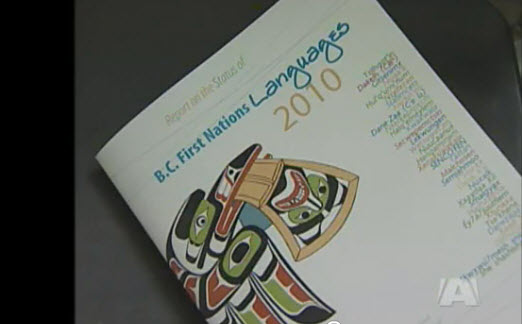
This You Tube video talks about the status of First Nations languages in B.C. The commentary is based on the recently released “Report on the Status of B.C. First Nations Languages 2010”. This First Peoples Council report states that the Vancouver Island First Nation languages are in a “critical state” and further that there is an “urgent need to protect BC’s 32 First Nations languages. Of these languages, a handful are stated to be “severely in danger” with the majority being already nearly extinct. To put this in perspective, BC is reportedly home to 60% of the Indigenous languages of Canada.

The video clip includes interviews with a Central Saanich student, a Lauwelnew Tribal School Teacher and a Tsartlip Elder. Some positive steps towards language recovery are also described.

To view the video: https://www.youtube.com/watch?v=KzfgvqkoTVM

To view the report: www.fphlcc.ca

Categories
Module 1

21st Century Schools Website

While researching for my term paper I came across the 21st Century Schools Website. This US-Based , but globally intended, Website advocates for a “new paradigm” in education. They believe that although the tools of modern technology are available for collaborative/innovative learning, they are not currently used to their fullest.

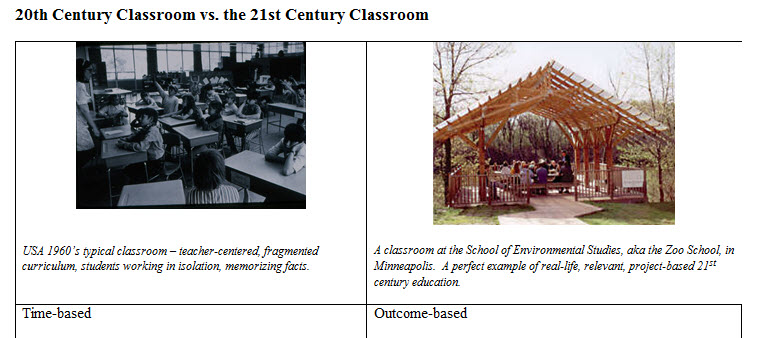
 If you navigate to the “What is 21st Century Education? Tab, you’ll find a good description of the site and what it seeks to accomplish. Scroll down this page to find a great summary table (image below) of the differences between 20th Century education and 221st Century education. After that, check out the “Curriculum and Instruction” and “Resources” tabs for many interesting and useful links.

http://www.21stcenturyschools.com/

Categories
Module 1

An Indigenous Approach to Creating a Virtual Library of Education Resources

This article describes how students in the “Library Instruction and Information Literacy” class in the Graduate School of Library and Information Science at the University of Texas at Austin incorporated a service-based learning model drawing on indigenous learning styles to create a virtual library for students and educators at a tribal college. The project deliverables were planned for the Northwest Indian College (NWIC) Teacher Training Program, Oksale and were based on the theories of Native American educator Dr. Gregory Cajete.

Cajete’s theory describes the prescription for a fulfilled life through the cycle of “being, asking, seeking, making, having, sharing, and celebrating”. This cycle was seen as a means to understand (in Cajete’s words):

  • One’s true face (character, potential, identity)
  • One’s true heart (soul, creative self, true passion)
  • One’s foundation (true work, vocation)


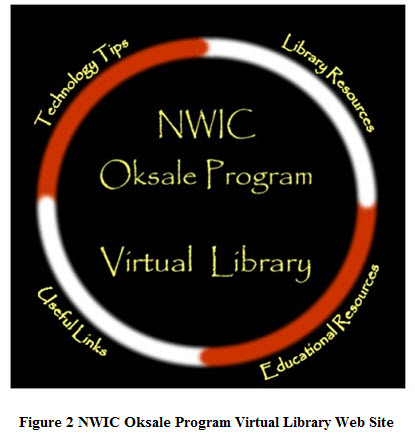
The design of the site (see Figure 2) used traditional Lummi colors (black, red, white, and yellow) and images (raven, frog, eagle, and salmon) to increase users’ familiarity and comfort with the site.

Cajete asks educators to “engender a commitment to service rather than competition, promote respect for individual, cultural, and biological diversity, and engage students in learning processes that facilitate the development of their human potential through creative transformation”.

http://www.dlib.org/dlib/march02/roy/03roy.html

Categories
Module 1

Improving Education on Reserves: A First Nations Education Authority Act

This is an interesting paper offered by the Caledon Institute that discusses the 2008 perspective on the present state of education for on reserve students, the Canadian Federal Government’s stance to this condition, and a prescription for improving education for on reserve students. This paper provides a really good summary and makes for interesting reading. The following is a very brief synopsis.

Present State (2008) and Canadian Government’s Stance

  • 1996 – 60% of First Nations on reserve residents aged 20-24 had not completed high school or obtained an alternate diploma. (From Canadian Census data)
  • 2001 – Statistic was unchanged.
  • 2006 – Statistic was unchanged.
  • Students now require more than grade 12 education to succeed, however grade 12 is the gateway to higher education.
  • Canadian government (Indian and Northern Affairs Canada 2004) is in unanimous agreement on the desperate need for improvement in education for those living on reserves.
  • Data suggests that funding for on reserve education is similar to provincially funded schools although this is not the perception of First Nations peoples.
  • There is consensus on the need for parity for First Nations schools.

Prescription for Improving On Reserve Education

  • Agreement that there is a need for money + good schools
  • There is also a need for the infrastructure to support and maintain a good education system addressing the areas of curriculum development and capital facilities planning.
  • The Cree School Board, recognized under the Quebec Education Act is an example of such a system.
  • For those interested, there is the following reference to additional models: “Sharing Our Success: Ten Case Studies in Aboriginal Schooling” (page 11)
  • The paper goes on to describe the background and role of the First Nations Education Authority Act that seeks to address the need for First Nations infrastructure planning across the Provinces.

http://www.caledoninst.org/Publications/PDF/684ENG.pdf

—————————————————————————————

For more information about the Caledon Institute, here is a brief summary quoted from their Website:

The Caledon Institute is a social policy think tank.

“Established in 1992, the Caledon Institute of Social Policy is a private, non-profit organization with charitable status. It is supported primarily by the Maytree Foundation, located in Toronto. Caledon is an independent and critical voice that does not depend on government funding and is not affiliated with any political party.

The Caledon Institute of Social Policy does rigorous, high-quality research and analysis; seeks to inform and influence public opinion and to foster public discussion on poverty and social policy; and develops and promotes concrete, practicable proposals for the reform of social programs at all levels of government and of social benefits provided by employers and the voluntary sector. Caledon’s work covers a broad range of social policy areas including income security (e.g., pensions, welfare, child benefits, Employment Insurance, benefits for Canadians with disabilities), community capacity-building, taxation, social spending, employment development services, social services, disability supports and health.”

http://www.caledoninst.org/

Categories
Module 1

Classroom English will be the death of Aboriginal languages

This Australia-based article discusses concerns around reducing the amount of time spent teaching in the local (Aboriginal) language down to a mandated one hour/day. Several reasons for doing so are listed, including the argument that Aboriginal employment is very low because education levels are very low because education is primarily conducted in English. It is argued that forcing students to learn in English will increase English literacy rates along with providing students with an education.

The author of this article disagrees with this strategy, noting that there are flaws in the logic, including the fact that low education levels are not the only reason for low employment. There are other reasons that can be cited, such as bureaucratic regulations requiring completion of literacy courses prior to gaining access to certain jobs.

Some of the areas of concern cited for moving to a one hour a day education in English are:

  • Poor attendance will likely become lower
  • Parental support may drop
  • Turnover of teachers may increase
  • Indigenous languages are further at risk

The article goes on to discuss the importance of preserving Aboriginal languages.

For those interested, several responses to the article follow it.

http://www.crikey.com.au/2008/11/20/classroom-english-will-be-the-death-of-aboriginal-languages/

Spam prevention powered by Akismet