Categories
Recommendations Reflections Wired World

The End of the Beginning

I won’t lie. It is a great relief that the summer courses have ended. The compressed nature of such courses makes taking two courses less than ideal and not everyone has the luxury of taking a break or just taking one course. My leave from work ends in May next year and in order for me to finish in time, I had to take the maximum courses offered in summer. That is why I didn’t agree with the disclaimer that our instructor Dean put up in response to some of the gripes the students have about the course on two counts but firstly the disclaimer:

“This is a graduate-level course on social media. As such, it is very software-intensive and some students have found that the course content and structure (use of blogs, tweets and navigating Vista) and the sheer number of social tools that are examined during the term causes considerable information overload. If you are unfamiliar with social media or are planning to take other courses while taking LIBR559M, please speak to the instructor first to determine your suitability for the class.”

Firstly, as I have mentioned, not everyone has the luxury of taking one course.

Secondly, knowledge of social media tools is important for information professionals and therefore, I think this is an important class. However, some people may not be comfortable due to the lack of familiarity but that is precisely why they would be taking the course in the first place – to learn and discover. To have a disclaimer that discourages those who are unfamiliar with social media is not productive and undermines the learning value this course has to offer.

I am a frequent user of social media prior to this course, except Twitter, but I still found this course valuable to me. I was delighted to discover plenty of new tools that can be used. It has been a springboard for me to think about social media related plans that libraries can adopt, all in all, I would still take this class again, given a choice, if only for the tools that it had allowed me to discover.

If this class is offered again, these are the things that I imagine would make it better (but this is of course only my opinion)

1) A wiki of social media tools (not definitions) that students are expected to go out and discover and when they discover new ones, they can add to it. This also makes it clear the amount of tool exploration they are required to do and they can better plan their time.

2) Assignments shouldn’t be a treasure hunt: it should be clear to quell anxieties of missed work and again, it allows students to plan their time around the assignment due dates/ expectations more efficiently.

3) I understand that the blog and forum have their uses but it was never clear to me what topics go on the forum and what goes on the blog and given that both forum and blog postings are requirements, then there is a potential that one may become redundant. I acknowledge that the forums are better for discussions and the blog is better for open topics and reflections so maybe what can be done is to have a specific discussion question or two for the forum for students to post in related to the module topic and leave the blog for open reflections, discoveries that are not tied to the module. This will give students the flexibility to explore areas of interest even more, from marketing to tools like (in my case), digital storytelling. The fact is that there are so many social media tools available and different ones will appeal to different people, giving students the luxury to explore whatever they want and helping them to discover what they find works best for themselves at the end of the day.

To be absolutely fair, the course probably does some of this but if it did, it wasn’t clear to me. This course has a lot of value to information professionals and I would like to see it offered again to a warmer reception. It has been an interesting journey for me, sometimes frustrating, sometimes delightful but one thing for certain is that I did take away good knowledge from it.
Categories
Recommendations Virtual Reality Wired World

An Immersive World for Libraries

I have never got far enough in Second Life to experience using a library within it but I imagine what would be most valuable would be the reference services and maybe digital resources but my question is this, if virtual library services can be delivered without the platform of an immersive world – from a webpage with links to digital resources to IM chats with librarians for reference questions – then what exactly makes the immersive world more attractive?

I like to think that the aspects that make it attractive, is how much it simulates a role playing game (RPG), where you can imagine that you are a physical being entering a library with something to discover. Done well, it can be a powerful and rewarding experience and this where I think Second Life falls short. The technical controls get in the way of the experience (at least for me and I am certainly not a stranger to RPGs, what more someone who has little experience with immersive worlds) that you never actually get round to enjoying the simulated experience. Additionally, without a “quest”, Second Life seems dull, other than discovering new places which becomes stale after a while.

This is where I think Quest Alantis that is used for educational purposes does way better. Information that is discovered within fulfills an objective and provides motivation for the user to explore the immersive world fully. This is not to say that immersive worlds, educational or otherwise, can only be used as a game setting. There is still potential for the library to use immersive worlds but there must be a real outcome for the user, otherwise, it would mostly be redundant. Here are some ways I can see it being used (and hopefully on a more intuitive platform than Second Life):

1) Staff training: virtual worlds can be used to train front-line library staff on customer service. Not unlike the border guards training example for Second Life.

2) Workshops for teens conducted by the library can be done over a virtual platform – how to find books, navigate the library, things that can be incorporated in a quest-like format to make the experience more engaging. These can be done without the stigma of being seen in the library (i.e. uncool)

3) Bookclubs, activity sessions with teens can also be done virtually for those who would prefer not to come to the library.

4) If a library is being built or upgraded, the community can be invited to add their vision of the ideal library on a virtual platform (would require some knowledge of online creation tools) or they can be invited to visit the virtual version of the library before the physical library is ready. This creates anticipation for the real thing.

5) An “after hours” library – should a library ever see a need to extend its service hours. A virtual one is always an option because only one virtual branch needs to be open as opposed to many branches.

At this point, I am still skeptical but should the whole virtual experience become seamless one day, providing services in immersive worlds or exploiting its affordances is something that needs to be seriously considered by libraries.

Categories
Digital Tools Information Management

Having fun with Aggregation

Today I spent some time making Symbaloo my homepage. It’s really nice to have everything in one place and my bookmarks visually presented to me. When they are in the bookmark folder, I am more likely to forget about them. This seems so much better. Another benefit that aggregation has for me is the desire to find more content to curate and place on my desktop (because there are now all these empty squares begging to be filled) or rather, when your information is properly managed and filtered, your appetite for it increases.

Now that I have all these nice squares filled up, I wonder if it makes a difference to my reading and browsing habits. Does increasing their visibility to myself make me more inclined to read them or will I just leave them as they are. Do I reach a point where I am happy with what I see such that I stop looking for more interesting sites? The latter concerns me more. When you search for something on the web, you may stumble across things serendipitously but when everything is nicely curated, you may just end up living in a bubble. Nonetheless, I am liking Symbaloo very much so far.

The other tool that I spent some time playing around with today is Linoit. Someone recommended it to me after discovering that I was messing around on Wallwisher. Linoit allows you to do what you can do on Wallwisher and more. Here are reasons why I think it’s better:

1) Much more visually attractive (different colour post-it notes) with the option of adding photos and videos.

2) It can be public or private and if it’s public, you can choose whether you want anyone to be able to add to it.

3) While it’s not as straightforward as double-click and type, it’s still fairly easy to use with a floating tool bar.

4) In the everyone can edit mode, the board can be used for discussions and feedback. In the public and locked mode, it can be used for presenting an idea to a group of people. In the private mode, it can be used a task list or a personal aggregator.

5) It’s compatible with the ipad and automatically synced.

6) All the various boards you have are lined up at the bottom so you can switch between your boards easily.

7) You can set due dates for the stickies which will then appear as a task list (great for tracking assignment due dates)

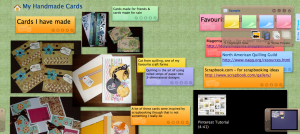
Unfortunately, free means sharing the space with advertisements. Here is a sample Linoit page I did for sharing. To see the full page, click HERE.

It’s quite a fun tool to use, if only for recording your tasks. I highly recommend it.

Categories
Digital Storytelling Digital Tools

Digital Storytelling presented visually on a glog

Someone once used the word tenacious to describe me and I think he was spot on. When I am obsessing about something, I am like a dog that won’t let go of its bone. Since I’ve been thinking about digital storytelling and maybe even dreaming about it, it naturally follows that my glog would be on digital storytelling. I initially wanted to do an actual video – I still do –  I just need to get all the official assignments out of the way.

I really do like creating things. If I wasn’t so busy the previous week, I imagine I would trying all sorts of things and tools. Glogster was a disappointment. I expected it to be a lot more user friendly. Options were limited and while there are a number of possible graphics and designs one could use, a lot of it looked a little tacky. The interface was clunky and there was no undo button. The interactive poster is a wonderful idea but until they streamline it, it’s not going to be something I will go back to using again too soon.

Anyway, here is my poster which I am very proud of.

Categories
Information Management Reflections

Civil Society & the Aggregation of Information

I thought for this week’s post on aggregation, I would think about how it affects civil society. The first thing I was actually thinking about is the type of civil society – from NGOs to community interest groups, the kind of impact aggregation would have on them would vary. The second thing was whether they would use it internally to collect and share information or whether they would use 2.0 tools to make increase their virtual presence.

On a very basic level, aggregation can benefit a group the same way it can benefit an individual, having a centralised place to collect and share information is great for exchanging ideas and tapping on each other’s knowledge. I thought Michelle’s recommendation Scoop.It. is great for interest-based organisations. The downside, however, is the assumption that everyone would be need to be technologically savvy enough to curate information or at least follow the person who does. Additionally, many charitable organisations do a lot of work on the ground and rely more on physical networks for information. In theory it seems like a great idea but it takes time to curate and many may simply not invest in that time.

Aggregation tools can impact an organisation positively, especially if someone has the required expertise and skills as well as a vision of how they are going to use such tools to reach out to the online public. A nature advocacy group can collect all their videos and articles so that people can easily find and follow them, a charitable organisation can share photos and information about their work and present them as a collective whole to get funding. With the world wide web, many groups can get international support where it would have once been impossible to do so. A petition against a controversial policy, international pressure, all of these have given much of civil society the bargaining power they need against governments or more visibility for a cause.

The flip side is this, bigger organisations often get more visible at the expense of smaller ones who do not have the resources or time to manage their online pressence. Let’s say I see a campaign for women’s rights online handled by an international NGO with all the resources to make themselves visible online and I find myself interested in the cause because they put up information, photos and of course a convenient link for donations. Somewhere in the back of my mind, I know there must be other similar organisations, maybe smaller and less media savvy but also doing good work. However, information about the work those smaller organisations do are either limited or not visible to me. I also do not know how I can help. As a result, I will end up supporting what I know. While it is true that these NGOs may be getting new supporters through the social web and these may be people who may otherwise never be involved in a cause, it is also true that they may overshadow others.

Information is both power and money and while these two things can be used to do good, it may also result in complacency. On the whole I think being able to manage a wide range of information online with tools for aggregation is a good thing but for every organisation we see online compiling their resources, there are many more out there who don’t and maybe as information professionals, a service we can provide for the community in our free time is to help some of these organizations, who are clearly doing good work, manage their information.

Categories
Digital Storytelling

From Stories to Digital Storytelling

Our lives are made out stories, stories of our ancestors, anecdotes of family and friends, the stories outside us that influence who we are; stories are present everywhere, from a book we read, a video we watch, the games with narratives and our own experiences that we share. When we tell stories, we are essentially creating and creation through stories is the bedrock of history as we know it.

However, this post is not about children’s storytelling, which is the way many would associate it with, but rather digital storytelling. I have been interested in digital storytelling for the past 3 years and it really stemmed from a literal understanding of what digital storytelling is, that is using “technology” to tell a story. I had converted some favourite children’s stories into a powerpoint which allowed me to “click” as I go along and gave the children larger visuals which were projected on a screen so they did not have to crowd around my tiny book. This worked really well for a group of children suffering from cerebral palsy because they needed the interactivity to sustain their attention. It got me thinking about how digital storytelling could work in traditional storytimes for children and how they too could partake in the creation of these stories. However, I had not had the time, until now, to do more research on it and I think this would be the best thing I got from this social media class – the chance to think about social media and storytelling.

It’s a little late for this but if I could rename my blog again and choose a focus for it, it would be “Telling Stories Through Social Media”.

I digress.

I picked up this article titled “Digital Storytelling in Practice” by Kelly Czarnecki (available online from the UBC library) and she explains in her introduction that storytelling has always utilised the latest technology, from cave paintings to oral tradition to the written form and then to film. In some ways, the intention to tell a story is the same but the difference is that the tools bring with them new and different dimensions. The video below is a nice little history on storytelling and illustrates how storytelling has evolved through the ages.

I struggle to find an adequate definition for digital storytelling – the one from Wikipedia defines digital storytelling as “the use of digital tools to allow ordinary people tell their own real-life stories”. To me, that is limiting because I think that digital storytelling can involve all kinds of stories, be it fables or folktales or even historical events. Longer films can also be digital stories as long as the presence of the storyteller is never lost. At its heart, digital storytelling is still storytelling and involves some kind of emotional investment on the part of the storyteller that he/she uses to draw the listener in. Real-life stories are just a more compelling form of digital storytelling because it enables an ordinary person to create something to share with the world. Sometimes visuals explanations are better than written ones. There are a few videos on the Center for Digital Storytelling site which I think shows the amazing power of digital stories. They define digital storytelling as “a short, first person video-narrative created by combining recorded voice, still and moving images, and music or other sounds” and that is perhaps a more inclusive definition than the one from Wikipedia. Do take some time to enjoy the videos.

The reason why I picked digital storytelling as the topic for creation is due to the fact that it expresses fully what creation in the social media context is. From an idea, a story, personal or otherwise, it is weaved together with the aid of visual resources and sound to become something that can be shared beyond time and space. Imagine how stories from oral traditions can be preserved through this or how grandparents can tell their own stories for the grandchildren to listen/watch when they are older. Granted that some technical skills are needed but with collaboration, someone with the skills and someone with the story could get together to create something.

There has been a number of digital storytelling projects done and many have been facilitated by libraries and this has been slowly catching on. Libraries are extremely important as facilitators for digital storytelling because they provide the knowledge (technical know-how) and environment that will allow people to share their stories. In that sense, libraries enable creation. I will write more about libraries and digital storytelling in a separate post because it deserves a whole post of its own.

Spam prevention powered by Akismet