Categories
Recommendations Virtual Reality Wired World

An Immersive World for Libraries

I have never got far enough in Second Life to experience using a library within it but I imagine what would be most valuable would be the reference services and maybe digital resources but my question is this, if virtual library services can be delivered without the platform of an immersive world – from a webpage with links to digital resources to IM chats with librarians for reference questions – then what exactly makes the immersive world more attractive?

I like to think that the aspects that make it attractive, is how much it simulates a role playing game (RPG), where you can imagine that you are a physical being entering a library with something to discover. Done well, it can be a powerful and rewarding experience and this where I think Second Life falls short. The technical controls get in the way of the experience (at least for me and I am certainly not a stranger to RPGs, what more someone who has little experience with immersive worlds) that you never actually get round to enjoying the simulated experience. Additionally, without a “quest”, Second Life seems dull, other than discovering new places which becomes stale after a while.

This is where I think Quest Alantis that is used for educational purposes does way better. Information that is discovered within fulfills an objective and provides motivation for the user to explore the immersive world fully. This is not to say that immersive worlds, educational or otherwise, can only be used as a game setting. There is still potential for the library to use immersive worlds but there must be a real outcome for the user, otherwise, it would mostly be redundant. Here are some ways I can see it being used (and hopefully on a more intuitive platform than Second Life):

1) Staff training: virtual worlds can be used to train front-line library staff on customer service. Not unlike the border guards training example for Second Life.

2) Workshops for teens conducted by the library can be done over a virtual platform – how to find books, navigate the library, things that can be incorporated in a quest-like format to make the experience more engaging. These can be done without the stigma of being seen in the library (i.e. uncool)

3) Bookclubs, activity sessions with teens can also be done virtually for those who would prefer not to come to the library.

4) If a library is being built or upgraded, the community can be invited to add their vision of the ideal library on a virtual platform (would require some knowledge of online creation tools) or they can be invited to visit the virtual version of the library before the physical library is ready. This creates anticipation for the real thing.

5) An “after hours” library – should a library ever see a need to extend its service hours. A virtual one is always an option because only one virtual branch needs to be open as opposed to many branches.

At this point, I am still skeptical but should the whole virtual experience become seamless one day, providing services in immersive worlds or exploiting its affordances is something that needs to be seriously considered by libraries.
Categories
Digital Tools Information Management

Having fun with Aggregation

Today I spent some time making Symbaloo my homepage. It’s really nice to have everything in one place and my bookmarks visually presented to me. When they are in the bookmark folder, I am more likely to forget about them. This seems so much better. Another benefit that aggregation has for me is the desire to find more content to curate and place on my desktop (because there are now all these empty squares begging to be filled) or rather, when your information is properly managed and filtered, your appetite for it increases.

Now that I have all these nice squares filled up, I wonder if it makes a difference to my reading and browsing habits. Does increasing their visibility to myself make me more inclined to read them or will I just leave them as they are. Do I reach a point where I am happy with what I see such that I stop looking for more interesting sites? The latter concerns me more. When you search for something on the web, you may stumble across things serendipitously but when everything is nicely curated, you may just end up living in a bubble. Nonetheless, I am liking Symbaloo very much so far.

The other tool that I spent some time playing around with today is Linoit. Someone recommended it to me after discovering that I was messing around on Wallwisher. Linoit allows you to do what you can do on Wallwisher and more. Here are reasons why I think it’s better:

1) Much more visually attractive (different colour post-it notes) with the option of adding photos and videos.

2) It can be public or private and if it’s public, you can choose whether you want anyone to be able to add to it.

3) While it’s not as straightforward as double-click and type, it’s still fairly easy to use with a floating tool bar.

4) In the everyone can edit mode, the board can be used for discussions and feedback. In the public and locked mode, it can be used for presenting an idea to a group of people. In the private mode, it can be used a task list or a personal aggregator.

5) It’s compatible with the ipad and automatically synced.

6) All the various boards you have are lined up at the bottom so you can switch between your boards easily.

7) You can set due dates for the stickies which will then appear as a task list (great for tracking assignment due dates)

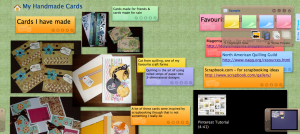
Unfortunately, free means sharing the space with advertisements. Here is a sample Linoit page I did for sharing. To see the full page, click HERE.

It’s quite a fun tool to use, if only for recording your tasks. I highly recommend it.

Categories
Digital Storytelling Digital Tools

Digital Storytelling presented visually on a glog

Someone once used the word tenacious to describe me and I think he was spot on. When I am obsessing about something, I am like a dog that won’t let go of its bone. Since I’ve been thinking about digital storytelling and maybe even dreaming about it, it naturally follows that my glog would be on digital storytelling. I initially wanted to do an actual video – I still do –  I just need to get all the official assignments out of the way.

I really do like creating things. If I wasn’t so busy the previous week, I imagine I would trying all sorts of things and tools. Glogster was a disappointment. I expected it to be a lot more user friendly. Options were limited and while there are a number of possible graphics and designs one could use, a lot of it looked a little tacky. The interface was clunky and there was no undo button. The interactive poster is a wonderful idea but until they streamline it, it’s not going to be something I will go back to using again too soon.

Anyway, here is my poster which I am very proud of.

Categories
Digital Storytelling

From Stories to Digital Storytelling

Our lives are made out stories, stories of our ancestors, anecdotes of family and friends, the stories outside us that influence who we are; stories are present everywhere, from a book we read, a video we watch, the games with narratives and our own experiences that we share. When we tell stories, we are essentially creating and creation through stories is the bedrock of history as we know it.

However, this post is not about children’s storytelling, which is the way many would associate it with, but rather digital storytelling. I have been interested in digital storytelling for the past 3 years and it really stemmed from a literal understanding of what digital storytelling is, that is using “technology” to tell a story. I had converted some favourite children’s stories into a powerpoint which allowed me to “click” as I go along and gave the children larger visuals which were projected on a screen so they did not have to crowd around my tiny book. This worked really well for a group of children suffering from cerebral palsy because they needed the interactivity to sustain their attention. It got me thinking about how digital storytelling could work in traditional storytimes for children and how they too could partake in the creation of these stories. However, I had not had the time, until now, to do more research on it and I think this would be the best thing I got from this social media class – the chance to think about social media and storytelling.

It’s a little late for this but if I could rename my blog again and choose a focus for it, it would be “Telling Stories Through Social Media”.

I digress.

I picked up this article titled “Digital Storytelling in Practice” by Kelly Czarnecki (available online from the UBC library) and she explains in her introduction that storytelling has always utilised the latest technology, from cave paintings to oral tradition to the written form and then to film. In some ways, the intention to tell a story is the same but the difference is that the tools bring with them new and different dimensions. The video below is a nice little history on storytelling and illustrates how storytelling has evolved through the ages.

I struggle to find an adequate definition for digital storytelling – the one from Wikipedia defines digital storytelling as “the use of digital tools to allow ordinary people tell their own real-life stories”. To me, that is limiting because I think that digital storytelling can involve all kinds of stories, be it fables or folktales or even historical events. Longer films can also be digital stories as long as the presence of the storyteller is never lost. At its heart, digital storytelling is still storytelling and involves some kind of emotional investment on the part of the storyteller that he/she uses to draw the listener in. Real-life stories are just a more compelling form of digital storytelling because it enables an ordinary person to create something to share with the world. Sometimes visuals explanations are better than written ones. There are a few videos on the Center for Digital Storytelling site which I think shows the amazing power of digital stories. They define digital storytelling as “a short, first person video-narrative created by combining recorded voice, still and moving images, and music or other sounds” and that is perhaps a more inclusive definition than the one from Wikipedia. Do take some time to enjoy the videos.

The reason why I picked digital storytelling as the topic for creation is due to the fact that it expresses fully what creation in the social media context is. From an idea, a story, personal or otherwise, it is weaved together with the aid of visual resources and sound to become something that can be shared beyond time and space. Imagine how stories from oral traditions can be preserved through this or how grandparents can tell their own stories for the grandchildren to listen/watch when they are older. Granted that some technical skills are needed but with collaboration, someone with the skills and someone with the story could get together to create something.

There has been a number of digital storytelling projects done and many have been facilitated by libraries and this has been slowly catching on. Libraries are extremely important as facilitators for digital storytelling because they provide the knowledge (technical know-how) and environment that will allow people to share their stories. In that sense, libraries enable creation. I will write more about libraries and digital storytelling in a separate post because it deserves a whole post of its own.

Categories
Reflections Wired World

When plugging-out gives you connection withdrawal syndrome

Over the weekend, I took a short break and hopped over to Vancouver Island to visit friends, took long walks and enjoyed the natural scenery – it was fresh air and a welcomed change from staring at the computer from morning to night. Unfortunately, I was suffering from a connection withdrawal syndrome. Every few hours or so, I would wonder about the tweets and blog posts I missed, the forum posting requirements that I have yet to fulfill… it hindered my ability to enjoy my time on the island to my fullest capacity.

I am not always like that. I don’t have a smart phone, my ipad is wi-fi only and I am perfectly capable of going on a long vacation and leaving the world behind. In short, I enjoy being plugged-out. It is important because there is simply too much going on and to try to follow every single online update would be to fry your own mental circuits. Enough is enough – the world goes on without you and you are no lesser for missing one update. In fact, being away allows me to listen to my own thoughts. When I am online, I am bombarded with everyone’s thoughts and after a while, I am not sure which ones belong to me and which ones came from the great big cyberverse.

So why did I feel such anxiety over the weekend? Was it because all of a sudden my online activities were graded and the opportunity cost of not being active online suddenly becomes greater? Or was it because I spent an excessive amount of time online in the three days before that I had gotten used to being plugged-in and removing it felt like something was ripped from me? I personally thought it was the former and that is very much centered around the word “opportunity cost”. It stems from the fear of missing some quintessential update which is in turn linked to how you are perceived. In an online class, it translates to “participation” which has a grade. In the online social universe, it would be missing someone’s updates that would have made you a better friend had you wished them “happy birthday” or “congratulations” or a word of sympathy for some misfortune. Part of it sounds silly (trust me – I know) but I have been at the lashing end before, being told that I was a lesser friend for not “expressing” my care and concern over the social universe. In retrospect, it’s hilarious but it was not funny when it was happening and it certainly shows that social media has redefined our expectations in relationships, especially if both parties are wired. I certainly do not think making token remarks on friends’ updates makes you a better friend so I do not see why not doing it makes you a lesser one.

That said, circling back to the first point. There are two worlds, the physical and the online one – they are not substitutes for one another and people are learning to live with both. The online world should not come at the expense of the physical world and if taking a break causes you to have withdrawal symptoms, then it probably is a signal that you need to get more fresh air. A sunny day may not be there tomorrow but the computer most likely will.

Categories
Gadgets

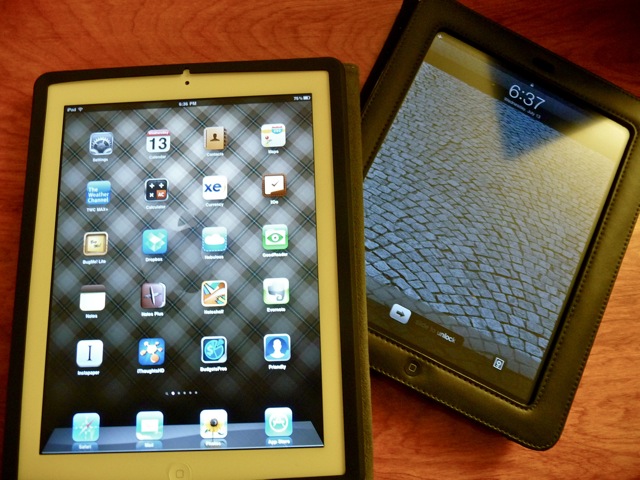
I wish I could eat my ipad… (but then I would have to buy another one)

I wonder what the nutritional value of an ipad is – does it have the value of fast food which is wildly popular but terribly unhealthy or that of a hearty wholesome meal that not only tastes good but is good for the body as well?

I swing between being embarrassed that I own an ipad and openly talking about it and its capabilities. Embarrassed because I dislike being lumped with the gadget crazy crowd who prides in having what the latest technology has to offer but I also acknowledge that I do like the ipad very very much. Perhaps I am being hypocritical but in my defense, I never owned an iphone and probably never will. My ipad was a gift to my father who in turn gave it to me because he didn’t know how to use it. I suspect when he discovers its full capabilities, he’s going to want it back but for now, it’s mine.

The ipad changed a lot of the way I did things and it is a great example of how the medium defines the content and in some ways supersedes it. The ipad itself is an empty shell but lends itself to be adapted for different things, whether it’s surfing the web, reading, note-taking, gaming and I would say cooking as well. I never liked bringing my computer to school because I  didn’t like typing my notes – I like to draw circles, scribble and draw maps – the ipad allows me to do all of these without pen and paper or the weight of a laptop. Reading academic papers has never been easier because I download them straight into the device which allows me to annotate them as well. Reading the news has also been easier with news aggregators that allow you to “flip” pages just as you would a physical paper.

The ipad appeals to my visual and kinesthetic self and is amazingly intuitive. I have never felt such great fondness for a computing device. I am a lover of physical books and traditional crafts but instead of competing with my interests, the ipad allows me to develop them – make lists of books while on the move, digitally draw out a new craft project, edit my photos or collect my ideas for a new piece of writing. As testimony to its intuitive nature, my grand aunt who is in her 70s is able to easily use it. Now that is what I call affordance.

I should also mention I cook with the ipad too – with youtube videos showing me how to prepare a meal step-by-step. At times like these, it is propped on the kitchen table as an aid to the terrible cook that I am.

Anyway, this is a lovely article on how the ipad has been used in different ways: How the ipad revolution has transformed working lives

Photo Note: There are 2 ipads because when there was 1, my husband and I had to squabble over it. We decided that in this case, 2 is better than 1 and now we play board games together over wi-fi.

Spam prevention powered by Akismet