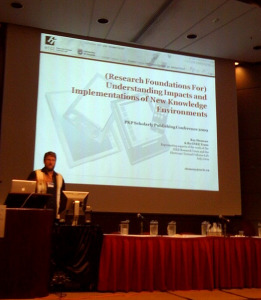
Dr. Ray Siemens presents at PKP 2009. Photo by C. Gratham
Presenter: Dr. Ray Siemens, Director, Implementing New Knowledge Environments (INKE) Project. Canada Research Chair in Humanities Computing and Professor of English, University of Victoria. Bio
July 10, 2009, 2:30 pm-3:00 pm. SFU Harbour Centre. Rm 1900
The INKE project represents the interdisciplinary work of researchers with specialties spanning humanities, text analysis, information studies, usability, and interface design. The team consists of 35 researchers, 20 institutions, and 20 other partners. Their SSHRC funded work takes a scholarly approach and cast an eye back on the history of the print medium to help understand the roles digital books might play in the future.
Session Overview
After providing an over-view of the team and project, Dr. Siemens summarized the motivation for the study by stating that e-books and e-textuality have “an exciting future … but an inconvenient present”. The exciting future can be illustrated by how pervasive various digital forms of text have already become in society today. But the inconvenient present lies in how little we actually know about this new media form and how the gaps we need to fill before we can make decisions about how to best use this “new knowledge machine”.
We still have a long way to go. As Dr. Siemens reminds us, “the e-book is still just a pale representation of it’s paper counterpart.” He suggests that one of the main reasons for this is that we still model electronic documents to mimic their print based forms and in doing so we import the same conceptual models from the print world. To achieve the benefits of e-books and documents, Dr. Siemens says that we need to reconceptualize these core critical and textual models.
The team’s research is clustered around the following four interdisciplinary areas: textual studies, user experience, interface design, and information management. And through these clusters they have identified a number of gaps in the existing knowledge leading to the following research questions:
Has the way we read and experience information changed since the rise of the Internet, and, if so, how?
How do different knowledge environments influence the way we engage and use information?
What new features can we design to improve digital information environments and their interfaces?
How can we better design the data that underlies and serves the needs of those using such digital information environments?
How does this interdisciplinary team work together to achieve our research objectives given the multiple lenses through which they approach the same questions?
Dr. Siemens closed his presentation with three “Rubber hits the road” impact questions:
Can the humanities find this problem worth engaging with?
Can the interdisciplinary cores yield something tangible?
If so, will the results be socially applicable, embraceable, and ubiquitous?
Questions
Time limitations did not allow questions for Dr. Siemens
Mr. Edgar presented the preliminary results from a survey of over 1,000 OJS editors around the world. The goals behind the survey were to gather information about who is using the journals, where they are located, and to gain a sense of their funding models as well as what motivates them to do this work,
While the data analysis is still in the preliminary stages, Mr. Edgar presented some of the survey results and commented on a number of the findings as follows:
South America, Europe, and North America (in descending order) accounted for 75% of the journals
Almost half the journals were in the Social Sciences with Health Sciences and Technology and Engineering the next most common topic areas
More than half the journals were sponsored by academic departments and another third by scholarly associations
The rate at which the journal accepted articles was quite variable with roughly equal numbers distributed across all the acceptance rate bands
A very high percentage of the journals used editorial and double blind review procedures
In most of the journals, the editor is personally responsible for copy editing, layout, and proofreading
But it is not a full-time job for the editors. In 80% of the journals, editing requires less than ten hours per week.
Most of the journals reported small (or zero) expenses and revenues. However, a small percentage reported more than $50,000 in both. Mr. Edgar commented that these zero expense journals seem to indicate a new model for journal publishing becoming possible
For those journals that generated revenue, it mostly came from institutional funding, followed by subscriptions, and then from advertising
Most of the editors were motivated to do their work due to a desire to provide new knowledge and a service to the community and not for financial benefit
While 83% of the journals qualified for inclusion in the Directory of Open Access Journals (DOAJ), only 22% actually were included
Around 40% of responders continued to produce print journals
Questions and Audience Comments
A lively discussion ensued following Mr. Edgar’s presentation. Some of the key points are as follows:
While the data analysis is still preliminary, they hope to have a more complete analysis by the fall of 2009.
One audience member asked how many of the OJS journals were included in the ISI. The original survey didn’t ask about inclusion in the ISI, but they did ask about indexing.
There was considerable discussion about why the number of OJS journals in DOAJ is small. One possible explanation is that the DOAJ has a big backlog in evaluating journals for inclusion, so it may be possible that the number of OJS journals in DOAJ will be increase as the backlog is cleared.
There was also much discussion about those institutions reporting zero costs. There are real costs: servers, people’s time, cost of producing the knowledge, etc. But some felt that those costs are rightly viewed as a part of the operating costs of the university and it may be legitimate to not include them specifically in the journal cost. On the other hand, some people need to be able to put a time/cost as part of their justification to create an OJS journal, and they would like to see those costs broken out. An audience member pointed out that the data collected (e.g. hours per week that editors spend on the journal) can be converted to generate this data.
Related Links
The Public Knowledge Project Open Journal System (OJS)
Dr. Willinsky set the context for his address by using adoption of Open Journal System to illustrate the expansion of open access. He noted that at the 2007 PKP conference, 1000 journals used OJS. Now, at the 2009 conference, there are approximately 3000 OJS journals. Of these, he noted that 29% spend $0 on expenses and 24% reported no revenue at all. Dr. Willinsky noted that these figures indicate the emergence of a new, third kind of independent journal that can run on a zero budget economic model.
However, Dr. Willinsky asks us not to focus on this knowledge being free (as in beer). After all, scholarly work is not free: it is very labour intensive. Through the entire domain of research, curriculum development, writing, editing, reviewing, and publishing in journals, scholarly work is expensive. Consequently, he argues for expanding the conversation about open access to scholarly publishing beyond the question of it being free. Instead, he asks us to reach back in time and recall how learning has long been treated as a type of (intellectual) property that is distinct from other (economic) properties. “There is a distinction between the type of intellectual property we produce in education and that produced by Michael Jackson or Justin Timberlake, so why should it be treated the same?”
Using a number of examples to illustrate the point, Dr. Willinsky recounted the historical consistency of the university being recognized as something outside of the regular economy. He pointed out that by the 12th century there was already such recognition in that university members had many special rights including some rights of the clergy, the right of safe conduct, and the right to bring manuscripts across borders without paying tax. He also spoke about how scholarly contributions were recognized through acts of patronism from royalty and how rent controls were used in Oxford to protect students from being exploited by greedy landlords.
In particular, Dr. Willinsky notes that this different view of the property of education is rooted in John Locke’s work on property. Locke spoke about property in two different ways: that we are given the work in common, and that every man has property in his own body. To Locke, because we labour (work), we have some claim to property based on the notion of the right to exclude (enclosure). The intellectual property of learning is founded in these basic Lockean principles (e.g. labour invested and held in common), but it is somewhat different because it’s value is not realized in the principle of exclusion. Instead, if we enclose intellectual property, we reduce it’s value. So the value of intellectual property is realized when it is shared and that value increases the less restrictive it is. Dr. Willinsky summarized this Lockean argument about the intellectual property of learning as follows: we hold all this knowledge in common and we realize it’s value in the unrestricted circulation of this intellectual property.
Turning to some of the relevant legal aspects of the argument, Dr. Willinsky began by recounting the fight over the licensing of books. In the 17th century, there was such excessive piracy that it removed the financial incentives for produce and publish books. Consequently, in 1710 the first copyright act (Statute of Anne) was passed to specifically recognize the rights of authors. Significantly, this statue was noted as an “act for the encouragement of learning”. Additionally, the act also recognized the right of universities to publish what ever they wanted and required publishers to provide to university libraries with 9 copies, on the best paper, of each book they published.
Moving to modern times, Dr. Willinsky illustrated this special place that intellectual properties of learning have been given with a number of examples:
Fair dealing (fair use in US) exceptions to copyright law. These include the right to quote for non-commercial, critical and parody use and provides protection under the law for students and scholars.
The academic exception to intellectual property rights. Scholars have the natural ownership rights to all the works they produce, unlike other non-educational industries where workers don’t have those rights.
Patent law allows us to use patented material for learning without paying a fee.
Tax exemptions for university endowments in the US.
In closing, Dr. Willinsky asked the audience to take up the challenge as follows:
In our work he asks us to focus not on making things free, but to promote the notion that the value of the work we do in education is realized in it’s sharing.
He asks us to look for opportunities to defend and experiment, to take advantages of opportunities to share our work, to expand our own policies moving toward open access, and to demonstrate the ways that intellectual properties of learning are different.
Through McGIll University’s Paulo and Nita Freire International Project for Critical Pedagogy, Dr. Steinberg and Mr. Smith have worked to help other centres with similar interests publish open access scholarly work as well as create communication networks to take advantage of social networking and other less formal publishing opportunities.
Dr. Steinberg spoke about the creative aspects of going from a journal in one’s mind to actually creating an open access journal. She noted that when working with associations, if they already had a print journal then it was a relatively easy transition to an open access online journal. However, the challenge is much greater for groups that don’t have previous experience creating a journal.
Dr. Steinberg illustrated her talk with the example helping Australian educators with the creation of a new journal: antipodes: a journal of critical southern education. Similar to Canada, the Australian educators face considerable challenges based on the difficulty in physically getting people together to communicate. Additionally, their government insists on a strict hierarchically tiered referred journal system. In this case, Dr. Steinberg noted that they focused first on creating a network of critical educators before they concentrated on creating the journal. As a result of , in addition to the community having a focus on critical pedagogy, they also had the common goal of discussing new models for peer refereed journals.
Mr. Smith continued the talk with some of the more technical as well as social networking aspects of their project. He started by commenting on a number of inspiring aspect from John Willinsky’s keynote address. Mr Smith noted that the International Journal of Critical Pedagogy (IJCP) uses the Open Journal System (OJS). But he pointed out that the journal is difficult to find from the Centre’s website since they are struggling with the best way to present the link (conceptually) between them.
Furthermore, Mr. Smith commented that the centre’s site is still being developed and they are trying to make it a better tool to connect people. Mr. Smith commented that they would like the site to be more than just a repository for formal scholarly work (e.g. referred journal) and that they are interested in promoting less formal but still very valuable modes of communication as well (e.g. blogs, wikis, forums). As an example of the benefit of these social networking possibilities, Mr. Smith provided an anecdote about an educator from St. Lucia whom he has become familiar with through the Centre’s website.
Discussion and audience questions
Dr. Steinberg responded to an audience question saying that if the local scholars were not already grounded in possible economic models for open access journals that she would help them work through various options.
One audience member asked about the possibility of integrating Drupal with the OJS, and Mr. Smith answered that he is very enthusiastic about the possibilities of connecting the two.
Dr. John Willinsky commented that these presentations reminded him that the importance is far greater than the journals only being free. He sees these examples as highlighting the importance of the networking and criticism opportunities that help to contribute to to creating a critical culture.
Another audience member commented that that there appears to be a relationship between more people submitting to the open access journals and more them doing more reviewing. That is, they are reviewing more work than they were before.
Athabasca University’s scholarly press, AU Press, focusses on the dissemination of knowledge and research through open access digital journals and monographs and through new electronic media.
Session Overview
The presenters illustrated Athabasca University’s journey over the past two years since the creation of their open access scholarly press: AU Press.
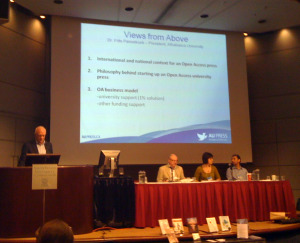
Part I – Views from above (Dr. Frits Pannekoek)
Dr. Pannekoek opened the presentation by reminding the audience that AU is fundamentally dedicated to removing all the barriers to learning and that they support the range of “open” initiatives in education including open educational resources, open data, open source software, as well as the open access to scholarly work that is the primary work of AU Press.
1) International and National Context for Open Access
Dr. Pannekoek cautioned the audience that while they are advocates of open access, this view was not uniformly shared by all, as he was recently reminded while attending the World Conference on Higher Education in his role as president of the International Council on Open and Distance Education (ICDE). Consequently, Dr Pannekoek believes that “we’ve got a big fight on our hands”, and he listed the following issues as significant barriers to further support for open access:
Support – the prevailing notion that digitized materials never have adequate level of support
Quality – the common assumption that the best model for learning lies in the traditional craft model (one-on-one relationship between professor and student)
Fraud – the fear of being plagiarised
Imperialism – the view in some quarters that the open access movement is another form of imperialism because it is largely controlled by the North
Dr. Pannekoek also summarized how people are reacting to the open access movement. In particular, he noted that we will face increasing regulation of the flows of knowledge (e.g. through funding structures) as well as commercial publishers who change their economic models to include more services that have traditionally been regarded as the domain of the universities themselves.
2) Philosophy behind starting up an open access university press
Dr. Pannekoek says it comes down to the basic question of “What can we do with the resources we have?” Athabasca University spends upwards of 70% of their budget on academic salaries so they decided to use their resources to value what those people do and produce.
3) Open access business model
Athabasca introduced the “1% solution”. Here they identified 1% of the budget in each area and dedicated it to scholarly communication and publishing. While they do solicit support from other areas, Dr. Pannekoek stressed the importance of looking within our own institutions for funding structures.
Part II – Not Either Or (Walter Hildebrandt)
Mr. Hildebrandt focused on six of issues important to the AU Press. First, he brought up the ideological issues related to open access publishing. These include considering the commoditization, privatization, and corporate control of knowledge in light of the public right to access publicly funded research. Next, he recapped the barriers and issues upon starting the AU Press. Here he recapped creating a charter, mandate, vision statement and goals and reviewed their funding arrangement. He also spoke of the initial skepticism at Athabasca University about expected revenue and of potential negative impacts of royalties of print publications.
Mr. Hildebrandt reminded the audience that AU Press publishes not just print or digitally, but both, and that they focus on certain areas of specialization. Thus far, their publications include twenty books, six journals, one website, and numerous author interviews, and he very proudly pointed out AU Press’s four award winning books.
Next, Mr. Hildebrandt reviewed some of their authors’ responses to open access monograph publishing. The concerns focused on issues around royalties and copyright control. On the positive side, authors reported increased citations and were encouraged that SSHRC encourages open access dissemination. But ultimately, as Dr. Hildebrandt says, people would “rather be read than not read”.
Mr. Hildebrandt concluded his part of the presentation by touching on the future plans for the AU Press. By the year 2011 they plan to publish 30-35 books per year, more websites, more podcasts and videos , and to partner with other similar minded institutions.
Digital Publishing (Kathy Killoh)
Ms. Killoh focused on some of the details of AU Press publishing. First, she differentiated AU Press’s mandate of open access publishing from cutting edge e-publishing. For AU Press, open access publishing doesn’t mean all the “bells and whistles”. Instead, they focus on placing publications online, for free, in PDF format. They do see value added e-publishing (xml, epub, etc) as potential revenue opportunities in the future.
Ms Killoh also asked, “Is selling open access e-books an oxymoron?” For AU Press, apparently not. She reported that, even though all this material is available for free on the web, they still sell many books (e.g. to libraries) that are made available through searchable databases by vendors.
Ms. Killoh also described some details of the author contracts and copyright at AU Press. Upon legal advice that the term is to vague, AU Press contracts avoid the term “open access”. Instead, they use the creative commons licences and refer to the specific terms within those licenses. The copyright remains with the author, but the sign over licensing rights to AU Press. Royalties are negotiated individually for all contracts.
Finally, to conclude her portion of the presentation, Ms. Killoh took the audience on a tour of the AU Press website.
Part III – Hits and Sales – (Shubhash Wasti)
Mr. Wasti raised areas of further information that the AU Press needs to more thoroughly evaluate the success of their open access publishing. They would like to know details of the number of visits they are getting for each publication. Preliminary data shows that their does seem to be some correlation between the number of downloads and the number of sales, but that the ratio is not constant. In the sample presented, the ratio of downloads to sales varies from a low of 3:1 up as high as 65:1. Additionally, AU Press would like to track the sales of printed books and investigate the relationship between the number of downloads and the number of sales. While the print sales seem “reasonable”, they would like to the relationship to a number of factors (e.g. subject area, demographics, accessibility from type of device, etc)
Question: How does the pricing of their print books compare to those of commercial publishers? Answer: They try to break even and to cover the cost of print because the cost of open access publishing is covered by the institutional support.
Question: What are the financial issues around keeping content online for a long time? Answer: They appear to be the same as the IT infrastructure issues that all institutions face. They need both an increase in capital and in operating budgets.