Categories
Research Themed Sessions

An Open-Access, Standards-Supportive Publication that Rapidly Disseminates Concise Genome and Metagenome Reports in Compliance with MIGS/MIMS Standards: the Session Blog

Presenters: Oranmiyan W. Nelson

July 9, 2009 at 2:30 pm

Session Abstract

Background

Dr. Nelson is currently completing his post-doctoral work at Michigan State University, in the Department of Microbiology & Molecular Genetics.  He is also the production editor of Standards in Genomic Sciences (SIGS), an open-access e-journal of the Genomics Standards Consortium (GCS) established in September 2005.

Session Overview

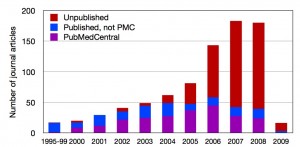
Genomics and metagenomics describes the study of an organism’s complete genetic data set, with emphasis on sequence mapping.  The former is limited to the study of organisms that can be isolated in pure culture, whereas the latter applies to an entire community of microbes in their native environment.  Technological advancements have facilitated a data explosion; genomic maps are now being produced at a faster rate than the existing publication infrastructure can accommodate.  The result is a loss of data, contextual metadata and annotation.  Essentially valuable data is disappearing before it can be interpreted or see the light of publication.
snapshot-2009-07-10-20-38-55
Number of published journal articles per year relating to the complete genome sequences of bacteria and archea

SIGS is a GSC initiative to attempt to bridge this gap, by producing concise peer-reviewed reports that comply with MIGS/MIMS standards, in addition to operation procedures, commentary and review articles.  Minimum Information about a (Meta)Genome Sequence (MIGS/MIMS) is a GCS initiative to expand on core reporting standards already established by the International Nucleotide Sequence Database Collaboration (INSDC).  MIGS/MIMS is characterized by a standardized checklist  that has been published in its entirety in Nature Biotechnology.  SIGS will attempt to keep up with data production by offering an accelerated editorial revision workflow, where copy-editing begins almost immediately after initial acceptance.
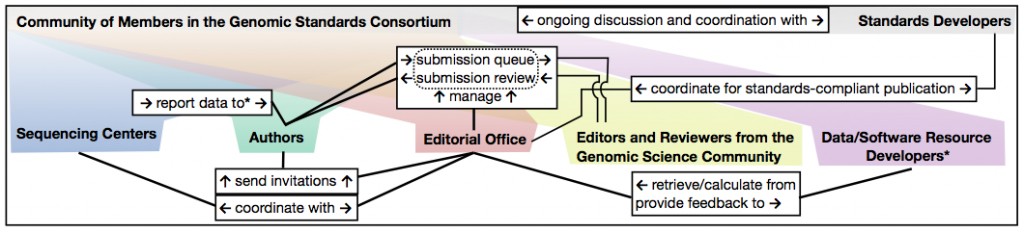
Editorial Workflow
Editorial Workflow

The e-journal’s goal is to produce 600 publications by June 2011 (approximately 30 per month), by attracting internationally credible authors under a cost-effective model for an open-access journal.

A sample short genomic report was then described, in conjuction with MIGS/MIMS standards. The anatomy of a report included a abstract and introduction (a), genetic sequencing information (b) genome properties (c) and comparisons with previously sequenced genomes (d).  Lastly, conclusions and references (e).
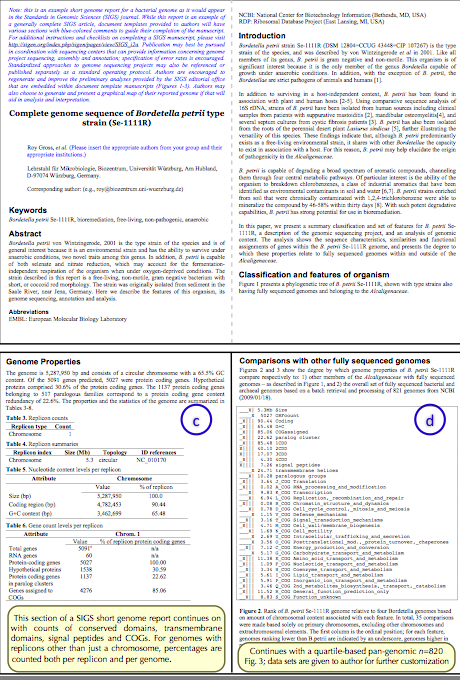
A short genome report

References

SIGS project summary poster

Categories
Technical Themed Sessions

Copenhagen Business School Library offers OCS as Conference Management System to Their Faculty: the Session Blog

Presenters: Kirsten Suhr Jacobsen, Helle Damgaard Andersen, Peder Lærke Nielsen

July 9th, 2009 at 3:00 pm

Session Abstract

Background

Helle Andersen has managed the Copenhagen Business School‘s webservices since 1999, including the main CBS page and related services such as the open conference system (OCS).  Kirsten Jacobsen has managed several international conferences hosted by CBS.  Together with Peder Nielsen, the library IT department leader, CBS offers conference management system OCS as part of the schools public web system.

Session Overview

The CBS has approximately 15,000 students and 1,000 staff making it one of the largest institutions in Northern Europe.  The school understands that conferences are a possible forum to attract investment, scholarship and students.  In turn, a professional conference system, may attract an increasing number of conferences to Denmark.

Copenhagen Business School

To help this initiative, the university has allocated 3 years of funding for a conference Secretariat at CBS.  A large number of conference management systems (CMS) were considered, and OCS was eventually chosen for being open-source, flexible, exclusively web-based  and with a large available community to provide technical support.

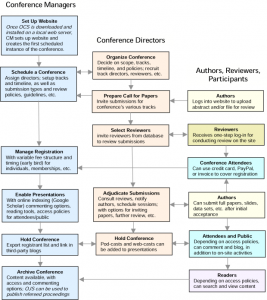
OCS is a comprehensive package that addresses the many facets of conference management, from online submissions of relevant content to management of all people involved (from registrants to presenters and organizers).  OCS even facilitates development of conference webservices and online discussion forums.  In fact, the PKP Scholarly Publishing Conference 2009, was managed using OCS.  The system’s main strengthes lies in its flexibility and  detailed indexing capactiy, which allows for dealing with multiple conferences simultaneously.  OCS 2.0 is originally based on open-source code developed for open journal systems, and the CBS group made several productive improvements through formatting modifications and software plug-ins.

Open Conference Systems Schematic

Unfortunately, the CBS group has run into multiple difficulties overcoming template configuration problems (especially with navigation menus), and a large portion of time was spent discussing multiple suggestions for improvement to the core software.  Majority of the CBS group’s concerns described issues surrounding formatting, style design, and the lack of descriptors from pull-down menus.  Other issues raised included expansion of administrative modules, and further development of OCS documentation and tutorials.  CBS has already started this process, and suggested that perhaps resources be pooled with the PKP support group and collaborative documents be published on wikipedia.

Peder Neilsen facetiously commented that it is a “Danish tradition of not talking about what is good, but what could be better.” Certainly the described OCS strengths lay not only in its cost (free), but also in the flexibility conferred by open-source code.  Furthermore, OCS users may benefit from accessing not only the development team, but a support group comprising of an international community of fellow users.  Certainly, this session highlighted the productive interplay between the open-source software developers (of whom Alec Smecher was present in the audience to represent) and the users.  Continual feedback drives steady modifications to the original source-code, new plug-in creations and  essentially product evolution.


Categories
Technical Themed Sessions

Website for CONICET´s Academic Publications: the Session Blog

Presenter: Alberto Apollaro

July 9, 2009 at 4:00 pm

Session Abstract

Background

Alberto Apollaro is a member of the Scientific Electronic Library Online (SciELO) Argentina group and is a specialist in webspace development and applications.  Mr. Apollaro joined CAICYT-CONICET in 1998 as a systems website administrator, including serving as the webmaster for CONICET’s specific website for academic publication.

Session Overview

The SciELO project’s directive is based on “the development of a model methodology for the preparation, storage, sharing and evaluation of scientific publications as an electronic support.”(1)  As an alternative to print, the library facilitates international distribution of Latin American scholarship with regional impact in an organized, accessible format.  This regional project stems from National Council for Scientific and Technical Research (CONICET) policy, which in turn is administered by the independent, Argentinian Centre for Scientific and Technological Information (CAICyT).

Comisión Asesora de Investigación Científica y Técnica	/ Consejo Nacional de Investigaciones Científicas Y Técnicas
Comisión Asesora de Investigación Científica y Técnica / Consejo Nacional de Investigaciones Científicas Y Técnicas


The CAICyT has charged the production a website which will allow Argentina systematically catalogue digitalized data that is editorialized and peer-reviewed as per the academic standards previously described by CONICET.  Also, in part of CAICyt’s directive to push Argentinean scholarly publication into the open-access era, CONICET draws upon 15 university repositories to fuel 32 open-access e-journals.  This initiative is facilitated by the use of the open-source Open Journal System (OJS) Software which allows online management of the process from submission through to publication.

The process began with journal selection from the Latindex, which contains over 2,800 titles.  Editors were then invited as the website was constructed.  CAICyT would provide the editors’ platform for discussion and consultation, while also providing publishers with guidelines for quality improvement .  OJS allows the website to self-archive authors’ submissions and facilitate peer-reviewing and copy-editing quickly and efficiently.

The expectation is that the CONICET website will provide a repository and portal for local Argentinean scholarship, and allow publication not just limited to text but multimedia also.  The streamlined editorial model allowed by OJS will hopefully encourage submission of regional scholarship and see it through to immediate publication, while operating under a more economically attractive model in comparison to traditional publication.

During the following discussion, Mr. Apollaro described the OJS is a very attractive mechanism to facilitate publication in Latin America (for the aforementioned reasons), but the problem lies in the current unfamiliarity shared amongst Argentinean scholars with OJS.  This is essentially holding back the website’s growth, and progress of the Latin American open-access movement in general.  Certainly, one of CONICET’s future efforts should be focusing on increasing open-access awareness in the Latin American scholarly community.

References

1) http://www.scielo.org.ar/scielo.php?script=sci_home&lng=en&nrm=iso

Spam prevention powered by Akismet