Categories
Library-Themed Sessions

Building content and community: digital publishing services at the University of Kansas: The Session Blog

July 10th, 2009 at 2:30pm

Abstract

Presenters: Brian Rosenblum and Scott Hanrath

Background

brian-rosenblum(Source)

Contact: brianlee@ku.edu

Brian Rosenblum is Scholarly Digital Initiatives Librarian at the University of Kansas Libraries, where he has administrative, production and outreach responsibilities in support of a variety of digital initiatives and scholarly communication activities, including KU’s institutional repository and digital publishing services. Prior to joining the Kansas digital initiatives program in 2005, Brian worked at the Scholarly Publishing Office at the University Library, University of Michigan, where he helped develop numerous electronic journals and digital scholarly projects.

Scott Hanrath
(Source: Paul Klintworth, PKP Conference, 2009)
Contact: shanrath@ku.edu
Scott Hanrath is Technical Lead, University of Kansas.

Session Overview

Brian Rosenblum outlined that in 2006 the University of Kansas (KU) library looked at new roles to support scholarship on campus. A survey was undertaken to determine campus needs. The university comprises some 28,000 students and 2,300 faculty.

Initially it was hard to ascertain which journals were asscociated with faculty research. The library is still encountering new journal activities. Local journal editors were interviewed to discuss needs, and a forum was formed to build relationships with editors.

New roles for the library included stewardship of scholarship production at Kansas, as well as working directly with faculty in terms of metadata tools and tagging systems. A mandate was established for the digital publishing services, including supporting faculty in all forms of digital publishing, exploring new publishing models, and promoting increased visibility and access. In 2005 the KU Scholarworks Repository was launched; however this does not have author submission  or peer review tools that OJS has.

Rosenblum gave some examples of KU digital publishing. The Biodiversity Informatics journal was launched by a single professor using OJS. This would not have been possible within the standard printing process. Several journals are available as back issues online (subject to a 3 year lag), enabling much wider access, of particular relevance to South America. Other journals are in traditional print, but also available online with immediate access. Rosenblum showed some download statistics, but these are coarse measures at present, needing more informatics for detailed records.

KU is the first public US university to have an open access research policy, announced in June 2009.

Scott Hanrath, as technical lead, outlined the technical aspects of digital publishing at KU. Technical roles have been split up between different departments, so there is a need for careful communication , planning, and identification of who does what. Customization of OJS has been mainly cosmetic, altering the look and feel of sites. Un-needed options have been stripped out. IT support staff have created the ‘KUdifier’ plug-in to personalize OJS. For the import process it’s been found to be better to work in smaller chunks, either 2 – 4 years of a journal or less than 400 articles at a time.

Rosenblum outlined the following points for the future: a more sustainable workflow, a need to outline the value of this service (especially in the light of budgetary cuts), improved OJS training, editorial advisory board meetings, and hosting a larger editors’ forum.

Question

A member of the audience asked about the process that led to the university adopting open access. Rosenblum replied that the tenured librarians encouraged the initiative to originate from the education department. There was a small, but vocal opposition. A visit from John Willinsky for consultation in February encouraged the process. The motion was passed with 22 in favour, and one abstention.

Resources

Brian Rosenblum Scientific Commons

Digital Initiatives at the University of Kansas

Journals at KU

News release (KU open access)

Categories
Research Themed Sessions

Public knowledge and knowledge mobilization: social sciences and humanities research funding policy in Canada, 1979-2009: The Session Blog

July 9th,  2009 at 2:30pm

Abstract

Presenter: Johanne Provençal

image_mini

(Source)

Background

Johanne Provençal is a doctoral candidate in the Curriculum Theory and Implementation Program in the Faculty of Education at Simon Fraser University (SFU). Provençal also has ten years of professional and academic experience in publishing, most recently working as a substantive and stylistic editor of scholarly writing. Johanne’s research interests include social theory and education; philosophy of education; scholarly discourse and scholarly publishing; communication and genre theory; and rhetorical theory and analysis. Provençal has published work on media literacy, the classroom as a public sphere, representation in educational research, and scholarly publishing. Provençal’s doctoral research examines SSHRC’s “knowledge mobilization” discourse and the implications and possibilities it has for the social sciences and humanities research community in Canada.

Session Overview

Provençal outlined four main parts to the session: SSHRC beginnings, the transformation from ‘grant council to ‘knowledge council’ in 2004/2005, SSHRC in 2009, and opportunities & challenges.

SSHRC was established in 1979. Provençal used examples of strategic plans from 1979, 1989 and 1996 to illustrate ‘early traces’ of knowledge mobilization. In 1979 mention was made to make social sciences research more visible. In 1989 the term knowledge transfer was used in the summary: “a more general point is the repeated emphasis on dissemination, communication, diffusion of research results: to spread results and achieve knowledge transfer to increase understanding and build constituencies to package results of fundamental research for political use to increase access to databases” (p. 2). In 1996 knowledge transfer is again stressed. Johanne’s rhetorical analysis shows that the scene is changing. Knowledge mobilization succeeds as agency within the collaboration.

In 2004/2005 there was a degree of tension as a result of the transformation from grant council to knowledge council. The first volume of a three volume report in 2004 reports that social sciences  research is caught in a “paradox of ubiquity and invisibility: present everywhere, but for all intents and purposes, visible almost nowhere” (p.12). The 2005 strategic plan calls for a systematic interaction between the general public and the research community.

The issue of visibility continues to predominate in 2009. Provençal mentioned that researchers need to tell their stories to the public. Yet it’s also the reception of those stories that is necessary for knowledge mobilization. This is a challenge area. Three examples were given of continuing opportunities: the  Knowledge Impact in Society pilot study, the Community-University Research Alliance program, and the funding of open access journals, started in 2008.

Questions

Heather Morrison asked about the raised visibility of knowledge mobilization by SSHRC. Provençal responded that the funding for open access journals only came in 2008. There is still some resistance from publishers about the business model. There is some ambiguity as funding is for research as well as open access journals. Generally journals philosophically support open access, but economics may dictate otherwise. A question was asked from the audience about whether SSHRC had consulted with researchers. Provençal responded that the culture for this to occur is not yet in place.

Resources

Canadian Association of Learned Journals

Ghosts in Machines and a Snapshot of Scholarly Journal Publishing in Canada

SSHRC

Courtesy of Johanne Provençal
Categories
Library-Themed Sessions

UK Institutional Repository Search: a collaborative project to showcase UK research output through advanced discovery and retrieval facilities: The Session Blog

July 9th 2009 at 10am

Abstract

Presenters: Sophia Jones and Vic Lyte (apologies for absence – please email any comments and queries)

Background

jones21(Source)

Sophia Jones, SHERPA, European Development Officer, University of Nottingham.

sophia.jones@nottingham.ac.uk 44 (0)115 84 67235

Sophia Jones joined the SHERPA team as European Development Officer for the DRIVER project at the end of November 2006. Since December 2007, she has also been working on the JISC funded Intute Repository Search project.

Jones has a BA in Public Administration and Management (Kent), an MA in Organisation Studies (Warwick) a Certificate in Humanities (Open University) and is currently studying part time for a BA in History (Open University). She is also fluent in Greek. Prior to joining the University of Nottingham, Jones worked as International Student Advisor at the University of Warwick, Nottingham Trent University and the University of Leicester.

Sophia’s interests include international travel, music, cinema and enjoys spending time reading the news of the day.


vic-lyte-mimas(Source)

Vic Lyte MIMAS, Director of INTUTE, University of Manchester

Mimas, University of Manchester, +44 (0)161 275 8330 vic.lyte@manchester.ac.uk
Vic Lyte is the Director of the Institute Repository Search Project. Lyte is also Development Manager at Mimas and also Technical Services Manager at Mimas National Data Centre. Lyte’s specialty areas are design and development of Autonomy IDOL technology within Academic & Research vertical and advanced search and discovery systems, architectures and interfaces with research and teaching context. Lyte’s work is lead by repository and search technologies.

Session Overview
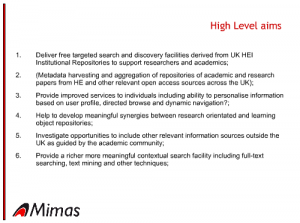
The UK Istitutional Repository Search (IRS) was initiated after a perceived gap was noticed in the knowledge access search process, where there appeared to be unconnected islands in knowledge materials.  The IRS followed on from the intute research project. The high end aims included easier access for researchers to move from discovery to innovation  by linking repositories to exchange knowledge materials. The IRS uses two main search methods: a conceptual search and a text-mining search. A question was asked by a member of the audience to differentiate the searches. Jones responded by stating that the conceptual search searches documents, whilst the text-mining search searches within documents.

Jonesa then demonstrated the two types of searches by using an example quesry of ethical research.  Searches can be added by suggested related terms, or narrowed down by filtering through repository or document type. The conceptual search results can also be viewed as a 3D interactive visualisation. The text-mining search can also be viewed as an interactive cluster map.

In summary Jones stated that IRS had met all its high end aims. In engaging in a focus group with the research community there was encouraging support. The only suggested improvement was a personalisation aspect, which the IRS would have the potential to add, with a projected roll out in the next phase of IRS.

picture-3(Source)

Questions and comments

1. How is the indexing managed? Answer: Please email Vic Lyte.

2. Does IRS have data-mining tools in the set? Answer: Yes, this was developed by NaCTeM.

3. How much does IRS cost? Please email Vic Lyte.

4. Is IRS available now? Yes, there is free access. However at this stage IRS is more of a tool than a service.

5. Comment from Fred Friend (JISC): I’m from the UK. If this is valuable, we’ll have to fight to protect these systems because of budget cuts and the publishers fighting. So, to keep it’s value, we’ll have to convince government about it.

References

Intute Repository Search (IRS) project

IRS Demonstrator Tool

Mimas Press Release February 26 2009

Spam prevention powered by Akismet