Categories
Editor-Themed Sessions

Moving from Paper Production to Online Open Access with Open Journal Systems: The Session Blog

Presenter: Laura C. Botsford, Assistant to the Editor, Canadian Journal of Sociology, University of Alberta

Time: 4-5 pm, July 9th, 2009

Place: SFU Harbour Centre, Sauder Industries Room 2270

———————————————————————————————

Session Overview

Background

In the early days of the Canadian Journal of Sociology, a great deal of manual work was required to print the journal, from getting galleys to making notes in the margins, to cutting to appropriate size and pasting onto paper sheets, etc. The editors of the journal soon realized that they were susceptible to too many external factors and decided to move to typesetting and a mainframe computer. While this newer technology had its advantages, there were many codes to learn and all that could be seen was the markup language; not the end result. The lack of a preview often created surprises for the editors when the pages were printed. Eventually technology progressed and the journal got some computers with What You See Is What You Get (WYSIWYG) capabilities– but they still had to go through the whole printing process. Dr. Kevin D. Haggerty took over as editor in 2007 and within a few months, decided to go electronic and open access with the journal. While everyone involved had many questions and qualms, they ultimately ‘took the plunge.’

Related Information Re: Printing Processes

Click here for a printing press demonstration on Youtube

A more recent version of the printing press:

(source)

Using the Open Journal System (OJS)

Moving to electronic publishing has reduced many of the traditional problems involved with the printing process and OJS has features that are very helpful, such as its functionality for the second review– the system automatically generates a list of reviewers and filters out those who have already declined in the first review.

However, OJS still poses many problems for users, so patience and technical support is absolutely critical.

Session Questions

Comment: There are currently seventeen journals running on the University of Alberta website, but the Canadian Journal of Sociology has been the most conversive, and questions have really pushed the development of OJS forward.

Question: What was the driving force to move to online and open access? We were becoming aware of the new generation of scholars coming up, and they are expecting to see their info on the internet. Also, printing and mailing is becoming increasingly expensive.

Question: How many copies were being printed prior to moving to electronic form? Answer: 1000

Question: How has converting from print to open access impacted the finances of the journal? Answer: It was a subscription journal, but the journal has been anomalous. We had some money in the bank, and received money from aggregators who have continued to contribute. One of the reasons for moving to open access was that subscriptions were dwindling– libraries were declining because they were lacking space and funding.

Question: Any plans to digitize back files? Answer: Yes. We haven’t tried it yet, but are definitely planning to.

Question: What is your business model? How much does it really cost to run the journal? Revenue stream? etc. Answer: Revenue stream usually from the Social Sciences and Humanities Research Council of Canada (SSHRC) and aggregators, but we also had money in bank that was invested. We also benefit from non-monetary things that the university provides, such as office space, release time from teaching for Dr. Haggerty, etc.

References

Taking the plunge Haggerty, K.D. (2008). “Taking the plunge: open access at the Canadian Journal of Sociology” Information Research, 13(1) paper 338. [Available at http://InformationR.net/ir/13-1/paper338.html]

Related Links

Categories
Library-Themed Sessions

Providing an Incentive: Developing Publishing Services for Researchers: The Session Blog

Presenter: Sara Fuchs, Digital Initiatives Library, Department of Scholarly Communication & Digital Services, Georgia Institute of Technology

Sara Fuchs
Sara Fuchs

Time: 4-5pm, July 9th, 2009

Place: SFU Harbour Centre, Sauder Industries Room 2270

———————————————————————————————

Abstract

Session Overview

Background

The Georgia Tech Library Department of Scholarly Communication & Digital Services set up an institutional repository in 2004 in hopes that faculty members could self-submit. Although they had always had a repository, it was usually set up after conferences had occurred. The department later decided to provide more support and began to help faculty create, store and view their papers, especially since nobody else on campus was offering similar services. The service provides both conference and journal support, as well as the uploading of any video recordings (of lectures as well), and digital archiving on the centralized repository for Georgia Tech authored materials, known as SMARTech. Submission onto SMARTech requires that the authors grant a non-exclusive license to Georgia Tech for non-commercial uses– mainly to raise awareness about open access to graduate students and supporting scholarly collaboration. SMARTech is now one of the largest institutional repositories in the United States and 35th in the world according to the Ranking Web of World Repositories, a project by the Spanish public research body Consejo Superior de Investigaciones Científicas (CSIC).

Lessons Learned with Open Conference Systems (OCS)

OCS works well for what it is supposed to do. It was a low pressure situation for the department because there was no need to maintain the OCS software, as everything was eventually going to end up in the repository. They found that clients enjoyed using OCS much more than the normal email workflow.

However, there were still challenges. With OCS, the process of accepting and rejecting proposals was more difficult– conference calls seemed to be much easier, and there is always a time lag in uploading presentations. Another challenge surfaced while setting up the Open Repositories 2009 Conference, mainly because they were working with two different websites. It made it very difficult to collect and retrieve conference papers. The Access Services Conference was the first time the payment function of OCS was used. Again, it was difficult to synchronize across two websites and this required going through multiple steps.

Customization

Clients wanted something more slick and streamlined, and wanted to use the more interactive parts of OCS, such as giving comments directly to authors, etc. In order to do this, all .css and template files had to be modified. New headers needed to be created, as well as modification of some menus, journal layout, and downloading of specific plug-ins. This proved to be very time-consuming, and this took design changes out of the hands of journal managers/editors. That being said, clients were highly satisfied and this became a showpiece of the department’s collaboration with faculty.

Questions

(Ran out of time)

Comment: Some of the difficulty in syncing between two websites might be easier if you upload/download directly from OCS instead of another location.

Related Links

Categories
Library-Themed Sessions

New Ground for Research Libraries: Conference Management Systems: The Session Blog

Presenters:

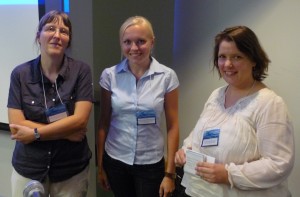
(From left to right: Helle Damgaard Andersen, Heidi Drasbek Martinussen, Kirsten Suhr Jacobsen)

Time: 2:30-3:30 pm, July 9th, 2009

Place: SFU Harbour Centre, Earl & Jennie Lohn Room 7000

Abstract

2008 Paper (.pdf, in Danish)

———————————————————————————————

Session Overview

Beginnings

Denmark’s Electronic Research Library (DEFF) began a project in 2008 to review twenty open source and proprietary conference management systems and to test out the three that were best suited for research libraries (i.e. includes functionalities such as registration/payment, review process, etc.) This project was carried out collaboratively by the Technical University of Denmark (DTU), Aalborg University, and Copenhagen Business School (CBS); each institution was to test out seven systems, respectively.

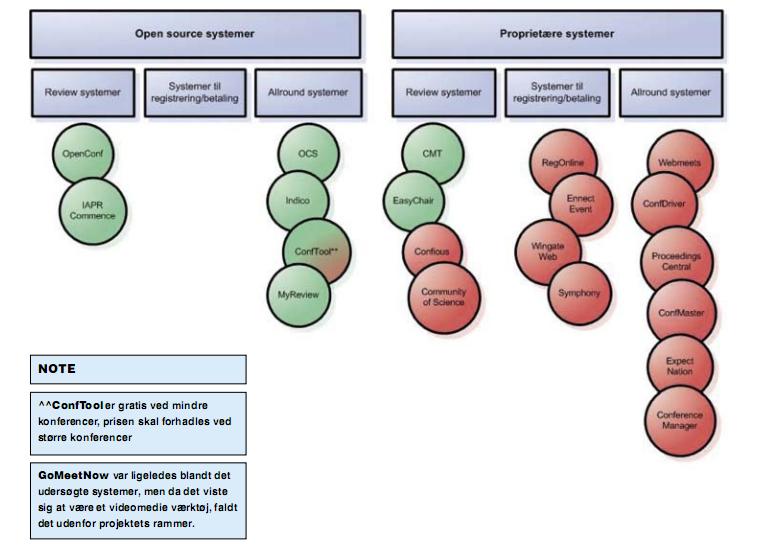
The following diagram represents the various characteristics of the systems, such as those that only support review or registration/payment functionalities, as well as pricing – red denotes that the system was VERY EXPENSIVE.

conference management systems comparison diagram

(source)

Following the preliminary testing stages, the three institutions each chose one of their seven conference management systems, and carried out pilot projects on the selected system:

1) Proceedings Central tested by Aalborg University

Proceedings Central (now ScholarOne Proceedings) was a proprietary system developed by Thomson Reuters. While it had many benefits, its major downfall was that it was expensive and only supported review functionalities, much more like the Open Journal Systems (OJS) publication system. In addition, it was frustrating to use outside of North America because the system was configured to follow US time only.

2) Indico tested by the Technical University of Denmark

The Technical University of Denmark (DTU) has been using the Indico system for several years now. It is an open source system that was originally developed by the European Organization for Nuclear Research (CERN) and supported by the European Union. Its greatest advantage is that it makes registration very easy– setting up registration forms can take as little as half an hour. The major challenge with Indico is that the system is not aesthetically pleasing, but they are currently working on developing a better looking version that is expected to be available in the fall. The presenters likened Indico to the ‘little brother’ of Open Conference Systems (OCS) as its functions are very comparable to the latter.

3) Open Conference System (OCS) tested by the Copenhagen Business School

The Open Conference System (OCS) was developed from OJS system and thus has inherited characteristics that are not always best suited for the needs of a conference management system. An example of this is that it is difficult to set up individual conferences– they must be set up as annual conferences.

Conclusions

While there are still many items on the presenters’ wish-list for OCS, the system seems to be the best so far in terms of designs, the building of the conference site, and multilingual support. It also has a large community of users behind it, and includes a wiki, as well as a support and user discussion forum.

Future Directions – a further look into the systems

The goal for the current project is to have DTU run fourteen conferences with Indico in 2009, and CBS run seven conferences with OCS to further develop and examine the respective systems. DTU and CBS also hope to collaboratively develop a ‘light’ version of OCS, that has fewer functions to better:

  • provide for a quick set up for registration,
  • support a conference that already has its own webpage, but requires payment and review functions,

The Role of the Library

The presenters also highlighted the role of the library in relation to the use of conference management systems. The library can serve as technical/user support, act as a central solution and housing for conferences, as well as provide payment system integration so that users are not limited to using PayPal.

Questions

Comment: Fantastic work. It is exciting to see someone to push forward OCS. Major problem with both OJS is that everyone is going in different directions. The more institutions pick up OCS, the more polish and fine-tuning it is going to get. Good to get feedback. This is the advantage to open source– this is how the software improves! And an obvious sign that the community works effectively.

Question: What is the volume for abstracts, attendees, etc. (that is provided by OCS)? Answer: Very wide range.

Question: How did you come down to deciding on Indico and OCS? Did you use a checklist for all the technical requirements for the 20 systems? Answer: Yes.

Question: Is there any proprietary system that has similar functional abilities of OCS and at reasonable price range? Answer: It is very difficult to get prices out of proprietary systems and functionality is usually very unclear-“this system does it all” seems to be the standard response.

References

Martinussen, H., Damgaard, H., Jacobsen, K., & Pedersen, J. (2008). Nye veje for forskningsbibliotekerne? conference management systems. DF Revy, 31(8), 21-23.

Related Links

Spam prevention powered by Akismet