Categories
Research Themed Sessions

Publishing Freedom of Information: the Open Government Records Plug-In for OJS: The Session Blog

Friday, July 10th, 2009 (11:30 AM)
SFU Harbour Center (Sauder Industries Room 2270)

Presenter: Mark Weiler, PhD Candidate, Simon Fraser University

Background

Freedom of information (FOI) legislation was enacted in Canada in 1983.  This legislation, in existence in various forms throughout the world, allows individuals to request access to government-held information.  In Canada, there is no formal database to allow interested parties to search for previously submitted FOI requests, or for the documents released as a result of these requests.

Session Overview – Session Abstract

Mark Weiler is interested in developing technologies that allow students and other academics to carry out historical research.  Recently, he became interested in the use of Open Journal Systems (OJS) and its capacity to make government-held knowledge more accessible to academics as well as to the general public.  This interest is in keeping with the aims and goals of the Open Access movement, namely, to make accessible information held by the government through Freedom of Information legislation.

Open Government Records (OGR), initially designed as a plug-in for OJS, helps journals to submit, track and publish FOI requests and the resulting correspondence and documentation that follows these initial requests.

The OGR website currently offers access to several FOI repositories touching on a number of areas of interest, including public servant curriculum and scholarships/grants.  What the website allows, above and beyond what a traditional print-published compilation of the FOI requests would, is the ability to offer access as the documents are obtained.

Commentary and Questions

The ensuing discussion highlighted a number of the potential uses of the OGR technology.  Notably, journalism schools were felt to be likely beneficiaries.  This type of repository could help inform work on government policy, public servant salaries, etc…  There was concern, however, that journalists may be reluctant to submit FOI requests to a database for fear of being “scooped”.

Another area of discussion concerned to potential use of this type of technology to help users submit information requests to journals in order to obtain more information about their corporate structure and partnerships.

Related links

Below are a series of links to websites and societies dedicated to civic action and freedom of information;

Open Government Records – The OGR website, with its FOI repositories.

Visible Government – A Canadian NGO website dedicated to increasing government transparency.

What Do They Know? – Database of UK FOI requests.

MySociety – UK civic action website.

References

Weiler, M. (2009). Publishing freedom of information: the open government records plugin for ojs. PKP Scholarly Publishing Conference 2009. Retrieved 2009-07-08, from http://pkp.sfu.ca/ocs/pkp/index.php/pkp2009/pkp2009/paper/view/131
Categories
Technical Themed Sessions

Importing Backissues into OJS: Development of an OJS Import Script with Django: the Session Blog

Friday, July 10th, 2009 (11:00 AM)
SFU Harbour Centre (Sauder Industries Room 2270)

Presenter: Syd Weidman, Library Systems Supervisor, University of Winnipeg – Session Abstract

Session Overview

Why was this an issue?

With the transition to open-access publishing of several journals at the University of Winnipeg, Syd Weidman and the University library have been involved in multiple aspects of this transformation.  Given that these journals have been in print for decades, one of the major obstacles that needed to be addressed was the importation of back issues into an online, open-access compatible format.

Initial attempts using the available software proved difficult.  They were met with bugs and their associated patches; overall, Syd described the process as “laborious and convoluted”.  He surmised that “in the context of importing [a large volume of] back issues, small efficiencies [may] have a large impact.”  With this notion in mind, Syd began work on the Open Journal Systems (OJS) Import Project.

Tackling the problem – Use of Django

Syd highlighted the basic design goals of any software to be used for this purpose; he stressed that the process needed to be as EASY as possible.  He sought to optimize the software’s ease of CONSTRUCTION, USE, DEPLOYMENT and MAINTENANCE.  Being most familiar and comfortable with the Python programming language, Syd opted to use the Django Web framework to build a Web-based application to carry out the task of importing back issues.

Django is an open-source framework that was initially used by the online publishing industry.  With a short digression, Syd took a moment to review the “4 freedoms” of open-source software, being the “free” use of software for any purpose, free access to its code, freedom to modify as well as an understanding that improvements will be shared with others (for more, take a look at the Free Software Foundation’s website.)  Django, in particular, has several advantages over other similar frameworks, namely:

  • object relational mapping – allows use of fewer lines of programming, increasing robustness
  • automatic administrator interface
  • elegant URL design
  • pluggable template system
  • flexible and robust cache system
  • i18n compatible – allows for the application to be adapted to other languages without significant engineering changes
  • excellent documentation
  • an active mailing list (a double-edged sword!)

Success!

With the development of the new importation software, the U of W was able to scan backissues into .pdf format, to ultimately be uploaded into their respective online journals.  This required the entering of appropriate metadata in order to allow for accurate archiving and searching.

Challenges and future directions

One of the difficulties in developing a script for another piece of software is to ensure that they remain in sync when new versions appear.  In a subsequent OJS release following the development of the OJS importing application, incompatibilities/bugs appeared, and needed patching.

Commentary/Questions

Just prior to the question period, Syd mentioned the recent development of another application, “Quick Submit”, which may now be able to perform similar functions to his program.

Related Links

University of Winnipeg library (and their OA publications: Canadian Bulletin of Medical History, Journal of Mennonite Studies and the Canadian Children’s Literature Journal)
Python programming language
Django framework

References

Weidman, S. (2009). Importing backissues into ojs: development of an ojs import script with django. PKP Scholarly Publishing Conference 2009. Retrieved 2009-07-08, from http://pkp.sfu.ca/ocs/pkp/index.php/pkp2009/pkp2009/paper/view/190

Categories
Library-Themed Sessions

Open Access and the Economics of Scholarly Communication: The Session Blog

Friday July 10th, 2009 (9:30 AM)
SFU Harbour Centre (Fletcher Challenge Room 1900)

Presenter: Heather Morrison, Project Co-ordinator, BC Electronic Library Network – Session abstract

Heather’s presentation was recorded.  It’s available here.

Session Overview

In this session, Heather Morrison presented an overview of the economic environment in which scholarly publication currently exists, focusing her attention on potential effects of the growth of the Open Access (OA) movement on this environment.

The Macroeconomics of Scholarly Publishing

Heather began by framing her discussion with the modern definition of economics, that is, the study of our behavior and the means by which we achieve certain ends given limited resources.  This was used to raise the following question: “Where is the money to help with the transition to fully OA publishing?”

The current economic situation was then explored with a description of the estimated costs of per-article publishing in the domains of science and technology.  These estimates range widely from one publisher to the next;

  • BMC – 1500$/article
  • PLoS One – 1300$/article
  • Springer Open Choice – 3000$/article
  • Hindawi – 800$/article

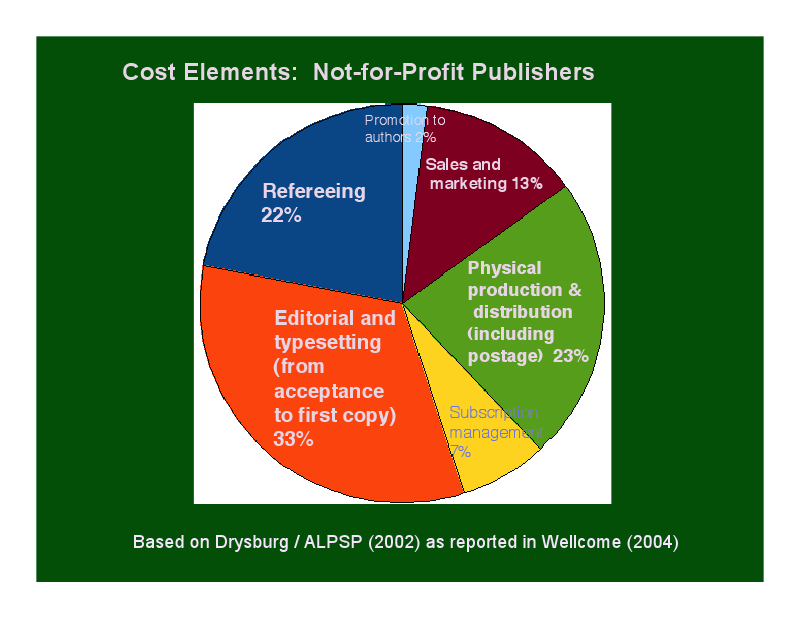
These costs, among not-for-profit publishers, are broken down in the following way:

HM-slide1

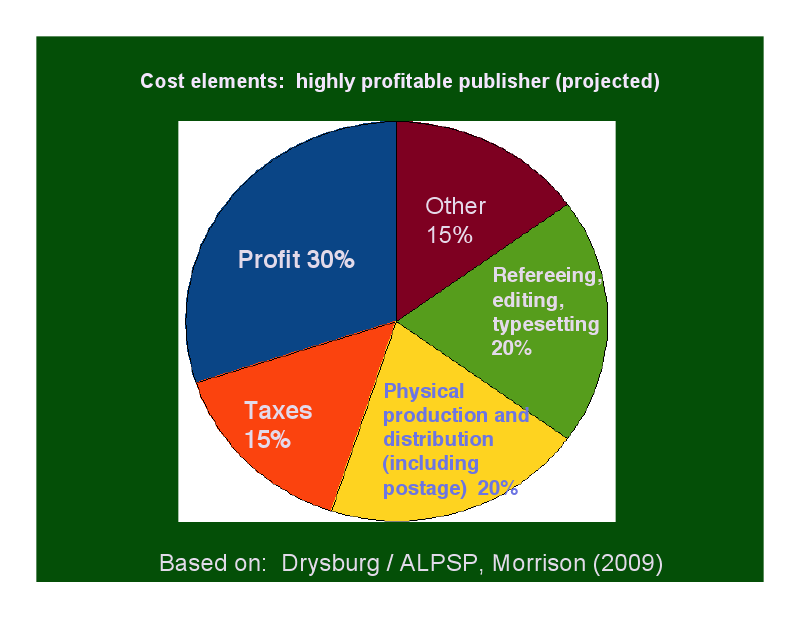
In the realm of highly profitable for-profit publishing, the per-article cost is broken down in the following manner (as per Heather Morrison’s research).  Alarmingly, in this economic model, nearly 50% of the per-article revenue goes to profits and taxes.  Perhaps most interestingly, she pointed to a number of examples where for-profit publishers charged from 6 to 7 times more for publications that were actually less cited than similar journals put out by not-for-profit publishers.

HM-slide2

Alternative to the current model

Looking at these numbers allows an examination of costs that may be reduced through a transition to fully OA publishing and the introduction of a number of efficiencies.  OA technology such as Open Journal Systems could offer the following benefits;

  • reduction in the costs of coordinating the refereeing process
  • elimination of typesetting and printing costs
  • reduced systems and staffing costs
  • elimination of authentication, hosting and troubleshooting costs
  • dropping the need for copyright policing

Other less direct efficiencies introduced by the adoption of fully open-access publishing include a rethinking of the rejection process, with a reduction in the need to resubmit rejected articles to additional journals.

With these new efficiencies and cost savings, Heather suggests, libraries would have additional resources to allocate to building collections, rather than buying collections; to funding institutional repositories rather than spending on inter-library loans and to digitizing and preserving electronic collections rather than shelving print journals.

What if the subscription-based scholarly publishing industry were to collapse?

The concern has been raised by a number of publishers that the introduction of fully open access publication may threaten the viability of the current subscription-based model.  Heather contends that although they are unlikely to fail any time soon, if the major publishers collapsed, there is sufficient open-access support available to help journals carry on with their publishing activities.  She argues that this collapse (again, however unlikely) would provide an opportunity to rethink, renew and rebuild our publishing system.

Commentary

Not surprisingly, this presentation gave rise to a healthy amount of discussion.  Questions were directed both to Heather Morrison and Frederick Friend who gave a talk on the future of scholarly publishing.  The following questions were raised;

How would fully open-access publishing be cheaper than the subscription-based system? The savings are thought to come from the wresting of control of costs from the publishers into the hands of academics.  In order for the savings to materialize, however, academics will need to focus on transforming several aspects of the economics of publishing.

If libraries are already struggling to cope with the rising costs of subscriptions, how can they set aside money for open-access initiatives? This will likely require a multi-faceted approach.  Librarians will need to set priorities along with researchers in order to make decisions about which subscriptions are most needed.  If needed, they may also need to consider canceling “one big deal” in order to leave room for OA funding.

Related links

Imaginary Journal of Poetic Economics – Heather Morrison’s Blog
Canadian Libraries Association Position Statement on Open Access
Scholarly Communication for Librarians – Heather’s new book

References

Morrison, H. (2009). Open access and the economics of scholarly communication. PKP Scholarly Publishing Conference 2009. Retrieved 2009-07-08, from http://pkp.sfu.ca/ocs/pkp/index.php/pkp2009/pkp2009/paper/view/136

Spam prevention powered by Akismet