Author Archives: E Wayne Ross

Time Magazine urges invasion of Myanmar

In an article titled “Is It Time To Invade Burma” Time Magazine suggest that the United States should consider “coercive humanitarian intervention” in cyclone ravaged Burma (Myanmar).

The article cites form UN and USAID officials as supporting an invasion.

The article’s author Romesh Ratnesar states that “…the Burmese government’s xenophobia and insecurity make them prone to view U.S. troops…as hostile forces.”

The article closes with a plea for invasion: “But we still haven’t figured out when to give war a chance.”

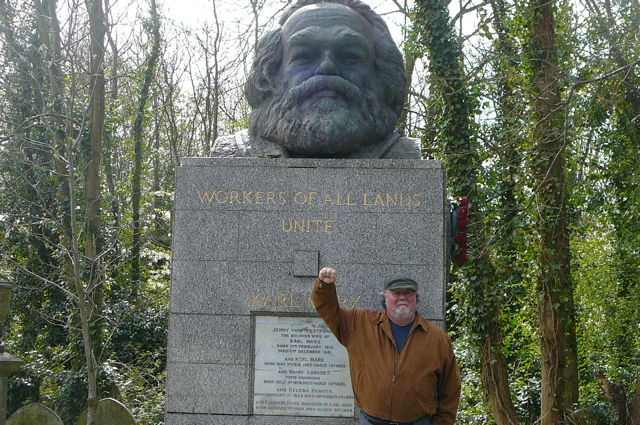
Rouge Forum Update—Happy Birthday Karl Marx

P1040761.jpg
Dear Friends,

Can you teach about Marx? If not, why not?

Karl Marx: (May 5, 1818 – March 14, 1883)

Here are some images of Marx.

Marx’s Theses on Feuerbach can be found here.

Marx still stands far above his inheritors, all of them. And, per Lenin, one cannot fully understand Marx without understanding Hegel, especially the “Science of Logic,” but the entire body of work. Lukacs’, “The Young Hegel,” is a good pathway back to Hegel himself.

Here is Lenin writing on Hegel’s Science of Logic, a vast improvement over Lenin’s earlier Materialism and Empiro Criticism.

And, given the current election spectacle, we might remember what Marx and Engels wrote on the question of capitalist democracy, “The state is nothing but an instrument of oppression of one class by another–no less so in a democratic republic than in a monarchy.”

The crux of Marxism, if there can be such a thing, is revolution, the negation of the negation: abolishing, retaining, moving to a higher level. Things change.

The question of class consciousness remains largely unresolved. Here is Bertell Ollman addressing the problem of why it is so many people are so easily turned into instruments of their own oppression, while others do resist

A podcast of Michael Baker’s radio interview with Seattle test resister Carl Chew can be found here: http://www.kzum.org/. You can also read a full interview with Chew by subscribing to Substance News.

We note, without envy, that Randi Weingarten, soon to be president of the American Federation of Teachers, will hold two jobs inside the AFT, and make about $600,000 a year, representing people being laid off in droves, people who often live in house trailers. NEA”s Reg Weaver, soon to be replaced by Dennis Van Roekel, makes about $450,000 a year and can live on his expense account.

School workers hold terrific potential power. In late April, 200,000 educators in the UK shut down the nation’s school system in protest against the government’s wage cutting plans. They were joined by 100,000 other workers striking in solidarity. More than a million people missed school.

Ken Goodman writes on the corrupt Reading First Phonics Education project, now clearly failed, at SusanOhanian.org.

We are still in the process of notifying nominees for the Rouge Forum Steering Committee, and awaiting word from others. That should be finalized by next week. We will also offer an analysis of why it is the anti-war, immigration rights, and anti-high-stakes testing movements are losing ground, despite a rise of apparent resistance.

Thanks to Melissa, Ido, Amber, Wayne, Sean, Tommie, Bob, Karen. Betty, Ann, Della, Candace, Erin, Beau, Sherry, Susan, Ken, Gerry, Georgia, Terry Ray, Elvira, Tony, Sandy, Sally, Adam, and Gina. Break up the Padres (sic)!

all the best

r

Happy May Day from the Rouge Forum!

Dear Friends,

It is May Day, the international workers holiday. Since the massive 2006 immigrant rights marches, what amounted to the biggest general strike in the last seventy years, May Day is finally restored to the US, where it began. For far too many years, it was replaced by Law Day (imposed in the fifties), a day when people were supposed to celebrate the tyranny of property laws.

Now around the US students, kids, workers, educators, community people, and organizers will hit the streets and rally again. School workers can support the kids who are likely to take the lead in walking out of school, joining the many scheduled marches in the struggle for equality and social justice. And we can join them.

This describes the San Diego action and this outlines actions around the country.

The Rouge Forum has celebrated Mayday for the last eleven years. Here is our traditional flyer.

And an update for our current context can be found here.

And a link to the music and lyrics of the “The Internationale”.

best
r
Life travels upward in spirals.
Those who take pains to search the shadows
of the past below us, then, can better judge the
tiny arc up which they climb,
more surely guess the dim
curves of the future above them.

Give me the lesson without the spin

From the Los Angeles Times
Give me the lesson without the spin

A high school student finds conservative bias in his American government textbook.
By Matthew LaClair

April 27, 2008

Throughout my life, my teachers have told me that school is a neutral environment where my classmates and I can count on teachers and textbooks to provide us with the factual and unbiased information that will equip us for life. Lately, though, I’ve begun to wonder whether they really mean it.

In my junior year of high school in New Jersey, my U.S. history teacher used the first week of class to preach his religious beliefs. He told students, among other things, that they “belong in hell” if they reject Jesus as their savior, that evolution and the Big Bang are ridiculous and unscientific theories, and that there were dinosaurs on Noah’s Ark.

When I confronted him in the principal’s office, he denied making the remarks. What he didn’t realize was that I had recorded the classes. But even after I informed school officials what had happened, they ignored my concerns. So after more than a month, my parents and I took the news to the media.

At first, I was harassed and intimidated by other students. School officials ignored the harassment and even a death threat I received.

Only after the story became national news did the school district begin to take us seriously. After lengthy negotiations (and against continuing opposition from the school board), we finally persuaded the district to address the teacher’s false and inappropriate remarks. The Anti-Defamation League was brought in to teach the faculty about the separation of church and state, and experts in the fields of church-state separation, evolution and cosmology came to our school to conduct assemblies.

After that, I thought I was done with controversy for a while. But now, in my senior year, I am back in the midst of it. In one of my classes, we use the 10th edition of “American Government” by James Q. Wilson, a well-known conservative academic, and John J. DiIulio, a political scientist and former head of President Bush’s Office of Faith-Based and Community Initiatives. (2005). The text contains a statement, repeated three times, that students may not pray in public schools. In this edition of the text, the authors drive the point home with a photograph of students holding hands and praying outside a school. The caption reads: “The Supreme Court will not let this happen inside a public school.”

I knew this was false. In fact, students are allowed to pray in schools; courts have ruled many times that a student’s right to pray may not be abridged. What’s generally impermissible is state-sponsored prayer, in which school officials lead prayer or students are called on or required to pray. It seemed clear to me that the purpose of the discussion in the textbook was to indoctrinate, not to educate.

Continued reading revealed numerous other instances of bias, as well as erroneous and misleading statements. For example, the section on global warming begins with a few well-chosen words to set the tone: “It is a foolish politician who today opposes environmentalism. And that creates a problem because not all environmental issues are equally deserving of support. Take the case of global warming.”

The authors neglect to mention the growing scientific consensus on this subject. They dismiss those who are concerned about global warming — that is, the overwhelming majority of scientists — as “activists” motivated not by data but by “entrepreneurial politics.” Those who deny or downplay it are described as “skeptical scientists.”

Pointing out dissent within the scientific community is appropriate. Suggesting that the majority, but not the minority, is politically motivated is not appropriate. If a controversy truly exists, then the authors should not instruct students which side to “support.”

I contacted a not-for-profit group called the Center for Inquiry. It enlisted support from scientists, including James Hansen, NASA’s top climate scientist, and organizations, including Friends of the Earth and People for the American Way, to address concerns about the textbook.

What is most distressing is not that some public school teachers preach their religion, or that some authors put politics ahead of education. It is that it is so rare for anyone to call them on it. This text is widely used. Yet to my knowledge, no one has challenged these incorrect and misleading statements.

As Americans, we should stand up for our common values. We should champion education and settle for nothing less than the best. Our teachers should do the same and should not misuse their positions to promote their personal agendas.

Matthew LaClair is a high school student in Kearny, N.J.

Rich Gibson and E. Wayne Ross discuss resisting “No Child Left Behind” on Michael Baker’s “Room 101” along with co-host Richard Hargesheimer

On this edition of “Room 101” (broadcast yesterday on KZUM 89.3 in Lincoln, Nebraska), Rich Gibson and Wayne Ross discuss the recent Rouge Forum conference in Louisville, Kentucky and the how educators are resisting the oppressive effects of high-stakes testing in North American classrooms. Rich and Wayne also discuss their recent article in CounterPunch magazine in which they define the role of schools and the bipartisan “No Child Left Behind” law in the rotting, militarized, imperial system.

Thomas Friedman pied by anti-capitalists at Brown

The Providence Journal reported that the incident involved paper plates with shamrock-colored whipped cream. After they were thrown at Friedman, one of those protesting threw in the air leaflets that criticized Friedman, saying:

“Thomas Friedman deserves a pie in the face because of his sickeningly cheery applause for free market capitalism’s conquest of the planet, for telling the world that the free market and techno fixes can save us from climate change. From carbon trading to biofuels, these distractions are dangerous in and of themselves, while encouraging inaction with respect to the true problems at hand.”

The Providence Journal reported later that one of the pie throwers was apprehended.

This is only a test: How two hours determine the future of a school

“So due to a simple law, the entire staff at Joseph Gallagher may soon be fired because some 11-year-old named Nzeyimana can’t use the word “prowl” in a sentence.”

Here’s a story from the Cleveland Scene, which does a nice job of conveying the perversion foisted on schools by the No Child Left Behind law, where if such schools don’t make “adequate yearly progress,” (including year-to-year test score increases for non-English speaking and cognitively disabled students), the state has the right to fire the principal, teachers, and staff and shut down the school.

How to improve education? Resist straitjacket of standards; make efforts learner-centered

Iowa teachers Dave O’Connor and Alan Young recently published an op-ed in the Des Moines Register that illustrates how the rhetoric of “rigorous standards” in education spawns rigid, inflexible, standardized approaches to to learning rather than opportunities for students to delve into the “messy world of critical thinking.”

In addition, O’Connor and Young note how the call for is “an expensive, bureaucratic system of state-controlled content enforced through a testing regime” in Iowa will cost of up to $125 million to initiate, just so it can be determined how successful Iowa students are at recognizing right answers on multiple choice tests. A shift of resources that will line the pockets of corporate test makers at the direct expense of lowering class size, enhancing access to technology or professional development.
desmoinesregister.com

April 21, 2008

How to improve education? Resist straitjacket of standards; make efforts learner-centered

Dave O’Connor and Alan Young

The Register’s April 9 editorial, “Help Iowa Aim High: Set Rigorous Standards,” used the word “rigorous” five times in an 11-paragraph piece. Princeton University’s Word Net defines rigorous as “rigidly accurate; allowing no deviation from a standard.”

The same online dictionary defines “rigid” as “inflexible: incapable of adapting or changing to meet circumstances.” Are rigidity, inflexibility and an inability to adapt to changing circumstances really the characteristics the Register believes Iowa should be looking to instill in its 21st century citizens?

As Register editors call for “more rigorous state content standards and mandatory core curriculum,” they should be honest with Iowans. What they are really calling for is an expensive, bureaucratic system of state-controlled content enforced through a testing regime. New standardized state assessments to replace the ITBS/ITED will then be implemented at an initial cost of up to $125 million to determine how successful our students become at recognizing right answers on multiple choice tests.

External nonprofit education organizations will come onto the state payroll to review our new standards and assessment to ensure that they are rigorous enough. An additional array of end-of-course assessments and practice tests will then appear to help make sure our students are ready for the state test.

Before you know it, millions of our limited tax dollars that could have been spent on class-size reduction, technology, professional development and other proven initiatives that directly impact student learning will instead have gone into the creation of a testing bureaucracy. This approach will drown district efforts to develop more important thinking and communication capacities Iowa students need to thrive in a democratic society or compete in the global marketplace.

As Professor Linda Darling Hammond of Stanford University has noted, “…Almost nothing we do in the world of work requires recognizing one of several pre-selected responses to questions about a single fact or piece of information. Most jobs in today’s knowledge-based economy require that we find, assemble and analyze information, write and speak clearly and persuasively; and work with others to solve messy problems that don’t have predetermined answers.”

Others have argued that focusing on standardized testing and centralized curriculum squelches creativity and innovation, “…the very things that our competitors in Asia are trying to copy in their own educational reforms.”

When state-controlled curriculum is implemented to support state-mandated standards, the focus is on what is most easily tested, not what is most valuable to learn. Education evolves into a race to cover a pre-determined list of facts in time for students to regurgitate them on cheap-to-grade bubble tests. Pennsylvania, for example, has one seventh-grade science and technology class with 178 state-mandated objectives that teachers must teach. Real, inquiry-based learning – where students play a role in choosing what to explore and teachers can develop curriculum that is responsive to student interests and real-world events – takes a back seat to test preparation.

There is scant evidence to prove that this approach is effective. Professor Gerald Bracey of the Center for Education Research, Analysis and Innovation found “absolutely no correlation” between states with rigorous standards and improved standardized test scores. And the testing companies themselves, after 60-plus years, still provide virtually no evidence that standardized tests improve student learning.

The Register’s editorial criticized Iowa’s current standards as “so broad they are almost meaningless.” Iowa’s current standards, when combined with a voluntary model core curriculum, provide teachers and districts with both the direction and the flexibility they need to teach students what they need to know to be active and engaged members of our democracy. At the same time, they allow students to delve into the messy world of critical thinking that rigidly accurate and inflexible standards documents ignore.

There are many ways we can and must improve education in Iowa. But they should be learner-centered, not subject-centered, and they should be made by those closest to the children. Moving curricular decision-making even farther away from the classroom and creating a system of mandatory compliance will not yield learning communities of excellence.

Mandating top-down, simplistic rigor as reform may satisfy some legislators and editorial writers that they have “done something,” but in reality it will subvert ongoing district efforts to create even better, higher-quality, learner-centered curricula and assessments.

Our children deserve better than this kind of failed “standard” educational reform.

DAVE O’CONNOR is a teacher at Merrill Middle School and ALAN YOUNG is a teacher and president of the Des Moines Education Association.
Newspapers give parents negative view of schools, survey finds

If parents are relying on newspapers for information about your local schools, then watch out: Their opinions about school safety, teacher quality, and academic success will be less positive than those of parents who get their information from other sources, according to a soon to be published report by The National School Board Association.

The report, “What We Think: Parental Perceptions of Urban School Climate,” by NSBA’s Council of Urban Boards of Education (CUBE) found significant differences in parents opinions about schools, based upon the source of their information.

For example:

  • More than 76 percent of parents with personal experience in their local schools agreed that their children’s schools were safe, the study found. But that figure dropped to 61.5 percent among parents who rely heavily on newspapers for information.
  • Nearly one in three parents believe some children carry guns or knives to school — if they rely on newspapers to form their opinions, Perkins added. Only 11.1 percent agree with that assessment if they get their information on schools from their children.
  • A similar disconnect was found when parents were asked about the likelihood that their child would do well on standardized tests. Among those who rely on newspapers, twice as many are skeptical about the chances of high academic performance (10.8 percent) as are those parents with a personal experience with the schools (5 percent).
  • Asked if teachers care about their child’s success, 85.5 percent of parents agree — if they rely on their children as a primary source of information on the schools. Only 57 percent of parents agree if they rely on newspapers for information.