Category Archives: Democracy

“Community and resistance—or imperial barbarism”

Below is note from Rich Gibson (San Diego State University) on the anniversary of the US war in Afghanistan.

Dear Friends,

Today is the 8th Anniversary of the US assault on Afghanistan, a full invasion, war, in response to a crime.

In my section A section of the New York Times (CA) , there is no mention of that.

Since then, $12.9 trillion was given to the banks. The wars will cost around $3 trillion if they project into next year, as they will.

The government became a full blown corporate state, an executive committee and armed weapon of the rich. Schools merged with the effort, becoming full-blown missions for capitalism. Those educators who collaborated became, knowingly or not, its missionaries.

The American public, having agreed to shop during Bush’s wars, can no longer shop. The US economy, 2/3 rooted in consumerism, cannot consume, nor produce, and the banks will not loan to the unemployed. Spectacles continue, more and faster. Baseball! Football! Porn!!

The demagogue, Obama and his friend, Arne Duncan, now throw the Bush agenda for education into hyperspeed: Regimented curricula promoting witless nationalism, anti working class high stakes exams, militarization, layoffs and cutbacks, some privatization, and, with perfect logic, merit pay.

The union leadership of every major union cooperated at every turn, played a significant role in electing Obama, in harmony with their Quisling roles of the past. They are the nearest and most vulnerable of workers’ enemies. Harsh measures for them.

Professional organizations accepted the division of academic labor they represent; remained largely impotent. Historians talked to historians, wrote a few petitions, rarely crossed the hall to deal with the sociologists. Some took up petitions, begging.

The rich grew much richer as barbarism rose. The poor became much poorer. Segmented by race, class, gender, split against each other by reactionary unions, now we see impoverished people battling for scraps.

The education agenda is a war agenda. The core issue of our time is the reality of the promise of endless war and booming inequality met by the potential of mass, activist, class conscious resistance, connecting reason to real power.

The youth at the occupation of UCSC point the way. Having a good school within this capitalist society is like having a reading room in a prison. Not acceptable.

The choice is clear enough. Community and resistance—or Imperial Barbarism.

Up the rebels!

Good luck to us, every one.

r

Call for manuscripts: Critical Education

Critical Education is an international peer-reviewed journal, which seeks manuscripts that critically examine contemporary education contexts and practices. Critical Education is interested in theoretical and empirical research as well as articles that advance educational practices that challenge the existing state of affairs in society, schools, and informal education.

Critical Education is an open access journal, launching in early 2010. The journal home is criticaleducation.org

Critical Education is hosted by the Department of Curriculum and Pedagogy at the University of British Columbia and edited by Sandra Mathison (UBC), E. Wayne Ross (UBC) and Adam Renner (Bellarmine University) along with collective of 30 scholars in education that includes:

Faith Ann Agostinone, Aurora University
Wayne Au, California State University, Fullerton
Marc Bousquet, Santa Clara University
Joe Cronin, Antioch University
Antonia Darder, University of Illinois, Urbana-Champaign
George Dei, OISE/University of Toronto
Stephen C. Fleury, Le Moyne College
Kent den Heyer, University of Alberta
Nirmala Erevelles, University of Alabama
Michelle Fine, City University of New York
Gustavo Fischman, Arizona State University
Melissa Freeman, University of Georgia
David Gabbard, East Carolina University
Rich Gibson, San Diego State University
Dave Hill, University of Northampton
Nathalia E. Jaramillo, Purdue University
Saville Kushner, University of West England
Zeus Leonardo, University of California, Berkeley
Pauline Lipman, University of Illinois, Chicago
Lisa Loutzenheiser, University of British Columbia
Marvin Lynn, University of Illinois, Chicago
Sheila Macrine, Montclair State University
Perry M. Marker, Sonoma State University
Rebecca Martusewicz, Eastern Michigan University
Peter McLaren, University of California, Los Angeles
Stephen Petrina, University of British Columbia
Stuart R. Poyntz, Simon Fraser University
Patrick Shannon, Penn State University
Kevin D. Vinson, University of the West Indies
John F. Welsh, Louisville, KY

Online submission and author guidelines can be found here.

HAW (Historians Against The War) recommended articles on torture, Afghanistan/Vietnam, Honduras, My Lai/Lockerbie, and the drug war in Latin America

Below are a collection of current articles available on the web that provide historical background on issues relevant to concerns taken up by Historians Against the War, as recommended by the HAW Steering Committee.

“Our Laws Condone Torture”

By Juan Cole in Salon.com, posted September 8

“The Phoenix Program Was a Disaster in Vietnam and Would Be in Afghanistan–And the NYT Should Know That”

By Jeremy Kuzmarov, History News Network, posted September 7

“These Colors Run Red!: The U.S. Follows the Soviet Union into Afghanistan”
By Andrew J. Bacevic, The American Conservative, October 1, 2009 issue

“Battle for Honduras—and the Region”
By Greg Grandin, The Nation, August 31 issue

“From My Lai to Lockerbie”
By Nick Turse, TomDispatch.com, posted August 30

“Saigon 2009: Afghanistan Is Today’s Vietnam. No Question Mark Needed.”
By Thomas H. Johnson and M. Chris Mason, foreignpolicy.com, posted August 20

“Lesson of Vietnam Lost in Afghanistan”
By Stanley Kutler, Truthdig, posted August 20

“Is Obama Aware of the History of Failure that Marks Our Drug War in Latin America?”
By Jeremy Kuzmarov, History News Network, posted August 17

In addition, this week’s “Life during Wartime” cartoon by Josh Brown, posted on the HAW home page, offers a chilling parallel between Afghanistan and Vietnam.

Texas state school board continues assualt on reason

The right-wing wing assault on reason in schools has intensified with the appointment Gail Lowe as the chair of the Texas State Board of Education. Lowe recently criticized the inclusion of US Supreme Court Justice Thurgood Marshall and legendary labor leader Cesar Chavez in the social studies curriculum because, according to Lowe, Marshall and Chavez are are “not particularly known for their citizenship.”

Governor Rick Perry appointed Lowe to the position after the Texas state senate rejected Perry’s attempt to have Don McLeroy appointed for a second term as board chairman. In his role as chair of the Texas State Board of Education, McLeroy championed creationism and lobbied to have Texas science curriculum focus on the “weaknesses” of evolutionary theory. In a January 2009 editorial, The New York Times described the McLeroy’s board as “scientifically illiterate” for their efforts to create a science curriculum that reflects conservative Christian beliefs about creation, rather than  scientific evidence.

Under Lowe, the Texas Board is not likely change its tune. According to the Houston Chronicle, Lowe, a small town newspaper publisher,  is “unapologetic about her conservative Christian views.” In an interview with the Associated Press, Lowe said “This country was founded on Judeo Christian principles and to say otherwise is to deny what is very unique about our country,” and she believes that believes students should be taught “biblical motives of the country’s founding fathers.”

Lowe has been a member of the Texas board since 2002 and has consistently voted with the panel’s ultra conservative faction—opposing inclusion of contraception information in health textbooks, attacking evolutionary biology as part of the science curriculum, and rejecting the inclusion of two of the most towering civil rights figures of the 2oth century in the social studies curriculum,  Marshall and Chavez .

Lowe’s comments on Marshall and Chavez were in response to comments from members of  board appointed advisory-panel who have argued that Marshall—who argued the Brown v. Board racial desegregation case in the 1950s and who later became the first African American US Supreme Court Justice—and Chavez—the Mexican American farm worker, labor leader,  and civil rights activist—should be deemphasized in the social studies curriculum because they lack “the stature, impact and overall contributions of so many others.”

Marshall and Chavez are “not particularly known for their citizenship,” Lowe told the Houston Chronicle. “Figures we use to represent those character ideals (citizenship, patriotism and community involvement) and the type of persons we want your students to emulate should be politically neutral.”

Hmmm, what kind of logic is that? Well, it’s racist logic of course. Can you even find one figure in a US history textbook who is “politically neutral”? Even a white person?

Thanks to Tony’s Curricublog for the heads up on this (and many other stories).

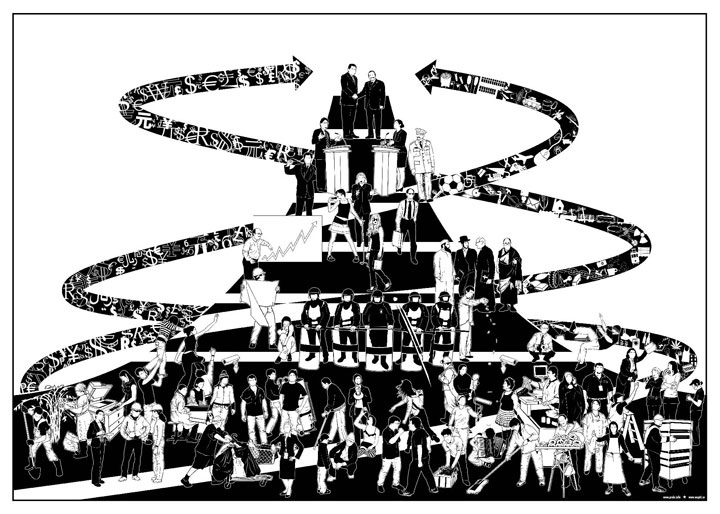
The new pyramid of the capitalist system

pyramid-1

Inspired by the old I.W.W. “PYRAMID of CAPITALIST SYSTEM”, this poster is a portrayal of class society as it appears to us today. The whirlwind of market forces encircle and shape society, operating through our activity, yet behind our backs. People at different levels of the modern capitalist pyramid enjoy it or defend it or cope with it or fight it or get drunk to forget about their place in it. This poster was designed in collaboration by wapiti.se and prole.info.

Download a print quality PDF of the new pyramid of the capitalist system here.

Order the Rouge Forum version of the original IWW pyramid of the capitalist system here.

Rouge Forum Update: Class Conscious Resistance and More!

Dear Friends,

Remember the closing date for nominations for the Rouge Forum Steering Committee is September 1. Email nominations to RF Community Coordinator Adam Renner at: arenner@bellarmine.edu.

Our No Blood For Oil, complete with those good-for-the-rest-of-your-life No Blood For Oil and Pyramid of the Capitalist System posters is updated. And the latest Rouge Forum News is now on our blog.

The core issue of our time is the relationship of rising color-coded social and economic inequality challenged by the potential of mass class-conscious resistance.

On The Perpetual War Front:

On The Social and Economic Collapse Front:


On The Education Agenda is a War Agenda and the Education Stim is a Merit Pay Stim Front:

On The Maybe Foucault Was on to Something After All Front (and don’t forget Debord):


On the Coming Soon–the End of Detroit Front:

Michigan’s Democratic Governor appointed Bob Bobb a Broad Foundation employee active earlier in Oakland and D.C. to run the finances of the Detroit Public Schools, awash for decades in corruption and incompetence. Bobb interprets his mandate as, “everything.” He’s fighting with the inept but elected School Board over who holds power while the district collapses around all of them. Bobb is surrounded by small crooks at every level, true, but the bigger crook is Bobb, whose job is to restore some sense of order, get the books in line, and to fashion a black school system that will produce children fit and willing to fight in imperialist wars or accept bad jobs, no jobs, or jail. Still, Bobb has some ethical problems of his own. He awarded his former employer a near $1 million no-bid contract. More on Detroit’s collapse soon.

On the Fight Don’t Starve Resistance Front:

Please Note This Important Education Resistance Meeting:
Resist Taking the California Star Test. Freedom in Education Meeting. Fresno State. 11 to 6 on August 29th. Lunch and Dinner Provided. Contact Joe Lucido: 559-225-1888. Join Us!

Thanks to Susan, Adam, Gina, Amber, George and Sharon, Tina, Bob A, Tommie, Donna, Linda, Candace, Della, Teeyah, Victoria, Bill B and G, Sandy and Van, MrJ, Wayne, Perry, Steve, Marc, Curry, Melinda, Sherry, Elvira, Patsy, Ricky, Chuck, Joey, Johnny B, Kim, Kelly, Marisol, Enrnesto, Keenan, Reggy B and Ina Y, Denny, Bruce, Debbie, Alan, Jim, Arelia, Jim O, and Dr. Divine.

Good luck to us, every one.

r

What they don’t want you to know about Canadian health care

As with most public policy issues, the American public is being fed a steady stream of untruths as part of the current debate over Obama’s health care initiatives. I’ve never understood the willingness of many Americans to take at face value the claims of politicians (and the mainstream media) who are so clearly controlled by corporate interests, but …

One of the main whipping boys in the current debate on health care policy in the United States is Canada’s health care system. US politicians and the media paint a picture of Canada’s “socialized” health care as bleak, gray queues of people lined up for months awaiting appointments with physicians not of their own choosing, for procedures that are inaccessible.

After living and working in Canada for six years there is no doubt in my mind that a single-payer health care system is better for individuals and society.

My family has had quick access to primary care physicians and specialists, short wait times in several visits to emergency rooms, and no co-pays. We have had family members and friends receive fast and high quality treatments for serious diseases over long periods of time, with no medical bills.

The Canadian system is not perfect, but unlike the U.S., where tens of millions of people have no or limited access to medical care (while the rich have unlimited access), the Canadian system values equal access to medical treatment for everyone.

Some Americans go to great lengths to deny the benefits of Canada’s universal health care, readily believing the lies that spew from the politicians and news media that serve the interests of US insurance and pharmaceutical industries. Take my sister, for example. She has never set foot in Canada, yet she argues with me about my own first-hand experiences with Canadian health care telling me that the “socialism” of Canadian medicine does not allow me to choose my own doctor, limits my access to care, and is run by a vast army of government bureaucrats hell bent on stamping out “freedom of choice.” There seems to be no room for the facts in the current debate on health care in the US, nevertheless I’ll offer up a few.

In the 1960s the US chose to provide health care for the elderly (Medicare) and poor (Medicaid), while Canada adopted universal coverage for hospital and physician services. All Canadians have insurance for hospital and physician services with no deductibles or co-pays. And most provinces provide care that goes beyond these areas to include home and long-term care, prescriptions and medical equipment, though there are co-pays for these coverages. Michael M. Rachlis, a Toronto physician and health policy analyst, has compared the results of these choices and identifies a number of lessons the US could learn from Canada on health care.

First, Rachlis notes that a single-payer system would eliminate most of the coverage problems in the US. The US spends 16% of its GDP on heath care compared to 10% in Canada—a difference of $800 billion which is almost entirely devoted to overhead costs instead of patient services. Rachlis points out that “Canadians don’t need thousands actuaries to set premiums or thousands of lawyers to deny care” and that US Medicare has up to 90% lower administrative costs than private health insurers.

Secondly, single-payer systems reduce duplication of administrative costs and allow lower prices to be neogtiated and, as a result of the difference in spending for non-patient care, Canadians actually get more services. Canadians see the doctor more often than Americans and take more drugs. Canadians have more lung transplants and get less heart surgery (but not so much less that they are more likely to die of heart attacks). Canadians live almost three years longer than Americans and their infant mortality is 20 per cent lower than in the US.

The bottom line according to Rachlis is that single-payer plans work because their funding goes to services not to overhead (and profits).

The Canadian system is not perfect, there are waits for elective care, and Rachlis notes that chronic disease management could be much improved. But, according to the Commonwealth Fund of New York has noted these are problems that Canada shares with the US.

The huge influence that drug and insurance companies weld over government is part of the explanation for why there is such resistance to universal health care among policy makers in the US.

But another piece of the puzzle is that most Americans are ignorant of what’s going on north of the border and thus more susceptible to being mislead by interests vested in the status quo. Rachlis points out that,

“The US media, legislators, and even presidents have claimed that our “socialized” system doesn’t let us choose our own doctors. In fact, Canadians have free choice of physicians. It’s Americans these days who are restricted to “in plan” doctors.

To top it all off, a recent study by Canadian Centre for Policy Alternatives—Canada’s Quiet Bargain: The benefits from public spending – pdf—indicates that the majority of Canadians enjoy a higher quality of life because public services funded by their taxes come at a solid bargain.

The study concludes that an average middle-income family in Canada would have to spend more than half its pay check to buy health care, education and the other ‘free’ public services now paid for with tax dollars. The study shows middle‐income Canadian families enjoy public services worth about $41,000—or 63% of their income. Even households earning $80,000-$90,000 a year enjoy public services benefits equivalent to about half of their income. Yet another lesson to be learned, if the US was willing to pay attention to what goes on north of the border.

Staughton Lynd: “What is to be done?…let’s make every school a freedom school.”

Staughton Lynd, author, attorney, radical historian, and civil rights leader presented one of three keynote addresses at the Rouge Forum’s 2009 Conference at Eastern Michigan University last month.

His speech—which shares its title with Lenin’s famous work on the principles of democratic centralism—draws on his experiences as director of the Mississippi Freedom Schools of the mid-1960s to identify where we can can begin to resist the antidemocratic impulses of greed, individualism, and intolerance in our work as educators.

Lynd’s talk reminds us that people learn by and through experience, not by reading the “right newspapers” or attending lectures. A claim that is somewhat reminiscent of Guy Debord’s assessment of what revolutionary organizations should be about:

“Revolution is not ‘showing’ life to people, but making them live. A revolutionary organization must always remember that its objective is not getting its adherents to listen to convincing talks by expert leaders, but getting them to speak for themselves, in order to achieve, or at least strive toward, an equal degree of participation.” —Guy Debord [“For a Revolutionary Judgement of Art”]

The bottom line in Lynd’s talk is as simple as it is challenging, let’s make every school a freedom school.

Read Lynd’s talk here and in the upcoming issue of The Rouge Forum News.

Historians Against the War adopt new, broader statement

Historians Against the War

Historians Against the War

Historians Against the War have ratified a new, broader statement of aims that goes beyond criticism of the US wars in Iraq and Afghanistan.

The new statement condemns US imperialism, and importantly, links US military aggression to global capitalism.

As historically minded activists, scholars, students, and teachers, we stand opposed to wars of aggression, military occupations of foreign lands, and imperial efforts by the United States and other powerful nations to dominate the internal life of other countries.

In particular, we continue to demand a speedy end to US military involvement in Iraq, and we insist on the withdrawal, not the expansion, of US and NATO military forces in Afghanistan. We also call for a sharp reduction of US military bases overseas, and an end to US financial and military support of regimes that repress their people, or that occupy the territories of other peoples. We favor as well a drastic redirection of national resources away from military spending and toward urgently needed domestic programs.

We deplore the secrecy, deception, and distortion of history, the repeated violation of international law, and the attack on civil liberties domestically that have accompanied US policies of war and militarism—policies that became especially belligerent in the aftermath of September 11.

We fear that the current, rapidly escalating crisis of global capitalism, which is creating suffering worldwide, will lead to escalating wars abroad and intensifying repression at home. We support solutions to this crisis that seek to enrich the lives and increase the power of people globally, and protect their fundamental human rights. We are unalterably opposed to any attempts to solve the crisis at their expense.

We are aware that, in the words of the late historian William Appleman Williams, “empire as a way of life” has long characterized the United States and is not easily changed. However, we are mindful as well that the current conjunction of international and domestic crises offers an opportunity to alter longstanding destructive patterns. As historians, we believe that we can and must make a contribution to the broad, international movements for peace, democracy, and environmental and social justice. In pursuing our objectives, we look toward building and joining alliances with a wide variety of intellectual and activist groups that share our concerns.

People who are in substantial agreement (broadly defined) with the statement are invited to go to the web site and become members of HAW.