Category Archives: Miscellaneous

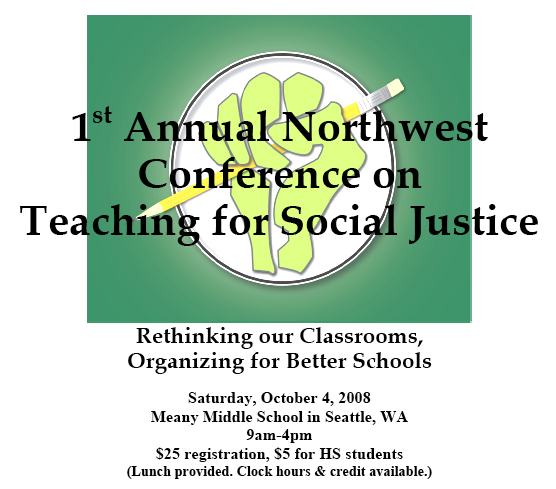
1st Annual Northwest Conference on Teaching Social Justice

Teaching%20Social%20Justice%20poster.png

Examples of Workshops:
Teaching Math and Science for Social Justice ● Parent-Teacher
Alliances for Better Schools ● Rethinking Special Education ● First Year 101 ● Anti-bias
Curriculum for English Language Learners ● Teaching About Japanese-American Internment ●
Living with High Stakes Testing While Working to End It
For more information, to sign up to lead a workshop, to table, or to register to attend,
please visit www.nwtsj.org

Co-Sponsors
Puget Sound Rethinking Schools, Tacoma Friday Club, Olympia Educators for Social Justice, Portland
Area Rethinking Schools, Rethinking Schools Magazine

Barry Bonds the Leon Trotsky of Baseball?

David Zirin, the best sportwriter in the USA, on the Barry Bonds boycott:
Boss’s Boycott: The Bonds Vanishes
By Dave Zirin

The Commissar Vanishes is a coffee table book for only the dourest of coffee tables. The hard-covered volume is a photographic compilation of the way that Josef Stalin systematically erased his chief political opponents, Leon Trotsky and his followers, from the history of the Russian Revolution.

Page after glossy page plainly displays the desecration of memory at the service of dictatorship. It shows before-and-after photos of people either airbrushed to invisibility or crudely vandalized, their faces blacked out with an ugly scribble.

Meet Barry Bonds, the Leon Trotsky of Major League Baseball. In 2007 Bonds broke the most hallowed record in sports, passing Henry Aaron’s record for home runs. When he wasn’t injured, this maestro of the batter’s box packed San Francisco’s ballpark, despite a team that stank like cottage cheese left on a radiator. At season’s end, the Giants refused to re-sign him, with owner Peter Magowan saying, “We’re going in a new direction; that would not be going in a new direction. The time has come to turn the page.” That is surely his right, but the page hasn’t just been turned, it’s been raggedly erased.

All traces of Bonds, the greatest player in baseball history, have vanished from the Bay. The left-field wall no longer carries an image of Bonds chasing Hank Aaron for the crown. There is no marker of where Bonds hit home run number 756. There is no reminder that Bonds ever even wore a Giants uniform.

But it’s not just Magowan trying to “disappear” Barry Bonds. He has been blackballed in a blatant and illegal act of Major League collusion, a bosses’ boycott. Yes, Bonds’ fielding has become painful to watch in recent years, as the seven time gold glover limped around the outfield on knees grinding together without cartilage. But despite the agony of movement most of us take for granted, Bonds still hit 28 home runs in 340 at bats, led the NL in walks, and had an on base percentage of .480. Since 1950, only Ted Williams, Mickey Mantle, Norm Cash, and Bonds himself have recorded higher OBP’s. [Cash’s epic season was an anomaly in an otherwise middling career. That a player could have a brilliant year out of nowhere, used to be one of the charms of baseball. Today they would be accused of sprinkling steroids on their corn flakes.]

Maybe Bonds can no longer roam the outfield, but there are at least a dozen AL teams that could use a designated hitter with a .480 OBP, not to mention a player whose every game would sell tickets and every at-bat would provoke baited breaths and empty bathrooms.

In this case of blackballing so obvious it would shame a Dartmouth frat house, one would think the media would be raising hell. But they have largely been yipping collusion lackeys. Bill Simmons, ESPN.com’s Sports Guy, wrote,

“Opening Day came and went without Bonds for the first time in 22 years, and nobody seemed to notice. I didn’t think about him for more than two seconds all spring. Did anyone? Can you remember being a part of a single “I wonder where Bonds is going to end up?” conversation? Did you refresh ESPN.com incessantly in hopes of a Bonds update?…Of course not. No one cared. The best hitter since Ted Williams is gone and forgotten. We wanted him to go away, and he did.”

There is one problem. Bonds doesn’t want to go gently into that good night and is pushing his union to fight back. He has asked the Players Association to file collusion charges on his behalf and the union has served Commissioner Bud Selig with papers. [There is a certain irony here as Bonds was hardly Big Bill Haywood during his career. In 2003, he became the first player in thirty years to not sign the Player’s Association’s group licensing agreement.]

The Player’s Association’s efforts on Bonds behalf have also met with high profile derision. Newsweek’s Mark Starr wrote “The union approaches new heights of absurdity when it bothers to investigate whether collusion has ended the career of baseball’s all-time home run king, Barry Bonds, who can’t attract an offer to play anywhere this 2008 season. What the union sees as possible collusion, once an honored practice among ownership, I see as a rare display of common sense.”

Bonds, according to Starr, is “widely regarded as a cancer in the clubhouse.”

This is moralistic spew. The idea that baseball owners would ruin their own team’s chances because they have collectively agreed to “turn the page” is a violation of Bonds’ rights and the unwritten social contract they have with fans. And when one considers the absence of saints on Major League Baseball teams, even on the God Squad in Colorado, it is all the more drenched in hypocrisy.

Mike Gimbel, who is a former adviser on player trades and acquisitions to the GM’s of the Boston Red Sox and the Montreal Expos, wrote it well.

“Bonds has been accused of not telling the truth to a grand jury investigating BALCO [the Bay Area Lab Company, implicated in steroid distribution]. He does not own BALCO and does not distribute steroids on behalf of BALCO. Why was the grand jury investigating Bonds? Weren’t they supposed to be investigating BALCO? How did that ‘investigation’ of BALCO turn into a witch hunt directed against MLB players?”

Good questions. Bonds deserves far better than to be forced into retirement and have his history coarsely expunged. The overriding ethos of the sports world is that of the meritocracy. If you are good enough, then you get to play. Yet a man who can get on base 48% of the time, has been told to go home and a new generation of fans will never see the Mozart of the batting cage. This is about more than a baseball player. It’s about people in power deciding on utterly unjust grounds, who gets to take the field, who gets to be heard, and even who gets to be remembered. Somewhere, Stalin smiles.
Baseball picks 2008 (Hey it’s still April)

The Canucks tanked and didn’t make the Stanley Cup playoffs; the Tar Heels blew it in the Final Four; and classes are over now, so I can turn my undivided attention to baseball. Please note I have not read anything about the season to this point so as to protect against unfair bias in my picks 😉

Here goes, Senior Circuit first cause it’s the most important:

N. L. East

Atlanta Braves (no bias here)
Philadelphia Phillies*
New York Mets
Washington Nationals
Florida Marlins

N.L. Central
Milwaukee Brewers
Chicago Cubs
Cincinnati Reds
Houston Astros
St. Louis Cardinals
Pittsburgh Pirates

N.L. West
Arizona Diamondbacks
Colorado Rockies
Los Angeles Dodgers
San Diego Padres
San Francisco Giants

A.L. East
Boston Red Sox
Toronto Blue Jays*
New York Yankees
Tampa Bay Rays
Baltimore Orioles

A.L. Central
Chicago White Sox
Cleveland Indians
Detroit Tigers
Kansas City Royals
Minnesota Twins

A.L. West
Los Angeles Angels
Seattle Mariners
Texas Rangers
Oakland Athletics

2008 World Series
Boston Red Sox over the Atlanta Braves

Cy Young Winners
AL: Josh Beckett (Red Sox)
NL: Carols Zambrano (Cubs)

MVPs:
AL: Alex Rodriguez (Yanquis)
NL: Mark Teixeira (Atlanta)

Call for Papers: Universities and Corporatization

New Proposals
http://newproposals.blogspot.com/
http://www.newproposals.ca

Call for Papers for Volume 2, Issue 1.

The Editorial Collective invites submissions for Volume 2 of New Proposals.
We encourage the submission of papers that take a politically engaged
stance. We are interested in full length articles (3,000 to 5,000 words) as
well as shorter commentaries (up to 2,500 words).

Papers should be no more than 3,000 – 5,000 words. References and citations
are to be kept to the minimum required to advance your argument. Articles
can be based in original research, synthetic reviews, or theoretical
engagements. We look forward to -in fact expect- a diversity of
perspectives and approaches that, while they may disagree on the
particulars, they will share with the Editorial Collective a commitment to
an engaged scholarship that prioritizes social justice.

New Proposals is a transnational peer-reviewed journal hosted at The
University of British Columbia in collaboration with the UBC Library
Journal Project.

Call For Papers, Volume 2, Issue 2 (Fall 2008)

Universities and Corporatization

What is the role of the university and the meaning of education at the
beginning of the twenty first century? How are corporate money, influence
and ideology shaping the face of the university? How do crushing debt loads
constrain student choices and shape the kind of education they seek and
receive?

Over the past few decades, people in many countries have experienced a
steady corporatization of their universities. University administrations
are increasingly structured on a corporate model and academic success is
defined by profit. For this upcoming special issue of New Proposals, we are
interested in articles and commentaries that analyze this situation in
different countries and regions. We welcome contributions that ask the
following kinds of questions: How is the privatization of the university
expressed and experienced in diverse settings? How do ‘audit culture’
governance systems exacerbate bureaucracy and influence the allocation of
resources? Has the debate about this issue been framed differently in the
case of public versus private universities? To what extent have faculty,
staff, and student unions and organizations intervened? How have public
intellectuals responded to this issue in different countries in the past
and present? Have various countries and different systems of education been
more or less successful in resisting this corporate model?

For this special issue, we welcome shorter commentaries (up to 2,500 words)
as well as full length articles. In particular, we are interested in essays
that develop a comparative perspective.
________________________________________________________________________
New Proposals: Journal of Marxism and Interdisciplinary Inquiry
http://ojs.library.ubc.ca/index.php/newproposals

What hath grade 8 English wrought?

My Dad

By C. R.

My dad is more gansta than your dad
He’s so gansta that his best friend is 50 Cent
and he wears his pants below his waist
He wears a do-rag that says “SUP FOO?”
He is soooo gansta that when he writes
he makes his S’s like this: $
My dad’s chain hangs lo’ and it wobbles
to tha flo
My dad is better than yoooouuu

CFP: Theory into Action

Theory in Action, the Journal of the Transformative Studies Institute is soliciting papers for our issue on “Theory, Social Justice, & Direct Action” Submissions are due December 31, 2007.

INAUGURAL VOLUME ON THEORY, SOCIAL JUSTICE, & DIRECT ACTION

While there have been many theoretical analyses of such aspects of social justice as stratification and inequality, and civil rights, there is a need for more research that connects activism with theory. We believe that theory without action and action without theoretical grounding are inherently flawed. To change the world, activists and scholars need to collaborate in order to inform one other’s work. To this end, we especially seek papers in which theoretical analysis fosters societal change or in which practical experience guides theoretical research.

Theory in Action invites U.S. and international submissions of well-researched and thought-provoking papers from various disciplines, including sociology, political science, psychology, art, philosophy, history, and literature. We welcome works by activists, independent scholars, graduate students, and faculty. We accept both theoretical and empirical papers by scholar-activists. Topics may include, but are not limited to:

* Novel Means of Resistance
* Direct Political Action
* Environment, Space, Social Justice, & Direct Action
* Direct Action for Social Justice
* Labor / Civil Rights & Direct Action
* Globalization
* Sex & Gender
* Activism, Academia, & Scholarship
* Activism & Resistance through the Arts
* The Media & its Relationship to Societal Justice and Change
* Non-violence vs. Active Self Defense and its Effectiveness
* Historical Analysis
* The Psychology of Transformative Learning & its Relationship to Action

Theory in Action is an international peer reviewed journal.

Submissions are due December 31, 2007.
Guidelines for submission are online at: http://transformativestudies.org.htm
Submissions should be sent using our on-line form found in the ‘submissions’ menu.

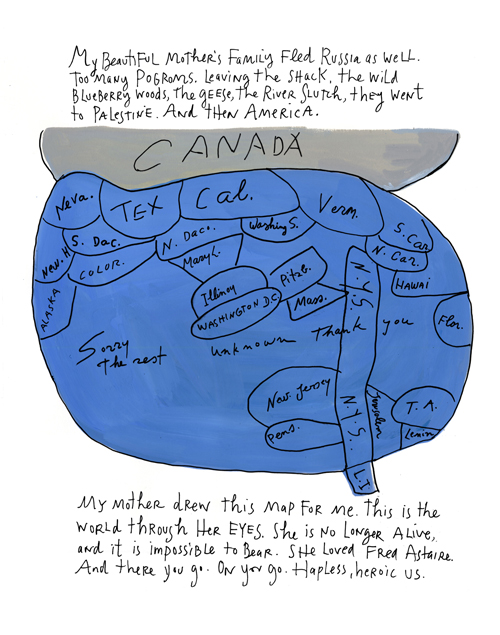
The Principles of Maira Kalman

kalman1_6.jpgMaira Kalman is one of my favorite illustrators and author/illustrator of some of the best kid’s books ever. I think the first Kalman book I bought, not for my kids, but for me was Stay Up Late (an illustrated version of David Bryne’s song, from Talking Heads’ album Little Creatures.

Kalman’s own kids books are hilarious, absurd stories of relationships among people (and animals)—Ooh La La (Max In Love); Hey Willie, See the Pyramids; Sayonara Mrs. Kackleman and others.

And she recently illustrated Strunk and Whites’ Elements of Style.

She also wrote and illustrated a column for The New York Times last year, which inspired a book (Principles of Uncertainty) and a short opera. Here’s a NYT video story where Kalman discusses The Principles of Uncertainty, her illustrated column turned book turned opera, at the New York Public Library.