
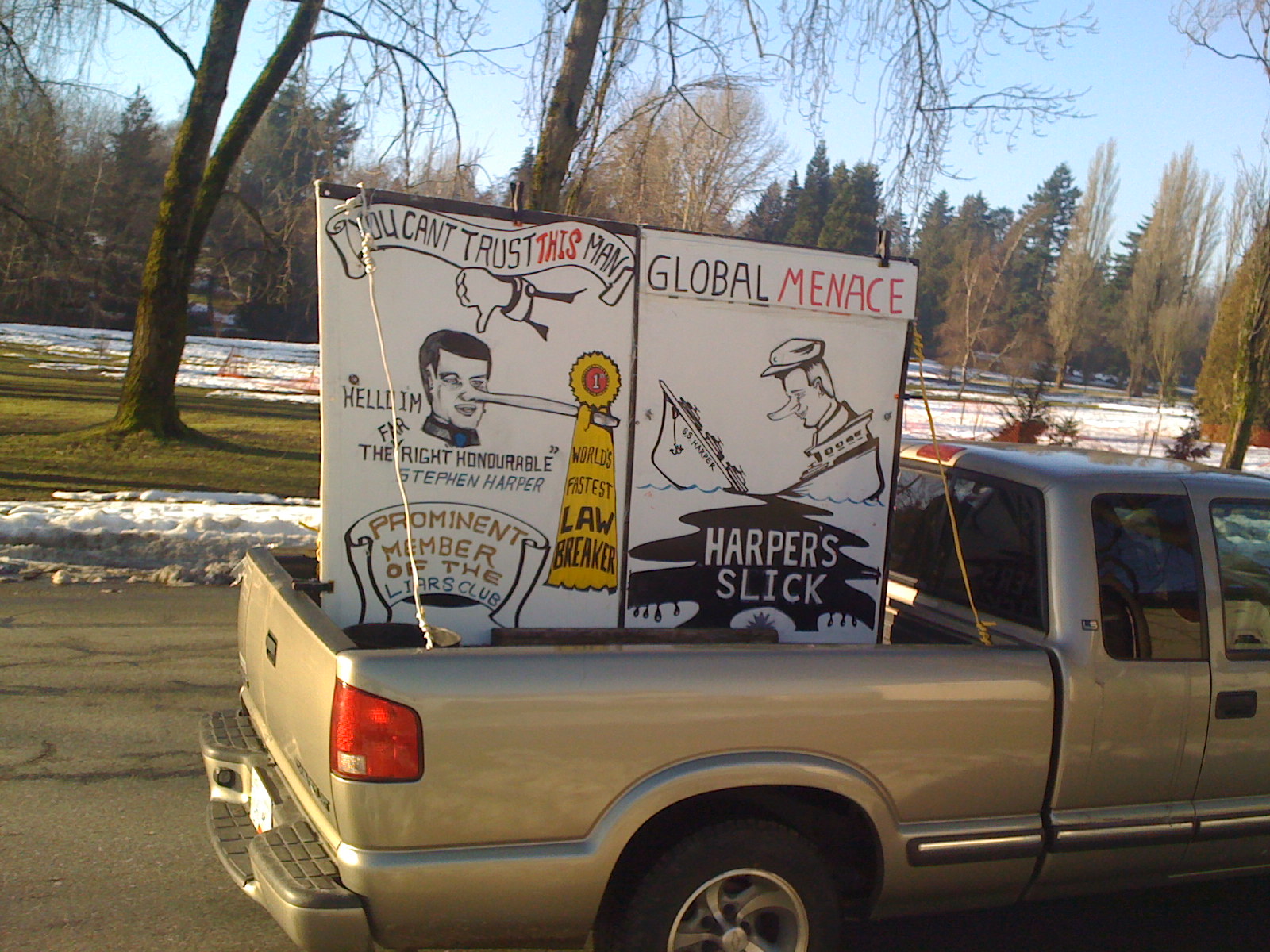
Anti-Harper mobile billboard at Ontario and 33rd in Vancouver.
Critical Theories in Education

Anti-Harper mobile billboard at Ontario and 33rd in Vancouver.
Dear Friends,
Happy New Year!
An up front reminder: The Rouge Forum Conference is May 14 to 17, 2009, in Ypsilanti, Michigan, near Detroit. The call for proposals is here: http://web.mac.com/wayne.ross/Rouge_Forum_Conference_2009/Welcome.html
The deadline is February 15 for proposals. Why come?
What’s our current context? A stock market collapse. Massive racist unemployment nearly redoubling each month. Hundreds of thousands of foreclosures and evictions. Police terror (the Oakland murder the most recent example) and immigration raids. Calls for more taxes and cuts in public services met by bankster bailouts in the trillions. Declared US wars in Afghanistan, Pakistan, and Iraq; undeclared wars in Gaza via Israeli proxies, Colombia, and cold wars growing with Russia and China–much of that revolving around oil. In schools all over the world: regimentation of the curricula to promote nationalism, high-stakes exams eradicating freedom, and militarization.
How can this be described as other than class war, an international war of the rich on the poor?
Now comes Obama promising Hope! and Change!
Probably not. His appointees alone say otherwise, all of them beholden to nearly the same oil bosses, war-makers, and financiers who propelled Clinton and Bush. Arne Duncan, education czar, promises privatized charter schools and merit pay—more of the same, faster.
The last 40 years demonstrate the primary role of capitalist democracy, which Obama personifies: An executive committee of the rich where they iron out differences, then allow us to choose which of them will oppress us best–and their armed weapon. Currently, the main result of Obama’s demagoguery is to resurrect forms of nationalism that were becoming exposed by the Bush regimes’ harsh tactics. Now we get the velvet glove over the iron fist, Obamagogue.
Only the Rouge Forum, which includes many voices, has had room for this kind of analysis in the US. We’ve combined this reasoned critique with action: test boycotts, strikes, and backing for resisters. Our publications circulate world-wide. In addition, we created a community of thinking people who can join together in friendly debate, overcoming isolation.
Hope and change rest not in seeking some politician to save us, but through building a mass class conscious base of people willing to fight back, to sacrifice to rearrange the social relations that allow the few to rule the many through ruses like nationalism, racism, sexism, and religious irrationality. Absent that goal, all struggle is mere tactics, lurching from opposing one unrelated form of oppression to the next, never getting to the root of things.
The union executives are no help. Already they prepare to offer concessions (concessions don’t save jobs, they only make employers want more), and to attack other sectors of workers not paying them dues (the California Teachers Association supports a regressive sales tax hike to pay for schooling) and to consolidate their power (NEA President Dennis Van Roekel seeks, again, to merge NEA with the AFL-CIO, SEIU’s Andy Stern moving to take control of the AFL and Change to Win, etc). The very structures of unions divide people by job, race, industry. NEA and AFT spent millions of dollars and thousands of volunteer hours to elect Obama who demonstrated open contempt for educators throughout his campaign. With school workers the most unionized people in the US, the unions are unprepared to resist the attacks on every facet of education ahead.
That’s why it’s important to come to the Rouge Forum Conference and offer your own leadership to a movement for Equality and Freedom in schools and out. The them of the conference, Education, Empire, Economy and Ethics at the Crossroads, offers a wide field for discussion and presentations.
You can add your own voice, right now, to the Rouge Forum blog established by Community Coordinator Adam Renner at
http://www.therougeforum.blogspot.com/
The Rouge Forum News deadline is February 15. Send articles, cartoons, art, etc., to Adam Renner (arenner@bellarmine.edu)
Thanks to Katy and Greg, Kerry, Mary, Paul, Gina and Adam, Amber, Wayne, Tommie, Donavan, Sally, Lisa, Sharon A. David, Marty, Gil G, Perry, Marc, Kevin, Shelly, Chris, Candace, Lacy, Anne, Donna, Alan S, Sherry, Tally A, Kim, Sue, Laura C, Lynn S, Stephanie, Colleen, Kelly, and Sarah.
All the best in the New Year,
Down the banks and
Up the Rebels!
r
Makes me sick to my stomach and it’s not just W and his pals, it’s the system (capitalism, imperialism), including Dems, who are waging class war, making the world safe for the rich. Obama, while not the idiot that W is, doesn’t offer a different direction, just a more thoughtful, appealing excuse for screwing over the rest of us. Obama’s “hope” is false, a cover for reeling in the idiotic, blundering that marked the last 8 years, while continuing down the same well worn path.
Copyright Criminals, a documentary about digital samplings head-on collision with copyright law, features many of hip-hop musics celebrated figures—including Public Enemy, De La Soul, the Beastie Boys, and Digital Underground—as well as emerging artists from record labels Definitive Jux, Rhymesayers, Ninja Tune, and more. The documentary also provides an in-depth look at artists who have been sampled, such as former James Brown drummer Clyde Stubblefield, as well as commentary by another highly sampled musician, funk legend George Clinton.
I highly recommend the work of Siva Vaidhyanathan for thorough and accessible overviews of the issues at stake in the battle over copyright, digital access, and peer-to-peer networking.
Siva’s The Anarachist in the Library: How the Clash Between Freedom and Control is Hacking the Real World and Crashing the System presents the clash between information oligarchs and information anarchists as not a mere technology war, but a battle that will define culture.
Siva’s book Copyrights and Copywrongs: The Rise of Intellectual Property and How it Threatens Creativity is available online. Also check out this interview with Siva from Stay Free magazine.
I also recommed the blog Sivacracy.net
Education Policy Analysis Archives has just published an article by Erica Frankenberg (UCLA) that describes the racial segregation of teachers in the United States.
Most often we think about the racial segregation of students in US schools—a phenomenon that is making a come back as school desegregation efforts are dismantled by US courts, see here, here, and here—but Frankenberg’s research describes how white teachers in the US, who are the overwhelming majority of teachers, are also the least likely teachers to have experienced racial diversity and most isolated.
According to Frankenberg’s research, the typical African American teacher teaches in a school were nearly three-fifths of students are from low-income families while the average white teacher has only 35% of low-income students. Latino and Asian teachers are in schools that educate more than twice the proportion of English language learners as schools of white teachers.
Education Policy Analysis Archives is a refereed open-access journal co-published by the Mary Lou Fulton College of Education at Arizona State University and the College of Education at the University of South Florida. More information about becoming a reviewer or submitting manuscripts is available at http://epaa.info/ojs/.
You can read the Frankenberg article at this link:
Frankenberg, E. (2009). The segregation of American teachers. Education
Policy Analysis Archives, 17(1). Retrieved [date] from
http://epaa.asu.edu/epaa/v17n1/.
There is nothing better than North Carolina barbecue (where I come from bbq means chopped pork). I’m particularly fond of the eastern NC, vinegar-based, barbecue (although mustard based bbq in South Carolina is pretty darn good too, I never miss a chance to visit Piggy Park in Cayce, SC).
Here’s a slide show primer on eastern NC barbecue that features Allen & Sons in Chapel Hill. Also check out the article “Finger Lickin’ Research,” both items from, of all places, The Chronicle of Higher Education.
The best barbecue anywhere just might be at B’s in Greenville, NC.
Actually George, you don’t have to be that smart to figure it out…
You’ve heard or read them before, but let’s review the last eight years of Bushisms as we count down the days to January 20th.
ON HIMSELF
“They misunderestimated me.”
Bentonville, Arkansas, 6 November, 2000
“There’s an old saying in Tennessee – I know it’s in Texas, probably in Tennessee – that says, fool me once, shame on… shame on you. Fool me – you can’t get fooled again.”
Nashville, Tennessee, 17 September, 2002
“There’s no question that the minute I got elected, the storm clouds on the horizon were getting nearly directly overhead.”
Washington DC, 11 May, 2001
“I want to thank my friend, Senator Bill Frist, for joining us today. He married a Texas girl, I want you to know. Karyn is with us. A West Texas girl, just like me.”
Nashville, Tennessee, 27 May, 2004
FOREIGN AFFAIRS
“For a century and a half now, America and Japan have formed one of the great and enduring alliances of modern times.”
Tokyo, 18 February, 2002
“The war on terror involves Saddam Hussein because of the nature of Saddam Hussein, the history of Saddam Hussein, and his willingness to terrorise himself.”
Grand Rapids, Michigan, 29 January, 2003
“Our enemies are innovative and resourceful, and so are we. They never stop thinking about new ways to harm our country and our people, and neither do we.” Washington DC, 5 August, 2004
“I think war is a dangerous place.”
Washington DC, 7 May, 2003
“The ambassador and the general were briefing me on the – the vast majority of Iraqis want to live in a peaceful, free world. And we will find these people and we will bring them to justice.”
Washington DC, 27 October, 2003
“Free societies are hopeful societies. And free societies will be allies against these hateful few who have no conscience, who kill at the whim of a hat.”
Washington DC, 17 September, 2004
“You know, one of the hardest parts of my job is to connect Iraq to the war on terror.”
CBS News, Washington DC, 6 September, 2006
EDUCATION
“Rarely is the question asked: Is our children learning?”
Florence, South Carolina, 11 January, 2000
“Reading is the basics for all learning.”
Reston, Virginia, 28 March, 2000
“As governor of Texas, I have set high standards for our public schools, and I have met those standards.”
CNN, 30 August, 2000
“You teach a child to read, and he or her will be able to pass a literacy test.”
Townsend, Tennessee, 21 February, 2001
ECONOMICS
“I understand small business growth. I was one.”
New York Daily News, 19 February, 2000
“It’s clearly a budget. It’s got a lot of numbers in it.”
Reuters, 5 May, 2000
“I do remain confident in Linda. She’ll make a fine Labour Secretary. From what I’ve read in the press accounts, she’s perfectly qualified.”
Austin, Texas, 8 January, 2001
“First, let me make it very clear, poor people aren’t necessarily killers. Just because you happen to be not rich doesn’t mean you’re willing to kill.”
Washington DC, 19 May, 2003
HEALTHCARE
“I don’t think we need to be subliminable about the differences between our views on prescription drugs.”
Orlando, Florida, 12 September, 2000
“Too many good docs are getting out of the business. Too many OB/GYN’s aren’t able to practice their love with women all across the country.”
Poplar Bluff, Missouri, 6 September, 2004
TECHNOLOGY
“Will the highways on the internet become more few?”
Concord, New Hampshire, 29 January, 2000
“It would be a mistake for the United States Senate to allow any kind of human cloning to come out of that chamber.”
Washington DC, 10 April, 2002
“Information is moving. You know, nightly news is one way, of course, but it’s also moving through the blogosphere and through the Internets.”
Washington DC, 2 May, 2007
OUT OF LEFT FIELD
“I know the human being and fish can coexist peacefully.”
Saginaw, Michigan, 29 September, 2000
“Families is where our nation finds hope, where wings take dream.”
LaCrosse, Wisconsin, 18 October, 2000
“Those who enter the country illegally violate the law.”
Tucson, Arizona, 28 November, 2005
“That’s George Washington, the first president, of course. The interesting thing about him is that I read three – three or four books about him last year. Isn’t that interesting?”
Speaking to reporter Kai Diekmann, Washington DC, 5 May, 2006
ON GOVERNING
“I have a different vision of leadership. A leadership is someone who brings people together.”
Bartlett, Tennessee, 18 August, 2000
“I’m the decider, and I decide what is best.”
Washington DC, 18 April, 2006
“And truth of the matter is, a lot of reports in Washington are never read by anybody. To show you how important this one is, I read it, and [Tony Blair] read it.”
On the publication of the Baker-Hamilton Report, Washington DC, 7 December, 2006
“All I can tell you is when the governor calls, I answer his phone.”
San Diego, California, 25 October, 2007
“I’ll be long gone before some smart person ever figures out what happened inside this Oval Office.”
Washington DC, 12 May, 2008
Here’s “post-racial” America for you. A traffic cop executes a 22 year-old unarmed man at BART station in Oakland, CA.
Here’s a report by KTVU, with video of the execution made by a train passenger. The most outrageous incident of a police violence I’ve ever seen.
The cop has given no account of the incident and has not been identified or even interviewed.
The Chronicle News Blog reports that Gabrielle M. Spiegel, President of the American Historical Association, declared postmodernism moribund.
Speigel, a professor of history at the Johns Hopkins University and “a well-known theorist who has written extensively about how language has shaped the writing of history, noted that ‘we all sense this profound change has run its course.'”
“The whole influence of poststructuralist and postmodernist historiography is receding,” she said. “What is worth saving?”
The Chronicle noted that: “Starting in the mid-1960s, scholars in history — and throughout the humanities — began to focus on how coded meanings in language affect the way that people experience, and understand, their lives. As the linguistic turn moved through semiotics, structuralism, poststructuralism, and deconstruction, scholars increasingly began to emphasize the multiple layers in language, and the instability of meaning. By the late 1980s, Ms. Spiegel noted, many historians were calling the impact of postmodernism “an epistemological crisis” that undermined traditional ideas of causation and action in history.”
So it’s back to the real world for historians, carrying a few insights from postmodernism…education scholars will likely discover the error of postmodern their pomo ways and return to the real world in the next decade or two.