Forum: Who sets the agenda for public eduction?

“Who sets the agenda for public education? Who should, how and why?”

The Charter for Public Education Network recently announced the first in a series of forums on issues of public education for parents, students, educators, trustees and interested members of the public.

When: September 6, 2007
Where: Segal Room, SFU Downtown (515 W. Hastings)
Format: Panel presentation followed by group discussion
Refreshment available

For more information see Charter for Public Education or contact Michael Zlotnik (604-988-8631).

Robert Fisk: Even I question the ‘truth’ about 9/11

The Independent (UK): Robert Fisk: Even I question the ‘truth’ about 9/11

Each time I lecture abroad on the Middle East, there is always someone in the audience – just one – whom I call the “raver”. Apologies here to all the men and women who come to my talks with bright and pertinent questions – often quite humbling ones for me as a journalist – and which show that they understand the Middle East tragedy a lot better than the journalists who report it. But the “raver” is real. He has turned up in corporeal form in Stockholm and in Oxford, in Sao Paulo and in Yerevan, in Cairo, in Los Angeles and, in female form, in Barcelona. No matter the country, there will always be a “raver”.His – or her – question goes like this. Why, if you believe you’re a free journalist, don’t you report what you really know about 9/11? Why don’t you tell the truth – that the Bush administration (or the CIA or Mossad, you name it) blew up the twin towers? Why don’t you reveal the secrets behind 9/11? The assumption in each case is that Fisk knows – that Fisk has an absolute concrete, copper-bottomed fact-filled desk containing final proof of what “all the world knows” (that usually is the phrase) – who destroyed the twin towers. Sometimes the “raver” is clearly distressed. One man in Cork screamed his question at me, and then – the moment I suggested that his version of the plot was a bit odd – left the hall, shouting abuse and kicking over chairs.

Usually, I have tried to tell the “truth”; that while there are unanswered questions about 9/11, I am the Middle East correspondent of The Independent, not the conspiracy correspondent; that I have quite enough real plots on my hands in Lebanon, Iraq, Syria, Iran, the Gulf, etc, to worry about imaginary ones in Manhattan. My final argument – a clincher, in my view – is that the Bush administration has screwed up everything – militarily, politically diplomatically – it has tried to do in the Middle East; so how on earth could it successfully bring off the international crimes against humanity in the United States on 11 September 2001?

Well, I still hold to that view. Any military which can claim – as the Americans did two days ago – that al-Qa’ida is on the run is not capable of carrying out anything on the scale of 9/11. “We disrupted al-Qa’ida, causing them to run,” Colonel David Sutherland said of the preposterously code-named “Operation Lightning Hammer” in Iraq’s Diyala province. “Their fear of facing our forces proves the terrorists know there is no safe haven for them.” And more of the same, all of it untrue.

Within hours, al-Qa’ida attacked Baquba in battalion strength and slaughtered all the local sheikhs who had thrown in their hand with the Americans. It reminds me of Vietnam, the war which George Bush watched from the skies over Texas – which may account for why he this week mixed up the end of the Vietnam war with the genocide in a different country called Cambodia, whose population was eventually rescued by the same Vietnamese whom Mr Bush’s more courageous colleagues had been fighting all along.

But – here we go. I am increasingly troubled at the inconsistencies in the official narrative of 9/11. It’s not just the obvious non sequiturs: where are the aircraft parts (engines, etc) from the attack on the Pentagon? Why have the officials involved in the United 93 flight (which crashed in Pennsylvania) been muzzled? Why did flight 93’s debris spread over miles when it was supposed to have crashed in one piece in a field? Again, I’m not talking about the crazed “research” of David Icke’s Alice in Wonderland and the World Trade Center Disaster – which should send any sane man back to reading the telephone directory.

I am talking about scientific issues. If it is true, for example, that kerosene burns at 820C under optimum conditions, how come the steel beams of the twin towers – whose melting point is supposed to be about 1,480C – would snap through at the same time? (They collapsed in 8.1 and 10 seconds.) What about the third tower – the so-called World Trade Centre Building 7 (or the Salmon Brothers Building) – which collapsed in 6.6 seconds in its own footprint at 5.20pm on 11 September? Why did it so neatly fall to the ground when no aircraft had hit it? The American National Institute of Standards and Technology was instructed to analyse the cause of the destruction of all three buildings. They have not yet reported on WTC 7. Two prominent American professors of mechanical engineering – very definitely not in the “raver” bracket – are now legally challenging the terms of reference of this final report on the grounds that it could be “fraudulent or deceptive”.

Journalistically, there were many odd things about 9/11. Initial reports of reporters that they heard “explosions” in the towers – which could well have been the beams cracking – are easy to dismiss. Less so the report that the body of a female air crew member was found in a Manhattan street with her hands bound. OK, so let’s claim that was just hearsay reporting at the time, just as the CIA’s list of Arab suicide-hijackers, which included three men who were – and still are – very much alive and living in the Middle East, was an initial intelligence error.

But what about the weird letter allegedly written by Mohamed Atta, the Egyptian hijacker-murderer with the spooky face, whose “Islamic” advice to his gruesome comrades – released by the CIA – mystified every Muslim friend I know in the Middle East? Atta mentioned his family – which no Muslim, however ill-taught, would be likely to include in such a prayer. He reminds his comrades-in-murder to say the first Muslim prayer of the day and then goes on to quote from it. But no Muslim would need such a reminder – let alone expect the text of the “Fajr” prayer to be included in Atta’s letter.

Let me repeat. I am not a conspiracy theorist. Spare me the ravers. Spare me the plots. But like everyone else, I would like to know the full story of 9/11, not least because it was the trigger for the whole lunatic, meretricious “war on terror” which has led us to disaster in Iraq and Afghanistan and in much of the Middle East. Bush’s happily departed adviser Karl Rove once said that “we’re an empire now – we create our own reality”. True? At least tell us. It would stop people kicking over chairs.

Well, it is August

Fucking Yankees, Reports Nation

The Onion

Fucking Yankees, Reports Nation

BOSTON—Moments after the New York Yankees continued a month-long stretch that has seen them climb from the bottom of the AL East to pull within a once unfathomable four games of the first-place Red Sox by defeating the Baltimore Orioles…

.onion_embed {background: rgb(256, 256, 256) !important;border: 4px solid rgb(65, 160, 65);border-width: 4px 0 1px 0;margin: 10px 30px !important;padding: 5px;overflow: hidden !important;zoom: 1;}.onion_embed img {border: 0 !important;}.onion_embed a {display: inline;}.onion_embed a.img {float: left !important;margin: 0 5px 0 0 !important;width: 66px;display: block;overflow: hidden !important;}.onion_embed a.img img {border: 1px solid #222 !important;;width: 64px;;padding: 0 !important;;}.onion_embed h2 {line-height: 2px;;clear: none;;margin: 0 !important;padding: 0 !important;}.onion_embed h3 {line-height: 16px;font: bold 16px arial, sans-serif !important;margin: 3px 0 0 0 !important;padding: 0 !important;}.onion_embed h3 a {line-height: 16px !important;;color: rgb(0, 51, 102) !important;font: bold 16px arial, sans-serif !important;text-decoration: none !important;display: inline !important;;float: none !important;;text-transform: capitalize !important;}.onion_embed h3 a:hover {text-decoration: underline !important;color: rgb(204, 51, 51) !important;}.onion_embed p {color: #000 !important;;font: normal 11px/ 11px arial, sans-serif !important;;margin: 2px 0 0 0 !important;;padding: 0 !important;}.onion_embed a {display: inline !important;;float: none !important;}

How Did Elvis Get Turned Into a Racist?

RIP Elvis Presley (January 8, 1935 – August 16, 1977)
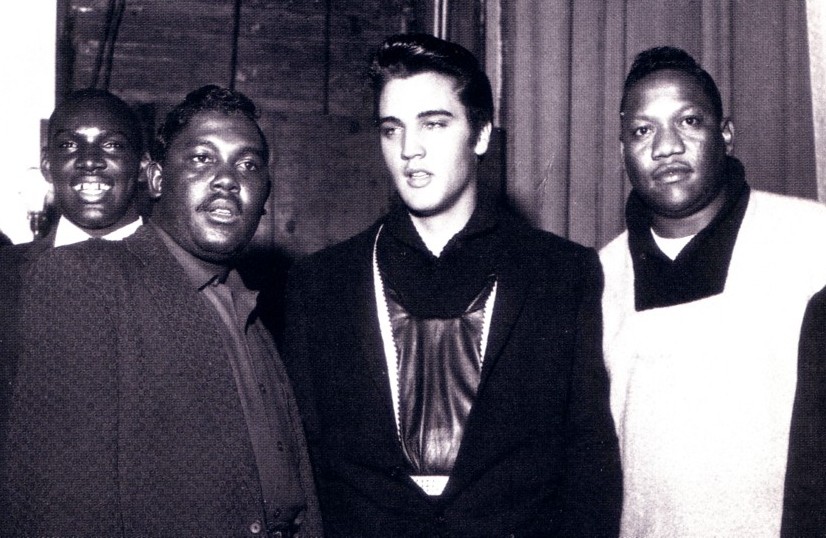
Elvis3.JPG

In an op-ed published a few days ago in The New York Times, Peter Guralnick examines how Elvis got turned into a racist and why that myth persists despite the lack of evidence to support it.

Guralnick wrote a two volume bio of Presley as few years ago, which I high recommend. The first volume, Last Train to Memphis: The Rise of Elvis Presley (1994) is one of the best biographies I’ve ever read, some how he manages to make the biography a story of not only Elvis but US culture in the 1950s.

The New York Times
August 11, 2007
Op-Ed Contributor
How Did Elvis Get Turned Into a Racist?
By PETER GURALNICK

ONE of the songs Elvis Presley liked to perform in the ’70s was Joe South’s “Walk a Mile in My Shoes,” its message clearly spelled out in the title.

Sometimes he would preface it with the 1951 Hank Williams recitation “Men With Broken Hearts,” which may well have been South’s original inspiration. “You’ve never walked in that man’s shoes/Or saw things through his eyes/Or stood and watched with helpless hands/While the heart inside you dies.” For Elvis these two songs were as much about social justice as empathy and understanding: “Help your brother along the road,” the Hank Williams number concluded, “No matter where you start/For the God that made you made them, too/These men with broken hearts.”

In Elvis’s case, this simple lesson was not just a matter of paying lip service to an abstract principle.

It was what he believed, it was what his music had stood for from the start: the breakdown of barriers, both musical and racial. This is not, unfortunately, how it is always perceived 30 years after his death, the anniversary of which is on Thursday. When the singer Mary J. Blige expressed her reservations about performing one of his signature songs, she only gave voice to a view common in the African-American community. “I prayed about it,” she said, “because I know Elvis was a racist.”

And yet, as the legendary Billboard editor Paul Ackerman, a devotee of English Romantic poetry as well as rock ’n’ roll, never tired of pointing out, the music represented not just an amalgam of America’s folk traditions (blues, gospel, country) but a bold restatement of an egalitarian ideal. “In one aspect of America’s cultural life,” Ackerman wrote in 1958, “integration has already taken place.”It was due to rock ’n’ roll, he emphasized, that groundbreaking artists like Big Joe Turner, Ray Charles, Chuck Berry and Little Richard, who would only recently have been confined to the “race” market, had acquired a broad-based pop following, while the music itself blossomed neither as a regional nor a racial phenomenon but as a joyful new synthesis “rich with Negro and hillbilly lore.”

No one could have embraced Paul Ackerman’s formulation more forcefully (or more fully) than Elvis Presley.

Asked to characterize his singing style when he first presented himself for an audition at the Sun recording studio in Memphis, Elvis said that he sang all kinds of music — “I don’t sound like nobody.” This, as it turned out, was far more than the bravado of an 18-year-old who had never sung in public before. It was in fact as succinct a definition as one might get of the democratic vision that fueled his music, a vision that denied distinctions of race, of class, of category, that embraced every kind of music equally, from the highest up to the lowest down.

It was, of course, in his embrace of black music that Elvis came in for his fiercest criticism. On one day alone, Ackerman wrote, he received calls from two Nashville music executives demanding in the strongest possible terms that Billboard stop listing Elvis’s records on the best-selling country chart because he played black music. He was simply seen as too low class, or perhaps just too no-class, in his refusal to deny recognition to a segment of society that had been rendered invisible by the cultural mainstream.

“Down in Tupelo, Mississippi,” Elvis told a white reporter for The Charlotte Observer in 1956, he used to listen to Arthur Crudup, the blues singer who originated “That’s All Right,” Elvis’s first record. Crudup, he said, used to “bang his box the way I do now, and I said if I ever got to the place where I could feel all old Arthur felt, I’d be a music man like nobody ever saw.”

It was statements like these that caused Elvis to be seen as something of a hero in the black community in those early years. In Memphis the two African-American newspapers, The Memphis World and The Tri-State Defender, hailed him as a “race man” — not just for his music but also for his indifference to the usual social distinctions. In the summer of 1956, The World reported, “the rock ’n’ roll phenomenon cracked Memphis’s segregation laws” by attending the Memphis Fairgrounds amusement park “during what is designated as ‘colored night.’”

That same year, Elvis also attended the otherwise segregated WDIA Goodwill Revue, an annual charity show put on by the radio station that called itself the “Mother Station of the Negroes.” In the aftermath of the event, a number of Negro newspapers printed photographs of Elvis with both Rufus Thomas and B.B. King (“Thanks, man, for all the early lessons you gave me,” were the words The Tri-State Defender reported he said to Mr. King).

When he returned to the revue the following December, a stylish shot of him “talking shop” with Little Junior Parker and Bobby “Blue” Bland appeared in Memphis’s mainstream afternoon paper, The Press-Scimitar, accompanied by a short feature that made Elvis’s feelings abundantly clear. “It was the real thing,” he said, summing up both performance and audience response. “Right from the heart.”

Just how committed he was to a view that insisted not just on musical accomplishment but fundamental humanity can be deduced from his reaction to the earliest appearance of an ugly rumor that has persisted in one form or another to this day. Elvis Presley, it was said increasingly within the African-American community, had declared, either at a personal appearance in Boston or on Edward R. Murrow’s “Person to Person” television program, “The only thing Negroes can do for me is buy my records and shine my shoes.”

That he had never appeared in Boston or on Murrow’s program did nothing to abate the rumor, and so in June 1957, long after he had stopped talking to the mainstream press, he addressed the issue — and an audience that scarcely figured in his sales demographic — in an interview for the black weekly Jet.

Anyone who knew him, he told reporter Louie Robinson, would immediately recognize that he could never have uttered those words. Amid testimonials from black people who did know him, he described his attendance as a teenager at the church of celebrated black gospel composer, the Rev. W. Herbert Brewster, whose songs had been recorded by Mahalia Jackson and Clara Ward and whose stand on civil rights was well known in the community. (Elvis’s version of “Peace in the Valley,” said Dr. Brewster later, was “one of the best gospel recordings I’ve ever heard.”)

The interview’s underlying point was the same as the underlying point of his music: far from asserting any superiority, he was merely doing his best to find a place in a musical continuum that included breathtaking talents like Ray Charles, Roy Hamilton, the Five Blind Boys of Mississippi and Howlin’ Wolf on the one hand, Hank Williams, Bill Monroe and the Statesmen Quartet on the other. “Let’s face it,” he said of his rhythm and blues influences, “nobody can sing that kind of music like colored people. I can’t sing it like Fats Domino can. I know that.”

And as for prejudice, the article concluded, quoting an unnamed source, “To Elvis people are people, regardless of race, color or creed.”

So why didn’t the rumor die? Why did it continue to find common acceptance up to, and past, the point that Chuck D of Public Enemy could declare in 1990, “Elvis was a hero to most… straight-up racist that sucker was, simple and plain”?

Chuck D has long since repudiated that view for a more nuanced one of cultural history, but the reason for the rumor’s durability, the unassailable logic behind its common acceptance within the black community rests quite simply on the social inequities that have persisted to this day, the fact that we live in a society that is no more perfectly democratic today than it was 50 years ago. As Chuck D perceptively observes, what does it mean, within this context, for Elvis to be hailed as “king,” if Elvis’s enthronement obscures the striving, the aspirations and achievements of so many others who provided him with inspiration?

Elvis would have been the first to agree. When a reporter referred to him as the “king of rock ’n’ roll” at the press conference following his 1969 Las Vegas opening, he rejected the title, as he always did, calling attention to the presence in the room of his friend Fats Domino, “one of my influences from way back.” The larger point, of course, was that no one should be called king; surely the music, the American musical tradition that Elvis so strongly embraced, could stand on its own by now, after crossing all borders of race, class and even nationality.

“The lack of prejudice on the part of Elvis Presley,” said Sam Phillips, the Sun Records founder who discovered him, “had to be one of the biggest things that ever happened. It was almost subversive, sneaking around through the music, but we hit things a little bit, don’t you think?”

Or, as Jake Hess, the incomparable lead singer for the Statesmen Quartet and one of Elvis’s lifelong influences, pointed out: “Elvis was one of those artists, when he sang a song, he just seemed to live every word of it. There’s other people that have a voice that’s maybe as great or greater than Presley’s, but he had that certain something that everybody searches for all during their lifetime.”

To do justice to that gift, to do justice to the spirit of the music, we have to extend ourselves sometimes beyond the narrow confines of our own experience, we have to challenge ourselves to embrace the democratic principle of the music itself, which may in the end be its most precious gift.

Peter Guralnick is the author of “Careless Love: The Unmaking of Elvis Presley.”

Rouge Forum Update: V-J Day and More

Dear Friends,

Depending on where you are, tomorrow is V-J day, celebrating the fact that the mass of the world’s people rose up, made shocking sacrifices, and crushed fascism, if only temporarily. Today, little note of VJ day is taken in the corporate media, perhaps because so many prominent Nazis in Germany and fascists in Japan were restored to power or brought to the USA under Operation Paperclip. The efforts of these fascists reverberate even today as we witness the reemergence of fascism, in somewhat new forms. But VJ day is a reminder that fascism shall not prevail. What is fascism?

Back to School!

For those developing literacy syllabi, remember Patrick Shannon’s outstanding presentation at the last Rouge Forum conference in Detroit, Pedagogies of the Oppressors: Critical Literacies as Counter Narratives and also linked here.

And, for audio, check out Wayne Ross’ web site where, in collaboration with Michael Baker, he is now podcasting Michael’s radio show on education and schooling. Michael’s guests include Peter McLaren, Noam Chomsky, Rich Gibson, Nancy Patterson, Prentice Chandler, and many others discussing education and schooling from a perspective that is rarely heard on the airwaves.

Visit the web site and click on “Room 101” in the menu. You can listen and subscribe to the podcasts from the site. The podcasts are also available free on iTunes. More information on the podcast and links are available here.

For those interested in the ongoing debates about how resistance can be built against war, militarism, and the enslavement of education in History circles, here is a note to the Historians Against the War, where I serve on the Steering Committee, urging openness, organization, and ethics as central to the project.

From September 7 to 19, my friend and longtime union organizer, Bob Apter, and I will be touring California, starting out from San Diego. We would like to meet with educators, students, parents, community organizers, who are interested in exploring ideas and action about schools and the wars, as well as those who are just concerned with the way teachers and kids are getting treated in an increasingly regimented environment. How are you keeping your ideals, and still teaching?

As much as anything, we want to listen to people, to learn what new teachers are hoping for, and what more experienced education workers see has changed—and what can be done. We want to meet with school retirees who can lend long-term perspectives. We also hope to connect with other anti-war coalition members along the way, to see how the work is going in other areas of the state, or around the US, so we can learn from one another.

We hope to connect with Susan Harman in mid-tour and go on to travel Northern California with her in the latter half of the trip.

In San Diego, Rouge Forum members have worked with the San Diego Coalition for Peace and Justice in developing a coherent strategic plan for the year, focused on schools, the wars, and broadening the base of existing progressive groups. We started with an analysis of the particular condition in San Diego, using this as a template.

Every community is different, but the questions posed can be used anywhere.

Remember, the Rouge Forum will have a considerable presence at the National Council for the Social Studies Conference in San Diego, November 28 to December 2nd. Of special interest is a Border Tour of San Diego. We will have limited seating for this tour, so please sign on early. It will be a good time to learn about the social relations that set up life in So-Cal, and to get together with like-minded people before the convention begins. This tour is going to be terrific.

And, not for the kiddies, here is George Carlin answering the critical question: why have school?

Last, internationally known marxist scholar, Dave Hill, wants a new position. Here is his vita. Dave has earned the right to a good spot. Let’s see if we can help Dave land a great job.

Happy New School year. Remember to tell the kids: We can understand and change the world. We do not have to be missionaries for capitalism.

best, r

Rouge Forum Update

Dear Friends,

Remember the dates: November 29 to December 2 the Rouge Forum will gather at the National Council For Social Studies conference in San Diego. We have presentations scheduled, as well as a tour of San Diego and a social event. We need ideas for resolutions to bring to NCSS and the College and University Faculty Association–as well as writers for the resolutions. More, we hope many social studies school workers will join us in an anti-war demonstration during the conference.

Mark calendars for the Rouge Forum Conference, Louisville, March 14, 15, 16, 2008.

We will need to do some fundraising for these efforts. The Rouge Forum has served for a decade as a beacon for liberals, radicals, and the left in education. Only the Rouge Forum has consistently connected curricula regimentation, high stakes exams, and imperialism, racism, and war. We’ve proved our mettle. Part of activism is helping pay the way. Ideas on fundraising are always appreciated. As one RF member said some time ago, “the way you get money sets the tone of what you are and will be.” Right now, we don’t have any.

The Rouge Forum No Blood For Oil page is updated. It holds new articles from Alex Cockburn, Chalmers Johnson, Sean Ahern, and others. Those spiffy Rouge Forum “US Get Out of the Middle East,” posters are still on sale, good for the rest of your life. Great for the upcoming round of demonstrations.

This week we feature two brief videos, one suggested by Susan Ohanian who plays a key role in the effort to eradicate the NCLB, curricula regimentation for endless war, and high-stakes testing.

That short cartoon is also linked to Susan’s web site.

Secondly, here is a link to Alternate Focus, an independent not-for-profit film group that produced, among others, the video, Bases Are Loaded, demonstrating that the massive buildup of US bases in Iraq is yet another piece of evidence that the US military is not going to leave Iraq, but plans a long-term occupation to control the oil fields, and the region. The online version of this film is like a Cliff’s Notes of the longer version.

Our friend and colleague Alfie Kohn has an excellent piece on standarization in schools, here.

Here are friends of the Rouge Forum acting to restrict military access to schooling, not in Oakland CA, but militarized Florida:

We note the House, controlled by Dems House Authorized the Expanded Illegal Surveillance Program.

As some people know, I am on the Steering Committee of the Historians Against the War. Here is a link to a piece I wrote in response to criticism from some members of the list who suggested that it is, to say the least, unacceptable, to note that the United For Peace and Justice Coalition is a funnel for the Democratic Party, that UFPJ fears talk of capitalism, exploitation, imperialism, and base-building for radical social change.

We urge everyone to participate in the day to day base-building that makes a movement possible, to battle the racism and sexism that poisoned past movements, and to join in the coordinated upcoming events like teachins, demonstrations, and direct action against the empire’s endless wars.

Thanks to Amber, Erin, Beau, Monty, Suber, Dave H, Joe B, Bob A, Susan H, Kerry N, Sharon Ago…., Della R, Candace, Cheri, Ken, Barb, Carol J, Sean, Gil G, Big Al, happily married still, and Wayne. Bon Voyage to Doug, now on the road to power in the vast northeast.

best r

Hursh: Use an array of academic yardsticks; scrub standardized tests

Here’s good column on what’s wrong with NCLB and some questions to ask regarding how we can move forward with more productive educational reform.

Democrat and Chronicle (Rochester, NY):
Use an array of academic yardsticks; scrub standardized tests
By David Hursh

In my view, No Child Left Behind needs to be significantly overhauled, if not rescinded, and I present below several proposals for change.

However, I would also like to make a more general point: If we are to improve education, it is crucial that we ask the right questions and carefully consider the evidence.

For example, NCLB proponents cite recent research by the Center for Education Policy indicating that more students have demonstrated proficiency in math and reading since the passage of the legislation.

However, the real question should be whether the percentage of students achieving proficiency since the passage of NCLB is increasing faster than it did before the law, and the answer is no.

What we were doing to improve student learning before the passage of NCLB would have likely resulted in the same increases.

Moreover, even the Center for Education Policy cautions that its data showing improvements in students’ test scores should not be used to conclude that the new policy is working.

It writes that improved test scores may “reflect easier tests … changing rules for testing, or overly narrow teaching to the test.”

We should also question whether improved test scores demonstrate that students are learning more. Recent reports show that while students’ scores on state standardized exams have increased, their scores on the national standardized test, the National Assessment of Educational Progress, have increased only in some subjects and grades.

My own view echoes that of 137 national education, civil rights, religious, labor and disability groups that have signed a joint statement on NCLB that concludes high-stakes standardized tests fail to adequately inform us about student learning, and that argue “the law’s emphasis needs to shift from applying sanctions for failing to raise test scores to holding states and localities accountable for making the systemic changes that improve student achievement.”

As reported by Fairtest, the National Center for Fair and Open Testing (fairtest.org), the recommended changes to NCLB, which I support, include:

# Replace over-reliance on standardized tests with the use of multiple achievement measures to provide a more comprehensive picture of student and school performance.

# Supplant arbitrary proficiency targets with ambitious achievement targets based on rates of success achieved by the most effective public schools.

# Enhance the knowledge and skills that teachers, administrators and families need to support high achievement and improve state and district capacities to assist them.

# Increase NCLB funding to cover a substantial percentage of the costs that states and districts will incur to carry out these recommendations.

# Fund research and development of more effective accountability systems that better meet the goal of high academic achievement for all children.

Over the next several months, the federal government will consider revamping NCLB. In my view, it needs substantial overhaul.

But whether or not you agree, now is the time to become informed about the policy through Web sites (Fairtest, U.S. Department of Education, The Coalition for Common Sense in Education) and public hearings, and to voice your opinions to federal representatives on how you would like the law changed.

Hursh is an associate professor at the University of Rochester’s Warner School of Education and a member of Rochester’s Coalition for Common Sense in Education dedicated to improving public schools.

How Truth Slips Down the Memory Hole

Another example of how the mainstream media (doesn’t) work. Pilger includes a great quote from Jim Petras:

“The great crimes against most of humanity”, wrote the American cultural critic James Petras, “are justified by a corrosive debasement of language and thought . . . [that] have fabricated a linguistic world of terror, of demons and saviours, of axes of good and evil, of euphemisms” designed to disguise a state terror that is “a gross perversion” of democracy, liberation, reform, justice.

ZNet Commentary
How Truth Slips Down the Memory Hole
July 25, 2007
By John Pilger

One of the leaders of demonstrations in Gaza calling for the release of the BBC reporter Alan Johnston was a Palestinian news cameraman, Imad Ghanem. On 5 July, he was shot by Israeli soldiers as he filmed them invading Gaza. A Reuters video shows bullets hitting his body as he lay on the ground. An ambulance trying to reach him was also attacked. The Israelis described him as a “legitimate target”. The International Federation of Journalists called the shooting “a vicious and brutal example of deliberate targeting of a journalist”. At the age of 21, he has had both legs amputated. Dr David Halpin, a British trauma surgeon who works with Palestinian children, emailed the BBC’s Middle East editor, Jeremy Bowen. “The BBC should report the alleged details about the shooting,” he wrote. “It should honour Alan [Johnston] as a journalist by reporting the facts, uncomfortable as they might be to Israel.” He received no reply. The atrocity was reported in two sentences on the BBC online. Along with 11 Palestinian civilians killed by the Israelis on the same day, Alan Johnston’s now legless champion slipped into what George Orwell in Nineteen Eighty-Four called the memory hole. (It was Winston Smith’s job at the Ministry of Truth to make disappear all facts embarrassing to Big Brother.)

While Alan Johnston was being held, I was asked by the BBC World Service if I would say a few words of support for him. I readily agreed, and suggested I also mention the thousands of Palestinians abducted and held hostage. The answer was a polite no; and all the other hostages remained in the memory hole. Or, as Harold Pinter wrote of such unmentionables: “It never happened. Nothing ever happened . . . It didn’t matter. It was of no interest.” The media wailing over the BBC’s royal photo-shoot fiasco and assorted misdemeanours provide the perfect straw man. They complement a self-serving BBC internal inquiry into news bias, which dutifully supplied the right-wing Daily Mail with hoary grist that the corporation is a left-wing plot. Such shenanigans would be funny were it not for the true story behind the facade of elite propaganda that presents humanity as useful or expendable, worthy or unworthy, and the Middle East as the Anglo-American crime that never happened, didn’t matter, was of no interest.

The other day, I turned on the BBC’s Radio 4 and heard a cut-glass voice announce a programme about Iraqi interpreters working for “the British coalition forces” and warning that “listeners might find certain descriptions of violence disturbing”. Not a word referred to those of “us” directly and ultimately responsible for the violence. The programme was called Face the Facts. Is satire that dead? Not yet. The Murdoch columnist David Aaronovitch, a warmonger, is to interview Blair in the BBC’s “major retrospective” of the sociopath’s rule.

Orwell’s Nineteen Eighty-Four lexicon of opposites pervades almost everything we see, hear and read now. The invaders and destroyers are “the British coalition forces”, surely as benign as that British institution, St John Ambulance, who are “bringing democracy” to Iraq. BBC television describes Israel as having “two hostile Palestinian entities on its borders”, neatly inverting the truth that Israel is actually inside Palestinian borders. A study by Glasgow University says that young British viewers of TV news believe Israelis illegally colonising Palestinian land are Palestinians: the victims are the invaders.

“The great crimes against most of humanity”, wrote the American cultural critic James Petras, “are justified by a corrosive debasement of language and thought . . . [that] have fabricated a linguistic world of terror, of demons and saviours, of axes of good and evil, of euphemisms” designed to disguise a state terror that is “a gross perversion” of democracy, liberation, reform, justice. In his reinauguration speech, George Bush mentioned all these words, whose meaning, for him, is the dictionary opposite. It is 80 years since Edward Bernays, the father of public relations, predicted a pervasive “invisible government” of corporate spin, suppression and silence as the true ruling power in the United States. That is true today on both sides of the Atlantic. How else could America and Britain go on such a spree of death and mayhem on the basis of stupendous lies about non-existent weapons of mass destruction, even a “mushroom cloud over New York”? When the BBC radio reporter Andrew Gilligan reported the truth, he was pilloried and sacked along with the BBC’s director general, while Blair, the proven liar, was protected by the liberal wing of the media and given a standing ovation in parliament. The same is happening again over Iran, distracted, it is hoped, by spin that the new Foreign Secretary David Miliband is a “sceptic” about the crime in Iraq when, in fact, he has been an accomplice, and by unctuous Kennedy-quoting Foreign Office propaganda about Miliband’s “new world order”.

“What do you think of Iran’s complicity in attacks on British soldiers in Basra?” Miliband was asked by the Financial Times. Miliband: “Well, I think that any evidence of Iranian engagement there is to be deplored. I think that we need regional players to be supporting stability, not fomenting discord, never mind death . . .”

FT: “Just to be clear, there is evidence?”

Miliband: “Well no, I chose my words carefully . . .”

The coming war on Iran, including the possibility of a nuclear attack, has already begun as a war by journalism. Count the number of times “nuclear weapons programme” and “nuclear threat” are spoken and written, yet neither exists, says the International Atomic Energy Agency. On 21 June, the New York Times went further and advertised an “urgent” poll, headed: “Should we bomb Iran?” The questions beneath referred to Iran being “a greater threat than Saddam Hussein” and asked: “Who should undertake military action against Iran first . . . ?” The choice was “US. Israel. Neither country”. So tick your favourite bombers.

The last British war to be fought without censorship and “embedded” journalists was the Crimea a century and a half ago. The bloodbath of the First World War and the Cold War might never have happened without their unpaid (and paid) propagandists. Today’s invisible government is no less served, especially by those who censor by omission. The craven liberal campaign against the first real hope for the poor of Venezuela is a striking example.

However, there are major differences. Official disinformation now is often aimed at a critical public intelligence, a growing awareness in spite of the media. This “threat” from a public often held in contempt has been met by the insidious transfer of much of journalism to public relations. Some years ago, PR Week estimated that the amount of “PR-generated material” in the media is “50 per cent in a broadsheet newspaper in every section apart from sport. In the local press and the mid-market and tabloid nationals, the figure would undoubtedly be higher. Music and fashion journalists and PRs work hand in hand in the editorial process . . . PRs provide fodder, but the clever high-powered ones do a lot of the journalists’ thinking for them.”

This is known today as “perception management”. The most powerful are not the Max Cliffords but huge corporations such as Hill & Knowlton, which “sold” the slaughter known as the first Gulf war, and the Sawyer Miller Group, which sold hated, pro-Washington regimes in Colombia and Bolivia and whose operatives included Mark Malloch Brown, the new Foreign Office minister, currently being spun as anti-Washington. Hundreds of millions of dollars go to corporations spinning the carnage in Iraq as a sectarian war and covering up the truth: that an atrocious invasion is pinned down by a successful resistance while the oil is looted.

The other major difference today is the abdication of cultural forces that once provided dissent outside journalism. Their silence has been devastating. “For almost the first time in two centuries,” wrote the literary and cultural critic Terry Eagleton, “there is no eminent British poet, playwright or novelist prepared to question the foundations of the western way of life.” The lone, honourable exception is Harold Pinter. Eagleton listed writers and playwrights who once promised dissent and satire and instead became rich celebrities, ending the legacy of Shelley and Blake, Carlyle and Ruskin, Morris and Wilde, Wells and Shaw.

He singled out Martin Amis, a writer given tombstones of column inches in which to air his pretensions, along with his attacks on Muslims. The following is from a recent article by Amis:

Tony strolled over [to me] and said, “What have you been up to today?” “I’ve been feeling protective of my prime minister, since you ask.”

For some reason our acquaintanceship, at least on my part, is becoming mildly but deplorably flirtatious. What these elite, embedded voices share is their participation in an essentially class war, the long war of the rich against the poor. That they play their part in a broadcasting studio or in the clubbable pages of the review sections and that they think of themselves as liberals or conservatives is neither here nor there. They belong to the same crusade, waging the same battle for their enduring privilege.

In The Serpent, Marc Karlin’s dreamlike film about Rupert Murdoch, the narrator describes how easily Murdochism came to dominate the media and coerce the industry’s liberal elite. There are clips from a keynote address that Murdoch gave at the Edinburgh Television Festival. The camera pans across the audience of TV executives, who listen in respectful silence as Murdoch flagellates them for suppressing the true voice of the people. They then applaud him. “This is the silence of the democrats,” says the voice-over, “and the Dark Prince could bath in their silence.”