I love this stuff!
Go Dale Jr.!
Critical Theories in Education
Here’s good column on what’s wrong with NCLB and some questions to ask regarding how we can move forward with more productive educational reform.
Democrat and Chronicle (Rochester, NY):
Use an array of academic yardsticks; scrub standardized tests
By David Hursh
In my view, No Child Left Behind needs to be significantly overhauled, if not rescinded, and I present below several proposals for change.
However, I would also like to make a more general point: If we are to improve education, it is crucial that we ask the right questions and carefully consider the evidence.
For example, NCLB proponents cite recent research by the Center for Education Policy indicating that more students have demonstrated proficiency in math and reading since the passage of the legislation.
However, the real question should be whether the percentage of students achieving proficiency since the passage of NCLB is increasing faster than it did before the law, and the answer is no.
What we were doing to improve student learning before the passage of NCLB would have likely resulted in the same increases.
Moreover, even the Center for Education Policy cautions that its data showing improvements in students’ test scores should not be used to conclude that the new policy is working.
It writes that improved test scores may “reflect easier tests … changing rules for testing, or overly narrow teaching to the test.”
We should also question whether improved test scores demonstrate that students are learning more. Recent reports show that while students’ scores on state standardized exams have increased, their scores on the national standardized test, the National Assessment of Educational Progress, have increased only in some subjects and grades.
My own view echoes that of 137 national education, civil rights, religious, labor and disability groups that have signed a joint statement on NCLB that concludes high-stakes standardized tests fail to adequately inform us about student learning, and that argue “the law’s emphasis needs to shift from applying sanctions for failing to raise test scores to holding states and localities accountable for making the systemic changes that improve student achievement.”
As reported by Fairtest, the National Center for Fair and Open Testing (fairtest.org), the recommended changes to NCLB, which I support, include:
# Replace over-reliance on standardized tests with the use of multiple achievement measures to provide a more comprehensive picture of student and school performance.
# Supplant arbitrary proficiency targets with ambitious achievement targets based on rates of success achieved by the most effective public schools.
# Enhance the knowledge and skills that teachers, administrators and families need to support high achievement and improve state and district capacities to assist them.
# Increase NCLB funding to cover a substantial percentage of the costs that states and districts will incur to carry out these recommendations.
# Fund research and development of more effective accountability systems that better meet the goal of high academic achievement for all children.
Over the next several months, the federal government will consider revamping NCLB. In my view, it needs substantial overhaul.
But whether or not you agree, now is the time to become informed about the policy through Web sites (Fairtest, U.S. Department of Education, The Coalition for Common Sense in Education) and public hearings, and to voice your opinions to federal representatives on how you would like the law changed.
Hursh is an associate professor at the University of Rochester’s Warner School of Education and a member of Rochester’s Coalition for Common Sense in Education dedicated to improving public schools.
Another example of how the mainstream media (doesn’t) work. Pilger includes a great quote from Jim Petras:
“The great crimes against most of humanity”, wrote the American cultural critic James Petras, “are justified by a corrosive debasement of language and thought . . . [that] have fabricated a linguistic world of terror, of demons and saviours, of axes of good and evil, of euphemisms” designed to disguise a state terror that is “a gross perversion” of democracy, liberation, reform, justice.
ZNet Commentary
How Truth Slips Down the Memory Hole
July 25, 2007
By John Pilger
One of the leaders of demonstrations in Gaza calling for the release of the BBC reporter Alan Johnston was a Palestinian news cameraman, Imad Ghanem. On 5 July, he was shot by Israeli soldiers as he filmed them invading Gaza. A Reuters video shows bullets hitting his body as he lay on the ground. An ambulance trying to reach him was also attacked. The Israelis described him as a “legitimate target”. The International Federation of Journalists called the shooting “a vicious and brutal example of deliberate targeting of a journalist”. At the age of 21, he has had both legs amputated. Dr David Halpin, a British trauma surgeon who works with Palestinian children, emailed the BBC’s Middle East editor, Jeremy Bowen. “The BBC should report the alleged details about the shooting,” he wrote. “It should honour Alan [Johnston] as a journalist by reporting the facts, uncomfortable as they might be to Israel.” He received no reply. The atrocity was reported in two sentences on the BBC online. Along with 11 Palestinian civilians killed by the Israelis on the same day, Alan Johnston’s now legless champion slipped into what George Orwell in Nineteen Eighty-Four called the memory hole. (It was Winston Smith’s job at the Ministry of Truth to make disappear all facts embarrassing to Big Brother.)
While Alan Johnston was being held, I was asked by the BBC World Service if I would say a few words of support for him. I readily agreed, and suggested I also mention the thousands of Palestinians abducted and held hostage. The answer was a polite no; and all the other hostages remained in the memory hole. Or, as Harold Pinter wrote of such unmentionables: “It never happened. Nothing ever happened . . . It didn’t matter. It was of no interest.” The media wailing over the BBC’s royal photo-shoot fiasco and assorted misdemeanours provide the perfect straw man. They complement a self-serving BBC internal inquiry into news bias, which dutifully supplied the right-wing Daily Mail with hoary grist that the corporation is a left-wing plot. Such shenanigans would be funny were it not for the true story behind the facade of elite propaganda that presents humanity as useful or expendable, worthy or unworthy, and the Middle East as the Anglo-American crime that never happened, didn’t matter, was of no interest.
The other day, I turned on the BBC’s Radio 4 and heard a cut-glass voice announce a programme about Iraqi interpreters working for “the British coalition forces” and warning that “listeners might find certain descriptions of violence disturbing”. Not a word referred to those of “us” directly and ultimately responsible for the violence. The programme was called Face the Facts. Is satire that dead? Not yet. The Murdoch columnist David Aaronovitch, a warmonger, is to interview Blair in the BBC’s “major retrospective” of the sociopath’s rule.
Orwell’s Nineteen Eighty-Four lexicon of opposites pervades almost everything we see, hear and read now. The invaders and destroyers are “the British coalition forces”, surely as benign as that British institution, St John Ambulance, who are “bringing democracy” to Iraq. BBC television describes Israel as having “two hostile Palestinian entities on its borders”, neatly inverting the truth that Israel is actually inside Palestinian borders. A study by Glasgow University says that young British viewers of TV news believe Israelis illegally colonising Palestinian land are Palestinians: the victims are the invaders.
“The great crimes against most of humanity”, wrote the American cultural critic James Petras, “are justified by a corrosive debasement of language and thought . . . [that] have fabricated a linguistic world of terror, of demons and saviours, of axes of good and evil, of euphemisms” designed to disguise a state terror that is “a gross perversion” of democracy, liberation, reform, justice. In his reinauguration speech, George Bush mentioned all these words, whose meaning, for him, is the dictionary opposite. It is 80 years since Edward Bernays, the father of public relations, predicted a pervasive “invisible government” of corporate spin, suppression and silence as the true ruling power in the United States. That is true today on both sides of the Atlantic. How else could America and Britain go on such a spree of death and mayhem on the basis of stupendous lies about non-existent weapons of mass destruction, even a “mushroom cloud over New York”? When the BBC radio reporter Andrew Gilligan reported the truth, he was pilloried and sacked along with the BBC’s director general, while Blair, the proven liar, was protected by the liberal wing of the media and given a standing ovation in parliament. The same is happening again over Iran, distracted, it is hoped, by spin that the new Foreign Secretary David Miliband is a “sceptic” about the crime in Iraq when, in fact, he has been an accomplice, and by unctuous Kennedy-quoting Foreign Office propaganda about Miliband’s “new world order”.
“What do you think of Iran’s complicity in attacks on British soldiers in Basra?” Miliband was asked by the Financial Times. Miliband: “Well, I think that any evidence of Iranian engagement there is to be deplored. I think that we need regional players to be supporting stability, not fomenting discord, never mind death . . .”
FT: “Just to be clear, there is evidence?”
Miliband: “Well no, I chose my words carefully . . .”
The coming war on Iran, including the possibility of a nuclear attack, has already begun as a war by journalism. Count the number of times “nuclear weapons programme” and “nuclear threat” are spoken and written, yet neither exists, says the International Atomic Energy Agency. On 21 June, the New York Times went further and advertised an “urgent” poll, headed: “Should we bomb Iran?” The questions beneath referred to Iran being “a greater threat than Saddam Hussein” and asked: “Who should undertake military action against Iran first . . . ?” The choice was “US. Israel. Neither country”. So tick your favourite bombers.
The last British war to be fought without censorship and “embedded” journalists was the Crimea a century and a half ago. The bloodbath of the First World War and the Cold War might never have happened without their unpaid (and paid) propagandists. Today’s invisible government is no less served, especially by those who censor by omission. The craven liberal campaign against the first real hope for the poor of Venezuela is a striking example.
However, there are major differences. Official disinformation now is often aimed at a critical public intelligence, a growing awareness in spite of the media. This “threat” from a public often held in contempt has been met by the insidious transfer of much of journalism to public relations. Some years ago, PR Week estimated that the amount of “PR-generated material” in the media is “50 per cent in a broadsheet newspaper in every section apart from sport. In the local press and the mid-market and tabloid nationals, the figure would undoubtedly be higher. Music and fashion journalists and PRs work hand in hand in the editorial process . . . PRs provide fodder, but the clever high-powered ones do a lot of the journalists’ thinking for them.”
This is known today as “perception management”. The most powerful are not the Max Cliffords but huge corporations such as Hill & Knowlton, which “sold” the slaughter known as the first Gulf war, and the Sawyer Miller Group, which sold hated, pro-Washington regimes in Colombia and Bolivia and whose operatives included Mark Malloch Brown, the new Foreign Office minister, currently being spun as anti-Washington. Hundreds of millions of dollars go to corporations spinning the carnage in Iraq as a sectarian war and covering up the truth: that an atrocious invasion is pinned down by a successful resistance while the oil is looted.
The other major difference today is the abdication of cultural forces that once provided dissent outside journalism. Their silence has been devastating. “For almost the first time in two centuries,” wrote the literary and cultural critic Terry Eagleton, “there is no eminent British poet, playwright or novelist prepared to question the foundations of the western way of life.” The lone, honourable exception is Harold Pinter. Eagleton listed writers and playwrights who once promised dissent and satire and instead became rich celebrities, ending the legacy of Shelley and Blake, Carlyle and Ruskin, Morris and Wilde, Wells and Shaw.
He singled out Martin Amis, a writer given tombstones of column inches in which to air his pretensions, along with his attacks on Muslims. The following is from a recent article by Amis:
Tony strolled over [to me] and said, “What have you been up to today?” “I’ve been feeling protective of my prime minister, since you ask.”
For some reason our acquaintanceship, at least on my part, is becoming mildly but deplorably flirtatious. What these elite, embedded voices share is their participation in an essentially class war, the long war of the rich against the poor. That they play their part in a broadcasting studio or in the clubbable pages of the review sections and that they think of themselves as liberals or conservatives is neither here nor there. They belong to the same crusade, waging the same battle for their enduring privilege.
In The Serpent, Marc Karlin’s dreamlike film about Rupert Murdoch, the narrator describes how easily Murdochism came to dominate the media and coerce the industry’s liberal elite. There are clips from a keynote address that Murdoch gave at the Edinburgh Television Festival. The camera pans across the audience of TV executives, who listen in respectful silence as Murdoch flagellates them for suppressing the true voice of the people. They then applaud him. “This is the silence of the democrats,” says the voice-over, “and the Dark Prince could bath in their silence.”

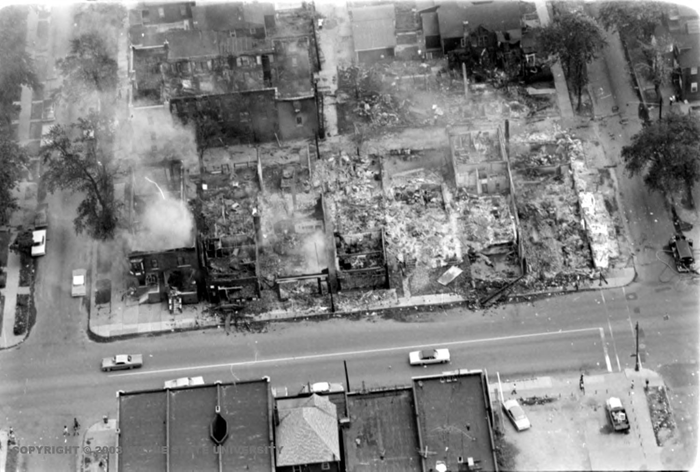
Detroit burns, 1967
Dear Friends,
Remember to mark calendars for the Rouge Forum Conference, Louisville, March 14, 15, 16, 2008.
The Rouge Forum No Blood For Oil page is updated.
Of special interest is organizer Tom Suber’s critical report to the Rouge Forum from the UFPJ conference in Chicago.
We salute the school workers of Peru who, with their militant actions against anti-working class high-stakes exams, sparked a general strike that lasted 15 days, demonstrating the Rouge Forum thesis that education workers are centripetally positioned to initiate resistance, if not carry it through to peace with justice.
George and Sharon Schmidt, editors of Substance News from Chicago, the hard-copy media of the education resistance, offer a free three month subscription to Rouge Forum readers. You can email your request to Substance at Csubstance@aol.com. You may be asked to verify that you are on the Rouge Forum list (in order to ward off spammers, etc).
Two historical notes:
1. Today is the 40th anniversary of the 1967 Detroit Rebellion, a massive urban uprising, commonly posed today as a riot. While the rebellion was spontaneous, an insurrection, it was hardly a riot. A massive outpouring of armed resistance to racist exploitation and, especially, police repression fought the US military apparatus (including the 82 Airborne) for five days, finally meeting defeat. Surely, more than 43 died (working in Receiving Hospital as a volunteer, I lost count of the bodies). John Hershey’s “Algiers Motel Incident,” demonstrates the kind of brutality that typified the police. Following the uprising, thousands of jobs were opened to black people, transportation was offered (even to the suburbs), welfare rules eased; the carrot replaced the stick, for awhile. NPR has a review of the time at here.
And the Detroit News here.
Detroit today is a dying ghetto (lost 1.2 million residents, the mayor boasts of how many empty homes he can bulldoze each year, not one major grocery store in the city) being killed off by racism. Its schools, lynchpin of any possible recovery, teeter on the brink of complete collapse. The rebellion only speeded decay that had gone on for years. For a fine reprise of the city, see Mirel’s, Rise and Fall of an Urban School System. Detroit may well be the future.
2. Today is also the 35th anniversary of the passage of Title Nine, which opened school sports to women and altered the landscape of the US in innumerable ways.
With great sorrow, we recognize the death of Michigan’s Rabbi Sherwin Wine, humanist and early supporter of the Rouge Forum. His was a life lived with courage and meaning.
Watch for upcoming notices of the Rouge Forum San Diego Film series (suggestions for films happily accepted).
All the best,
r
Washington Post: New Manuals Push A Putin’s-Eye View In Russian Schools
By Peter Finn
Washington Post Foreign Service
Friday, July 20, 2007; A01
MOSCOW — With two new manuals for high school history and social studies teachers, written in part by Kremlin political consultants, Russian authorities are attempting to imbue classroom debate with a nationalist outlook.
The history guide contains a laudatory review of President Vladimir Putin’s years in power. “We see that practically every significant deed is connected with the name and activity of President V.V. Putin,” declares its last chapter. The social studies guide is marked by intense hostility to the United States.
Both books reflect the themes dominating official political discourse here: that Putin restored Russian strength and built what the Kremlin calls a “sovereign democracy” despite American efforts to isolate the country.
The principal author of the history manual — “The Newest History of Russia, 1945-2006” — is Alexander Fillipov, deputy head of the National Laboratory of Foreign Policy, a research institute affiliated with the Kremlin.
Putin, who succeeded the ailing Boris Yeltsin in 2000, demonstrated that “when a healthy and energetic person got this position it became obvious how vast presidential power is,” the manual states.
“Sovereign Democracy” is the title of one of the history manual’s chapters. The term was coined by Kremlin strategist Vladislav Surkov, who attended the launch of the two books at a teachers’ conference in Moscow last month. Supporters of the president use the phrase to describe the centralization of power under Putin as essential to the building of a stable Russian state, free from outside interference.
But critics say the term is a self-serving veil for unchecked executive power, which has led to the disempowerment of parliament, the judiciary and many media voices in Putin’s Russia. That viewpoint finds no place in the manuals.
” ‘Sovereign democracy’ is a political slogan, and it’s unethical not to point out that there are other political parties and other points of view that believe it is part of the authorities’ myth-making,” said Vasily Zharkov, a history lecturer and deputy director of the Institute of Eastern Europe, who attended the teachers’ conference.
Other events, such as the so-called Orange Revolution in Ukraine in 2004, in which hundreds of thousands of Ukrainians overturned the official results of a presidential election they believed to be fraudulent, are explained as largely American-inspired plots.
“Tension was built up artificially in Ukraine, and a ‘revolution’ scenario was readied,” the history manual states. Supporters of the pro-Russian candidate, Viktor Yanukovych, “were stripped of their victory,” it says.
The social studies manual, “Social Studies: The Global World in the 21st Century,” observes that “from the beginning of the 1990s, the U.S. tried to realize a global empire. The basic political principle underpinning any empire is divide and rule. Therefore one of the U.S. strategies was to isolate Russia from all the other former Soviet republics.”
But the United States may be near “final collapse,” according to the manual, because “America can no longer integrate into a single unit or unite into a nation of ‘whites,’ ‘blacks,’ (they are called African-Americans in the language of political correctness) ‘Latinos’ (Latin Americans) and others.”
The manuals, which run to several hundred pages each, will serve as guides for the drafting of new textbooks to be introduced in September 2008.
“We are developing a national ideology that represents the vision of ourselves as a nation, as Russians, a vision of our own identity and the world around us,” said Leonid Polyakov, a professor of political science at the Higher School of Economics in Moscow and editor of the social studies manual.
Polyakov was speaking at a meeting Putin held with high school teachers and academics after the teachers’ conference last month.
“Teachers will then be able to incorporate this national ideology, this vision, into their practical work in a normal way and use it to develop a civic and patriotic position,” Polyakov said, according to a Kremlin transcript.
Russian officials said the guides would not be mandatory for teachers and insisted that they did not represent an attempt to impose a single version of history.
“We must see the dark moments of history and its problems,” Surkov said at the conference. “But I presume that it would also be wrong to go as far as to completely deny the successes and achievements of our great country. . . . Without answering the questions of who we are, how we should live and what we are living for, effective political work and an effective economic system are impossible.”
Some educators said that any material that comes with a Kremlin stamp of approval is likely to sideline other curricular material.
“The scariest thing, and the fact that makes me really sad, is that these manuals and any new textbooks will be seen not as a recommendation or a choice for teachers, but as an order,” said Galina Klokova, who specializes in the teaching of history at the Russian Academy of Education.
The author of the “Sovereign Democracy” chapter in the history guide said as much when he responded on his blog to criticism from teachers that parts of the book were little more than crude Kremlin propaganda.
“You will teach children in line with the books you are given and in the way Russia needs,” wrote Pavel Danilin, a 30-year-old editor at the Effective Policy Foundation, a consulting firm that works for the Kremlin and is headed by Kremlin loyalist Gleb Pavlovsky. “To let some Russophobe [expletive], or just an amoral type, teach Russian history is impossible. It is necessary to clear the filth and if it doesn’t work then clear it by force.”
The teaching of history has always been a charged subject in post-Soviet Russia, especially when it touches on the rule of Soviet dictator Joseph Stalin, whose purges led to the deaths of millions and the notorious gulag system of labor camps.
A textbook that took an unflinching look at Stalin’s policies, including his nonaggression pact with Nazi Germany in 1939 and the mass deportation of Chechens and other Caucasians during World War II, was pulled by education officials in 2003.
That book also suggested that students discuss whether Putin could be considered “authoritarian,” a term his domestic and Western critics often use to describe him.
According to the new history manual, Stalin was brutal but also “the most successful leader of the U.S.S.R.”
“As for the methods of coercion used toward the ruling bureaucratic elite, the goal was to mobilize the leadership in order to make it effective in the process of industrialization, as well as in rebuilding the economy in the postwar period,” the manual states, while providing few details on the scale and horror of Stalin’s totalitarianism. “This task was fulfilled by means of, among other things, political repression, which was used to mobilize not only rank-and-file citizens but also the ruling elite.”
To historian Nikita Sokolov, the manual is so equivocal on Stalin’s terror that “his crimes are being taken into the shadows.”
“A very dangerous thing is happening,” said Sokolov, co-author of the book “Choosing Your Own History.”
“They want to take us back to unified thinking. The president and the presidential administration believe we lack the national self-confidence to confront and debate the past.”
But Vladislav Golovano, a middle school teacher in the Siberian republic of Yakutia, disagreed, saying, “Our history should not be cause for self-flagellation,” according to the Kremlin transcript of Putin’s post-conference meeting with teachers and academics.
Putin told the group that “we must not allow others to impose a feeling of guilt on us,” according to the transcript. “We do have bleak periods in our history, just look at the events starting in 1937,” he said, referring to the beginning of the Stalinist atrocities known as the Great Terror. “And we should not forget those moments of our past.”
The president went on to say that “in any event, we have never used nuclear weapons against civilians, and we have never dumped chemicals on thousands of kilometers of land or dropped more bombs on a tiny country than were dropped during the entire Second World War, as was the case in Vietnam. We have not had such bleak pages as was the case of Nazism, for example.”
The Guardian (UK)
July 22, 2007
The American Dream of riches for all is turning into a nightmare of inequality. But a backlash is brewing, reports Paul Harris in New York
On the surface, Mark Cain works for a time-share company. Members pay a one-off sum to join and an annual fee. They then get to book holiday time in various destinations around the globe.
But Solstice clients are not ordinary people. They are America’s super-rich and a brief glance at its operations reveal the vast and still widening gulf between them and the rest of America.
Solstice has only about 80 members. Platinum membership costs them $875,000 to join and then a $42,000 annual fee. In return they get access to 10 homes from London to California and a private yacht in the Caribbean, all fully staffed with cooks, cleaners and ‘lifestyle managers’ ready to satisfy any whim from helicopter-skiing to audiences with local celebrities. As the firm’s marketing manager, Cain knows what Solstice’s clientele want. ‘We are trying to feed and manage this insatiable appetite for luxury,’ Cain said with pride.
America’s super-rich have returned to the days of the Roaring Twenties. As the rest of the country struggles to get by, a huge bubble of multi-millionaires lives almost in a parallel world. The rich now live in their own world of private education, private health care and gated mansions. They have their own schools and their own banks. They even travel apart – creating a booming industry of private jets and yachts. Their world now has a name, thanks to a new book by Wall Street Journal reporter Robert Frank which has dubbed it ‘Richistan’. There every dream can come true. But for the American Dream itself – which promises everyone can join the elite – the emergence of Richistan is a mixed blessing. ‘We in America are heading towards ‘developing nation’ levels of inequality. We would become like Brazil. What does that say about us? What does that say about America?’ Frank said.
In 1985 there were just 13 US billionaires. Now there are more than 1,000. In 2005 the US saw 227,000 new millionaires being created. One survey showed that the wealth of all US millionaires was $30 trillion, more than the GDPs of China, Japan, Brazil, Russia and the EU combined.
The rich have now created their own economy for their needs, at a time when the average worker’s wage rises will merely match inflation and where 36 million people live below the poverty line. In Richistan sums of money are rendered almost meaningless because of their size. It also has other names. There is the ‘Platinum Triangle’ used to describe the slice of Beverly Hills where many houses go for above $10m. Then there is the Jewel Coast, used to describe the strip of Madison Avenue in Manhattan where boutique jewellery stories have sprung up to cater for the new riches’ needs. Or it exists in the MetCircle society, a Manhattan club open only to those whose net worth is at least $100m.
The reason behind the sudden wealth boom is, according to some experts, the convergence of a new technology – the internet and other computing advances – with fluid and speculative markets. It was the same in the late 19th century when the original Gilded Age of conspicuous wealth and deep poverty was spawned by railways and the industrial age. At the same time government has helped by doling out corporate tax breaks. In the Fifties the proportion of federal income from company taxes was 33 per cent, by 2003 it was just 7.4 percent. Some 82 of America’s largest companies paid no tax at all in at least one of the first three years of the administration of President George W Bush.
But who are the new rich? Some of the names are familiar, Microsoft tycoon Bill Gates and savvy stock investor Warren Buffett. But most are unknown, often springing from the secretive world of financial hedge funds. Men like James Simons, who took home compensation of $1.7bn last year. Last year the 25 top earning hedge fund bankers in the US earned an average of $570m each. The average US household income is $50,000.
It is such men – and they are usually men – who feed the outlandish luxury goods economy of Richistan. It is they who are responsible for the rebirth of the butler industry, which was all but dead in the Seventies and is now facing a shortage of trained staff. So keen is the demand that many can expect to earn a six-figure salary when they graduate from booming butler schools.
Then there is the runaway feeder-industry of luxury consumer items. The new ultra rich turn up their noses at Rolexes; the sought-after brand is Franck Muller, which sells a high-end timepiece for $736,000. Or try a Mont Blanc pen, encrusted in jewels, for $700,000. Louis Vuitton’s most exclusive handbag sells for $42,000. Only 24 were ever made and none ever touched a shelf as all were pre-sold to Richistani clients.
In places such as Manhattan and Los Angeles, restaurants and bars outdo themselves in excess. New York’s Algonquin Hotel has a $10,000 ‘martini on a rock’ (it comes with a diamond at the bottom of the glass). City eateries sell burgers for more than $50. One offers a $1,000 omelette. In Los Angeles there is a craze for Bling mineral water – at $90 a bottle.
Then there are the boats. The private yacht industry in America has been caught in an arms race of size and luxuriousness. So far, there has been a clear winner: Oracle-founder Larry Ellison’s 450ft water palace, the Rising Sun. More than 80 rooms on five storeys and a landing craft that carries a Jeep, a basketball court doubling as a helipad and a fully-equipped cinema.
Now an Oregon-based company is taking things further: private submarines. An estimated 100 or so private subs are now drifting around the world’s oceans. Then there are the rockets – several notable billionaires are now leading the way in private exploration of space. One of them is Robert Bigelow who has ploughed $500m into trying to build an inflatable space hotel. A miniature prototype model was successfully launched and tested last month. In a scene that perhaps James Bond would find familiar, armed guards now patrol the fences of Bigelow Aerospace’s headquarters wearing badges decorated with an alien as their corporate logo.
But this is not just a world of riches gone mad that the rest of America can ignore. The growth of such a large super-rich class, coupled with a deepening poverty in many communities, is starting to tear at the fabric of society. Even some of the most wealthy – like Gates and Buffett – have spoken openly of the needs to address the massive ‘inequality gap’ that they have come to exemplify. In effect, some of the very richest Americans are calling for themselves to be taxed. In a speech last month Buffett – the third richest man in the world – pointed out that his tax rate was 17.7 per cent of his income while his secretary was taxed at 30 per cent. ‘Many of the new super-rich are looking long term at the world and they see a collapsing US education system and health-care system and the disappearance of the middle class and they realise: this is bad for everybody,’ said Frank.
Defenders of low tax for the very rich point to the theory of trickledown economics – the spending power of the rich benefiting the poor. But while the super-rich have boomed, the earning power of the average and poor citizen has not nearly matched the performance of the elite. In 2005 the top one per cent of earners in the US gained 14 per cent in income in real terms, while the rest of the country gained less than one per cent. The situation is especially bad for the severely poor – those living at half the poverty level – whose numbers are at a 32-year high. The rich are getting richer but are not bringing everyone else with them. ‘If you look at the impact of the last 20 years it seems pretty clear that trickledown just does not work,’ said Paul Buchheit, economics professor at Chicago’s Harold Washington College.
There are some signs of a change in attitude. Recent huge Wall Street flotations such as the listing of private equity giants like Blackstone have created a push in Congress for taxes on the instant billionaires they have created. Scandals of excess such as Enron and WorldCom and the trial of Conrad Black have been high-profile. But few politicians, needing campaign cash from new millionaires, will get far preaching higher tax. Calls for more equality tend to have come from men like Buffett and Gates whose fortunes are so enormous that a little extra tax would make no difference. Bush has pushed to phase out taxes like the estate tax, which benefit only the rich. ‘I don’t see it changing. No matter what administration is in power,’ said Buchheit.
But many think it must change. To a large degree, the debate over the booming lives of the super-rich is an argument about the American soul. It is a country that has always worshipped wealth, where the creation of a fortune was seen as virtuous and a source of pride.
But now that huge wealth has started to squeeze the ‘middle class’ out of existence, leaving the haves and have-nots in very separate worlds. It is possible that political will may develop to address the problem or that the problem will correct itself. The notorious end of the Gilded Age came in the panic of 1893 that sank America into depression.
Frank believes the signs of a coming storm are there. ‘The trick is to spot when prosperity turns to excess,’ he said. ‘When a large amount of people make a lot money very quickly it’s a sign you are near the top of the market.’
In a world of mega-yachts, private submarines and space hotels, that peak might be close at hand. And it’s a long way down.
Billionaire’s row
· There are 7.5 million households in America worth up to $10m. A further two million are worth $10m-$100m and thousands are worth more than $100m.
· There is now a two-year waiting list for 200ft yachts. If put end to end, the boats on that list, which cost $50m each, would be 15 miles long.
· Sebonack Golf Club in the Hamptons, Long Island, charges $650,000 for membership. That doesn’t include the $12,000 annual dues, or tips for caddies.
· Google founders Sergey Brin and Larry Page have a private Boeing 767.
· John D. Rockefeller was America’s first billionaire. Adjusted for inflation, he had $14bn – less than the net worth of each of Sam Walton’s five children today. There were 13 US billionaires in 1985. Now there are more than 1,000. There are as many millionaires in North Carolina as in India.
· ‘Affluent’ is Richistani for ‘not really rich’. According to Frank, you need about $10m to be considered entry-level rich.
The Doming of America
by Dave Zirin
“You can’t throw money at the problem.”
As a former public school teacher in Washington, I heard this cliche from
countless bureaucrats. It was code for “Stop whining about ancient
textbooks and prehistoric classroom materials, because there is no money.”
Imagine my shock when the city announced it would be spending more than
$500 million on a new baseball stadium. Clearly when it comes to the needs
of billionaire sports owners, there always seems to be money available to
be thrown.
This is hardly a D.C. story. The building of stadiums has become the
substitute for anything resembling an urban policy in this country. The
stadiums are presented as a microwave-instant solution to the problems of
crumbling schools, urban decay and suburban flight.
Stadiums are sporting shrines to the dogma of trickle-down economics. In
the past 10 years, more than $16 billion of the public’s money has been
spent for stadium construction and upkeep from coast to coast. Though some
cities are beginning to resist paying the full tab, any kind of subsidy is
a fool’s investment, ending up being little more than monuments to
corporate greed: $500 million welfare hotels for America’s billionaires
built with funds that could have been spent more wisely on just about
anything else.
The era of big government may be over, but it has been replaced by the Rise
of the Domes. Reports from both the right-wing Cato Institute and the more
centrist Brookings Institution dismiss stadium funding as an utter
financial flop, yet the domes keep coming.
Our stadiums, funded on our dime, become the political province of those
owners who paid nary a penny for the privilege. In many stadiums, they have
started “faith days at the park” where evangelical Christian organizations
set up booths and Christian rock gets blared over the loudspeakers. No
separation of church and state, even when the state is footing the bill.
Then there is the force-feeding of political dogma. No freedom from that,
either. On the orders of George Steinbrenner, the New York Yankees now
string up chains along the seats to keep people standing and secured — and
not going to the concessions or bathroom — for the seventh-inning singing
of “God Bless America.”
As Neil DeMause, co-author of the book “Field of Schemes” said to me, “The
history of the stadium game is the story of how, by slowly refining their
blackmail skills, sports owners learned how to turn their industry from one
based on selling tickets to one based on extracting public subsidies. It’s
been a bit like watching a 4-year-old learn how to manipulate his parents
into buying him the new toy that he saw on TV; the question now is how long
it takes our elected officials to learn to say ‘no.’ ”
But our elected officials have been more like the children, as sports
owners tousle their hair and set the budget agendas for municipalities
around the country with a simple credo: stadiums first and people last.
In August 2005, we saw the extreme results of these kinds of priorities.
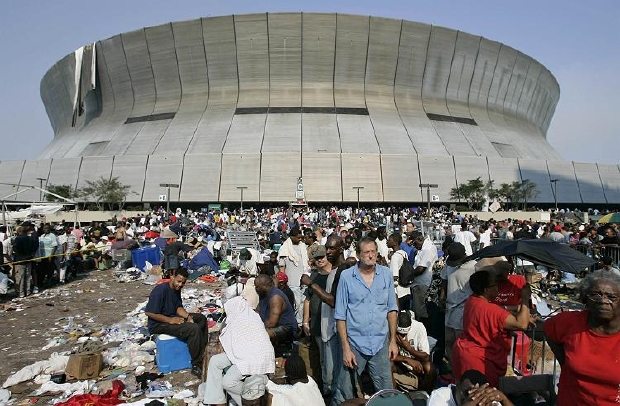
After Hurricane Katrina flattened the Gulf Coast, the Louisiana Superdome,
the largest domed structure in the Western Hemisphere, morphed into a
homeless shelter from hell, inhabited yet uninhabitable for an estimated
30,000 of New Orleans’ poorest residents.
It took Hurricane Katrina for them to actually see the inside of the
Superdome, a stadium whose ticket prices make entry restrictive. At the
time of the hurricane, game tickets cost $90, season seats went for $1,300,
and luxury boxes for eight home games ran more than $100,000 a year. But
the Katrina refugees’ tickets were courtesy of the federal and local
government’s malignant neglect.
It was only fitting, because these 30,000 people helped pay for the stadium
in the first place. The Superdome was built entirely on the public dime in
1975, as a part of efforts to create a “New New Orleans” business district.
City officials decided that building the largest domed stadium on the
planet was in everyone’s best interest. Instead, it set off a 30-year path
toward destruction for the Big Easy: a path that has seen money for the
stadium but not for levees; money for the stadium but not for shelter;
money for the stadium but not for an all-too-predictable disaster.
The tragedy of Katrina then became farce when the Superdome’s inhabitants
were finally moved: not to government housing, public shelters or even
another location in the area, but to the Houston Astrodome. Ladies and
gentlemen, we had the March of Domes.
I spoke to former Major League Baseball All-Star and “Ball Four” author Jim
Bouton about the publicly financed “doming of America, and this is what he
said:
“It’s such a misapplication of the public’s money. … You’ve got towns
turning out streetlights, they’re closing firehouses, they’re cutting back
on school supplies, they’re having classrooms in stairwells, and we’ve got
a nation full of kids who don’t have any health insurance. I mean, it’s
disgraceful. The limited things that our government does for the people
with the people’s money, to spend even a dime or a penny of it on ballparks
is just a crime.
“It’s going to be seen historically as an awful folly, and it’s starting to
be seen that way now, but historically that will go down as one of the real
crimes of American government, national and local, to allow the funneling
of people’s money directly into the pockets of a handful of very wealthy
individuals who could build these stadiums on their own if it made
financial sense. If they don’t make financial sense, then they shouldn’t be
building them.”
Bouton went on to say, “If I was a team owner today, asking for public
money, I’d be ashamed of myself. Ashamed of myself. But we’ve gone beyond
shame. There’s no such thing as shame anymore. People aren’t embarrassed to
take — to do these awful things.”
Bouton is absolutely correct. When it comes to fleecing our cities, some of
the richest people in this country have shown a complete absence of shame.
The question is whether we are going to finally stand up and impose our
priorities onto them, instead of continually taking it on the chin.
Polls show consistent majorities don’t want public funds spent on stadiums.
That means the silent majority of sports fans oppose the stadium glut as
well. We sports fans need to make ourselves heard. We may love baseball. We
may love football. We may bleed our team’s colors on game day. But that
doesn’t mean we should have to pay a billionaire millions of dollars for
the privilege to watch.
[Dave Zirin is the author of the new book “Welcome to the Terrordome:” with
an intro by Chuck D (Haymarket). You can receive his column Edge of Sports,
every week by going to http://zirin.com/edgeofsports/?p=subscribe&id=1.
Contact him at edgeofsports@gmail.com]
Los Angeles Times
Who’s behind the integration decision?
It’s the Pacific Legal Foundation, champion of right-wing causes for 35 years.
By Mark Tushnet,
MARK TUSHNET teaches constitutional law at Harvard Law School.
July 7, 2007
THE SEATTLE school integration case decided by the Supreme Court last month was brought in the name of a group called Parents Involved in Community Schools on behalf of Jill Kurfirst and her ninth-grade son. But it was a little-known, Sacramento-based organization called the Pacific Legal Foundation — a conservative public interest law firm involved in the case from the beginning — that developed many of the legal arguments five justices ultimately found persuasive.
Where did the foundation come from? The story begins with former Justice Lewis F. Powell. Shortly before he was nominated to the court in 1971, Powell, then a Virginia lawyer, wrote a memo to a friend at the U.S. Chamber of Commerce titled “Attack on the American Free Enterprise System.” In it, Powell worried that liberal groups had nurtured specialist lawyers and developed litigation strategies to defend government regulation. Businesses, he argued, were suffering because they had a “disposition to appease” and weren’t able to present a countervailing view of what constituted the public interest.
Powell’s memo prodded the business community to help create a number of not-for-profit law firms devoted to arguing a conservative point of view. Ronald Zumbrun and Raymond Momboise, former advisors to California Gov. Ronald Reagan, founded the first one — the Pacific Legal Foundation — in 1973. On its website today, the foundation says it exists to fight “tyranny” engendered by “overzealous bureaucracies and government red tape” and that it is a foe of “government regulators and environmental extremists.” Other issue areas: fighting racial preferences, combating eminent domain laws and encouraging government to take economic impact into account when designating critical habitat for endangered species.
After some initial enthusiasm, big business found these new public interest law firms less useful than it had hoped. The firms’ case selection policies were erratic, and the winnable cases they brought — mostly against environmental regulations and land use laws — had few implications for the business community’s larger concerns.
Big business soon turned to a newly developed, specialized Supreme Court bar in Washington (of which Chief Justice John G. Roberts Jr. was a leading member) to pursue its more important priorities: tort reform through judicial restrictions on punitive damages and interpreting national statutes in a business-friendly manner to reduce and eliminate penalties for business misconduct. Conservative public interest law firms played only minor roles in these cases.
By the time Chief Justice William H. Rehnquist died in 2005, most of the initiatives championed by the conservative public interest law firms — restricting federal power, putting constitutional limits on regulation and fighting environmental regulation — had hit a wall.
Still, Pacific Legal Foundation and other such law firms continued to operate, funded by donors interested in a conservative agenda. But always needing to raise more money from outsiders affected what the firms could do. They had to pick cases that garnered a lot of publicity, which meant they were not always the best for giving constitutional law a conservative cast. You can win cases (and publicity) if you can find “horror stories” about government regulation, but winning such cases makes few inroads toward more reasonable government regulations.
The Seattle case shows that conservative public interest law firms can win some big cases. These firms, however, are notorious for lacking follow-through. They get publicity from winning in the Supreme Court, not from slogging through the lower courts time and again to define the contours of the law on the ground. Winning in the Supreme Court may excite donors, but haggling with school boards over how to enforce the court’s decisions does not.
The foundation’s press release called last month’s ruling “the most important decisions on the use of race since Brown vs. Board of Education.” Five years earlier, Clint Bolick, a co-founder of the Institute for Justice, another conservative public interest law firm, hailed the Supreme Court’s decision upholding the constitutionality of Cleveland’s school voucher program as a Brown for the 21st century.
These invocations call for some historical perspective. What’s happened with school vouchers since 2002? Basically, nothing. Indeed, what happened after Brown itself? Again, basically nothing — for a decade. As late as 1964, only a handful of African American children in the deep South attended schools with whites.
Things changed after 1964 not because of Brown but because that was the year Congress enacted the Civil Rights Act. It also made significant amounts of federal money available to schools for the first time, and threatened to deny that money to schools that didn’t desegregate.
Brown began to matter because the NAACP was determined to see the decision enforced, because its lawyers had organizational staying power and because the political environment favored integration.
We won’t know for a while what the fate of this year’s integration rulings will be. But the track record of conservative public interest law firms suggests that they won’t carry through on their victory. And what the political environment will be over the next decade is in our hands, not theirs.
Dear Friends,
The largest union in the USA, the National Education Association, just concluded its national meeting. More than 9000 delegates attended, by far the largest union meeting this year. What was done? Not much. NEA’s leaders, whose salaries top out at more then $450,000, spent plenty on perks for the delegates, including a party sponsored by anti-union Target corporation.
NEA’s program was not devoted to the life and death issues of the day. Instead, nearly every Democratic presidential candidate, and one Republican, paraded before the attendees who became an audience, not activists developing strategy for greater people’s control of schools and communities.
Rouge Forum members distributed a thousand flyers. Our email list grew a bit, but clearly the top levels of NEA are not going to be helpful in matters of war, legalized segregation, curricula regimentation, the militarization of schools, or high-stakes exams. Nobody is going to save us but us.
Mark your calendar for the next Rouge Forum Conference in Louisville, March 14, 15, and 16, next year. And, if you would like to invite a Rouge Forum speaker to your campus, just let us know.
We note the tragic irony of the Sunday New York Times editorial blaming Bush for the Iraq war’s failures, demanding a speedy exit.
The Times, remember, is as responsible as any voice of power for inveigling public support the imperial war. Its pages still seek to obscure the invasion’s reasons: oil and regional control. Now the Times portrays nearly every insurgent as “Al Queda,” following their earlier path.
Only days before Defense Secretary Gates made it clear the US is not leaving Iraq. That is one thing the Bush/Clintons are not lying about. The US cannot leave Iraq, cannot abandon the oil fields, and cannot allow the world to continue to witness the US military exposed as cowardly and incompetent.
This reality is spelled out quite clearly in a Clinton-based think tank report. The Center for a New American Security, headed by Madeline (“500,000 dead is acceptable damage”) Albright, issued the “Shaping U.S. Ground Forces for the Future: Getting Expansion Right,” paper. It demonstrates the need for 100,000 more ground troops, to protect US vital interests, and a draft, coupled with national service requirements—buttressed by more sophisticated appeals to nationalism.
Next week we will initiate an analysis of why it is the US anti-war movement (other than the courageous direct-actions of Cindy Sheehan) has been unable to influence the conduct of these wars, and what might be done.
The Rouge Forum No Blood For Oil website is updated.
What can educators and activists to connect intellectual work with daily life in these critical times? We have three examples:
1. An analysis of the recent Supreme Court decision attacking integration by Adam Renner, in Louisville.
2. “My Child Needs a Union!” by Joan Locurto
3. Exemplary work led by Kathy Emery, in San Francisco, “Lessons from the Freedom Schools.”
San Francisco Freedom School begins July 7th and runs for seven consecutive Saturdays through August 18th (10 AM – 4 PM, pot luck lunch, 152 Church Street at Market). We study the Civil Rights Movement as a case study of how social movements happen. (As Jean Anyon argues in Radical Possibilities, there can’t be any real progressive education reform unless in the context of a social movement).
Learn the lessons of the Civil Rights Movement IN DEPTH from veterans of that struggle, activities and films. The sessions are FREE! — free textbooks too! All ages welcome. We have an extensive film and book library from which you can borrow throughout the year. Get SFUSD professional development credit.
Summer Curriculum: http://educationanddemocracy.org/SFFS/2007_curriculum.htm
To register for any, several or all Saturdays or get more info write to Kathy Emery at mke4think@hotmail.com
General info about the summer program here.
Thanks to Alan S (for the CNAS heads up) Dan C., Gil G, Bob A, Suber, Big Al (happily married), Josh, Melissa, and Evelyn, Echo, Erin, Stan Cutter, Sharon Agopian, Sidney G, Mary in South Africa, Vincent R, Ann W, Calley, Susan M, Donnie Alcorn, George and Sharon and the Kids (keep that arm oiled), Bonnie M, and David.
best
r